
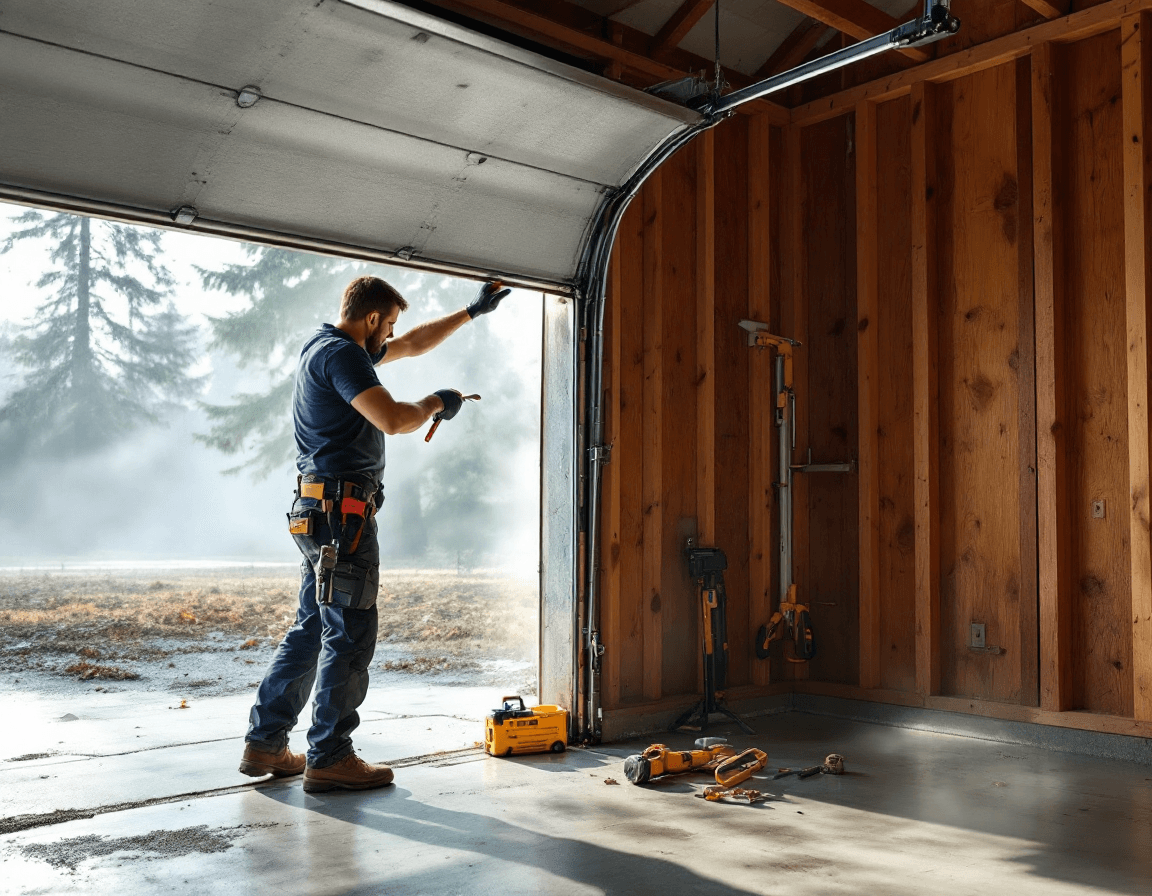
Off-track garage door repair in Monroe, WA is one of the most common calls we take from homeowners east of Highway 2, and it usually starts with a sound nobody wants to hear: a sharp bang, a grinding noise, or a door that suddenly sits at an angle. When a door comes off one or both tracks, the panels can bind, the rollers can pop free, and the whole assembly can stop moving in either direction. Our technicians handle these calls throughout Monroe and the surrounding Snohomish County communities, and the good news is that most off-track problems are fixable without replacing the door. The bad news is that continuing to run the opener on a derailed door can turn a $125 realignment into a much bigger job.
Monroe sits in a valley where the weather tends to be damp for much of the year, and that moisture works its way into every moving part of a garage door system. Steel track sections develop surface rust at the joints, rollers lose their smooth rotation, and hinge brackets loosen gradually over several wet seasons. Homeowners in the Downtown Monroe neighborhoods, along the older streets near the river, and out in the newer subdivisions often notice the same pattern: the door works fine through summer, then starts drifting out of alignment once the first heavy fall storms arrive. If you are searching for help with this problem in ZIP 98272, you are most likely dealing with a door that has been slowly moving toward failure for months.
This page explains what causes doors to leave their tracks in our area, how to recognize early warning signs, what our crew does during a realignment, what you can expect to pay, and why certain repairs must be left to licensed professionals. Our team is licensed, bonded, and insured, which matters a great deal when a door is under spring tension or a cable is under load. If your door is off its track right now, please avoid pulling on it or forcing it open by hand, and call (888) 799-3819 so a technician can assess it safely.
Why Doors in Monroe Tend to Drift Off Their Tracks
Garage doors are designed to ride inside two vertical tracks on each side, with rollers that travel along the track as the door rises and falls. In a well-aligned system, the tracks are plumb, level, and parallel, and the rollers sit squarely in the track channel. Anything that disturbs that geometry, even by a fraction of an inch, can push a roller out of its channel. In Monroe, several local conditions make that disturbance more likely than in drier parts of the state.
Wet winters are the first factor. Moisture accelerates corrosion on the galvanized steel of the tracks, and rust can build up at the bolted joints where track sections meet. As the metal flakes and swells, the track channel can narrow or shift slightly, which lets rollers catch on the edge instead of gliding through. We also see many doors where the vertical track has worked loose from its wall bracket over time, often because the fasteners were driven into softer material or because the wall anchors were never tightened after installation.
Temperature swings matter too. Monroe does not usually see the extreme cold of eastern Washington, but freeze-thaw cycles during colder snaps can cause the wood framing around a garage opening to move slightly, which can pull a track bracket out of true. Wind is another culprit. Strong gusts that come through the Snohomish River valley can push on a large, lightweight door, especially when the door is partially open, and that lateral force can knock a roller loose from a track that was already marginal. Put these factors together and it is easy to see why a door that worked perfectly for years can suddenly come off its track on a blustery November morning.
Warning Signs Your Door Is Heading Off Track
Off-track failures almost never appear without warning. Most doors give off several small signals over days or weeks before a roller finally pops out, and learning to recognize them can save you from a full derailment. Many Monroe homeowners tell us they noticed something odd but assumed it was normal wear. Here are the signs our technicians look for first when we inspect a door that is starting to misbehave.
- The door makes a scraping or squealing noise on one side only, usually near the bottom of the track.
- A visible gap appears between the top weatherstrip and the header, or between the door edge and the jamb, on one side but not the other.
- The door hesitates, jerks, or stops briefly during opening or closing, even though the opener motor sounds normal.
- One or more rollers look shiny, flattened, or sit at a visible angle inside the track channel.
- The door does not close fully on one side, or the bottom seal rests unevenly on the threshold.
If you see any of these signs, stop using the opener until the door has been checked. Continuing to operate a door that is binding can strip the opener gears, bend the track further, or cause the door to fall unexpectedly. A door that is leaning or visibly out of square should be treated as a safety hazard, particularly if children or pets use the driveway.
What Actually Happens Inside the Track When a Roller Pops
Understanding the mechanics helps explain why a derailment that looks dramatic is often straightforward to correct. Each roller is held in a track channel by its own axle and, on many residential doors, a roller stem attached to a hinge or a door section. When a roller leaves the channel, the door section tilts toward the gap, and the neighboring sections are forced to follow the same angle. That is why one popped roller can make the entire door look crooked, bind halfway up, or jam completely.
Once the rollers are out, the first job is to determine whether the track itself has been damaged. A roller that simply slipped out because a bracket shifted can usually be guided back into the channel after the track is cleaned, straightened, and re-secured. A track that has been dented or spread apart will not hold rollers properly no matter how carefully they are reseated, and it must be brought back to its original width and curvature before the door can run safely. We check the vertical tracks, the horizontal tracks at the ceiling, and the curved transitions where the two meet, because a problem in any of those areas can produce the same symptoms.
Rollers themselves can also be the source. Nylon rollers that have cracked, sheared, or lost their bearings can tear out of the track even when the track is fine. In older Monroe homes we sometimes find doors still running their original steel-wheeled rollers, which wear unevenly and are more prone to jumping. Replacing worn rollers with quality units often prevents a repeat derailment and makes the door noticeably quieter, which many homeowners appreciate after living with a squeal for years.
Vehicle Strikes Near Downtown Monroe and the Fairgrounds Corridor
Some of our off-track calls have nothing to do with weather or age. A vehicle backing out of a driveway, a delivery truck making a tight turn, or a car that drifts off the road can strike a door hard enough to bend track sections, dent the door panels, or separate a track from its brackets. Monroe has a mix of narrow residential streets, busy commercial corridors, and event traffic that picks up around the Evergreen State Fairgrounds during fair season and other large gatherings. Homes and garages near those routes can see more traffic than the neighborhood might suggest, and a moment of inattention is all it takes.
If a vehicle has struck your door, the damage may not be obvious right away. A door can look nearly normal from the outside while a track section has been pushed out of its plane, or a bracket has cracked behind the trim. Check whether the door moves smoothly before you use the opener, and watch for any change in sound or movement. If the door is partly open and cannot be closed, do not try to force it closed or pry it free, because a bent track can release suddenly. Keep people and vehicles clear of the opening and call for service.
Impact damage often combines several problems at once: a bent track, one or more popped rollers, a damaged bottom section, and sometimes a torsion or extension spring that has been knocked out of adjustment. This is one reason we always recommend a full inspection rather than a quick fix. We document what is bent, what can be straightened, and what needs replacement, so you know exactly what you are paying for before any work begins.
Our Realignment Process From First Look to Final Check
When a technician arrives for an off-track call, the first step is always safety. We confirm that the door is not under unexpected load, that the opener is disconnected or locked out, and that no one is standing in the path of the door. Only then do we inspect the tracks, rollers, hinges, brackets, and cables. We want to understand not only what is wrong but why it happened, because a repair that ignores the underlying cause usually fails again within a few months.
The actual realignment usually follows a predictable sequence. We clear debris and old lubricant from the track channel, then loosen the track fasteners just enough to let us adjust the track back into its correct position. Bent sections are carefully straightened or replaced, and every bracket is re-secured into solid framing rather than a loose or rotted spot. Rollers are reseated, damaged ones are replaced, and the door is moved slowly by hand through its full travel to confirm that it tracks smoothly without binding at the top, middle, or bottom.
- Confirm the door is safe to handle and the opener is locked out.
- Inspect tracks, brackets, rollers, hinges, and cables for damage.
- Straighten or replace bent track, and re-anchor loose brackets.
- Reseat or replace rollers and lubricate moving parts with a suitable product.
- Test the full range of motion by hand, then with the opener, and check balance.
Before we leave, we explain what we found, what we fixed, and what we recommend monitoring. Some doors need a follow-up adjustment after the first few weeks of use, especially after a wet spell, and we are happy to walk you through what to watch for.
Typical Pricing for Off-Track Repairs in Monroe
Most off-track repairs in the Monroe area fall between $125 and $400. Where a job lands in that range depends on how many rollers are involved, whether the track needs straightening or replacement, how much damage the hinges and brackets have sustained, and whether the door needs any additional work to run safely. A single popped roller on a door with sound track is generally at the lower end of that range, while a multi-point derailment with bent sections and damaged brackets sits closer to the top.
We believe homeowners should understand what drives cost before they agree to any work. A straightforward realignment is usually a shorter visit, while a door that has been struck by a vehicle may require more time to bring the track back to specification and verify that the springs and cables are still properly balanced. If we discover a problem that falls outside the scope of a realignment, such as a failing spring or a cable that has frayed, we will explain the situation and provide options rather than adding unexpected charges to the original visit. Pricing for a specific door can only be confirmed after an inspection, so please call (888) 799-3819 if you want a clearer picture for your home.
Why Springs and Cables Stay in Licensed Hands
Off-track repairs often bring a homeowner face to face with the most dangerous part of a garage door system: the springs and cables. Torsion springs sit above the door and hold a tremendous amount of stored energy, and extension springs run along the sides of the track under high tension. Cables carry the door's weight and must be seated correctly on the drum. A spring or cable that releases unexpectedly can cause serious injury, and it is not a task for a homeowner with a socket set and a YouTube video.
We recommend that you never attempt to wind, unwind, or adjust a torsion spring yourself, and never try to remove tension from a spring to free a jammed door. Even experienced DIYers have been hurt by springs that let go without warning. If a derailed door has a cable that has come off the drum or a spring that appears to be damaged, keep the door closed if possible, do not operate the opener, and call a licensed professional. Our crew carries the tools and training to handle spring and cable work safely, and we will always tell you when a spring needs to be replaced rather than adjusted.
Keeping Your Door on Track Through Monroe's Wet Seasons
Prevention is far less expensive than emergency repair, and a few simple habits can dramatically reduce the chance of derailment. Because Monroe's wet months tend to be long, the most valuable maintenance you can do is focused on keeping metal parts clean, dry, and properly lubricated. Wipe down the track channels once or twice a year to remove grit and dirt, and apply a silicone-based or lithium-based lubricant to the rollers and hinges rather than heavy grease that collects dust. Avoid spraying lubricant directly onto the opener's gears or onto the door's vinyl or rubber seals, where it can cause damage over time.
Look at the tracks and brackets every season as well. Tighten any loose fasteners you can reach safely, and check the wall anchors that hold vertical track to the framing. If you notice rust forming at track joints, a professional can clean and treat it before it begins to affect the track geometry. Finally, have the door inspected periodically, particularly after heavy windstorms or a vehicle incident. A short check can catch a shifting bracket long before it allows a roller to escape.
When Straightening Is No Longer Enough
Not every bent track can be restored, and an honest technician will tell you when replacement is the better path. Track sections that have been creased, split at a seam, or deformed enough that they no longer hold a consistent channel width generally need replacement. Rollers can also be worn to the point where they will not stay seated even on good track. In those cases, the most cost-effective option is often to replace the damaged components while keeping the rest of the door in service.
Replacement decisions also depend on the age and condition of the door as a whole. If the panels are cracked, the hinges are corroded, or the springs are near the end of their expected life, putting money into a single track repair may not make long-term sense. We would rather explain those trade-offs clearly than push a repair that will fail again next winter. When we recommend replacing components, we will show you what is damaged, explain why, and let you decide how to proceed.
Scheduling Off-Track Service Across Monroe and Nearby Communities
Our technicians serve Monroe and more than sixty cities across the greater Seattle and Western Washington area, which means we can typically respond to off-track calls in the Monroe region without long delays. When you call, it helps to describe what you are seeing: which side of the door is affected, whether the door is partially open or fully closed, whether you have heard a bang or grinding noise, and whether anyone has struck the door recently. That information lets us prepare the right tools and arrive ready to assess the problem.
Please keep the door closed and the opener off until a technician has looked at it. If the door is stuck open, keep vehicles and people clear of the opening and avoid touching the springs or cables. Our team is licensed, bonded, and insured, and we will always prioritize safety over speed. For a fast assessment of an off-track door in Monroe or the surrounding area, call (888) 799-3819, and a member of our team will help you get your garage back in working order.