
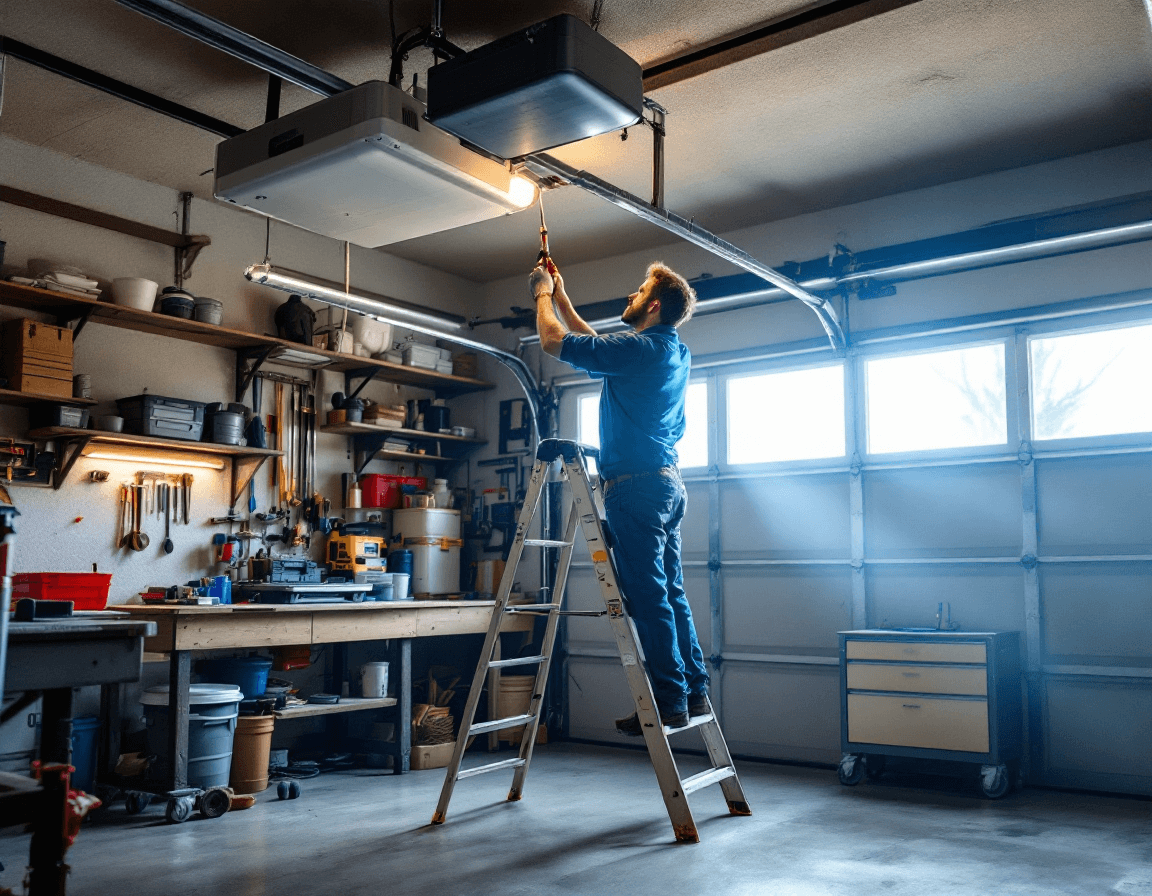
Garage Door Opener Repair in Monroe, WA is one of the most common calls we take from homeowners across the Snohomish Valley, and most of the time the problem is smaller than it feels at 6:45 on a dark November morning. An opener that hums but won't lift the door, a remote that suddenly stops working, or a door that reverses halfway down can all leave a household stuck in the driveway. Our technicians troubleshoot motors, gear sets, logic boards, and travel-limit settings on every major opener brand, and we start with the diagnosis instead of guessing at parts.
Monroe sits in a landscape that is hard on electronics and moving metal. Winters bring long stretches of damp air, the Skykomish and Snoqualmie watersheds keep the valley humid well into spring, and the freeze-thaw swings that come through the foothills can shift a door's balance and stress its hardware. Homes around downtown Monroe, the neighborhoods near Lake Tye, and the acreage homes out toward the Tualco Valley each deal with these conditions a little differently. A garage that sits close to a wooded lot may see more moisture and debris than one tucked into a newer subdivision, and that difference often shows up in how an opener behaves.
Whether your opener is a belt-drive unit installed twenty years ago or a recent model with a Wi-Fi bridge, the underlying symptoms tend to follow patterns. This guide walks through the most common problems we see in and around Monroe, explains what each symptom usually means, and tells you when a simple check is reasonable and when it is time to call in a licensed pro. Typical opener repairs in our service area run between $95 and $375, depending on what has failed and what parts are needed.
Why Monroe Garages Put Openers Under Unusual Strain
Garage openers in the Monroe area do more work than the manufacturer's brochure suggests. Many households here park trucks, trailers, and boats in the garage, and the door cycles more often when families are running between school, job sites, and weekend trips toward the mountains. That repeated cycling wears gears and drive components faster than occasional use would. A door that opens and closes several times a day in a wet climate accumulates grit, moisture, and corrosion on rails and hinges, and the opener has to work harder to overcome that added friction.
Humidity is the quieter culprit. Circuit boards, wall-button wiring, and safety sensor connectors can develop intermittent faults when moisture creeps into junction boxes or when a loose connector oxidizes over a couple of seasons. Garages attached to older Monroe homes sometimes have less insulation and less ventilation than newer builds, so condensation settles on metal and electronics more readily. Even a well-sealed garage can see temperature swings of twenty degrees or more between a cold morning and a mild afternoon, and those swings move everything slightly.
Dust and fine debris also matter. Homes near open fields, farm roads, and the fairgrounds area can pick up more airborne material than a typical urban lot, and that material settles onto rollers, tracks, and the trolley assembly. When an opener seems to strain, the cause is often a dirty track or a misaligned roller rather than the motor itself. Knowing your local conditions helps you read the symptoms correctly and avoid replacing parts you do not need.
When the Motor Hums but the Door Refuses to Move
One of the most unsettling symptoms is an opener that powers on, makes its usual startup sound, and then simply hums while the door stays put. This usually points to one of three things: a disconnected or slipped drive component, a failed or overloaded motor, or a door that has become mechanically locked by a fault in the springs or track. Before you suspect the motor, look at whether the trolley arm is still connected to the door bracket. A bracket that has come loose can let the trolley slide without lifting the door, and the motor will sound as though it is working hard.
A safe first step is to disconnect the opener from power at the outlet or breaker, then check the emergency release cord. Pull it only when the door is closed, because releasing the trolley on an open door can let it drop suddenly. Lift the door by hand to see whether it moves freely, and watch for any binding, grinding, or uneven resistance from one side to the other. If the door is heavy, stiff, or hard to lift by hand, the problem may be the springs or cables rather than the opener, and that is a job for a licensed technician.
Spring and cable work carries serious risk, because torsion springs and lift cables store large amounts of energy. Even experienced homeowners can be injured by a spring that releases unexpectedly, so please do not attempt to adjust, wind, or replace them yourself. Our technicians are licensed and insured to handle that work safely, and we recommend calling a professional whenever the diagnosis points toward the springs or cables. If the door moves smoothly by hand and the opener still hums without lifting it, the motor, gear set, or drive coupling are the likely suspects.
Homeowners often find it helpful to run through a short checklist before calling for service. Here is the sequence our technicians commonly use as a starting point:
- Confirm the opener has power and that the outlet or breaker has not tripped.
- Check that the trolley arm is attached securely to both the carriage and the door bracket.
- Verify the emergency release is fully engaged, not partly pulled.
- Look for visible debris, ice, or swelling in the track near the bottom of the door.
- Note whether the hum changes or stops after a few seconds, since that detail helps narrow the cause.
Remote and Wall Button Silence: Sorting Signal From Hardware
When the door ignores the remote and the wall button simultaneously, the fault almost always sits in the opener itself rather than in the remotes. A remote that works from one car and not another points toward battery or programming issues in the handheld, but a wall button that also fails indicates a problem in the control wiring, the logic board, or the power supply. Start by checking whether the opener's indicator light responds when you press the wall button. If nothing at all happens, the issue is usually power or a blown fuse on the board.
Moisture is a frequent cause of this symptom in the Monroe area. Wall button wiring often runs through unsealed junction boxes or along exterior walls where temperature swings can create condensation. Over time, the low-voltage connections can corrode, and the button will work intermittently or not at all. A technician can test the wiring continuity and inspect the connector points, which is a far better approach than replacing the wall button by guesswork.
Remote interference is less common but worth ruling out. Some households in the area have newer Wi-Fi routers, garage-mounted security cameras, or smart-home hubs operating on frequencies that can cause occasional dropouts. Relocating the router or changing the opener's receiver channel, if your model supports it, can sometimes resolve intermittent remote behavior. If the remote works in some positions and fails in others, the receiver antenna wire may be damaged or pinched, and that is a simple repair when identified early.
Replacing remotes is sometimes the right answer, but it should not be the first step. A technician can determine within a few minutes whether the signal is reaching the logic board, which tells you whether the problem lies in the remote or the opener. This is one of the cases where a short diagnostic visit often prevents unnecessary parts from being purchased.
The Grinding Head: Stripped Gears and What They Tell You
A harsh grinding or clicking sound from the opener head is one of the clearest signs that the gear assembly needs attention. On many screw-drive and belt-drive openers, the drive gear or worm gear can wear, crack, or strip after years of cycling. In a damp climate, lubricant can break down and attract grit, which accelerates wear. The sound may begin as an occasional tick and grow into a loud, rough noise that tells you the gears are no longer meshing cleanly.
A stripped gear is not something to ignore, because continued operation can damage the motor or leave the door stuck halfway through its cycle. When a gear slips, the opener may still attempt to run, the door may stop unexpectedly, or the trolley may fail to engage. Some homeowners try to fix this by adding grease or tightening random bolts, but that rarely addresses the underlying wear and can create new problems. Gear replacement is typically a focused repair, and in many cases the rest of the opener remains in good shape.
Other grinding sounds come from different sources. Worn rollers and bent track sections can produce a rattling or scraping noise that resembles gear trouble, especially when the opener is running under load. A technician should listen to the noise with the door both closed and open, and check whether it changes with the door's position. That simple observation often separates a gear problem from a track or roller issue, which saves time and money.
Repairs to the gear assembly are usually priced within our general range of $95 to $375, though the final cost depends on the opener model, parts availability, and whether the motor also needs attention. Because gear replacement is labor-intensive on some units, we recommend a diagnostic visit before committing to a specific repair, so the technician can confirm the cause and explain the options.
Doors That Reverse Before Closing: Travel Limits and Safety Sensors
A door that closes partway and then immediately reverses is one of the most frustrating symptoms, and it is also one of the most common in Monroe homes. Modern openers include safety reversal systems, and they are designed to protect people and objects in the door's path. When the photo-eye sensors, which are the paired units mounted near the floor on either side of the door, detect an obstruction or lose alignment, the opener will stop and reverse. Dirt, cobwebs, spider activity, and sun glare can all interrupt the beam, and in a damp garage, a small film on the lenses can be enough.
Travel limits are the other frequent cause. These settings tell the opener where the door should stop when fully open and fully closed. If they drift out of adjustment, the door may reverse before reaching the floor or fail to seat properly. Changes in the door's balance or small shifts in the track can throw the limits off, and the problem may show up after a cold snap or a long rainy season. Adjusting travel limits is a reasonable task for many homeowners, but the process differs by brand, so consult the manual or call a technician if you are unsure.
Sensor checks are straightforward and worth doing monthly. Clean both lenses with a soft cloth, make sure the sensors face each other, and confirm that the indicator lights on each unit show a steady status. Mounting height is important, and the sensors should sit close to the floor, usually within about six inches, so they can detect a child or pet. If a sensor has been bumped or the bracket has loosened, realignment may be all that is needed.
When the door still reverses after cleaning and realignment, the problem may be in the logic board or the force settings. Forces that are set too sensitive can cause reversal on a door that is simply heavier in cold weather, because lubricant thickens and friction increases. A technician can measure the force and adjust it within the manufacturer's allowable range, which helps keep the door safe without making it unreliable.
Blinking Lights as a Diagnostic Language
Many openers communicate problems through a pattern of blinking lights on the motor head or wall control. A steady flash, a double blink, or a long-short sequence can each indicate a different condition, such as a sensor obstruction, a lost travel setting, a stuck button, or a fault in the logic board. The problem is that patterns vary from brand to brand and even between model years, so a homeowner trying to interpret the lights without the manual can easily reach the wrong conclusion.
Start by counting the flashes and noting how long the pattern repeats. Take a quick video with your phone if the pattern is brief, because it can be hard to remember details later. Then check the owner's manual, which usually includes a troubleshooting table that matches each blink pattern to a likely cause. If the manual is lost, most manufacturers publish their documentation online, and a technician can identify the pattern quickly during a visit.
Some blinking is harmless and simply indicates that the opener is in a learning or programming mode. Other patterns signal a safety stop or a fault that needs professional attention. A repeating fault on the logic board may suggest a failing component, and continuing to cycle the door can make the situation worse. If the lights flash while the door is moving, stop using the opener until the cause is identified.
Here are signs that a flashing pattern warrants a service call rather than a home fix:
- The same blink sequence returns after you power-cycle the opener and clear obvious obstructions.
- The door reverses or stops at inconsistent points while the lights are flashing.
- You smell burning or notice discoloration around the logic board or wiring.
- The opener runs but the lights and the door respond at different times.
Chain and Belt Trouble After a Wet Season
A loose chain or belt is a symptom that can grow quietly. Chain-drive openers can stretch over time, and a sagging chain may begin to rattle, skip teeth, or ride off the sprocket. Belt-drive openers are quieter and generally longer-lasting, but a belt that has stretched or been exposed to moisture and temperature swings can slip or jump its pulley. In our area, the combination of damp air and cold mornings can accelerate wear on both types, especially when the opener has not been adjusted in several years.
Checking tension is a reasonable task for a careful homeowner, but it must be done with the opener disconnected from power. Look for slack that exceeds what the manufacturer specifies, and check whether the chain or belt sits properly on the sprocket or pulley. A chain that has come completely off the track needs to be reseated carefully, and a belt that has slipped may have damaged teeth or a stretched section that requires replacement. If you see frayed edges, broken links, or visible cracking, stop and call for service.
Tightening the chain or belt too far can strain the motor and shorten the life of the drive components, so tension should be adjusted only to the manual's guidance. Many openers include a tension adjustment at the rear or the motor mount, and small changes make a noticeable difference. Lubrication matters too, but the correct lubricant depends on the drive type, and the wrong product can attract dirt and accelerate wear.
Some Monroe homes have older chain-drive openers in garages that see a lot of temperature variation. If the chain has begun to stretch noticeably, replacement may be more economical than repeated adjustments. A technician can assess the wear and recommend the option that keeps the opener reliable for the next several years.
Intermittent Failures That Come and Go With the Weather
Some of the most challenging calls involve openers that work perfectly for days and then fail without warning. The door may open on the first press, refuse to respond on the second, and then cooperate again an hour later. This pattern often traces back to loose connections, moisture in the control wiring, or a failing component on the logic board that behaves differently as temperature changes. Because the fault is unpredictable, it can be frustrating to diagnose on the spot, and it may disappear completely by the time a technician arrives.
Keeping a simple log helps. Note the date, time, outdoor temperature if you know it, and what happened, such as whether the door failed to open, stopped midway, or reversed. Over a week or two, patterns often emerge. A failure that always occurs on cold mornings suggests a different cause than one that happens after heavy rain, and that information helps a technician focus the inspection.
Intermittent faults deserve attention even when they seem minor. A connection that works sometimes may fail completely at the worst moment, such as when you need to get a car out before work or when you are trying to close the garage during a storm. Monroe's weather can change quickly, and a door that cannot be closed reliably is a security concern as well as an inconvenience. Prompt diagnosis usually costs less than waiting for a complete failure.
Technicians can test for voltage drops, check connector seating, inspect the wall control and safety sensor wiring for moisture damage, and evaluate the logic board under load. These steps take time, but they reveal problems that a quick reset will not fix. A reset may restore function temporarily, which is why the underlying cause should be confirmed rather than assumed.
Understanding Repair Costs Across Common Opener Problems
Homeowners often ask how much opener repair typically costs, and the honest answer depends on the symptom, the opener brand, and what parts are required. For most opener repairs in our service area, pricing falls between $95 and $375. Simple fixes such as sensor realignment, remote programming, or minor adjustments tend to fall toward the lower end. Gear replacement, logic board repair, or motor work usually sits higher, because those parts cost more and the labor takes longer.
Several factors influence the final price. The age and availability of the opener model affects parts costs, since older units may require components that are harder to source. The location of the problem matters as well, because a fault buried in wiring inside a finished wall or a jammed trolley assembly can require more time. Whether the repair can be completed in one visit or needs a follow-up with a special part also changes the total.
It is worth asking for a clear explanation of what the technician found and what the repair includes before work begins. A good diagnostic visit should identify the cause, outline the options, and explain whether the existing opener is worth repairing. In some cases, especially with very old units or when multiple components are failing, replacing the opener may be the more practical path, and an honest technician will say so.
Our team is licensed, bonded, and insured, and we approach every estimate with the goal of fixing the real problem rather than selling unnecessary parts. We are happy to walk you through the findings so you can decide what makes sense for your household and budget.
When to Stop Troubleshooting and Call a Licensed Technician
Knowing when to step back is an important part of safe garage door care. Simple tasks such as cleaning sensors, checking the remote batteries, and confirming that the power is on are reasonable for most homeowners. Anything involving torsion springs, lift cables, drum assemblies, or heavy door panels should be left to licensed professionals, because these components store significant energy and can cause serious injury when mishandled. The same applies to any repair that requires opening the opener housing while it is connected to power, or working on wiring inside the wall.
Other warning signs include a door that feels unusually heavy, visible damage to the track, a cable that looks frayed or loose, or a spring that appears gapped or broken. If the door sags, jerks, or drops unexpectedly, shut off the opener, keep people and vehicles clear, and call for service. Do not attempt to force the door open or closed when it is not moving smoothly.
A licensed technician brings more than tools to the job. We bring the training, insurance, and safety practices needed to diagnose the fault accurately and complete the repair without creating new hazards. Our service covers motor, gear, circuit board, and travel-limit troubleshooting on every major opener brand, and we can advise you on whether a repair makes sense or whether a replacement opener would serve you better over the long run.
If your Monroe garage door is giving you trouble, we are ready to help. Call Seattle Garage Door Fix at (888) 799-3819 to schedule a diagnostic visit, describe what you are seeing, and get a clear plan for getting your door back to reliable, safe operation.