
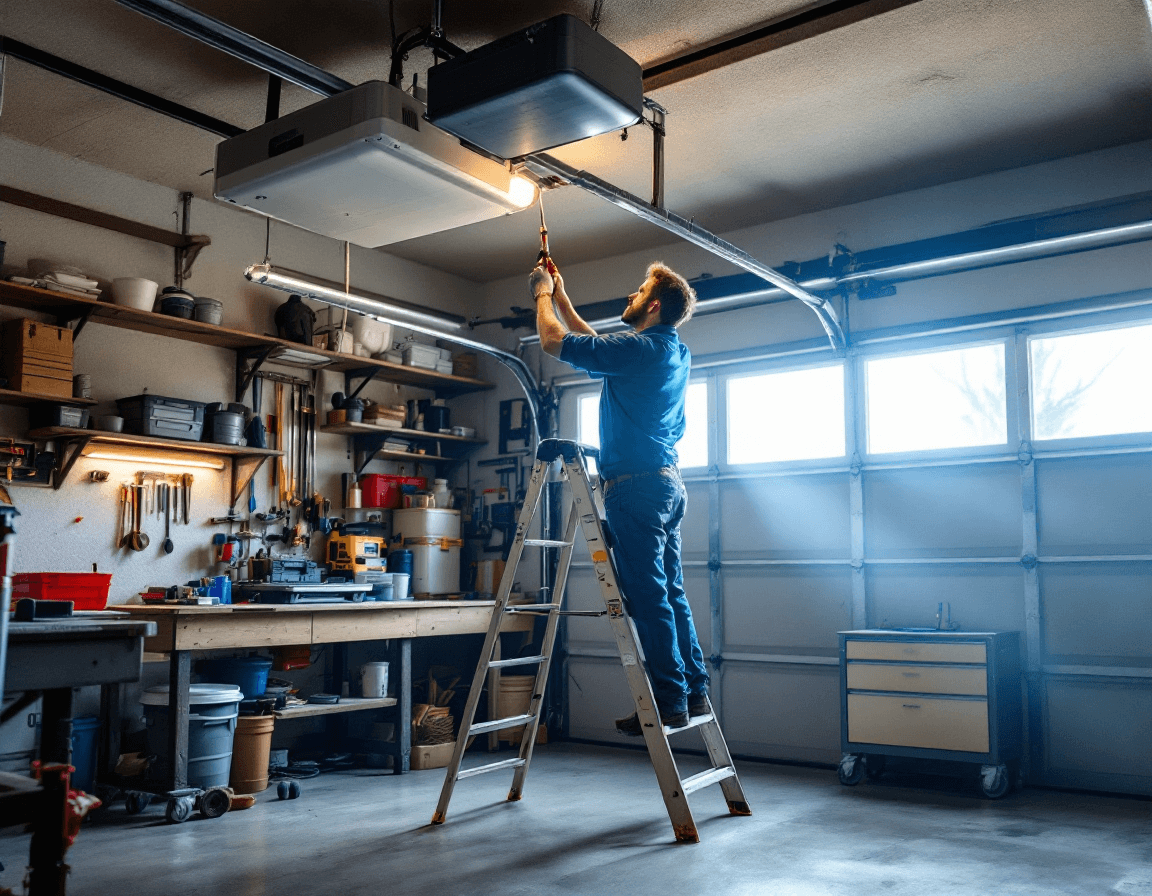
Garage door opener repair in Everett, WA is one of the most common calls we take from homeowners between Paine Field and the Snohomish River, and it is usually a problem that can be diagnosed without tearing the whole system apart. Whether your opener is a belt drive in a 1990s split-level near Silver Lake or a newer chain-drive unit in a Harbour Pointe townhome, the symptoms tend to point to a handful of causes: a worn gear, a tired circuit board, a travel setting that drifted, or a safety sensor that has lost its alignment. Knowing what your opener is trying to tell you can save a service call or help you describe the problem clearly when you reach out.
Everett's climate shapes how these systems age. Winters bring long stretches of drizzle, steady moisture off Possession Sound, and cold mornings that stiffen lubricants, while summers are mild but still humid enough to cause condensation inside metal housings. Homes close to the water or in low-lying parts of the city often see more corrosion on exposed hardware, and garages that double as workshops or storage rooms tend to collect dust and debris that finds its way into gears and sensor lenses. A good repair starts with the environment as much as the machine, because a fix that ignores moisture and grime will often fail again within a season.
This page walks through the most frequent opener problems we see across Everett neighborhoods, including the Downtown core, Silver Lake, and Harbour Pointe, along with the ZIP codes 98201, 98203, 98204, and 98208. Each section explains what the symptom usually means, what a technician checks, and where the line falls between a simple homeowner adjustment and work that should be left to a professional. Repair pricing for most opener jobs falls in the range of $95 to $375, depending on the part involved, the brand, and how much diagnostic time the problem requires.
Motor Runs But the Door Stays Put
When the opener motor hums, the light may come on, and the door still refuses to move, the power side of the system is probably working. The most common culprit in this situation is a disconnected or slipping drive connection between the motor and the rail carriage. On many trolley-style openers, a plastic or metal release arm can be bumped or left in the disengaged position, which lets the motor spin freely without pulling the door. Check first that the red emergency release cord is hanging straight and has not been pulled, and that the trolley is still attached to the door arm.
A second cause is a worn drive gear or a stripped pinion that no longer grips the rail or chain. Motor noise without movement often comes with a sharp clicking or a whine that rises and falls, and the trolley may move a short distance before stopping. Technicians will inspect the drive mechanism, measure the amount of play, and check whether the motor shaft is turning relative to the gear. If the motor itself is failing, you may notice a burning smell, inconsistent speed, or a clicking start that never completes.
Because the springs and cables on the door itself store large amounts of energy, any diagnosis that involves the door's balance should be handled by a licensed professional. Do not attempt to disconnect the door from the opener while the door is under tension, and never try to adjust torsion springs at home. A trained technician can confirm whether the problem sits in the opener or in the door hardware, and they can do it without creating a hazard for you or your household.
Remote and Wall Button Silence in Wet Weather
A remote that works sporadically or a wall button that goes dead after a rainy week is frustrating, but it is rarely the opener's main circuitry failing outright. In Everett, moisture is a frequent factor. Remote batteries lose capacity faster in damp, cool garages, and the small contacts inside can corrode when humidity sits on them for weeks. Before assuming the receiver has failed, replace the battery, clean the contacts with a dry cloth, and test the remote at the door rather than from the far side of the driveway.
Wall control problems often trace back to the low-voltage wiring that runs from the wall panel to the opener head. Staples or small nicks in the insulation can allow water to reach the copper conductors, especially where the wire runs along a wall that sees condensation during the winter. A technician will check continuity, look for corrosion at the terminal screws, and confirm that the wall button itself is not the problem. Some openers also have a learn mode that can be reset, and some newer models use encrypted rolling codes that may need to be re-paired after a battery change or a power outage.
Interference is a less obvious cause. Garages near busy corridors, home offices with wireless routers, or properties with nearby LED lighting systems can sometimes disrupt the remote signal. If your remote works only when you stand in one spot, the cause may be environmental rather than mechanical. Our technicians can test signal strength at the opener and recommend whether a receiver antenna relocation or a replacement remote is the better fix.
Grinding Sounds and Stripped Gears in the Opener Head
A grinding or metallic scraping noise from the opener head is one of the clearest signs that a gear has begun to fail. Many residential openers use nylon or composite gears in the drive assembly, and these wear down over years of daily cycles. Once teeth start to chip or strip, the motor can still spin, but the output shaft no longer transfers force evenly, which causes the door to hesitate, jerk, or stop partway. Left unaddressed, a stripped gear can damage the motor shaft or the bearing that supports it.
Replacing a gear is a precise job that requires removing the motor cover, relieving tension on the drive system, and aligning the new part so that the teeth mesh correctly. Technicians will also check the lubrication, since a dry or contaminated gear train wears much faster than one that has been properly greased. In Everett's damp climate, we often find old grease that has absorbed moisture and turned gritty, which accelerates wear. A proper cleaning and lubrication with manufacturer-approved products usually extends the life of the remaining components.
Before calling for service, it helps to note when the grinding happens. If it occurs only at the start of travel, the cause may be a worn trolley or a loose mounting bracket. If it occurs throughout the cycle, the gear train is the likely source. Describing the sound in your own words, such as a chatter, a snap, or a steady rasp, gives the technician a head start on the diagnosis.
When the Door Reverses Before It Closes
A door that closes most of the way and then springs back up is one of the more alarming symptoms, and it is also one of the most important to address quickly. Modern openers are required to reverse the door if they encounter resistance, and this safety feature is intended to protect people and objects in the door's path. When the reversal happens immediately or when the door will not close fully, the opener may be responding to a real obstruction, a misaligned sensor, or an incorrect travel or force setting.
Start by checking the photo-eye sensors mounted near the floor on each side of the door. They must face each other, both status lights should be steady, and the lenses should be free of dust, cobwebs, and spider activity, which is common in Everett garages during the warmer months. Sun glare through a side window can also confuse the beam, so note whether the problem appears only at certain times of day. Wiring between the sensors and the opener can fray over time, and a technician can test the connection with a multimeter.
If the sensors are clean and aligned but the door still reverses, the travel limits or force settings may need adjustment. These controls determine where the door stops when fully open or closed, and how much pressure the opener is allowed to apply before reversing. Improper force settings can cause the door to reverse under normal conditions, while settings that are too high can create a safety risk. Adjusting these values should be done carefully, and our technicians test the door's full range of motion afterward to confirm that the reversal feature works correctly.
Blinking Patterns on the Opener Light Board
Many openers communicate faults through a flashing light or a series of beeps. The pattern may repeat two, three, or four times and then pause, and each sequence corresponds to a specific diagnostic code in the manufacturer's manual. Homeowners often ignore these signals or assume they mean the opener is simply working, but a repeating pattern is usually a fault warning. Writing down the number of flashes and the timing before you call will make the diagnosis faster.
Common causes include a sensor misalignment, a force limit reached during closing, a stuck or obstructed door, or an internal circuit board issue. Circuit boards can be affected by voltage spikes during thunderstorms, which are not unusual along the Snohomish County coastline and in open areas near the Port. A surge protector on the opener's outlet can reduce this risk, but a board that has already been damaged may need replacement. Technicians will test the power supply, inspect the board for burned components, and confirm whether the fault is electrical or mechanical.
It is worth remembering that the light pattern is a diagnostic tool, not the entire story. An opener may blink a code because of a stuck sensor, while the actual problem is a door that has lost balance or a track that has shifted. A professional looks at the whole system, including the door, track, rollers, and hardware, so that the repair addresses the root cause rather than just clearing the code.
Loose, Slipping, or Broken Chains and Belts
Chain-drive and belt-drive openers depend on tension to move the door smoothly. A chain that has stretched or a belt that has begun to slip can cause the door to jerk, stall, or make a loud rattling noise. Chains may also come off the sprocket, usually after a sudden stop or a sharp impact. Belt drives are quieter and often preferred in Everett homes with living space above or beside the garage, but they can still lose tension, crack, or develop uneven wear over time.
Tension adjustment is one of the few tasks some homeowners attempt, but it should be approached carefully. Many manufacturers specify a particular amount of slack, and an over-tightened chain or belt places excess load on the motor and bearings. A technician will check the tension against the manufacturer's specifications, inspect the sprocket or pulley for wear, and replace any damaged components. If a chain has come off, the sprocket and the carriage may also need attention, since a misaligned track can cause the same problem to recur.
Belt and chain repairs are often combined with lubrication and alignment checks, because all three factors affect how the door moves. Summer heat can soften some older belts, while cold winter mornings can make them brittle. Our technicians inspect the drive system during each visit so that a worn belt does not leave you stranded during a busy week.
Brand-Specific Notes for Common Openers in Snohomish County Homes
Every major opener brand has its own design quirks, and knowing these can help diagnose a problem more accurately. Chamberlain and LiftMaster units, which are widespread across Everett, use a range of logic boards and sensor configurations depending on their age, and their learn buttons and travel-limit controls are located in different places depending on the model. Genie openers often use distinctive light and beep codes, and their trolley designs can differ from those of other manufacturers. Ryobi, Craftsman, and several house-brand openers share components with these lines, but parts compatibility should always be confirmed before ordering.
Older openers in homes built several decades ago may use discontinued logic boards or drive mechanisms that are no longer manufactured. In these cases, a technician may recommend a universal replacement board or a complete opener upgrade rather than a repair. Newer models with smartphone integration or battery backup features can introduce their own troubleshooting steps, such as app resets or firmware updates. We service all of these systems, and our approach is to identify the specific model before recommending parts so that the repair fits your equipment.
When you describe your opener, include the brand, model number from the label on the motor housing, and the approximate age of the unit if known. This information helps the technician arrive prepared and reduces the time spent identifying the correct procedure. It also helps determine whether a repair makes more financial sense than a replacement, which is a decision we discuss openly with customers.
Intermittent Failures and the Humidity Factor
Some of the most frustrating opener problems are the ones that come and go. The door works fine on Monday, refuses to respond on Wednesday, and then behaves normally again by Friday. Intermittent faults often trace back to loose wiring, corroded connectors, or a circuit board that is sensitive to temperature and humidity changes. In the Pacific Northwest, where damp air and temperature swings are common from late fall through early spring, these faults can be difficult to reproduce during a single visit.
A thorough diagnosis includes checking every electrical connection, inspecting the outlet and its grounding, and testing the opener under different conditions. Technicians may look for signs of moisture inside the motor housing, corrosion on the terminal blocks, or a loose plug at the ceiling. They will also verify that the garage door's safety sensors and wall control are not sharing a faulty ground with other equipment. Intermittent problems sometimes require several site visits, and a patient, methodical approach is more effective than replacing parts at random.
Preventive measures can reduce the chance of recurring faults. Keeping the garage ventilated, using a dehumidifier in enclosed spaces, and avoiding the storage of damp materials near the opener can all help. Installing a surge protector on the opener's outlet guards the board against the voltage spikes that accompany storms. Regular cleaning of the sensors and tracks also prevents small problems from becoming larger ones.
Quick Checks You Can Do and Jobs to Leave to a Pro
Some opener issues can be handled safely by homeowners, while others require professional tools, training, and experience. Knowing the difference protects both your equipment and your household. The following list covers simple checks that most people can perform without special equipment:
- Replace remote batteries and clean the battery contacts with a dry cloth.
- Wipe the photo-eye sensor lenses and confirm that both status lights are steady.
- Check that the red emergency release cord hangs straight and is not tangled.
- Look for visible debris, leaves, or tools in the door's path, and clear them safely.
- Note the exact flashing pattern or beep sequence and write down when it occurs.
Certain tasks should always be handled by a licensed technician, because they involve high-tension components or complex electrical work. The list below outlines work that falls into this category:
- Adjusting, removing, or replacing torsion springs or extension springs.
- Repairing or replacing cables, drums, or the bottom bracket on the door.
- Replacing the motor, the logic board, or the drive gear assembly.
- Working inside the opener housing while the unit is connected to power.
- Making any adjustment to door balance, which affects both safety and operation.
If you are unsure which category your problem falls into, it is better to call than to guess. A quick phone conversation can often clarify whether the issue is a simple adjustment or a repair that requires specialized equipment, and it keeps you from making an unsafe situation worse.
What a Typical Opener Repair Visit Involves
A standard opener repair visit begins with a conversation about the symptoms you have noticed, how long they have been happening, and whether anything changed before the problem started, such as a power outage, a storm, or a recent door adjustment. The technician then inspects the opener, the door, the tracks, the sensors, and the wall control, and tests the system through several complete cycles. This process helps separate the root cause from the symptoms and prevents unnecessary parts from being installed.
Once the cause is identified, the technician explains the repair options and provides a clear estimate before any work begins. Most opener repairs in our service area fall between $95 and $375, depending on the part, the brand, and the amount of labor involved. Simple fixes such as sensor realignment or a remote programming session are usually at the lower end, while motor replacements, board swaps, and gear rebuilds fall at the higher end. We discuss each option openly so you can decide what fits your budget and your timeline.
After the repair, the technician tests the door several times, checks the safety reversal, confirms the travel limits, and reviews the maintenance steps that can extend the life of the system. You will receive a summary of what was done and any recommendations for future service. Our goal is to leave your opener working reliably through the next wet season, not just through the afternoon of the visit.
Garage door opener repair in Everett, WA is best handled by a team that understands both the equipment and the local climate. If your door is refusing to move, reversing unexpectedly, grinding, flashing codes, or operating only some of the time, call Seattle Garage Door Fix at (888) 799-3819 to schedule a licensed technician. We serve Everett and surrounding Snohomish County communities, and we will help you get your garage door working safely again.