
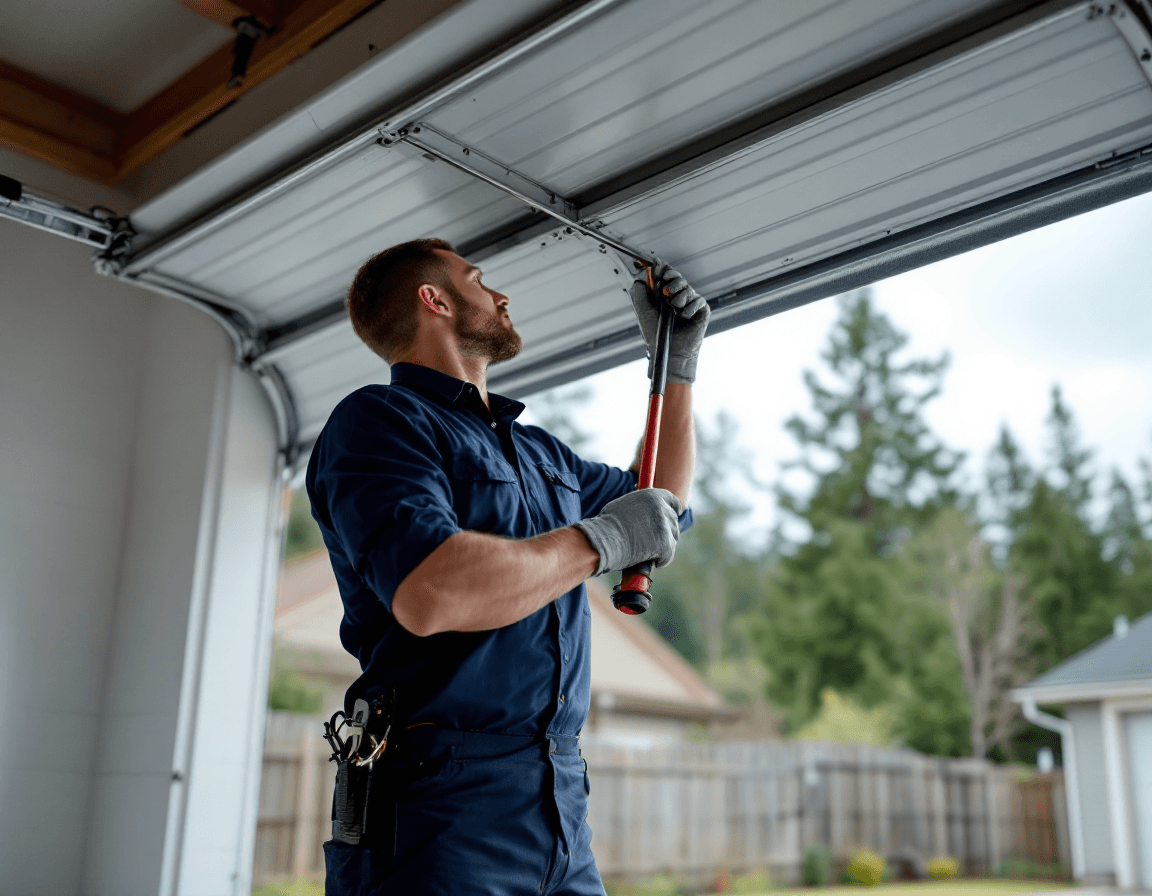
Garage Door Spring Replacement in Everett, WA is one of the most common calls we take, and one of the most misunderstood. Many homeowners assume the door itself has failed, when the real problem is a tired or broken spring that can no longer carry the door's weight. Because the springs do most of the lifting, a single failure can turn a smooth-running door into a stuck, heavy, or dangerous one overnight. Knowing how the system works makes it easier to recognize trouble early.
Everett homes face a particular mix of conditions that wear on garage door hardware. Long, damp winters, cool nights, and the marine air that drifts in from Port Gardner and Possession Sound all contribute to corrosion and stiffness. This page explains what causes springs to fail in our area, how to tell when a replacement is due, what your options are, and what to expect when a licensed technician comes to your driveway. Our goal is to give you enough background to make a confident decision, whether you live near Downtown Everett, out by Silver Lake, or along the Harbour Pointe waterfront.
Whatever your situation, the most important point is this: spring work carries real force and should be left to trained professionals. The information below is meant to help you understand the repair, not to encourage a do-it-yourself project. If anything in this article makes you think your door needs attention, call a licensed technician before you touch the springs, cables, or drums.
Why Springs Wear Out Faster Than Expected Around Everett
Springs do not wear out on a calendar. They wear out through repeated cycles of winding and unwinding metal, and every time the door opens or closes, the steel flexes under tension. In a Snohomish County winter, that metal also spends long stretches in cold, wet conditions, which can speed up surface corrosion and make the coils more brittle. Homes close to the water sometimes see additional salt exposure that accelerates rust on exposed hardware.
Humidity plays a quiet role as well. Moisture that collects around the header bracket, the bearing plates, and the coil itself can gradually weaken a spring from the outside in. We often find that springs on the north side of a house, or on doors that rarely see direct sun, show more surface rust than their neighbors. That pattern matters because a spring can look acceptable on the outside while the interior of the steel has already lost strength.
Many Everett homeowners also use their garage as a daily entry point, which adds cycles that a door in a less busy household might never see. A family that leaves for work, returns for lunch, and comes and goes several times in the evening can put far more wear on its springs than a weekend-only driver. Understanding how your own household uses the door helps explain why one spring might last a decade while another fails within a few years.
Recognizing the Signs Before the Loud Bang
Most spring failures do not happen silently. The most dramatic one is the sharp bang that sounds like a gunshot in the garage, usually when the door is closed or just starting to open. That noise typically means a spring has broken and released its stored energy all at once. If you hear it, do not attempt to open or close the door manually, and keep people and pets away from the door while you arrange service.
Long before a dramatic break, though, springs often send smaller signals. Pay attention to the following, because each one can point to a spring that is near the end of its service life:
- The door feels much heavier than it used to when you lift it by hand or when the opener pulls it upward.
- The opener motor hums, strains, or runs for several seconds while the door barely moves.
- The door rises a few inches, then stops and needs a push to finish its travel.
- A visible gap or separation appears in the torsion spring coil when you look at it from a safe distance.
- The door seems to close too fast, drops hard, or hangs crooked on one side.
If you notice any of these, schedule an inspection promptly. A door that is merely struggling can often be stabilized with a timely replacement, while waiting may cause the opener to burn out or the remaining spring to fail under added strain. Early attention usually keeps the repair simpler and avoids collateral damage.
What a Broken Spring Does to the Rest of the Door
Torsion springs are mounted on a steel shaft above the door opening, and when one breaks, the door loses much of its counterbalance. The remaining spring, if there is one, suddenly has to handle a load it was never designed to lift alone. That imbalance can twist the shaft, stress the bearings, and pull the cables unevenly, so the door may look fine on one side while the other side is already lagging behind.
Extension springs behave differently. These run along horizontal tracks on either side of the door, and when one breaks, the door may drop suddenly or rest partially open. Because extension systems often include a safety cable running through the center of each spring, a broken spring should not turn into a runaway panel, but the door can still become unstable, unsafe, and difficult to close. Either system needs immediate attention once a break has occurred.
Repairs that ignore the rest of the hardware tend to fail sooner. A replacement spring installed on worn drums, frayed cables, or a bent shaft will carry the same stress into the same weak points, shortening its life. That is why a responsible spring job includes checking the drums, cables, rollers, hinges, and bearing plates at the same time. Treating the spring as the only issue is a common shortcut that many homeowners eventually regret.
Choosing Between Torsion and Extension Springs for Your Everett Door
Before any replacement, a technician needs to identify which spring system your door uses. Torsion systems mount above the opening, usually with one or two long coils wound around a horizontal shaft. They are common on newer and heavier residential doors and generally provide smoother operation and better balance. Extension systems sit alongside the tracks and are typically found on older or lighter doors, and they can be a practical option where headroom is limited.
Neither system is automatically better for every home. The right choice depends on the door's weight, its size, the available space above the opening, and the existing hardware. A technician should measure the door, check the track configuration, and confirm the correct spring size and wire gauge rather than guessing. Replacing a torsion system with an extension system, or the reverse, is a larger modification that should be discussed carefully before work begins.
We also recommend asking whether the replacement will match the door's original design. Mixing spring types or installing springs with the wrong rating can cause uneven lifting, premature wear, and frustrating balance problems. A careful installer will explain each choice in plain language and will not rush you into a decision you do not understand.
High-Cycle Springs and When They Are Worth the Extra Investment
Standard springs are rated for a specific number of cycles, and that rating reflects how long the spring is expected to last under typical use. High-cycle springs are wound from specially selected steel and sized to handle more demanding workloads over a longer period. They are a sensible choice for households that use the garage as a primary entrance, run home businesses from the space, or simply open and close the door many times a day.
These springs are not a magic upgrade for every home. A retired couple who opens the garage twice a week may find a standard spring perfectly adequate, and paying extra for a longer rating may not change their experience. Instead, think about how many times the door moves in a typical day, whether there are teenagers or frequent visitors, and whether you plan to stay in the house for many years. Those factors help determine whether a high-cycle spring is worth the added cost.
Whatever you choose, make sure the spring matches the door's weight and the manufacturer's specifications. A high-cycle spring installed incorrectly will not last longer than a standard spring installed correctly. Balance and proper winding matter at least as much as the cycle rating itself.
Understanding Spring Replacement Pricing in Everett
Most spring replacements in our service area fall in the range of $180 to $450, depending on the type of spring, the size and weight of the door, and the amount of related work involved. A single torsion spring on a standard two-car door may fall toward the lower end of that range, while a heavier custom door, a pair of springs, or a job that also requires new cables and drums may land higher. Extension systems and high-cycle upgrades can shift the total as well.
Pricing should be clear before the work begins. A reliable technician will explain what is included, whether the price covers the spring, labor, balancing, safety checks, and cleanup, and whether any additional parts might be needed after inspection. Be cautious of quotes that seem unusually low without explanation, since they may leave out essential steps such as proper balancing or a full hardware inspection. A fair estimate should be specific rather than vague.
If the door has several worn components, you may face a decision between repairing the immediate problem and addressing everything at once. Our recommendation is usually to inspect the full system so you can weigh the options with real information. Spending a little more during one visit can prevent a second service call a few months later.
Why Balancing Matters More Than Most Homeowners Realize
Once a new spring is installed, the door must be balanced so it stays in place when you let go of it halfway open. A properly balanced door should rise and lower smoothly with the opener, and it should remain stationary if you manually lift it to about waist height and release. If the door drifts up or slams down, the spring tension is not correct, and the opener and other parts will absorb extra strain.
Balancing is a precise adjustment, and it is one of the reasons spring work belongs with trained technicians. Winding a torsion spring incorrectly can cause serious injury, and even a correctly wound spring can be set at the wrong tension if the technician does not verify it against the door's weight and hardware. Our crews check the balance after installation and again once the door has completed several full cycles, because minor settling can change the feel of the door slightly.
Balance also affects the opener's lifespan. When a door is correctly balanced, the opener does not have to fight the weight, and motor wear drops considerably. Many homeowners who replace an opener too early discover that the real problem was poor balance all along. Asking a technician to check balance after any spring job is a simple way to protect your larger investment.
Cables, Drums, and the Quiet Damage a Spring Break Leaves Behind
When a spring fails, the cables attached to the bottom bracket can be jolted, frayed, or pulled off the drum entirely. A cable that has come loose may look intact at first glance, yet it can slip again under load and create a dangerous situation. Drums can crack or slip on the shaft, and the lifting cables may wrap unevenly, causing one side of the door to rise faster than the other.
Inspection after a break should include the cable ends, the drum grooves, the shaft set screws, and the bearing plates on each side. Any sign of fraying, kinking, rust, or looseness calls for replacement rather than patching. Cables that have been stretched or overstressed do not return to their original condition, even if they appear straight. Replacing them at the same visit is usually more economical than scheduling a second trip later.
Homeowners often ask whether they can reattach a cable themselves after a break. We strongly advise against it. The cable is under tension from the spring system, and a mistake during reattachment can cause the door to drop or the cable to release violently. Leave the cables and drums to a licensed technician who has the tools and training to handle them safely.
Safety Guidelines Every Everett Homeowner Should Follow
Garage door springs store a large amount of energy, and that energy is the reason spring work is dangerous. Even a small mistake can cause a spring to release or a cable to whip, leading to serious injuries. The safest approach is to treat the entire spring system as off-limits to homeowners and to call a licensed, bonded, and insured professional whenever a spring or cable needs attention.
While you wait for service, a few precautions can reduce risk. Keep children and pets away from the door, and avoid standing under or beside the door when it is moving. Do not try to lift a stuck door by hand, and do not attempt to tighten, wind, or loosen spring components. If the door has broken loose from the opener, disconnect the opener by pulling the emergency release cord only if the door is closed, and then wait for a professional before operating it further.
- Never wind, adjust, or remove a torsion spring with household tools.
- Do not stand directly beneath a door that is partially open or under tension.
- Keep the opener disconnected until the spring has been replaced and the door is balanced.
- Call a licensed technician for any cable, drum, or bracket repair.
- Report any sudden bang, drop, or crooked movement as soon as it happens.
What to Expect From a Spring Visit in Your Neighborhood
When a technician arrives in Everett, the visit usually begins with a safety check and a conversation about what you have observed. We ask about the bang, the strain, the gap in the coil, or the uneven movement, because those details help narrow the cause. The crew then examines both spring systems, the cables, the drums, the bearings, and the opener, so the repair addresses the real source of the problem rather than only the most obvious symptom.
Once the cause is confirmed, the technician explains the recommended parts and the expected cost, which typically falls within the $180 to $450 range for most spring replacements. After approval, the old spring is removed safely, the new spring is installed and wound to the correct tension, and the door is balanced and tested through several cycles. We clean up the work area and review what was done so you know what to watch for in the coming months.
Service calls come to homes across Everett and nearby communities, including neighborhoods such as Downtown Everett, Silver Lake, and Harbour Pointe. Our team serves a range of ZIP codes in the area, including 98201, 98203, 98204, and 98208, and we are glad to schedule visits that fit your household's routine. If you are unsure whether your door needs attention, describe what you are seeing and we can help you decide how urgent the repair is.
Garage Door Spring Replacement in Everett, WA should never be a guessing game, and a broken or failing spring is too important to delay. If your door is making a loud bang, refusing to lift, hanging crooked, or straining your opener, call Seattle Garage Door Fix at (888) 799-3819 for a licensed technician to inspect and repair it safely. We will explain your options clearly, provide a straightforward estimate, and make sure your door is balanced and ready for daily use.