
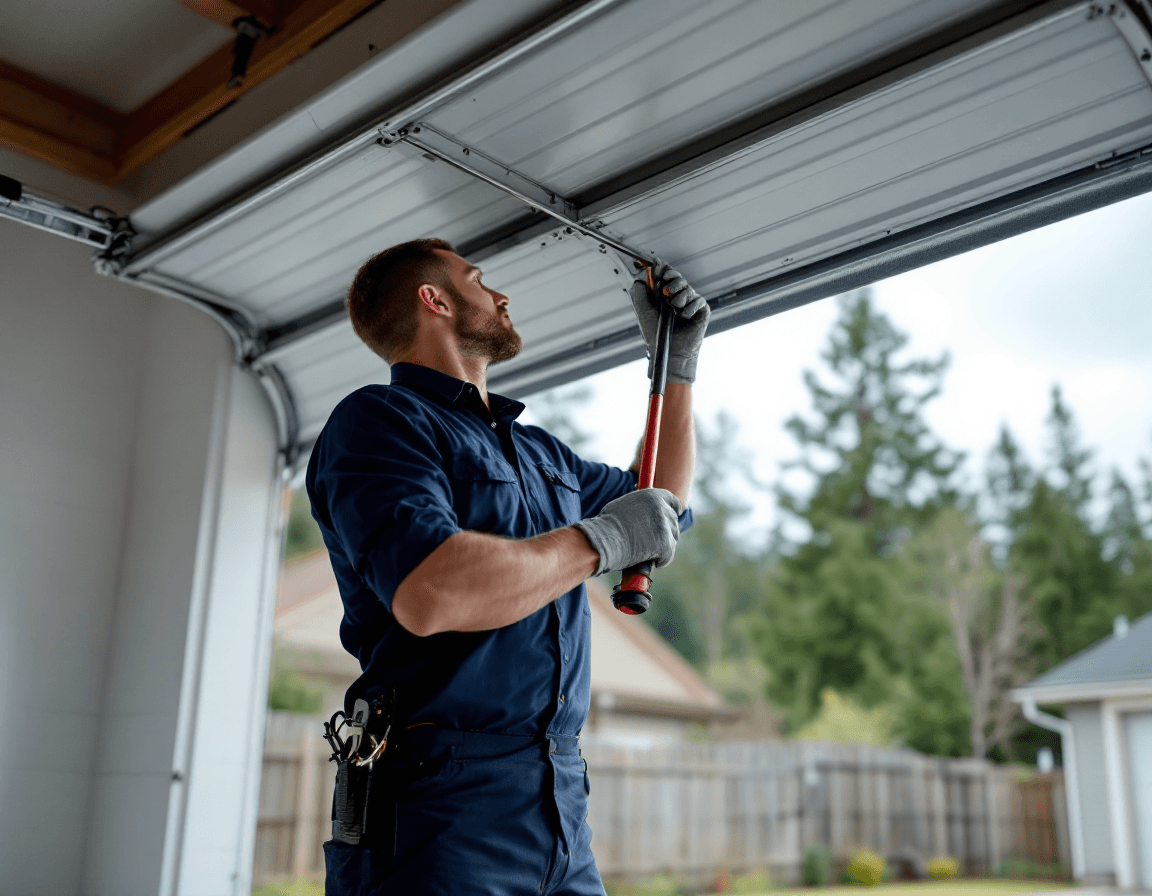
Garage Door Spring Replacement in Mukilteo, WA is one of the most common repairs we handle for homeowners along the Snohomish County shoreline, and it is also one of the most urgent when it goes wrong. The springs carry most of the weight of your door, so when one breaks, the door can go from smooth and quiet to stuck halfway up in a single morning. Mukilteo homes range from older bungalows near the waterfront to newer builds in planned communities, and the springs in each can be worn by the same damp, salty air that drifts in off Possession Sound. Knowing what a broken spring looks like and how it is fixed will help you act quickly and safely.
A spring replacement is not a do-it-yourself job for most people, and that is the single most important thing to understand before you start. Garage door springs store tens of pounds to well over a hundred pounds of tension, depending on door weight and spring type, and that energy can cause serious injury if it is released without proper tools and training. Our technicians are licensed, bonded, and insured, and they handle the winding, removal, installation, and balancing that these springs require. This page explains what homeowners in Mukilteo typically experience, why local conditions matter, what the work generally costs, and what to expect when a technician arrives at your door.
Most spring replacements we complete for Mukilteo households fall in a price range of $180 to $450, with the final number depending on the spring type, the door size, and whether cables, drums, or the opener also need attention. We will walk through those variables below so you can plan without guessing. If your door is making a loud noise, stuck, or lifting unevenly right now, call us at (888) 799-3819 and we can help you decide whether the door is safe to operate until a technician arrives.
Reading the Bang: What a Snapped Spring Sounds Like in Your Garage
Many Mukilteo homeowners first learn that something is wrong when they hear a sharp crack or a loud bang from inside the garage, sometimes followed by a clatter. That sound is usually a torsion spring breaking under load, and it can be startling even when you are expecting it. The noise often happens when the door is closing or opening, and it may seem to come from above the door rather than from the sides. In many cases the door will still look intact, which can lead people to assume the problem is minor.
After a break, the door often feels different. It may sit lower than usual, refuse to lift past a certain point, or drop suddenly when you try to open it manually. Some owners notice a visible gap in the coil of the torsion spring that runs across the header, or a spring that looks stretched or uneven compared with its partner. If you see a gap, do not attempt to pull the spring apart or tighten anything on your own, because the remaining tension can still be dangerous.
It helps to keep the garage closed and avoid walking under the door until a technician has inspected it. Keep children and pets away from the area, and use the wall button or remote only if the door is still moving predictably. If the door is hanging crooked or the cables look slack, stop using it entirely. A cautious approach at this stage costs nothing and can prevent a far more expensive repair.
Torsion or Extension: Knowing Which Spring Your Door Carries
Garage doors in the Mukilteo area typically use one of two spring systems, and identifying yours is an important first step in understanding the repair. Torsion springs mount on a steel shaft above the door opening and wind and unwind as the door moves, which makes them the most common choice for modern residential doors. Extension springs run along the horizontal tracks on each side of the door and stretch as the door rises. Some older or lighter doors still use extension springs, and many homes have one type on a single-car door and the other on a double.
Torsion systems usually break with a loud crack and leave a visible gap in the coil, while extension springs often sag, stretch, or pull apart at the hook end. Extension springs also tend to be safety hazards when they fail, because the coils can whip across the garage if tension is released unexpectedly. Both types require proper winding bars and calibrated tension, and neither should be adjusted by an untrained person. The correct replacement depends on the door's weight, height, track configuration, and the cycle rating you need.
When we inspect your door, we check the spring type, the wire size, the inside diameter, and the cable drum configuration before recommending a replacement. Matching these specifications matters because a spring that is slightly off can make the door lift unevenly or wear out the opener prematurely. We also look at the bracket and bearing plate condition, since a worn bracket can cause a new spring to fail sooner than expected.
Why Puget Sound Air Wears Springs Faster Than You Might Expect
Mukilteo sits on the shoreline of Possession Sound, and that location shapes the environment your garage door lives in. Western Washington's wet winters bring long stretches of rain and high humidity, and the moisture that settles on metal parts promotes surface rust and corrosion. Salt-laced air carried in from the water can speed that process, especially on exposed hardware in garages that are not fully sealed or that are close to the shore. Over time, rust on the spring coils reduces their ability to hold tension evenly.
Temperature swings also play a role. A cold snap can stiffen lubricants and make metal more brittle, while warm, damp days can cause expansion and contraction that stress the coils. Many garages in older Old Town homes have uninsulated walls or doors with weathered seals, which means the spring experiences more temperature variation than a climate-controlled space would. None of this means a spring must fail, but it does mean that a spring rated for a certain lifespan in a dry climate may reach the end of that life sooner here.
Regular inspection and lubrication can slow this wear considerably. A light coat of a garage-door-specific lubricant on the coils, applied once or twice a year, helps repel moisture and reduce friction. Wiping down exposed hardware after a salt-heavy week or after heavy coastal wind is another simple habit. These steps do not replace professional service, but they give you an early warning when a spring starts to show signs of age.
The Symptoms That Mean Stop Using the Door Today
Some spring problems are obvious, while others develop slowly and can be mistaken for opener trouble or ordinary wear. Knowing the warning signs will help you decide whether to keep using the door or to call for service right away. The following conditions should all be treated as urgent, and in most cases the door should not be operated until a technician has checked it.
- A loud bang or crack from the garage, especially when the door is moving or has just been closed
- A visible gap, stretched section, or separation in the torsion spring coil
- The door refuses to lift, stops a few inches off the ground, or opens partway and stalls
- The door feels extremely heavy when lifted by hand, or drops quickly when released
- The opener strains, hums, or clicks but the door barely moves
- Cables that look loose, slack, frayed, or have come off the drum after a spring break
- The door closes too fast, lands hard, or hangs crooked on one side
If you notice any of these, avoid putting your hands near the springs, cables, or track, and do not attempt to manually force the door open or closed. Disconnecting the opener and using the emergency release can be useful for moving a door that is otherwise stable, but a door with a broken spring should be treated as dangerous even after it has been released. Keep everyone clear of the door's path until a licensed technician arrives.
What Replacement Typically Costs and What Shapes the Bill
For most spring replacements in Mukilteo, the typical range is $180 to $450. That spread reflects real differences in the work rather than arbitrary pricing. A single extension spring on a light residential door sits at the lower end of the range, while a torsion spring pair on a heavier insulated door with a complex balancing job sits toward the upper end. Your exact quote depends on several factors, and it is worth understanding them before the technician arrives.
- Spring type and size: Torsion and extension systems, wire gauge, and inside diameter all affect the parts required.
- Number of springs: Many doors use two torsion springs, and replacing both at once is often recommended since they wear at similar rates.
- Door weight and material: Insulated steel, wood, and glass doors each place different loads on the springs.
- Cycle rating: Standard and high-cycle springs carry different price points, discussed in the next section.
- Related repairs: Cables, drums, bearings, and brackets sometimes need attention during the same visit.
- Balancing and testing: A thorough balance and safety check is part of a proper job and is included in the quoted work.
We provide an itemized estimate before any work begins, so you know what each part and task costs. If the technician finds additional problems, such as a frayed cable or a worn bearing plate, you will be told about them before any extra work is performed. Pricing transparency is part of how we operate, and you are always free to ask questions before approving repairs.
High-Cycle Springs and Whether a Busy Household Needs Them
Standard springs are designed for a typical number of open-and-close cycles, but households that use their garage door frequently may wear them out sooner. A family with teenagers coming and going, a home business that uses the garage as a workshop, or a household with multiple vehicles may cycle the door several times a day. In those situations, high-cycle springs offer a longer working life because they are engineered with stronger wire and tighter manufacturing tolerances.
High-cycle options usually cost more than standard springs, and the price difference is part of the discussion during an estimate. For a home that opens the garage only a few times a week, a standard spring may be perfectly adequate. For a household that cycles the door many times a day, the higher upfront cost can make sense because it reduces the frequency of future service visits. We discuss your actual usage pattern rather than pushing the most expensive option.
Regardless of the cycle rating you choose, the spring must be properly matched to the door and balanced correctly. A high-cycle spring installed on an unbalanced door will still wear faster than it should, so the balancing step matters just as much as the part itself. Ask the technician to explain how the spring was selected and how the door was tested after installation.
Balancing the Door: The Step Most Quick Fixes Skip
A replacement spring is only part of a good repair. The door must also be balanced so that it lifts smoothly and stays where you leave it. A properly balanced door should rise with minimal effort and remain stationary when you release it partway open. If the door drifts up or down on its own, or if it seems to fight the opener, the balance is off and the opener, springs, and cables are all working harder than they should.
Balancing involves adjusting spring tension, checking the cable routing, and confirming that the drums and bearings are seated correctly. Our technicians test the door through its full range of motion and look for signs of uneven movement, binding, or excessive force. They also verify that the opener's force settings and safety reversal features are working as intended, since a poorly balanced door can trigger reversals unnecessarily or fail to reverse when it should. This testing is a core part of the job and not an optional extra.
Many homeowners try to balance a door by simply adding or removing tension without the proper tools. That approach is risky and often leads to a door that looks fine but fails within weeks. A professional balancing job takes into account the door's weight, the spring's rated capacity, and the geometry of the tracks, which is why we insist on doing it right the first time.
Cables, Drums, and What Happens After a Spring Breaks
When a torsion spring breaks, the lift cables attached to the drums often lose tension and can slip off or fray. In some cases the cable simply becomes loose, while in others it may be damaged by the sudden release of energy. A loose or damaged cable is a serious safety concern, because the door can drop unpredictably if the cable is not properly seated. For this reason, cables should be inspected every time a spring is replaced.
Drums can also be affected. If a cable has slipped off a drum, the drum may need to be realigned or replaced, and the cable must be rerouted correctly. We check each drum for wear, cracks, and proper alignment on the shaft, and we confirm that the cable is wound evenly. Worn or damaged drums can cause the door to lift crookedly, so replacing them at the same time as the spring often prevents future problems.
Homeowners sometimes notice that a door still moves after a spring break but hangs slightly out of level. This is usually a sign that a cable or drum has shifted, and it should be corrected promptly. Running a door with one side higher than the other places extra stress on the opener, the tracks, and the remaining spring. A thorough inspection after any break helps keep the whole system working together.
Keeping Springs Healthy Through Mukilteo's Rainy Winters and Salty Summers
Preventive care is the best way to extend the life of your springs and avoid surprise breakdowns. A simple seasonal routine takes only a few minutes and can catch small problems before they become urgent repairs. Because Mukilteo's climate brings steady moisture for much of the year, we recommend paying particular attention to the springs and hardware during the wet season and again after summers with heavy salt-laden air.
- Inspect the torsion coils and extension springs every few months for rust, gaps, or uneven spacing
- Apply a garage-door-specific lubricant to the coils and moving hardware once or twice a year
- Wipe down exposed metal after heavy coastal winds or prolonged damp weather
- Check cables for fraying, kinks, or slack, and report any changes to a technician promptly
- Watch the door's movement for signs of unevenness, drifting, or new noises
- Schedule a professional inspection every year or two, especially for older doors or heavily used garages
These steps are most effective when combined with professional service. A technician can spot wear patterns that a homeowner may miss, such as hairline cracks in a spring coil or early bearing damage. Regular checkups also give you a chance to plan replacements on your own schedule rather than responding to an emergency.
Booking a Visit: What to Expect When a Technician Arrives in Mukilteo
When you call for spring replacement service in Mukilteo, we begin by asking about the symptoms you are seeing and how the door is behaving. We may ask about the door's size, the type of opener, and whether the door has been modified in the past. This information helps us prepare the right parts and tools before the technician arrives, which often shortens the visit and reduces the time the door is out of service.
When the technician arrives, they will first inspect the door and its surroundings to confirm the cause of the problem. They will check the springs, cables, drums, brackets, bearings, and opener, and they will explain what they find in plain language. You will receive a written estimate before any work begins, and you can ask questions about the parts, the procedure, or the warranty. Our technicians are licensed, bonded, and insured, and they work carefully around your home, your vehicles, and your belongings.
After the replacement, the technician will test the door through several full cycles, adjust the balance, and confirm that the opener's safety features are working correctly. They will show you how the door should move and what to watch for in the coming weeks. If you have questions about maintenance or future cycle needs, this is a good time to ask. Our goal is to leave your door safe, balanced, and ready for daily use.
Garage door springs are under far more stress than most people realize, and a break can turn an ordinary morning into a stuck and dangerous situation. If your Mukilteo garage door is making a loud noise, refusing to lift, or showing any of the warning signs described above, do not wait to see whether it gets worse. Call Seattle Garage Door Fix at (888) 799-3819 to schedule a licensed technician, and we will help you get your door safely back in service.