
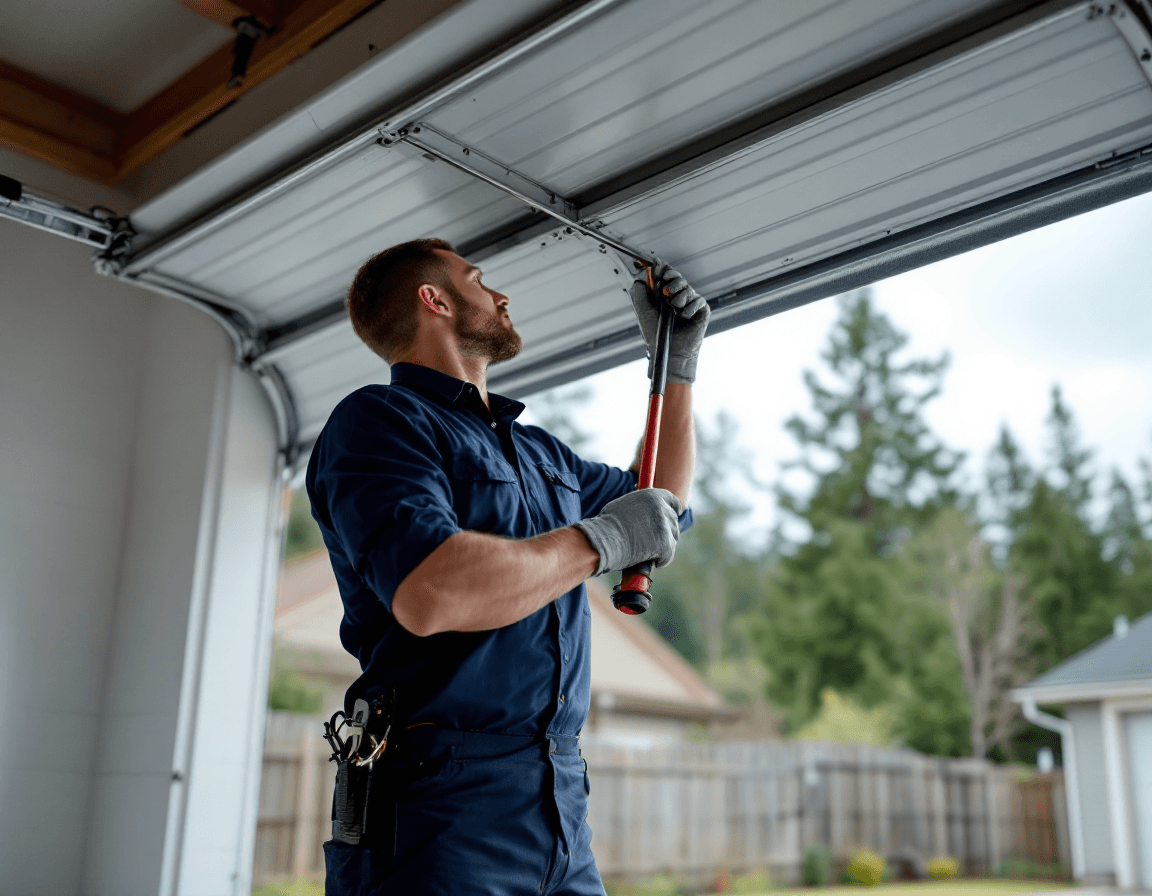
Garage Door Spring Replacement in Mill Creek, WA is one of the most common repairs we handle for homeowners in the Mill Creek area, and it is also one of the most urgent. The springs carry most of your door's weight, so when one fails, the door can go from smooth to nearly immovable in a single cycle. Whether the failure happened with a loud crack overnight or a slow decline over a few rainy weeks, the result is the same: the door needs a licensed technician who can replace the spring safely and set the balance correctly.
Mill Creek sits in the northern part of Snohomish County, where the climate is mild by most American standards but hard on metal. Winters bring long stretches of drizzle and damp air, summers stay cool enough that many homes never run the air conditioning hard, and the seasonal swing between a cold January morning and a warm afternoon in May adds stress to every moving part. Those conditions quietly shape how springs age, which is why a door that worked fine three years ago may now be struggling. Understanding what the spring is doing, and what it is not doing, helps you decide when to call.
This page explains how spring failures show up in Mill Creek homes, how we evaluate the damage, what drives the cost, and why this is a job to leave to trained hands. We will walk through the sounds, the stalls, the hardware that gets damaged along with the spring, and the high-cycle options that make sense for households that open the door several times a day. If you are reading this with a door stuck halfway up or a loud memory of a bang still fresh, you can skip ahead to the safety section and the phone number at the end, but the sections in between will help you understand what the technician is about to do.
Why Pacific Northwest Moisture Wears Springs Down Faster Than You Might Expect
Garage door springs are made of tempered steel, and steel has one persistent enemy in a wet climate: oxidation. In a Mill Creek garage, humid air can settle on the spring coils through the damp months, and any small amount of surface rust weakens the metal over time. Many homes in the area also have garages that are not fully climate controlled, so the spring spends the winter cold and wet, then the spring sun brings expansion and contraction that can work tiny stress fractures deeper into the wire. Rust is not always visible from the floor, which is why a spring can fail with little warning.
Temperature swings matter as well. Torsion springs store energy by twisting, and the tension they hold is affected by how the metal responds to temperature changes over thousands of cycles. A door that opens and closes dozens of times a week in a home with two commuters and a teenager with a car will accumulate far more wear than a garage used mainly for storage. Mill Creek has plenty of households where the garage is the primary entry point, so the daily cycle count can be higher than homeowners expect.
Homes in newer subdivisions near the Town Center and in the wooded pockets around Silver Firs often have garage doors with heavier insulated panels. Insulated doors weigh more than older single-layer models, and the spring is sized for the door's weight. When a heavier door is paired with a spring that is already fatigued by moisture, the result can be an early break. This is one reason we always check the door's weight, panel type, and track alignment before recommending a specific replacement spring.
Listening for the Bang: What a Snapped Torsion Spring Sounds Like
The most memorable symptom of a spring failure is the sound. A torsion spring that breaks releases its stored energy all at once, and that release can produce a loud bang that homeowners often describe as a gunshot, a car backfire, or a heavy object dropped on a concrete floor. Many people hear it from inside the house, sometimes after dark, and assume something has hit the garage. If you hear that sound, the first step is to stay out of the garage and check the door from a safe distance.
Once the noise settles, you may notice the door looks different. Some homeowners find the door is partly open, others find it closed but noticeably crooked, and a few find that it will not move at all. A snapped spring rarely leaves visible damage on the door panels, but it often leaves a gap in the coil on the shaft above the door. That gap is one of the clearest signs of failure, and a technician can usually spot it in a few seconds with a flashlight.
Here are the signs we most often hear described after a loud spring break:
- A single sharp bang or crack followed by silence, sometimes with a noticeable jolt through the floor
- A visible gap or separated coil on the torsion shaft above the closed door
- The door sitting partly open, crooked, or sagging on one side
- Cables that appear slack, loose, or hanging off the drum
- A door that seems much heavier than usual when operated by hand, which is itself a warning sign
If you see any of these, avoid the temptation to test the door repeatedly. Repeated cycling can damage the opener, the cables, and the remaining spring, and it increases the chance of an injury.
When the Door Stops Halfway: Diagnosing a Partial Lift
A door that opens a few inches and stops is a classic symptom, and it is frustrating because it looks like a minor problem. In many Mill Creek garages, this happens after a spring has lost enough tension that the door can no longer hold its own weight through the full travel. The opener tries to lift the door, but the weight overwhelms the motor, or the door hits a stop and refuses to climb further. Sometimes the spring has not fully broken, but it has weakened enough to make the balance fail.
It is worth noting that a partial lift can also come from causes other than the spring. Track obstructions, a bent roller, a misaligned sensor, or a worn opener trolley can all mimic the symptom. We check those components during the same visit so that the replacement addresses the real problem. A quick visual inspection can rule out a few of these, but a thorough balance test is more reliable, and it is one of the reasons we recommend a professional rather than a guess.
Homeowners sometimes ask whether they can simply disconnect the opener and lift the door by hand to see if it moves smoothly. This is a reasonable question, but it can be dangerous with a weak or broken spring, because a door under unbalanced load can drop suddenly. Keep fingers clear of the tracks, keep children and pets away from the door, and let a technician perform the balance check. The door should be treated as heavy and unpredictable until it is confirmed safe.
Torsion Versus Extension Springs: Knowing What Your Garage Actually Uses
Before any replacement, a technician needs to identify the spring system. Most modern residential doors in Mill Creek use torsion springs, which mount on a steel shaft above the opening and wind up to lift the door. Extension springs, by contrast, run along the horizontal tracks on each side and stretch as the door opens. Older homes in the area, and some lower-cost installations, still use extension springs, and the two systems require different tools, safety approaches, and replacement parts.
Torsion springs are generally considered the safer and smoother option for daily use because they keep the spring mass out of the way of the door and provide a more balanced lift. Extension springs can work well, but they include safety cables that run through the coil, and those cables are there to contain the spring if it breaks. Removing or ignoring those cables is a serious hazard. If your door has extension springs and you notice fraying or missing safety cables, that is worth mentioning during a service call.
Identifying the system also helps set expectations about cost and timing. Torsion spring replacements often involve matching the wire size, inside diameter, length, and cycle rating to the existing door, and they may require rebalancing the door once the new spring is installed. Extension spring jobs tend to be quicker in some cases but require careful attention to the safety cables and the track hardware. Both are within the scope of a typical residential spring replacement in our service area.
Cables, Drums, and the Hardware That Gets Damaged Along With the Spring
A spring break rarely stays isolated. When a torsion spring releases suddenly, the cables attached to the drums can unspool, tangle, or come loose from the drum anchor. In some cases the cable snaps, and in others the drum itself is cracked or the bearing is damaged. Even a door that appears to have only a broken spring may have a cable that needs replacement before it can be safely lifted again. This is why we inspect the entire lifting system during every spring visit.
Cable damage is more than an inconvenience. A cable that has come off the drum can allow the door to drop unevenly, which can bend tracks, stress rollers, and crack panel joints. Crooked closing is one of the more subtle signs: the door may close with a lean, or one side may hit the floor first. When that happens after a spring break, the cable tension and drum alignment often need correction along with the spring.
We also look at the center bearing, end bearing plates, lift cables, and the hinges that connect the panels. These parts are inexpensive relative to the cost of a secondary failure, and replacing them during the spring visit is often more efficient than returning later. Ask the technician to explain what they found and what they recommend, so you understand which components are worn versus which are simply aging normally.
Why the Opener Hums but the Door Barely Moves
A garage door opener that strains, hums, or clicks while the door barely moves is a strong indicator that the springs are not doing their job. The opener is designed to assist the spring, not to carry the full weight of the door. When the spring has lost tension, the opener must work much harder, and it can overheat, trip its internal safety features, or wear out its gear train. Continuing to run the opener in this condition can turn a spring repair into a larger repair.
Homeowners sometimes assume the opener is failing and spend money on a new motor before discovering the real cause. Openers do fail, of course, but the spring is a far more common culprit in a door that hums without lifting. A technician can usually tell the difference by checking the door's balance, watching how the opener responds, and inspecting the spring for gaps or stretching. If the spring is the cause, replacing the opener would not solve the problem.
If you hear the opener humming without movement, shut off power to the opener at the unit or the breaker and avoid repeated attempts. Continued running can burn out the motor and make the repair more expensive. Once the spring is replaced and the door is rebalanced, the opener can be tested under normal load to confirm it is operating within its intended range.
Pricing a Spring Swap in Mill Creek: What Shapes the $180–$450 Range
For most residential torsion and extension spring replacements, our pricing typically falls between $180 and $450. That range reflects the variety of door types and spring systems in the area, along with the differences in spring size, cycle rating, and whether additional hardware needs replacement. A simple single-spring swap on a standard door will usually sit toward the lower end, while a double-spring setup on a heavy insulated door, or a job that requires cable and drum replacement, may fall higher. We give an estimate after inspecting your specific door, because the spring you need depends on details that are not visible from a phone call.
Several factors influence where a job lands within that range. The door's weight, height, and width all determine the spring specification. The type of spring, torsion or extension, changes the labor and parts involved. Whether the old spring broke cleanly or left debris in the track, whether the drum is damaged, and whether the opener needs adjustment after the balance is restored can all add time. A technician who rushes the diagnosis may give you a lower quote that leads to a second visit, which is rarely a bargain.
Ask for an itemized explanation before work begins. A reputable technician should be able to tell you which parts are included, what the balance test involves, and whether any additional components are being recommended. You should not feel pressured into upgrades you do not need, and you should understand why each recommended part is on the list.
High-Cycle Springs and Precise Balance for Busy Mill Creek Households
Many families in Mill Creek open and close the garage door several times a day, especially on school mornings and weekend errands. Standard springs are often rated around 10,000 cycles, which may sound like a lot but can be reached within several years in a busy household. High-cycle springs are engineered for significantly more cycles and are a practical upgrade when the door gets heavy daily use. They cost more upfront, but they can reduce how often the spring needs replacing.
Choosing a high-cycle option is not automatically the right decision for every home. A garage used primarily for storage may not need it, while a home where the garage is the main entrance and the door cycles frequently often benefits from the longer service life. We discuss the cycle count, your typical usage, the door weight, and your budget before recommending a specific option. The goal is to match the spring to the way you use the door, not to sell the most expensive part on the shelf.
Balance is equally important. A new spring installed without proper tuning can leave the door too heavy, too light, or uneven. A door that closes too fast can slam and stress the hardware, while one that is out of balance can drift upward or downward on its own. After installation, we test the door's balance by disconnecting the opener and checking whether the door stays put at various heights. Fine adjustments to the spring tension may be needed to bring the door into balance, and that is one reason the work should always be handled by someone trained in the process.
Keeping Your Hands Off the Winding Bars: A Safety Briefing
Garage door springs store a large amount of energy, and the process of replacing or adjusting them involves working with that energy under tension. Winding bars, which are used to set torsion spring tension, can slip, snap back, or cause serious injury if handled incorrectly. Even experienced technicians treat spring work with careful procedure and proper equipment. For this reason, we strongly recommend against attempting spring replacement yourself, no matter how many online videos you have watched.
The risks are not limited to the spring itself. A door that drops under unbalanced load can crush fingers, damage vehicles, or injure anyone standing nearby. Extension springs can release their stored energy with force, and their safety cables are designed to limit that release, not to make the work safe for an untrained person. Removing a spring, adjusting its tension, or working on the drum without proper knowledge exposes you to hazards that homeowners often underestimate.
If your door is damaged, the safest steps are simple. Keep the door closed if possible, avoid lifting it manually, keep children and pets away from the garage, and turn off the opener at the breaker if the door is unstable. Call a licensed professional who can assess the system and perform the repair with the proper tools. Our team is licensed, bonded, and insured, and we treat every spring job as a controlled procedure rather than a quick fix.
Scheduling a Visit Around Your Mill Creek Routine
Spring failures rarely happen at convenient times, and many homeowners discover them on a weekday morning when they need the car. Whether your home is near the Mill Creek Town Center, tucked into the neighborhoods around Silver Firs, or farther out in the surrounding areas, the goal is the same: get the door safely operational and the system properly balanced. When you call, describe what you heard, what the door is doing now, and whether anyone has tried to operate it since the failure. That information helps the technician prepare the right parts and tools before arriving.
Consider keeping a few details handy when you contact us. Note the approximate age of the door and opener if you know it, the door's width and height, the color and style of the panels if you have them written down, and whether you see any gap in the spring coil or cable. If you have photos of the spring or the cable drum, share them. These details do not replace an on-site inspection, but they make the first conversation more efficient and help us give you a realistic estimate sooner.
Plan to be present during the visit if possible, or at least available to answer questions and approve the work. A good technician will show you the broken or worn components, explain the replacement options, and demonstrate how the balanced door should feel. That transparency is part of how we work, and it helps you understand the system well enough to keep an eye on it between service calls.
If your Mill Creek garage door has a broken spring, a partial lift, a loose cable, or an opener that hums without moving the door, do not wait for it to fail completely. Call Seattle Garage Door Fix at (888) 799-3819 to schedule a spring replacement and balance check with a licensed, bonded, and insured technician. We will inspect the system, explain your options, and give you a clear estimate, typically within the $180–$450 range for most spring replacements, before any work begins.