
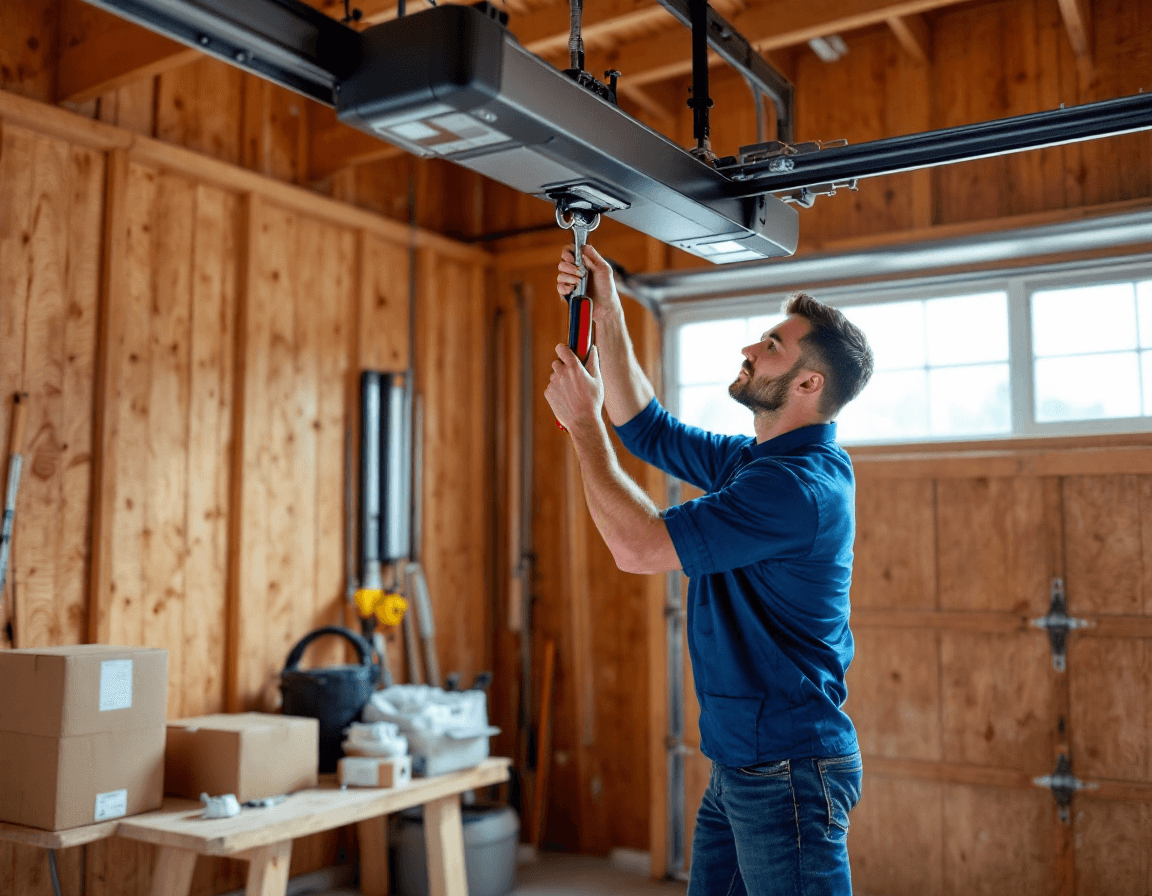
Garage Door Opener Installation & Replacement in Mill Creek, WA is one of the most practical upgrades a homeowner can make, and it is often more affordable than people expect. Mill Creek sits in the heart of Snohomish County, where long gray stretches of winter drizzle, damp spring mornings, and summer evenings that cool quickly all put steady wear on the motors, logic boards, and rails that keep a garage door moving. Homes around Mill Creek Town Center, the Silver Firs area, and the neighborhoods across the 98012 ZIP code range from older builds with single-speed openers to newer houses already wired for smart-home devices. Whatever your situation, the opener is the part of the system that does the most work, and it is usually the first component to show its age.
This page explains how to tell when an opener needs replacing, how to choose between belt-drive, chain-drive, and wall-mount designs, and what smart features and battery backup actually add to daily life. It also covers what affects the installed price, which typically falls between $275 and $650 depending on the model you select, and where the line sits between work a homeowner can reasonably plan and work that belongs in the hands of a licensed technician. Seattle Garage Door Fix is licensed, bonded, and insured, and we install and replace openers across Mill Creek and more than 60 nearby cities. The goal here is to give you enough background to make a confident decision, whether you call us today or simply want to understand your options first.
Reading the Signs Your Opener Is Giving Up
Most openers do not fail overnight. They give warnings over months, and homeowners often adjust to those warnings without realizing how much the unit has declined. A motor that once lifted the door smoothly may now hesitate, groan at the top of its travel, or stop halfway and then resume after a second press. Noise is another common clue, especially a rattling or grinding sound that worsens each season. When the door seems to take longer to open or close than it used to, the motor is often working harder than it should.
Reliability problems tend to show up in patterns. The remote may work only when you stand in one spot in the driveway, the wall button may respond inconsistently, or the light may flicker when the door moves. Some openers reverse the door for no clear reason, which is frustrating and can point to a sensor, a logic board, or a force setting that has drifted out of calibration. In the damp Pacific Northwest air, corrosion on wiring connections and contacts can cause intermittent faults that come and go with the weather, so an opener that works on a dry afternoon may act up after a week of rain.
- Slow, hesitant, or labored movement, particularly near the top or bottom of travel
- Loud grinding, rattling, or squealing that gets worse over time
- Doors that reverse without an obvious obstruction
- Remote or keypad controls that work only from certain spots
- Lights that flicker or fail during operation
- An opener that is more than roughly 15 years old and needs repeated service calls
If several of these signs appear together, replacing the opener is usually a better use of money than continuing to patch it.
Belt, Chain, or Wall-Mount: Choosing the Drive That Fits Your Garage
The drive system determines how the opener moves the door, and it has a large effect on noise and maintenance. Chain-drive openers use a metal chain running along a rail. They are typically the most budget-friendly option and handle heavy doors well, but they are louder, and the chain can stretch and need periodic adjustment. Belt-drive openers use a reinforced rubber belt instead of metal, which runs much quieter and transmits less vibration into the house. For a garage that shares a wall with a bedroom, a home office, or a living area, a belt drive is often the most comfortable choice.
Wall-mount openers take a different approach. Instead of hanging the motor from the ceiling, they mount to a wall near the door and connect through an arm. This design saves ceiling space, which matters in garages that also hold overhead storage, bike hoists, or ceiling-mounted shelving. It also keeps the motor away from the top of the door where it can be bumped during loading. Not every garage suits a wall-mount system, because the wall must be structurally sound and the layout must allow the arm to reach the door properly, so a technician should confirm fit before you buy.
When comparing drive types, it helps to think about how you use the garage rather than focusing only on the sticker price. A detached garage used mostly for tools may be perfectly well served by a chain drive. An attached garage in a family home, especially one with a bedroom above or next to it, usually benefits from a belt drive. Heavier wood or insulated steel doors also tend to pair well with a sturdier drive and a motor sized for the door's weight, which a technician can measure during a site visit.
Why Rolling-Code Security Matters on an Older Unit
Many older openers operate on fixed-code remotes, meaning the signal from the handheld transmitter is the same every time. That predictability creates a real weakness, because a determined person with a simple device could capture and replay the signal to open the door. Modern openers use rolling-code technology, where the code changes with every press and the opener and remote stay synchronized through a shared algorithm. The result is a far harder system to copy, and it is one of the most meaningful reasons to replace an opener older than about a decade.
Rolling-code security also matters for the way many households actually use their garages. Garage doors are frequently the easiest point of entry into a home, and a garage opener that is not keeping up with current security standards leaves a gap that is easy to close. If your current remotes are fixed-code units, or if you are unsure what type you have, a technician can check the model label and the remote type during an inspection. Replacing the opener also typically means replacing the remotes, which gives you a fresh set of synchronized transmitters and lets you retire any old devices that might still be floating around a former neighbor's or contractor's hands.
It is worth noting that rolling-code security works best alongside good habits. Keep the door closed when you are not using it, avoid leaving remotes visible in parked vehicles, and consider setting a timer or alert if your opener supports one. The technology does much of the work, but a well-secured garage depends on the whole system, including the locks on the entry door between the garage and the house.
Smart Control and myQ Setup Without the Guesswork
Smart openers have moved from novelty to everyday convenience. Many models connect to a home Wi-Fi network and work with mobile apps, including the widely used myQ platform, so you can check whether the door is open, close it from your phone, or receive an alert when it moves. Some setups also integrate with voice assistants and home automation routines, letting the door close automatically at a set time or when the household leaves. For a family with children coming and going on different schedules, or for anyone who has ever driven away wondering whether the garage was left open, these features provide real peace of mind.
Getting smart features to work reliably depends on a few practical details. Your router needs to provide a solid signal in the garage, and in larger or older Mill Creek homes with thick framing, the signal can be weaker than you expect. Some installers add a Wi-Fi extender or position the opener's receiver with care to improve connectivity. You will also need to create an account, pair the opener, and confirm that notifications and permissions are set correctly, which is a quick task when a technician handles it but can become frustrating if you attempt it alone without the right documentation.
Smart control should be set up with security in mind. Use a strong, unique password for the account tied to your opener, enable two-factor authentication where it is offered, and review which people or devices have access. If you share access with family members, keep a list so you can revoke it if a phone is lost or a relationship changes. Smart features add convenience, but they also add a digital layer that deserves the same care you give to your house keys.
Keeping the Lights On: Battery Backup and Power Outages
Western Washington winters bring windstorms, and wind storms can knock out power for hours or occasionally longer. When the electricity fails, a standard opener stops working, and a garage door without power may be impossible to open from the outside without the manual release. Battery backup solves this problem by keeping the opener running for a limited number of cycles during an outage, so you can get the car out or bring it back in without standing in the rain struggling with the door by hand.
Battery backup kits vary in how many cycles they provide, how long they take to recharge, and how they alert you when the battery is low. Some systems also keep smart features working during outages, while others only power the motor. A technician can explain what a given model offers and whether it fits how your household uses the garage. For someone with medical equipment, an electric vehicle that needs to be charged in the garage, or a daily commute that depends on a quick exit, backup power is often worth the added cost.
Battery backup is not a substitute for regular maintenance. The battery itself has a service life, and it should be tested and replaced on schedule. Ask your technician to show you where the battery sits, how to check its status, and what the indicator light means, so you are not discovering a dead battery during the next outage. Keeping the emergency release accessible and clearly labeled is equally important, since it is the fallback when both power and battery are unavailable.
Repair or Replace: When an Opener Has Earned Retirement
Not every opener problem calls for a new unit. A worn remote, a misaligned photo-eye sensor, or a blown fuse can often be fixed quickly and inexpensively. The question becomes harder when the motor is failing, the logic board is damaged, or the gears are stripped, because repair costs can climb quickly and an aging unit may fail again soon after. A good rule is to compare the expected cost of repair against the price of a modern opener, while factoring in the features and security improvements a new unit would bring.
Age is a useful indicator. Openers installed many years ago were built to different standards, and parts for discontinued models can be difficult to find. If your opener is old, runs loudly, lacks rolling-code security, and has already needed multiple repairs, replacement usually delivers far more value than another patch. Replacement also gives you a chance to correct mismatches that often hide inside older installations, such as an undersized motor for a heavier door or a rail that no longer fits the current hardware.
Replacing an opener is not the same as replacing the entire door system. The door panels, springs, cables, and track may still be in good condition and perfectly suited to a new opener. However, springs and cables are under high tension and can cause serious injury if mishandled, so any inspection or replacement of these components should be left to a licensed technician with the right tools and training. A responsible installer will assess the whole system and tell you honestly whether the door is ready for a new opener or whether other parts need attention first.
What a Mill Creek Installation Visit Actually Looks Like
A typical opener installation begins with a conversation about your goals. A technician will want to know what you dislike about the current unit, whether you need quieter operation, whether smart control matters to your household, and whether backup power is a priority. From there, the technician checks the door's size, weight, and balance, examines the track and mounting surfaces, and confirms the ceiling or wall space available for the new opener. This assessment shapes which models will fit and work reliably for your specific garage.
On installation day, the technician removes the old opener, inspects the rail and hardware, and mounts the new unit according to the manufacturer's specifications. The door is tested for smooth travel, the safety reversal system is verified, and the photo-eye sensors are aligned and checked. Remotes, keypads, and any smart connections are programmed, and the homeowner receives a walkthrough covering how to operate the opener, use the emergency release, and maintain the battery if one is included. Most standard installations are completed in a single visit, though complex setups or unexpected conditions can extend the timeline.
Mill Creek homes vary considerably, so the visit should reflect your particular house. A garage tucked under a second-story bedroom may call for extra attention to noise control, while a detached garage in a more open setting may have a different power supply to check. Ask questions during the visit, and do not hesitate to request a clear explanation of any recommendation. A knowledgeable technician should be comfortable walking you through the reasons behind each choice.
Pricing From $275 to $650: What Shapes the Final Number
Installed opener pricing in our service area generally falls between $275 and $650, and the final figure depends primarily on the model you choose. Entry-level chain-drive units sit at the lower end, while quieter belt-drive models, wall-mount systems, and units with smart connectivity and battery backup tend to cost more. The price reflects both the hardware and the labor required to install, align, and test it properly. Comparing quotes is smart, but comparing them on equal terms matters, because a lower price may leave out features or service steps that you actually need.
Several factors can influence where your project lands within that range. The drive type is one, along with the motor's horsepower and how well it suits the weight of your door. Battery backup, smart control, and integration with existing home systems add cost. Mounting complexity also matters, since a garage with unusual ceiling heights, a wall-mount configuration, or rail adjustments requires more time. Finally, if the old opener's hardware needs repair or replacement during the job, that work will affect the total.
- Drive type: chain, belt, or wall-mount
- Motor strength matched to door size and weight
- Smart Wi-Fi and myQ compatibility
- Battery backup capacity and included features
- Mounting complexity and any rail or bracket work
- Additional hardware repairs discovered during installation
A clear, itemized estimate lets you see exactly what you are paying for and helps you decide which features are worth the investment for your household.
Weather, Moisture, and Placing Your New Opener in a Pacific Northwest Garage
The Pacific Northwest climate asks more of a garage opener than many homeowners realize. Mill Creek's damp winters bring prolonged humidity, and moisture can seep into electrical connections, cause corrosion on terminals, and encourage rust on brackets and rail hardware if they are not protected. Temperature swings between cool nights and mild days cause metal parts to expand and contract, which can loosen fasteners and shift alignment over time. For these reasons, a thoughtful installation accounts for local conditions rather than simply following a generic template.
Placement and protection both matter. Connections should be secured and sealed as appropriate, and the power outlet serving the opener should be safe and accessible. Ventilation in the garage helps reduce condensation, which can affect both the opener and stored items. Homeowners can help by keeping the door's weather seal in good condition, clearing debris from the track, and wiping down exposed metal occasionally, especially after long periods of rain or in salt-air exposure on coastal days.
Seasonal checks are a simple habit that pays off. In the autumn, before the wettest months arrive, look over the remote batteries, the photo-eye sensors, and the door's reversal behavior. In the spring, after the wettest weather has passed, listen for new noises and watch for signs of loosening hardware. A technician can provide a maintenance schedule matched to your garage and your specific opener model.
Safety Lines We Hold: What We Leave to Licensed Specialists
Garage doors are heavy, and the systems that counterbalance them are dangerous. Torsion springs and extension springs store enormous amounts of energy, and a broken or improperly adjusted spring can cause severe injury. Cables, drums, and bottom brackets carry similar risks when they are under tension. For this reason, we strongly recommend that any spring, cable, or drum work be performed only by a licensed professional with proper training and equipment. Opener installation and replacement can sometimes involve these components, so it is important to know where the boundaries are.
As a homeowner, you can safely take part in several tasks. You can test the auto-reverse feature by placing a flat object in the door's path, which should cause the door to reverse before it reaches the object. You can check that the photo-eye sensors are clean and unobstructed, keep the track clear of debris, and test the emergency release to confirm it works. You can also replace remote batteries and keep the manual handy. Avoid attempting to adjust springs, disconnect tension, or remove heavy door sections on your own, because these tasks can cause serious harm even when they seem straightforward.
If anything about your door feels unsafe, stop using it and call a licensed technician. A door that slams, reverses unexpectedly, sits crooked, or shows visible damage to springs or cables needs prompt professional attention. Seattle Garage Door Fix is licensed, bonded, and insured, and our technicians follow strict safety practices on every job. When in doubt, ask for a professional inspection rather than guessing.
Choosing a new opener for your Mill Creek home is a meaningful investment in convenience, security, and quiet operation, and it is a project that rewards careful planning. Whether your current unit is loud, slow, unreliable, or simply past its useful life, a licensed technician can assess your garage, recommend the right drive type and features, and install everything correctly the first time. Call Seattle Garage Door Fix at (888) 799-3819 to schedule an inspection or request an itemized estimate for your opener installation or replacement.