
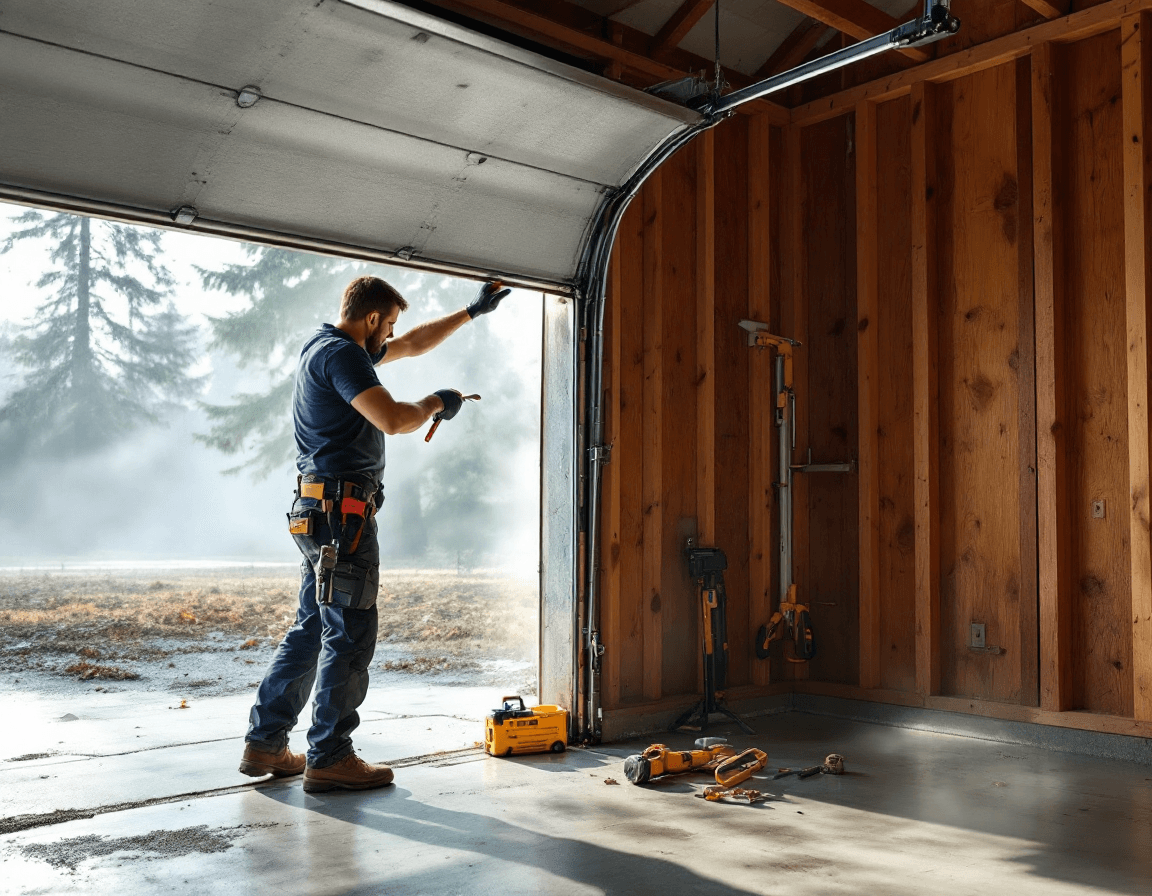
Off-track garage door repair in Mill Creek, WA is one of the more common calls we handle in the 98012 area, and it often starts with a sound that is hard to ignore: a sharp bang, a grinding noise, or a door that suddenly sits at an angle. Mill Creek's mix of newer subdivisions, sloped driveways, and Pacific Northwest weather puts steady stress on garage door hardware. Over time, that stress can pull a door out of its tracks, pop rollers loose, or bend the steel rails that guide it. When that happens, the door is no longer moving the way it was designed to move, and continuing to use it can make the damage worse.
Our technicians work across Mill Creek, from the neighborhoods around Mill Creek Town Center to the quieter streets near Silver Firs, and the problems we find are remarkably consistent. Most off-track doors come down to a handful of causes: worn rollers, loose track bolts, a track bumped out of alignment, or an impact from a vehicle or a stray delivery cart. The good news is that many of these repairs are straightforward when they are caught early and handled by someone with the right tools. This page explains what the problem looks like, why it happens here, what a repair involves, and what homeowners should avoid doing on their own.
If your door is currently off track, stop using the opener and keep everyone, including pets, clear of the door's path. Then call (888) 799-3819 so a licensed technician can assess it safely. The sections below walk through the details so you know what to expect.
Reading the Warning Signs Before a Door Jumps the Track
A door rarely leaves its track without warning. Before a full derailment, most doors give off small clues: a rattle when the door reaches the top of its travel, a slight wobble as it rises, or a faint scraping sound near one of the vertical tracks. Paying attention to these early signs can turn a more involved repair into a quick adjustment. Many homeowners notice the problem only after the door has already stopped working, but the early stages are usually easier and less expensive to fix.
Look at the gap between the top weatherstrip of the door and the header above it, and check that the gap looks even on both sides. Stand inside the garage with the door closed and look up along each vertical track to see whether the track appears straight from floor to ceiling. Watch the door as it opens and closes, paying attention to whether one side moves faster than the other or hesitates briefly. A door that seems to lean toward one side, even slightly, is telling you something about its tracks or rollers.
- Popping or banging noises at the top or bottom of the door's travel
- A door that sits lower on one side when closed
- Visible gaps between the door panels and the vertical track
- Rollers that look flattened, cracked, or pulled out of their brackets
- Tracks with dents, kinks, or bolts that appear loose or missing
- The opener reversing the door for no obvious reason
How Damp Mornings and Wet Winters Affect Off-Track Doors
Western Washington's climate is gentle in many ways, but it is hard on steel and wood. Mill Creek's long stretches of drizzle, humid spring mornings, and the occasional hard freeze create cycles of expansion and contraction in door panels, hinges, and track brackets. Moisture finds its way into the bottom bracket bolts and the roller stems, where it encourages rust that quietly weakens the connection. Once a bolt starts to loosen, the track can shift slightly every time the door moves, and that movement compounds over months.
Cold weather adds a different kind of stress. When temperatures drop quickly, metal parts contract, and a roller that was snug in the summer can sit a little loose during a January cold snap. Garages in Mill Creek also tend to hold a lot of humidity, especially in homes with an attached garage that shares a wall with a laundry room or a kitchen. That humidity can warp older wood-core doors and cause the bottom section to drag unevenly across the floor. An uneven load is one of the most common reasons a roller is forced out of its track.
Seasonal changes also bring a practical risk that homeowners often overlook. The first dry week after a long rainy stretch is often when a door that has been quietly drifting out of alignment finally gives way, because the track bolts loosened gradually through the wet months and the door suddenly has to carry more load. If you notice new noises after a storm or a cold snap, that is a good time to have the door checked.
Why Rollers Pop Out of the Track and What Makes Them Fail
Rollers are small parts with a big job. Each one rides inside a track channel and carries a portion of the door's weight, so when a roller fails, the door loses one of its guide points. Many residential doors use nylon rollers with steel stems, while others use sealed steel rollers for quieter operation and longer life. Nylon rollers are inexpensive and quiet, but they can crack, flatten, or wear through their bearings after years of use. When a roller breaks or slips out of the track's curve, the door can pop free with a loud clatter.
Roller failure often starts at the hinge points, where the door sections meet. If a hinge is loose or a hinge bolt has backed out, the roller stem can shift and the wheel can ride up the edge of the track. Sometimes the roller simply wears out, and its tread becomes too thin to hold the track's curve. At other times, a roller is fine but the stem has bent, which lets the wheel tilt and jump the track during travel. Each of these conditions calls for a different fix, which is why a proper inspection matters more than a quick guess.
Technicians replace worn rollers with matched sets when possible, because mixing old and new wheels can produce uneven travel. A good replacement also includes checking the hinges and the track brackets, since a new roller will not stay seated if the surrounding hardware is loose. Replacing rollers is one of the more budget-friendly repairs in an off-track call, and it often accounts for a large share of the total cost. Sealed steel rollers last longer than nylon in damp climates, which is worth discussing if you are upgrading after a repair.
A Crooked Door Usually Points to a Problem in the Track
When a door looks crooked, the first instinct is often to blame the door itself. In practice, the track is more often the culprit. The vertical and horizontal sections of track are bolted to the wall, the ceiling, and the framing, and any of those mounting points can shift over time. A track that is mounted to a wall with loose lag screws or a soft piece of framing can pull out of plumb by a surprisingly small amount, and that small amount is enough to make a door lean.
Technicians check track alignment with a level and a straightedge, looking at both vertical runs and the horizontal sections that carry the door overhead. They also check the spacing between the track and the door edge at several points, because a track that is slightly closer to the door on one side will cause binding. Sometimes the fix is as simple as tightening mounting bolts and adding a bracket where the track has begun to flex. Other times the track has been bent and must be straightened or replaced in sections.
It is important to know that a door can look crooked for reasons that have nothing to do with the track. An imbalanced spring system, for example, can make one side of the door heavier, and that imbalance can produce the same lean. Because spring work carries serious risk, the technician should evaluate the springs and cables along with the track before deciding on a repair plan. A crooked door that is simply realigned without addressing the underlying cause will often return to the same position within weeks.
Binding, Gaps, and a Door That Refuses to Move
A door that jams partway up or down is one of the more alarming situations homeowners face. Binding usually means that a roller has left the track, a section of track has been pinched, or a panel has shifted enough to rub against the frame. Some doors also bind when the bottom weatherstrip catches on an uneven floor or a piece of debris that has collected under the door. Attempting to force the door by pushing or pulling it can bend tracks further and damage the opener, so it is best to stop once you notice resistance.
Gaps tell a similar story. A visible space between the door edge and the track, especially at the top corners, suggests that the track has pulled away from the door or that a roller has backed out of its channel. Gaps near the bottom of the door can mean the door is sitting unevenly on the floor, which often happens when one side has lost a roller or when the bottom bracket has come loose. Gaps also let rain, cold air, and pests into the garage, so they are more than a cosmetic concern in our climate.
When a door is jammed, the most important step is to protect yourself and your property. Keep hands and fingers away from the tracks, the springs, and any moving panels, and do not attempt to pry the door free. If the opener has been used during the jam, disconnect power to it before doing anything else. A licensed technician can inspect the door safely, release tension where necessary, and realign the components without risking injury.
Vehicle Impacts and the Tight Turns of Local Driveways
Many off-track calls in Mill Creek begin with a driver who clipped the garage door while backing out. Driveways in newer neighborhoods can be narrow, and the turn from the street into a garage is often tighter than it looks, especially when a second vehicle is parked nearby or a trash bin has been left at the curb. A low-speed bump can knock a section of track out of line, bend a rail, or pull a panel out of its hinge. Even a small impact can misalign a door enough to cause rollers to ride unevenly.
Impacts also happen from the inside. Moving furniture, bikes, ladders, and kayak racks can strike the bottom section of a door or a vertical track when they are hauled through the garage. Garage clutter placed too close to the track is another common cause, because a shelf or a storage bin can be bumped as the door travels. Since so many of our homes use the garage as a main entry point, these small collisions happen more often than people realize.
If a vehicle or an object has struck your door, check the track and rollers before attempting to use the opener. Look for bent metal, dents along the track, or a door panel that sits lower or higher than the others. Even if the door still seems to work, an impact can weaken brackets and hinges, and those weaknesses can show up weeks later. A technician can inspect the full door system and recommend whether the damage calls for straightening, replacement, or simply a tune-up.
Straightening Bent Track Without Making It Worse
Track repair is a precise task. Garage door tracks are formed from thin steel, and bending them back into shape requires controlled pressure and careful measurement. A track that has been kinked or dented may look like it can be hammered back into place, but a rough repair often leaves stress points that cause rollers to catch and wear quickly. Experienced technicians use track-straightening tools, measure the channel width at multiple points, and check that the curve transitions are smooth.
Track sections are usually joined by bolts or rivets, and a separated section needs to be re-secured with the correct hardware. Using mismatched bolts or over-tightening can crack the track or strip the holes, which creates a new problem on top of the original one. Sometimes a section is too damaged to straighten reliably, and it must be replaced. Replacement track should match the existing profile, gauge, and mounting holes so the rollers ride smoothly.
Homeowners sometimes ask whether they can fix a bent track themselves with a rubber mallet and a level. Light cosmetic dents may not affect function, but any kink in the curved section or any bend in the vertical run should be professionally assessed. The cost of a proper track repair is usually modest compared with the cost of a damaged roller, a bent door panel, or an opener that has been strained by a binding door. A technician can tell you which category your damage falls into.
Where Off-Track Repair Stops and Spring Work Begins
Off-track repair and spring work are closely related, and this is where safety matters most. Garage door springs store a large amount of energy, and they remain under tension even when the door is closed. When a door is off track, the springs and cables may be partially loaded or slack, and the way the door is supported can change the risk level. Anyone who attempts to adjust, remove, or wind a spring without the proper training and equipment can suffer serious injury.
For that reason, our guidance is clear: homeowners should not attempt spring or cable work. A licensed technician will assess the spring system, confirm that the cables are seated on the drums, and determine whether any spring component has been damaged or stretched. In some cases, an off-track door has also lost a cable or an end bearing, and those parts must be repaired by a professional using the correct tension procedure. Spring replacement is a separate job that requires specialized tools and safety protocols.
Knowing the boundary between a simple realignment and a spring job helps homeowners make good decisions. Realigning a track, re-seating a roller, or tightening a bracket can often be done without touching the springs. When the technician finds a cable that has come off a drum or a spring that has been damaged, they will explain the situation and recommend the appropriate repair. That approach keeps the work safe and ensures the door is returned to a stable, balanced state.
What a Typical Off-Track Visit Looks Like and What It Costs
Most off-track repairs in the Mill Creek area fall between $125 and $400, depending on what the technician finds. A simple re-seating of a roller that popped free, with no bent parts, sits at the lower end of that range. A call that involves replacing several rollers, tightening multiple track brackets, and straightening a section of track typically falls toward the higher end. The exact figure depends on the door type, the number of damaged components, and whether the work can be completed in a single visit.
A typical visit begins with a safety check. The technician will confirm that the opener is disconnected, look over the door and tracks, and identify any signs of spring or cable involvement. Next, the door is supported so it can be safely returned to the track. Rollers are re-seated or replaced, track sections are aligned and secured, and the door is tested through several full cycles to confirm smooth, even travel. The technician will also check the opener's force settings and safety reversal function once the door is running properly.
Costs can vary for reasons that are not always obvious. Doors with insulated panels, older steel tracks, or hard-to-reach mounting points may take longer to repair. Commercial-style doors in some Mill Creek homes with larger openings may require more hardware. If additional work is needed, a good technician will explain the options and the reasons behind them before proceeding, so you can make an informed choice.
Keeping a Door Seated Through Mill Creek's Wet and Changing Seasons
Preventing an off-track event is far easier than repairing one, and a few simple habits go a long way in the Pacific Northwest. Schedule an inspection at least once a year, ideally in early fall before the wet season sets in. Ask the technician to check the track bolts, roller condition, hinge tightness, and weatherstripping. Dry, clean tracks and well-lubricated hinges help the door move smoothly, while seasonal tightening of bolts keeps the track from drifting.
Homeowners can also help by keeping the garage floor clear and the door path free of obstacles. Store bikes, bins, and tools away from the tracks, and check that the bottom weatherstrip is not tearing or curling. If the door begins to sound different, move more slowly, or sit unevenly, take it seriously and schedule a visit before the problem escalates. Acting early often means a smaller repair and a lower bill.
Finally, consider the parts themselves. Sealed steel rollers, galvanized or powder-coated track, and corrosion-resistant hardware are worth discussing if your door is due for upgrades. These choices can extend the life of the system in a climate where moisture is a constant factor. Whatever you decide, a door that is inspected regularly and maintained with care will stay aligned far longer than one that is ignored until it jumps the track.
If your garage door is off track, crooked, jammed, or showing any of the warning signs described above, do not wait for it to fail completely. Turn off the opener, keep clear of the door, and call Seattle Garage Door Fix at (888) 799-3819 to schedule a licensed technician for your Mill Creek home.