
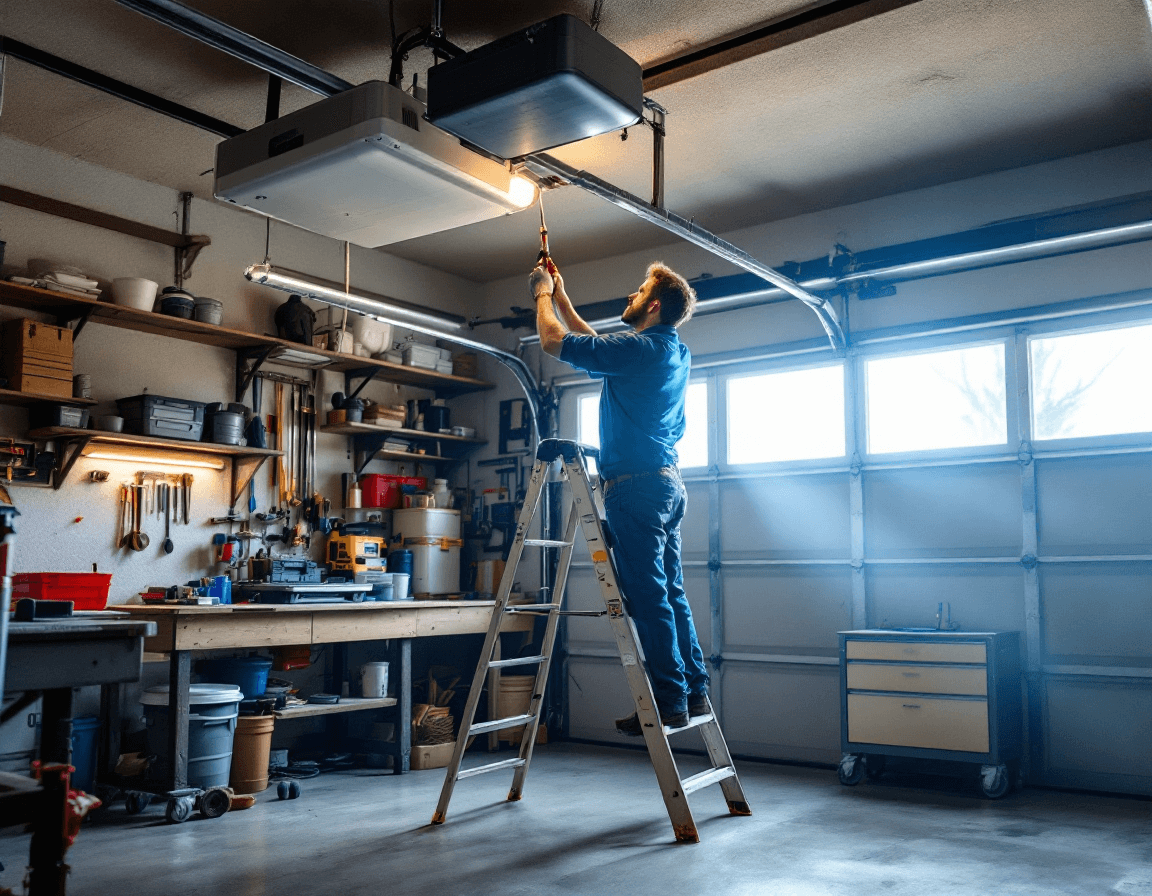
Garage Door Opener Repair in Mill Creek, WA is one of the most common calls we take from homeowners in this part of Snohomish County, and it is rarely a problem that requires guessing. When an opener stops working, the cause usually sits in one of a few places: the motor, the drive gear, the logic board, the travel-limit settings, the safety sensors, or the wiring between them. Figuring out which one is responsible saves money and prevents the frustrating cycle of replacing parts that were never the problem.
Mill Creek homes have a particular character that affects how openers age. Many houses in the town center area and surrounding neighborhoods, including the residential streets near Silver Firs, were built with attached two-car garages that get regular use from morning commutes and weekend errands. Those garages also see the moisture, cool temperatures, and occasional power fluctuations that define a Western Washington year. A good repair starts with understanding how those conditions work on the equipment, not just what the error light says.
This page explains the most common opener problems we see in the 98012 area, what they typically mean, and how a licensed technician approaches each one. We also explain what a repair visit usually involves, what you can safely check yourself, and where the line falls between a simple adjustment and work that should only be handled by a professional. If you have an opener that is misbehaving right now, the sections below will help you narrow down the cause before the technician arrives.
How Pacific Northwest Weather Shapes Opener Trouble in Mill Creek
The Pacific Northwest climate is mild by national standards, but it is persistently damp for much of the year. Long stretches of gray drizzle and high humidity in fall and winter introduce moisture into garages that often have limited ventilation, especially in homes where the garage is shared with a laundry area, a workshop, or stored recycling. Over time that moisture finds its way into connectors, circuit board edges, and the metal components of the opener head. Corrosion on terminal screws and the sensor wiring is one of the quieter causes of intermittent faults that appear only on wet mornings.
Cold snaps, which happen often enough in Snohomish County to matter, also change how a garage door behaves. Lubricants thicken, the door's rollers and hinges stiffen, and the opener has to pull harder to get the panels moving. An opener that handled a summer closing cycle without complaint can suddenly start reversing or stalling in January because the door is working against more resistance than the force settings were tuned for. Technicians often see this pattern during the first hard freeze of the season.
Wind and rain also affect the exterior side of the system. Wind-driven rain can splash into the bottom of the door, and the safety sensors mounted near the floor are exposed to dust, spider webs, and water spotting. A sensor lens that is slightly cloudy or misaligned after a windy week can cause the door to refuse to close or to reverse immediately. Keeping the sensor lenses clean and checking their alignment is one of the simplest maintenance steps a homeowner can take, and it eliminates a surprising number of service calls.
When the Motor Runs but the Door Refuses to Move
One of the most puzzling symptoms is hearing the opener motor spin up, perhaps with a steady hum, while the door sits still or shudders without lifting. Homeowners often assume the motor has failed, but in many cases the motor is working correctly and the force is being lost somewhere between the motor and the door. The most common culprits are a disconnected or slipping drive mechanism, a worn drive gear, a failed trolley, or a door that has become mechanically bound by a broken spring or a track obstruction.
A technician will start by disconnecting the opener from the door using the emergency release cord, then operating the door by hand to see whether it moves freely. If the door is heavy, binding, or jerks at certain points, the problem is likely in the door hardware or springs rather than the opener itself. This is a good moment to stress an important safety rule: torsion springs and extension springs are under extreme tension, and they should never be adjusted, removed, or replaced by a homeowner. A licensed technician is the only appropriate person to handle spring work.
If the door moves smoothly by hand, the next step is examining the drive. Belt-drive and chain-drive openers can lose grip if the belt has stretched or the chain has slackened. Trolley disconnects can also wear, so the carriage no longer grabs the rail when the motor pulls. Each of these is a repair that a technician can usually complete in a single visit, and parts are typically inexpensive compared with the cost of a full opener replacement.
Remote and Wall Button Failures: Tracing the Signal Chain
When the door won't respond to the remote or the wall button, it is tempting to assume the remote is dead and buy a new one. Sometimes that is the answer, but it is worth checking the rest of the chain first. A typical opener system includes the handheld transmitters, a wall control panel, the receiver built into the opener head, the antenna wire, the logic board, and the power supply. A failure at any link can produce the same symptom, which is why methodical testing matters.
Start with the simplest checks. Replace the batteries in the remote and confirm the wall button responds by pressing it firmly. If the wall button works but the remote doesn't, the transmitter or its programming is the likely issue. If neither works, the fault is more likely in the opener head, the wall control wiring, or the power supply. Many Mill Creek homes have wall stations located in older positions with long low-voltage runs, and those wires can become pinched or nicked during drywall work or when a shelving unit is installed.
- Confirm the remote batteries are fresh and the wall button responds.
- Check that the antenna wire hanging from the opener head is intact and not tucked into the motor housing.
- Look for corrosion or loose screws at the wall control terminal block.
- Note whether the problem happens only on humid days, which can point to moisture in the connections.
- Check whether other remote-controlled devices in the house, such as a gate or a garage light, are affected at the same time.
If those checks don't resolve the problem, a technician will test the receiver and logic board directly and may find that a failed component needs replacement. Radio interference from nearby devices occasionally causes random remote failures too, so the technician will also consider what else is running in the area.
Grinding Sounds and Stripped Drive Gears
A grinding, clicking, or chewing sound coming from the opener head is one of the more worrying symptoms, and it deserves prompt attention. In many screw-drive and gear-drive openers, the sound comes from a stripped gear or a worn drive nut that no longer engages the rail properly. Continued operation can cause the problem to worsen, and eventually the opener may stop completely while leaving the door partly open or stuck in place.
Stripped gears develop gradually from a combination of heavy use, insufficient lubrication, and occasional forced operation when the door was binding. A door that is slightly out of balance can also put uneven stress on the drive, which accelerates wear over months. Technicians typically inspect the gearbox, check the drive nut or sprocket, and examine the rail for debris or damage. Replacing a worn gear is generally a straightforward repair, and it is much less expensive than waiting until the entire drive assembly fails.
Homeowners should avoid repeatedly pressing the button when they hear grinding, because each attempt may push a damaged gear further out of alignment. If the door is stuck, use the emergency release to move it by hand only after confirming the path is clear and no one is near the door. Then schedule a repair. The typical cost range for most opener repairs we perform falls between $95 and $375, depending on the part involved and the complexity of the diagnosis, and a technician can give you a firm quote once the fault is identified.
Doors That Reverse Immediately or Won't Close Fully
A door that starts to close and then reverses right away, or one that stops a few inches short of the floor, usually points to one of two issues: a safety sensor problem or a force setting that has drifted out of range. Modern openers are required to include entrapment protection, which means the door must reverse if it contacts an obstruction during closing. That is a valuable safety feature, but it can also trigger falsely when a sensor is misaligned, dirty, or receiving interference from direct sunlight through a garage window.
Begin by inspecting the two safety sensors mounted near the bottom of the door tracks. Both should face each other, their indicator lights should be steady, and their lenses should be clean. Pull a fresh cloth across the lenses and check for cobwebs or dust. In Mill Creek, leaves and grit tracked in on wet shoes can accumulate near the sensors, especially in homes where the garage opens directly to a yard. If the sensors look fine but the door still reverses, the force or travel settings may need adjustment.
Travel limits control how far the door moves before stopping at the fully open and fully closed positions. When these limits drift, the door may stop short of closing, or it may keep pushing against the floor and trigger the reversal. Adjusting limits is a task technicians perform routinely, but it requires care because the force settings interact with the door's balance. Incorrect adjustments can create a safety hazard, so this is not a task to attempt without training.
Flashing Lights and What the Pattern Is Trying to Tell You
Many openers use a status light or a series of blinks to communicate a fault. A repeating pattern, such as several fast flashes followed by a pause, is the opener's way of signaling a specific condition. The exact meaning varies by manufacturer, and the code is typically listed in the owner's manual or on a label inside the opener cover. Reading the pattern accurately can save a great deal of time during a service call.
Common patterns relate to safety sensor faults, travel-limit errors, obstruction detection, or communication problems between the wall control and the opener head. A repeating blink that continues even after the door is cleared often signals that the opener has entered a protective lockout state. Some models will not operate again until the fault is cleared, which may require resetting the unit or correcting the underlying issue. Homeowners should record the exact pattern before pressing anything, since the code is the most useful clue a technician can receive over the phone.
When you call for service, describe the blink sequence as precisely as you can. Note how many flashes come in each burst, how long the pauses are, and whether the light is solid, blinking, or alternating colors. This information helps the technician narrow the likely cause before arriving, and it often means the first visit includes the correct part on the truck rather than requiring a return trip.
Loose Chains, Belts, and Trolley Problems
A loose chain that sags or a belt that has slipped off its pulleys can produce noise, jerky movement, or complete failure to lift. Chain-drive openers are common in Mill Creek because they are durable and relatively affordable, but chains stretch over time and need occasional tensioning. Belt-drive openers are quieter and popular in attached garages near living spaces, yet belts can loosen or come off if the door is forced or if the tensioning hardware has worked free.
Checking the chain or belt is a reasonable visual inspection for a homeowner. With the power disconnected at the opener, look for a chain that sags excessively or a belt that has walked off its track. Do not attempt to tighten components beyond what the manufacturer specifies, and never work on the opener while it is connected to power. If the chain has jumped off the sprocket or the belt is damaged, a technician should replace or reseat it and check the surrounding hardware for wear.
The trolley, which is the carriage that rides along the rail and connects the opener to the door arm, can also cause problems. A worn trolley may disconnect unexpectedly, leaving the door without power to lift. Technicians check the trolley's release and its engagement, lubricate moving parts, and replace components that show excessive wear. Keeping the rail clean and lightly lubricated, using products recommended by the manufacturer, reduces the rate at which these parts degrade.
Intermittent Operation After Storms and Power Fluctuations
Intermittent faults, where the opener works one day and fails the next, are among the most frustrating for homeowners. In the Mill Creek area, storm season can introduce voltage fluctuations, brief outages, and surges that affect the logic board and the power supply. An opener may restart with incorrect settings, lose its memory of travel limits, or behave erratically until it has fully recalibrated. Some units are more sensitive than others, and older boards are particularly vulnerable.
A surge protector designed for garage door openers can reduce the risk of damage from these events. Plugging the opener into a dedicated outlet, ideally one that is not shared with a freezer or a large appliance that cycles on and off, also helps. If you notice the opener resetting itself after storms, record the date and time, since a technician can compare the pattern against other conditions such as humidity, temperature, or recent wiring work.
Intermittent problems can also come from loose connections that expand and contract with temperature changes. The wiring inside the opener head, the terminals at the wall control, and the safety sensor connections all experience small movements over time. A technician will inspect each connection, tighten what needs tightening, and replace damaged wire sections when necessary. Because intermittent faults can be hard to reproduce, a careful visual inspection combined with functional testing is often the fastest route to a lasting solution.
What Makes Repairs Different Across Opener Brands
Most major opener brands, including Chamberlain, LiftMaster, Genie, Ryobi, and Craftsman models, share the same basic architecture: a motor, a drive mechanism, a logic board, a receiver, safety sensors, and a travel-limit system. However, each brand has its own programming methods, error codes, parts compatibility, and wiring layouts. A technician who works across brands learns which parts are interchangeable and which require exact matches, and that knowledge prevents costly mistakes such as ordering the wrong logic board.
Model age also matters. Older openers may use obsolete remote frequencies or proprietary components that are harder to source, while newer units may integrate smart features or additional safety protocols. In some cases, a repair on an older unit is not cost-effective, and a technician can explain the tradeoff honestly so you can decide between repairing and replacing. We aim to give homeowners a clear picture of their options rather than pushing a particular outcome.
Before the visit, locate your opener's model number, which is typically printed on a label on the motor housing or the side of the unit. Having the model and manufacturing date ready speeds up parts identification and lets the technician check compatibility before arriving. If the label is worn or painted over, note the brand name and any visible model designation, and the technician can confirm the rest on site.
What a Repair Visit Involves and How Pricing Works
A typical opener repair visit begins with a conversation about the symptoms you have observed, followed by a complete inspection of the door, opener, sensors, wiring, and hardware. The technician will test the system under load, check travel-limit settings, verify safety reversal behavior, and confirm that the door is balanced and moving smoothly. Diagnosis is an important part of the work because it prevents replacing parts that were functioning correctly. Once the fault is identified, the technician explains the repair and provides a quote before proceeding.
Pricing for most opener repairs falls in the range of $95 to $375, depending on the component involved, the complexity of the diagnosis, and whether additional hardware is needed. Simple adjustments and sensor realignments are typically at the lower end, while logic board replacement, gear replacement, or motor work sits higher in the range. Spring replacement and other door-hardware repairs are priced separately because they require specialized equipment and carry significant safety considerations. Every repair we perform is handled by licensed, bonded, and insured technicians, and we will discuss the options before any work begins.
We recommend scheduling service promptly when you notice warning signs such as grinding, reversing, or a door that stops mid-travel, because small problems left alone can cascade into larger failures. If you are unsure whether a symptom is urgent, describe what you are seeing and let a technician help you decide. Calling early often means a simpler and less expensive repair.
Garage door openers in Mill Creek work hard in a climate that tests them every season, and most faults trace back to a handful of causes that a careful technician can diagnose quickly. If your opener is running but the door won't move, responding erratically, reversing, grinding, or flashing a repeating light pattern, we can help you find the cause and get the door working safely again. Call Seattle Garage Door Fix at (888) 799-3819 to schedule a licensed technician for opener repair in Mill Creek and the surrounding 98012 area.