
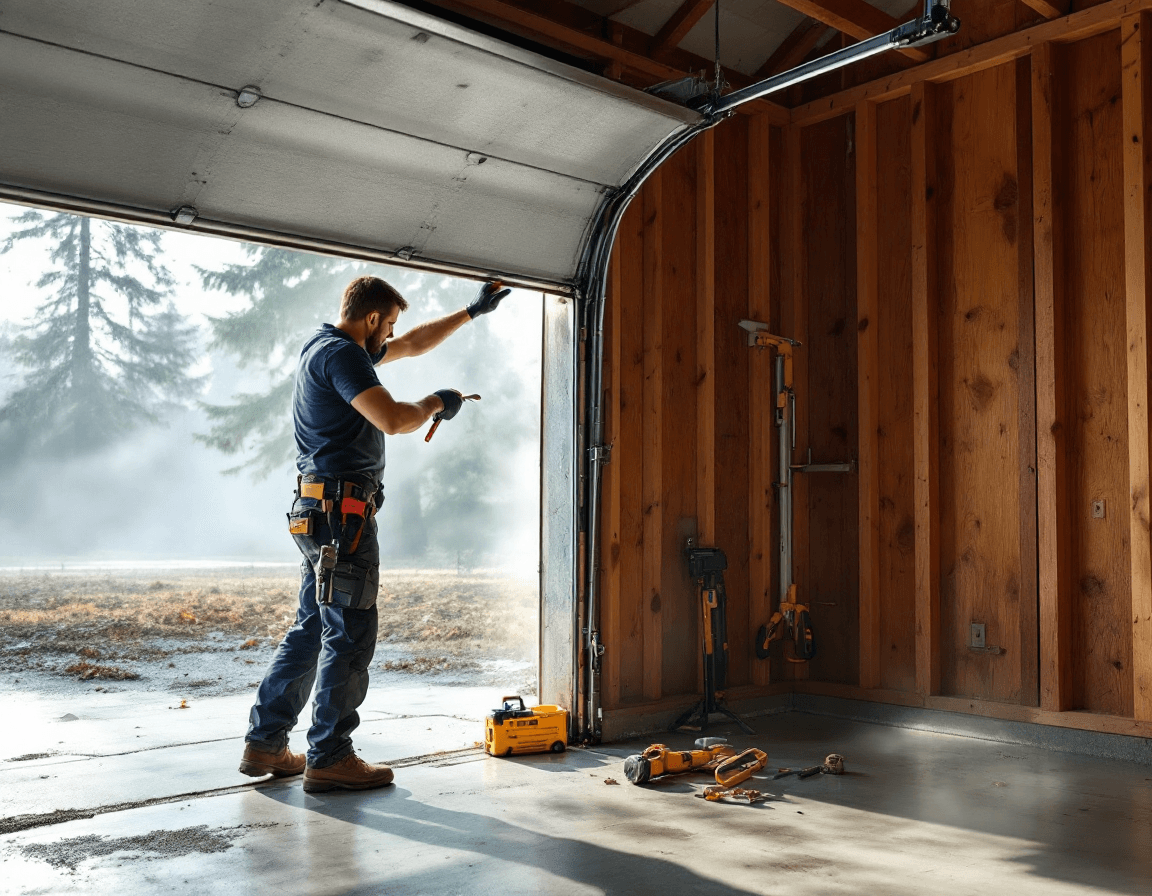
Off-track garage door repair in Lynnwood, WA is one of the most common calls we take, and it is also one of the most misunderstood. A door that has jumped off its track can look like a major failure, but many of these problems come down to a few rollers, a bent section of track, or a door that was knocked slightly out of square. The good news is that most off-track repairs are straightforward when they are handled early. The bad news is that trying to force a derailed door back into place is one of the fastest ways to turn a $150 repair into a much bigger one.
Our technicians work across Lynnwood and the surrounding Snohomish County communities, from the apartments and townhomes near the Alderwood shopping area to single-family homes on the quieter streets east of Highway 99. We see the same patterns repeat: a door that was fine on Sunday but binds on Monday after a hard rain, a roller that popped out during a routine trip to the store, or a track dented after a delivery truck clipped it while backing into a driveway. This page explains what off-track problems look like, why they happen so often in our area, what a careful repair involves, and what you can safely check on your own.
Whether your door has come completely off the track, is sitting crooked, or simply refuses to move in either direction, the sooner you have it looked at, the better your odds of a simple fix. Garage doors are heavy, and the forces stored in their springs and cables are significant. Read on to understand what is happening inside that big panel, and when it is time to pick up the phone.
What "Off-Track" Really Means for Your Garage Door
A garage door rides on two parallel steel tracks, one on each side of the opening, and the panels are linked to each other by hinges. Rollers attached to the edges of the door sit inside those tracks and guide the door up and back toward the ceiling as it opens. When people say their door is "off track," they usually mean one or more of those rollers has come out of the channel, so the door is no longer being guided where it should be. In some cases the entire door edge has slipped out of the track, and in others only one side has dropped while the other is still seated.
Not every off-track situation looks dramatic. Sometimes the door appears to be closed and level, but a closer look reveals a gap of an inch or more between the top panel and the track on one side. Other times the door moves a few feet, stops, and then grinds, which is a sign that a roller is riding on the wrong edge of the track or is wedged against the track lip. Understanding which of these you are dealing with matters, because the repair for a single popped roller is very different from the repair for a bent track section.
It also helps to understand that the track is only one part of a system. The door, rollers, hinges, track brackets, opener, and balance system all have to work together. When one component fails, the others often get stressed as they try to compensate. That is why a technician looking at an off-track door will typically check the whole assembly rather than simply hammering the track back into shape.
Warning Signs That Show Up Before a Full Derailment
Most doors do not jump off the track without giving some warning. In the weeks leading up to a derailment, homeowners often notice small changes that are easy to dismiss. A door that makes a scraping or popping sound on one side, a door that seems to lean slightly when it reaches the top, or a gap that appears between the weatherstripping and the floor can all signal that the rollers or track are starting to misbehave.
Keep an eye out for the following signs, which often appear together:
- A grinding, squealing, or scraping sound that starts on one side of the door
- A visible gap between the top section of the door and the vertical track
- The door appearing to sit higher on one side when it is closed
- A roller that looks cracked, flat, or sitting at an odd angle in its track
- The door stopping partway up or down and then restarting with a jerk
- Track bolts that look loose, rusted through, or missing
If you notice any of these, avoid running the opener repeatedly to see whether the problem goes away. Each cycle can push a misaligned roller further out of position or put extra strain on a bent track section. A short pause to have the door inspected is almost always cheaper than waiting until the door is completely jammed in the middle of its travel.
Why Lynnwood's Weather Puts Extra Strain on Garage Door Tracks
Lynnwood sits in the Pacific Northwest, and our climate has a real effect on garage door hardware. Long stretches of gray, wet weather mean that doors spend months exposed to moisture, and that moisture finds its way into metal joints, roller bearings, and the mounting bolts that hold the track to the wall and ceiling. Over time, the galvanized and painted surfaces on tracks can begin to pit, especially on the lower brackets where water collects and drains slowly.
Humidity also causes wood and composite doors to swell and shift, particularly during the months when we go from dry summer days to soaking October storms. A wood or insulated steel door that has absorbed moisture may be a fraction of an inch wider or heavier than it was in July. That change can be enough to push a roller against the track lip or to make a door bind at the top of its travel. The effect is often more noticeable on doors that face the prevailing weather or sit beneath a roof overhang that does not fully protect them from wind-driven rain.
Temperature swings play a role too. Our winter mornings are often cold enough to stiffen lubricants and make metal contract slightly, while afternoon warmth can cause the same metal to expand. Those small movements, repeated thousands of times over a few years, gradually loosen track brackets and wear the edges of the channels. Taking the climate into account helps explain why an off-track problem that seems sudden is often the end result of a slow process that has been building for a long time.
The Small Parts That Usually Fail First
When we inspect an off-track door, the first thing we look at is rarely the track itself. Rollers are typically the components that give out first, because they carry the door's weight, roll thousands of times a year, and are often made of inexpensive nylon or steel with simple bearings. A nylon roller that has cracked or worn flat will not stay seated in the track, and once it pops out, the door can pull other rollers out of position as it moves.
Hinges come next. Each panel of a sectional door is connected to the next by hinges, and those hinges can bend, crack, or pull loose from the panel when the door has been forced or has run off track repeatedly. A loose or bent hinge changes how the door tracks around the curve at the top of the opening, which in turn can make the rollers ride out of their channel. Replacing a single hinge or roller is usually much less expensive than replacing a panel, but only if the damage is caught before it spreads.
Track brackets and bolts round out the list. Brackets that have been loosened by years of vibration can allow the track to shift a fraction of an inch, which is enough to misalign the door. We also see many cases where a missing or stripped bolt has let one section of track drift out of square, and the door has slowly been dragging its rollers against the lip for months before anyone noticed. Checking these small fasteners is one of the most useful things a technician can do during an off-track visit.
When a Vehicle or Accident Has Bent the Track
Impact damage is one of the most common causes of serious off-track problems we see in Lynnwood. Driveways in many neighborhoods are narrow, and it is easy to clip a garage door frame while backing out, especially when the opening sits close to the property line or when a second vehicle is parked nearby. Delivery trucks, moving vans, and even bikes or yard equipment can knock a track out of alignment. Sometimes the damage is obvious, with a visible dent or kink in the steel. Other times the track looks fine at a glance but is bent just enough to push the rollers off their path.
A hard hit can also damage the door itself. A panel that has been pushed inward may rub against the track on one side, while the opposite side continues to move freely. This creates a crooked appearance that can be mistaken for a simple alignment problem, but it may actually require replacing a panel or a section of track. Because the forces involved in an impact are unpredictable, it is important not to assume that a bent track can simply be hammered straight without further checking.
If your door has been hit by a vehicle, take photographs of the track and door before anything is moved, and note the date and time. Even if the damage seems minor, a technician should look at the entire door assembly, including the springs and cables, since an impact can change the tension and alignment of those components. Insurance adjusters often ask for documentation of the damage, and a clear record can help the process go more smoothly.
How a Technician Realigns an Off-Track Door
A proper off-track repair starts with making the door safe. The technician will disconnect the opener, confirm that the door is not under unexpected tension, and check whether the springs or cables have been affected. Doors that have come off track can sometimes hang at an angle with a great deal of stored energy, so this step is not optional. Only after the door is secured does the work of realignment begin.
Next, the technician examines each roller, hinge, and track section. Rollers that are sitting outside the channel are carefully guided back into the track, and any that are cracked or worn are replaced. The track is checked for straightness using a level and visual inspection, and any loose brackets or bolts are tightened or replaced. If a section of track is bent, the technician determines whether it can be gently corrected or whether it needs to be swapped out entirely. The goal is to restore the door's path so that it moves smoothly from the bottom of its travel to the top, without binding or wobbling.
Once the components are back in place, the door is tested by hand and then with the opener. Technicians watch for any sign of rubbing, pulling, or uneven movement on either side. A door that is properly aligned should move quietly and level, and it should close with a consistent seal along the bottom. If anything still looks off, the adjustment process continues until the door tracks correctly through its full range.
What a Typical Off-Track Repair Costs in Lynnwood
Most off-track repairs in our service area fall in the range of $125 to $400. The final number depends on what is actually wrong with the door. Realigning a door and re-seating one or two rollers is usually at the lower end of that range, while straightening a damaged track section or replacing several rollers and brackets moves the cost upward. Because the repair is shaped by what the technician finds, a reliable quote can only be given after the door has been inspected.
Here is a general overview of the kinds of work that tend to fall into each part of the range:
- Re-seating a popped roller and checking alignment on a single side
- Replacing one or two cracked or worn rollers and adjusting the track
- Tightening or replacing loose track brackets and mounting bolts
- Straightening a minor bend in a section of track
- Replacing a damaged hinge or a bent track section after an impact
Some situations sit above the typical range, particularly when a door has been badly damaged, when a panel needs to be replaced, or when the springs have been affected by the event that caused the derailment. In those cases, a technician will explain the scope of the work before any repairs begin, so there are no surprises on the invoice. A clear estimate is part of how we work, and you should always feel comfortable asking questions about what is being done and why.
Keep Your Hands Off the Springs and Cables
It is tempting to try to fix an off-track door yourself, especially when the problem looks like a simple roller that slipped out of place. However, the most dangerous parts of a garage door system are the torsion springs above the door or the extension springs along the sides, and the cables that connect them to the door. These components store enormous amounts of energy, and a spring or cable that releases unexpectedly can cause serious injury. For that reason, any work involving springs, cables, or the drum assembly should be left to a licensed, trained professional.
Even work that seems limited to the track can become risky if you are standing under a door that is partly off its rails. A door that suddenly shifts, drops, or sags can crush fingers or worse, and many homeowners underestimate how quickly a seemingly stable panel can move. If the door is hanging crooked, do not attempt to lift it, push it, or pry it back into the track. Keep children and pets away from the area and avoid operating the opener until a technician has looked at the system.
There are a few safe steps you can take while you wait. If your door has a manual release cord, you may disconnect the opener by pulling the cord, but do this only with the door fully closed and only if you can do so without leaning into the door. Take photos of the track, rollers, and any visible damage so the technician knows what they are walking into. Then call us at (888) 799-3819 so a licensed professional can assess the situation with the proper tools and safety equipment.
Neighborhood Notes: Serving Lynnwood's Core and Nearby ZIP Codes
Our technicians work throughout Lynnwood and the surrounding areas, and we regularly serve homes across the ZIP codes 98036, 98037, and 98087. These neighborhoods include a mix of older single-family homes, newer townhome developments, and residences close to the commercial corridors that make Lynnwood a busy hub in south Snohomish County. Each area presents its own challenges, from tight driveways near the Alderwood retail district to multi-car garages in quieter residential blocks.
Homes close to Alderwood and the Lynnwood City Center area often have shared or narrow driveways, which can increase the chance of minor impacts during daily traffic. Residents in those areas frequently call about doors that were bumped by a neighbor's vehicle or by a delivery vehicle parked too close to the opening. Homes farther from the commercial core may have longer driveways and more space to maneuver, but they are still exposed to the same wet winters and seasonal humidity that affect every garage in the region. In both cases, a few simple habits can reduce the likelihood of a derailment.
No matter which part of Lynnwood you call home, our technicians arrive prepared to handle the common off-track issues we see in this area. We bring the tools needed to safely secure the door, check the springs and cables, and realign the track. If your home is located near the Alderwood area or the City Center, let the technician know during scheduling so they can plan for parking and access. Clear communication helps the visit go smoothly for everyone.
Preventing the Next Derailment in a Lynnwood Climate
The best off-track repair is the one you never need. A little routine attention can catch small problems before they become derailments. Start by visually inspecting the tracks every few months, looking for loose brackets, bent sections, rust spots, or debris that may be lodged inside the channel. Wipe the track clean of dirt and leaves, since grit can increase friction and wear on rollers. A dry film lubricant made for garage door tracks can help keep the rollers moving smoothly, but avoid spraying grease or heavy oil into the track, which attracts dirt.
Pay attention to the way your door moves. A healthy door opens and closes at a steady pace with minimal noise, and it should stop evenly when you release the opener. If you notice new sounds or hesitation, schedule an inspection rather than waiting for the door to jam. Keeping the weatherstripping in good condition also helps, since a door that has been swelling and shrinking with moisture may need adjustment to maintain a proper seal.
Finally, be mindful of the things that happen around your garage. If you are backing out or pulling in, take a moment to check the clearance on both sides of the opening. If you are expecting a delivery, let the driver know where to park so the truck does not clip the frame. If a storm has rolled through and you notice the door sitting differently the next morning, make a note of it and have it checked before it becomes a bigger issue. Taking these small steps can save a lot of trouble over the long wet seasons we get here in Lynnwood.
If your garage door has come off its track, is binding, or simply does not look right, call Seattle Garage Door Fix at (888) 799-3819. Our licensed, bonded, and insured technicians serve Lynnwood and the surrounding Snohomish County communities, and we will walk you through what is happening and what it will take to get your door moving safely again.