
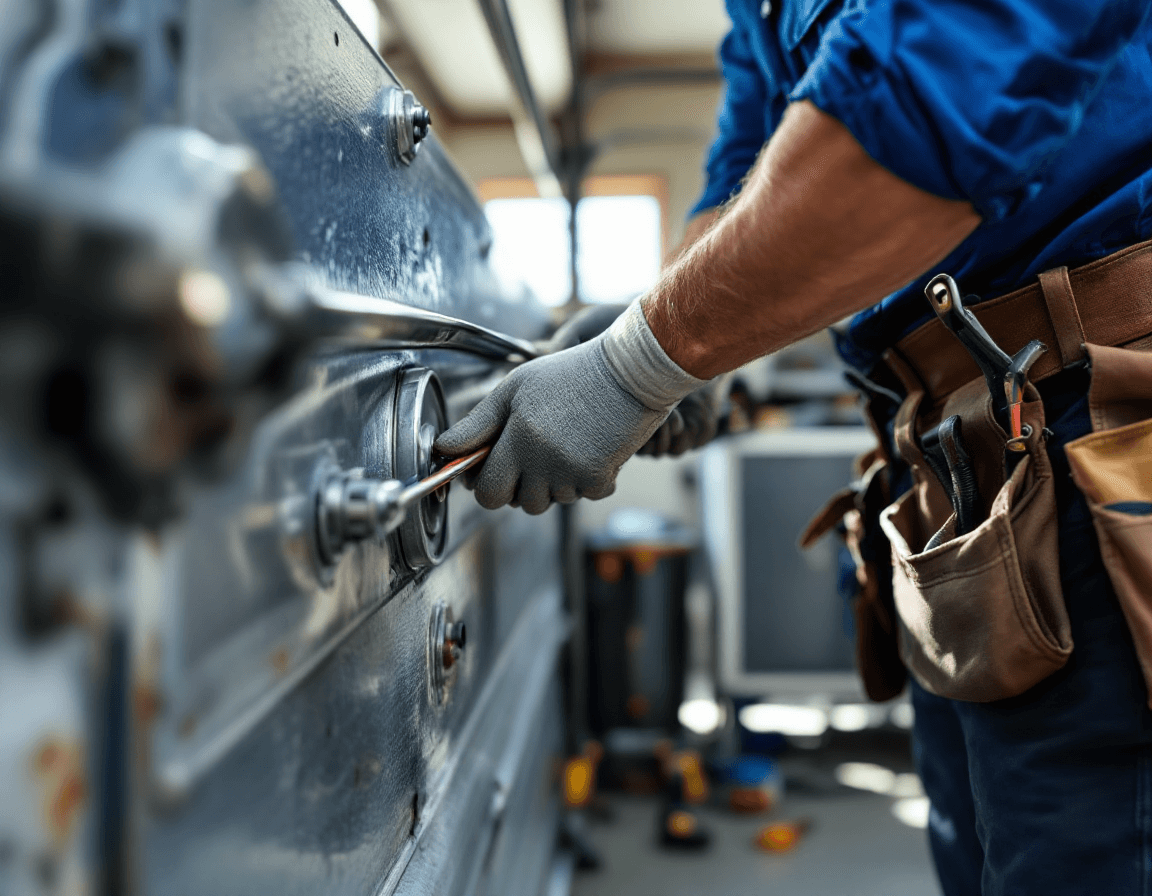
Garage door cable replacement in Lynnwood, WA is one of the most common repairs we handle, and it is also one of the easiest to put off until it becomes urgent. Lift cables do a lot of work every time the door goes up and down, and in a damp, cool climate like ours, they quietly wear down for years before one finally gives way. When that happens, the door can drop unevenly, jam halfway open, or stop moving entirely, often at the start of a busy morning. This guide explains how lift cables fail, what the warning signs look like, and what a professional repair involves in Lynnwood and the surrounding neighborhoods.
Seattle Garage Door Fix has served Lynnwood homeowners for years, working on everything from older tract homes near Alderwood to newer townhomes closer to the City Center. We are a licensed, bonded, and insured garage door company, and cable work is one area where that matters a great deal. The cables and the spring system around them store a large amount of tension, and mishandling them can cause serious injury. Our goal in this guide is to help you understand what is happening above your door, so you can make informed decisions and know when to call a professional.
Whether your door is hanging crooked, a cable has frayed at the drum, or you heard a loud bang and the door refuses to budge, the sections below will walk you through what to look for and what to expect. We have written this page with homeowners in mind, not engineers, so the explanations stay practical. If you are dealing with a broken cable right now, please keep the door closed and do not try to force it open. Call us at (888) 799-3819 and we will help you figure out the safest next step.
Why Lift Cables Wear Out Faster in Western Washington
Lift cables are steel, and steel does not like constant moisture. In the Pacific Northwest, long stretches of gray, damp weather mean that garage air often carries moisture for months at a time, especially in attached garages where the door seals are not perfect and cold air moves in from outside. Over time, that moisture can lead to surface rust on the cable strands, and rust is a quiet enemy because it weakens the wire from the outside in. A cable can look nearly fine from a few feet away and still have compromised strands near the drum or the bottom bracket.
Lynnwood's temperature swings add another layer of stress. Winter nights can drop well below freezing, and the cold makes metal contract and makes lubricant thicker, so the system works harder to lift the door in the morning. Then a mild afternoon arrives and the steel expands again. Repeated cycles like this put fatigue into individual wires, and fatigue is often the reason a cable parts without warning. Many of the cables we replace have not been exposed to anything dramatic; they have simply reached the end of their working life.
Usage matters too. A household that opens the door several times a day, or one that uses the garage as the main entry point for kids, groceries, and bikes, will put far more cycles on the cables than a home where the door opens twice a week. Two identical doors can have very different cable lifespans depending on how they are used. When we inspect a door, we consider the local climate, the age of the system, and how often the door moves, because those factors together give a much better picture than age alone.
Reading the Early Warning Signs Before a Cable Lets Go
Most cable failures give some kind of notice, even if it is easy to miss. A door that was smooth last winter may start to feel heavier, or it may pause briefly at a certain height before continuing. Some homeowners notice a faint squeak or a grinding sound that gets worse when the door is cold, and others see a slight tilt in the bottom panel that seems to come and go. These are the moments when a cable inspection is worth scheduling, long before the situation becomes an emergency.
The following signs are the ones we most often hear described when a homeowner calls us about cables. Any one of them deserves attention, and several together mean the cable has likely reached the end of its life:
- Visible fraying, kinks, or loose wire strands along the length of a lift cable
- Orange or brown rust spots, especially where the cable wraps around the drum or passes over a pulley
- A door that sits lower on one side than the other when it is closed
- A door that feels heavy or jerks at one point in its travel
- A clicking, popping, or snapping sound during opening or closing
- A cable that appears loose or slack at the drum while the other side looks tight
It is worth noting that a single worn cable often brings its partner along. Lift cables are installed as a pair, and they share the load of the door. When one cable fails, the remaining cable has to carry much more weight, which is why we almost always recommend replacing both cables together. Replacing just the broken one can leave the other one close to failing, and then you are back on the phone a few months later. Cost-wise, this is often the more economical choice as well, since the labor is largely the same either way.
What a Snapped Cable Looks Like at the Drum
When a lift cable snaps, the result is usually dramatic. Homeowners often describe a loud crack or bang, sometimes followed by the door dropping a few inches or suddenly swinging loose on one side. The noise can be startling enough to make people think something major has happened to the opener or the springs. In many cases, the cable has separated right at the drum, where the strain is greatest and the wire wraps tightly around the drum's grooves.
Inspecting the drum is a critical part of any cable job. The drum is a grooved cylinder mounted on the torsion or extension shaft, and the cable winds around it as the door opens. Over years of use, the drum grooves can wear, the cable can bind, or the anchoring point can loosen. A new cable installed on a worn or damaged drum may not seat correctly, and it can fail again quickly. That is why our technicians check the drum, the bearing plates, and the cable anchor at the same visit where the cable is replaced.
If your cable has snapped, the door is no longer balanced in the way it was designed to be. Even if the door looks like it has stopped in a stable position, you should not attempt to lift it by hand, climb onto the stepladder to tug on cables, or try to tension the springs. The stored energy in a garage door system is significant, and lift cables and springs can cause severe injury when handled without training and the correct equipment. Our advice is simple: keep people and pets away from the door, use the manual release only if it is safe to do so and the door is closed, and call a licensed technician to secure the system.
When a Cable Comes Off the Drum
A cable that has jumped off the drum is a different problem from one that has snapped, and it is one of the calls we hear most often from Lynnwood homeowners on busy weekday mornings. The door may still be intact, but it hangs at an angle, the cable sits loose in its track or slips out from its groove, and the opener either strains or refuses to run. Sometimes the cable has partly wrapped around the drum and then unspooled, creating a tangled bundle that is difficult to see from the ground.
Cables can come off the drum for several reasons. A worn or damaged drum groove may fail to hold the cable in place. An uneven or lopsided door can pull the cable sideways as it winds. Sometimes a cable that has been slack for a long time, perhaps because of a previous repair, will slip out of position. In all of these situations, the cable must be re-seated and the drum inspected, and in many cases the cable itself has been stretched or kinked and needs replacement.
Please avoid trying to re-wrap a cable onto the drum yourself. The tension in the system can release suddenly, and the drum can spin with considerable force. If you see a cable that has come off the drum, the best course is to keep the door closed, disconnect the opener power if you are comfortable doing so from the outlet or breaker, and wait for a licensed technician. We will examine the drum, rewind the cable correctly, and confirm that both sides are balanced before you use the door again.
Lopsided Doors and What the Crooked Track Is Telling You
A garage door that hangs crooked is one of the most visible signs of a cable problem, and it is also one that homeowners sometimes misread. A door that looks uneven may have a worn cable on one side, a stretched or broken spring, a loose track, or a bent section of track that is causing binding. The only way to know for sure is to look at the whole system together, because the symptoms can overlap in confusing ways.
In Lynnwood, we often see crooked doors in homes where the garage has settled slightly over time, or in attached garages where the header above the door has shifted a little. Those structural issues can make the door track misaligned, which then loads one cable more heavily than the other. We have seen doors where a homeowner replaced the opener, assuming it was the problem, only to find that a cable on one side had been stretching for months. The opener was doing its job; it was simply fighting an unbalanced door.
When you notice a lopsided door, look at the bottom edge of the panel when the door is closed, and then watch the tracks as the door moves. Does one side rise faster? Does one roller catch or wobble? Does the door bounce or drift when you stop it halfway? These clues help us narrow down the cause quickly. Regardless of what we find, an uneven door should be inspected soon, because continuing to run it can damage the opener, the rollers, the panel, and the remaining cable.
How Our Technicians Approach a Cable Replacement
Every cable job begins with a safety assessment, and we take that step seriously. Before any tools come out, the technician checks the condition of the door, the spring system, the drum, and the surrounding hardware, and confirms that the door can be secured safely during the work. If there are signs of a more serious problem, such as a broken spring or a damaged shaft, we explain those findings before proceeding, because the scope of the repair may change.
The actual cable replacement involves releasing the tension in the spring system, removing the damaged cable from the drum and bottom bracket, and installing new cable that matches the existing hardware and load. The new cables are routed carefully so they wind evenly onto the drum, and the cable ends are secured at the anchors according to manufacturer guidance. Once the cables are in place, the door is balanced and tested through its full range of motion. We check that the door closes flush, that the tracks are aligned, and that the opener operates without strain.
We know many homeowners want to understand what is happening, so we are happy to walk you through the work after it is done. We will show you the new cables, point out the drum condition, and explain any additional recommendations, such as lubricating the rollers or adjusting the door balance. Our intent is to leave you with a door that operates smoothly and a clear understanding of how to keep it that way. Nothing about this work should be rushed, and a good technician will never pressure you into unnecessary upgrades.
Choosing Between a Cable Swap and a Full Spring Service
One question we often hear is whether a cable replacement is enough or whether the springs should be serviced at the same time. The honest answer depends on the age and condition of the entire system. Cables and springs are designed to work together, and when one wears out, the other has usually been under similar stress. If the springs are nearing the end of their cycle rating or show visible gaps, stretching, or rust, replacing only the cables may leave you with another failure in a short time.
Spring replacement is a separate and more demanding job than cable work, and it carries higher risk because the springs hold substantial tension. We do not recommend homeowners attempt either task themselves, and this is one reason we stress licensed professional service for all spring and cable repairs. A licensed technician has the training and tools to release and wind springs safely, and the experience to recognize when a system has reached the point where a complete service is the more responsible choice.
When we visit, we will tell you plainly whether a cable-only repair is appropriate or whether a broader service makes more sense. Some homes need only the cables. Others, especially older doors with original springs, benefit from a full review of the spring system so the door is balanced and predictable for the next several years. You should feel comfortable asking questions and getting a clear explanation before any work begins.
What the $110–$300 Range Usually Covers
Many Lynnwood homeowners ask us about cost before they call, and we understand why. Most standard lift cable replacements fall in a range of roughly $110 to $300, depending on the door size, the cable type, the condition of the drum and hardware, and whether additional parts are needed. We prefer to give you a realistic range rather than a single number that might not match your situation, and we will confirm the exact price after we have looked at your door.
A typical cable replacement visit includes a safety inspection, removal of the damaged cables, installation of new matched cables, checking the drum and anchors, balancing and testing the door, and a short review of what we found. The following items often influence the final cost, so it helps to know what to expect:
- Door size and weight, since heavier or larger doors may require different cable specifications
- Condition of the drum, bearing plates, and cable anchors, which may need minor service
- Whether the springs are also worn and should be serviced at the same visit
- Access to the work area, including clearance around the door and the opener mount
- Whether the opener, rollers, or track need adjustment as part of the balancing process
We always explain our findings before recommending additional work, and we do not add services without your agreement. If a more significant repair is needed, we will show you the options and let you decide how to proceed. Our goal is transparency, so you can compare the cable repair with other choices and feel confident in the decision.
Protecting Your Cables Through Lynnwood's Seasons
Good maintenance will not make a cable last forever, but it can extend its life and help you catch problems early. In our climate, the most useful habit is a seasonal visual check. Once or twice a year, when you are already in the garage, take a minute to look at the cables on both sides of the door. Note any rust, fraying, or slack, and make sure the drums are seated correctly. Doing this regularly lets you spot trouble while it is still a planned repair instead of an emergency.
Keeping the garage reasonably dry also helps. Moisture is a major contributor to rust on cables and hardware, so addressing leaks, drainage, and door seals can have a real effect over time. If your garage holds damp air, a small dehumidifier or better ventilation may be worth considering. Weather stripping along the bottom of the door and around the frame keeps out driving rain and cold drafts, which can otherwise accumulate moisture inside the garage through the winter.
Lubrication is useful, but it should be done carefully. Rollers, hinges, and the bearings on the drum shaft typically benefit from a light garage-door lubricant, while the cables themselves should not be coated in heavy grease that attracts dirt. Please keep your hands and tools away from the springs and cables while lubricating, and never try to adjust tension yourself. If you are unsure what is appropriate for your door, ask us during a service visit and we will give you specific guidance.
Neighborhood Notes for Alderwood, City Center, and Nearby ZIP Codes
We serve homeowners throughout Lynnwood and the surrounding area, including the 98036, 98037, and 98087 ZIP codes. The city has a wide mix of housing, from single-family homes with long-established garages to newer attached units near the City Center and along the commercial corridors. Each type of home presents its own cable considerations, and our technicians are used to working in tight garages, shared driveways, and older construction where the header and track layout is not standard.
Homes near Alderwood often have garages that have seen decades of daily use, so cable and drum wear can build gradually. Many of these doors are the original installations or have been serviced only once or twice, which means the springs and cables may be approaching the end of their useful life. Our crews frequently find that a cable repair in these homes is a good opportunity to review the full system and set the door up for many more years of reliable operation.
Closer to Lynnwood City Center, we see a higher share of attached garages in multi-unit buildings and newer townhome developments. Access can be tight, and shared walls or limited headroom sometimes affect how the door can be serviced. We plan these visits carefully and bring the right equipment so the work proceeds safely and efficiently. Wherever you live in Lynnwood, we will tailor the repair to your garage, your door, and your schedule.
Get Your Lynnwood Garage Door Cables Checked
If your door is hanging crooked, a cable has frayed or come off the drum, or you heard a loud snap followed by a stuck door, please do not wait to call. Keep the door closed, keep people and pets clear of the opening, and call Seattle Garage Door Fix at (888) 799-3819. Our licensed, bonded, and insured technicians will inspect the cables, drum, and spring system, explain what we find, and restore safe, balanced operation for your Lynnwood home.