
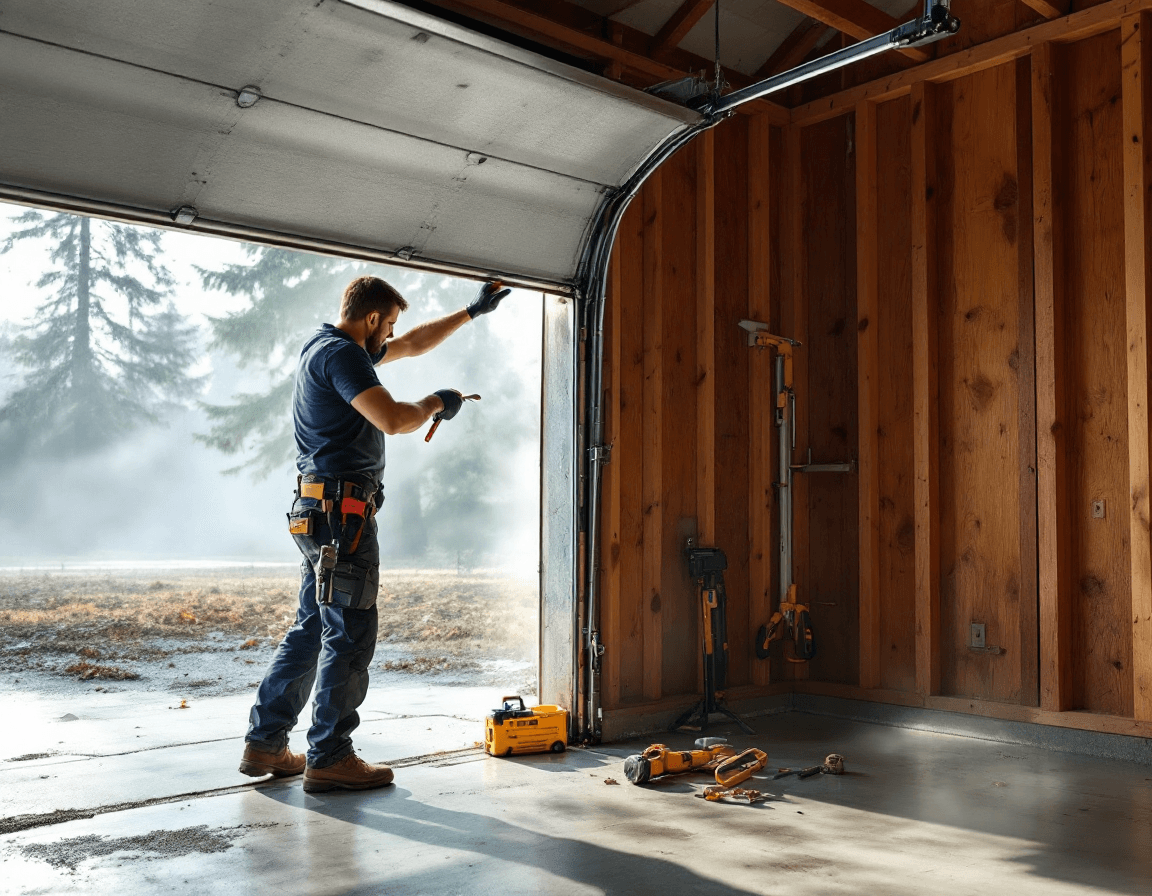
Garage doors in Mountlake Terrace take a lot of abuse. Wet winters, a steady stream of commuter traffic along the I-5 corridor, and tight driveways in many older neighborhoods all add up to a door that gets bumped, twisted, and pushed harder than most homeowners realize. When a door comes off its track, it often looks like a major failure, but many off-track problems are repairable in a single visit if they're addressed quickly. Our technicians regularly see doors that have slipped out of one side of the track after a rough winter, a bad wind storm, or a small fender-bender in the driveway.
The good news is that a door that has come off track is usually not a sign that the entire system is finished. In most cases, the springs, opener, and door panels are still in working order, and the real problem is that a roller, a track section, or a bracket has shifted out of its intended position. Getting the door back on track quickly limits further damage to rollers, hinges, and the door itself. It also prevents the door from being forced open or closed by hand, which is one of the most common ways people end up with bent panels or strained opener gears.
This page explains what typically causes off-track doors in Mountlake Terrace and the surrounding 98043 area, how to recognize the early warning signs, and what a professional realignment usually involves. We also cover pricing, the safety boundaries homeowners should respect, and simple habits that help keep a door running true through our wet, gray Pacific Northwest seasons. If your door is currently stuck or leaning, the most important step is to stop operating it and call a licensed technician.
What Usually Knocks a Door Off Its Track Around Mountlake Terrace
Local causes of off-track doors tend to follow patterns that reflect how and where people live in Mountlake Terrace. Many homes in the city were built in waves of subdivision development, and a large share of them have single-car or two-car garages with doors that have been operating for decades. Over that time, track bolts loosen, wall anchors pull out of drywall or older framing, and the vertical track drifts slightly out of plumb. Once that happens, a roller that used to ride smoothly can start to catch on the edge of the track and eventually pop free.
Vehicle contact is another frequent cause, especially in driveways where the garage opening sits close to the curb or where a second vehicle is parked nearby. A bumper that taps the lower panel can push one side of the door outward just enough to pull a roller out of the track. Delivery trucks, moving vans, and larger SUVs are the most likely to cause this kind of impact, particularly on narrow residential streets where turning room is limited. Even a small contact can knock a track section out of alignment without leaving obvious damage on the outside of the door.
Settling foundations and seasonal ground movement play a role as well. The clay-heavy soils common across parts of Snohomish County expand when saturated and contract as they dry, which can subtly shift a slab or the wall framing around the door opening. When the opening changes shape, the track that was installed to match it may no longer sit square. Homeowners often don't notice this until a door starts to lean, bind, or show a gap along one edge.
Reading the Warning Signs Before a Door Derails
Most doors give some warning before they fully come off track, and learning to spot those signs can save a repair bill and a lot of frustration. A door that begins to make a scraping or grinding noise on one side is often rubbing against the track lip, which means a roller or track section is no longer running true. Similarly, a door that opens or closes with a slight hitch, or that seems to hesitate at a particular point in its travel, may be starting to lift a roller out of its groove. These sounds and movements are easy to dismiss, but they usually get worse with each cycle.
Visual clues can be just as helpful. Look at the gap between the top weatherstripping and the header, and compare it to the gap at the bottom corners along the floor. If one side of the door sits noticeably lower or higher than the other, the door may already be binding, and the track may be pulling away from the wall on that side. Check whether the rollers appear to sit crooked in the track, or whether any roller seems to have slipped toward the outer edge of the track channel. A gap that appears between the door panel and the vertical track, especially on one side, is another reliable sign that alignment has drifted.
Here are a few warning signs homeowners in Mountlake Terrace often notice before a full derailment:
- A grinding, scraping, or popping sound on one side of the door during operation
- The door sitting visibly lower or higher on one corner than the other
- A gap between the door edge and the vertical track that wasn't there before
- The door pausing, jerking, or hesitating at a consistent point in its travel
- A roller that looks tilted, flattened, or seated at an odd angle inside the track
If you notice any of these signs, stop using the automatic opener until the door has been inspected. Continuing to run a misaligned door can bend the track further, strain the opener, and turn a straightforward realignment into a larger job involving replacement sections or new rollers.
Why Pacific Northwest Weather Loosens Tracks Over Time
Western Washington's climate is gentle in some ways and demanding in others. We rarely see the deep freezes that cause severe contraction in colder states, but we do get long stretches of rain, heavy humidity, and damp air that settle into metal and wood. Galvanized steel tracks can develop surface corrosion where moisture collects at the bottom of the channel, and that roughened surface can increase friction on the rollers. Over several winters, this friction can make a door feel sluggish or uneven, which places extra stress on the track brackets and the wall anchors holding everything in place.
Wind is another local factor that deserves attention. Storms that roll through Snohomish County can push against a large, flat garage door with considerable force, especially when the door is in its raised position and the opening is exposed. Repeated wind loading can gradually loosen fasteners in the horizontal track sections and can cause the vertical track to flex slightly. Homeowners who live on exposed lots or in neighborhoods with open sightlines to the lake area sometimes notice this more than others, since the door takes the brunt of gusts coming off open ground.
Seasonal temperature swings, even when modest, also matter. Metal expands in warm afternoons and contracts overnight, and over many years that movement can work bolts loose and cause small shifts at joints. Wood framing around older garage openings swells in wet months and shrinks in dry spells, which can change the reference points that the track was originally installed against. The result is often a door that tracked perfectly for years but begins to drift in the fall and winter, then seems to settle again in summer.
Rollers That Pop Out: The Most Common Off-Track Fault
Rollers are the small wheels that ride inside the track and carry the weight of the door as it moves up and down. Most residential doors use nylon or steel rollers with a stem that fits into hinge brackets along the door panels. When a roller wears unevenly, cracks, or loses its grip on the stem, it can jump out of the track, especially when the door is moving quickly or when one side is under more tension than the other. A popped roller is one of the most common reasons a door appears to come off track, and it is often the simplest problem to correct.
Re-seating a roller is not complicated, but it does require the right approach. A technician will first confirm that the door is fully closed and that the opener has been disconnected or the power has been turned off. The door is then lifted or supported to relieve tension on the rollers so they can be guided back into the track without bending the track lip. In many cases the roller is undamaged and simply needs to be guided back into the channel, while in others the nylon wheel is cracked or the stem is worn, and replacing the roller is the better choice.
Homeowners should avoid trying to force rollers back into the track by hand or with a hammer. Doing so can crimp the track lip, bend the roller stem, or damage the hinge bracket, and any of those problems can make the door harder to fix later. A roller that has popped out often has a reason for doing so, such as a loose track bolt or a shifted bracket, and a technician will look for that underlying cause rather than simply seating the roller and hoping for the best.
Bent, Dented, or Separated Track Sections After a Bump
A track section that has been bent, dented, or pulled apart at a joint needs more than a quick push back into place. Track is typically made of thin galvanized steel that is designed to guide rollers smoothly, and even a small dent can create a high spot that catches the roller and causes it to pop free. In some cases, the track has separated at a splice where two sections meet, leaving a gap that allows the roller to drop out entirely. These issues are common after a vehicle contact or after a door has been forced open or closed while off track.
Straightening damaged track is a skilled task that requires careful measurement. A technician checks the vertical and horizontal runs for plumb and level, examines the curve where the track transitions from vertical to horizontal, and looks for any hairline cracks at bends or fasteners. Minor dents can often be gently tapped back into shape with the correct tools, while more severe bends may require replacing the affected section. Because the track must align precisely with the rollers and the door's travel, even small errors can cause ongoing problems, so careful work matters more here than speed.
If a vehicle has struck the door, it is worth having the door inspected even if the damage looks minor. Impacts can bend the door panels, misalign hinges, and stress the springs or cables, and a short inspection can catch these issues before they cause a bigger failure. Keep photos of any visible damage and note the date and time of the incident, since this information can be helpful if you need to discuss the repair with an insurance provider.
When a Door Jams Mid-Travel and Refuses to Budge
A door that jams halfway up or down and refuses to move in either direction is one of the most stressful situations homeowners face. Often the cause is a roller that has come out of the track at the very moment the door was partially open, leaving the panel wedged between the track and the wall. The opener may strain, click, or stop entirely, and continued pushing can damage the opener motor, the gears, or the door panels. In this situation, the safest first step is to stop operating the door and avoid any attempt to force it.
Many jammed doors in Mountlake Terrace are caused by a combination of factors rather than a single failure. For example, a roller may have popped out after a track bolt loosened, and the door then shifted enough to bind against the track at the top or bottom. Cold, damp mornings can make the rollers stick slightly, which may be enough to push a marginal door into a jam. A professional will evaluate the spring tension, the opener's force settings, and the track alignment together, since correcting only one piece may not resolve the problem.
Do not attempt to lift or pry a jammed door while it is partially open. The door is heavy, springs may still be under significant tension, and an unexpected release can cause serious injury. If the door has been manually released, keep hands and tools clear of the track, and call a licensed technician to assess the situation. Waiting a few hours for professional help is far safer than trying to muscle the door into position.
Safety Lines: What Homeowners Should Never Touch
Garage door work involves some of the most dangerous components in a home. Torsion springs and extension springs store enormous amounts of energy, and when they release unexpectedly they can cause severe injury. Cables, drums, and lift assemblies are equally hazardous when tension is applied. For this reason, homeowners in Mountlake Terrace should never attempt to adjust, remove, or wind springs, and should never loosen cables or drums in an effort to free a jammed door. These tasks require specialized tools, training, and a clear understanding of how the system is balanced.
Off-track repairs sometimes appear to involve only the rollers and track, but the door's weight is still being carried by the springs and cables. Loosening track bolts or removing a track section while the door is partially raised can cause the door to drop suddenly or shift unpredictably. The safest approach is to leave all track adjustments to a licensed professional who can secure the door, relieve tension where needed, and verify that the system is stable before work proceeds. Our technicians treat spring and cable work as a specialized job because the consequences of an error are too serious to improvise.
Homeowners can take a few simple precautions while waiting for service. Disconnect the opener if the door is off track, keep children and pets away from the door area, and avoid parking vehicles directly in the path of a partially open door. If you have a manual release cord, pull it only when the door is fully closed unless a technician has instructed you otherwise. These steps reduce the chance of an accident and help protect the door until a qualified person can take over.
What a Typical Off-Track Visit Involves on Local Homes
When a technician arrives at a Mountlake Terrace home for an off-track call, the visit usually begins with a careful look at the door as it sits. The technician will check whether the door is square in its opening, whether the top and bottom gaps are even, and whether any roller or track section shows visible damage. They will also examine the hinges, end caps, bearings, and wall brackets, since a problem at one of these points is often the reason a roller left the track in the first place. Once the initial assessment is complete, the technician explains what they found before starting any repair work.
The next step is usually to secure the door and relieve tension safely, then reseat the rollers and realign the track. On many residential doors, this means loosening the track fasteners just enough to guide the track into correct position, checking plumb and level, and then tightening the bolts again. If the track has been bent, the technician may straighten the affected section or replace it. Once everything is aligned, the door is tested through several full cycles to confirm that it tracks smoothly, that the rollers stay seated, and that the opener is operating within its normal range.
Many homes in the area have wall brackets anchored into wood framing or older drywall, and these anchors sometimes need reinforcement to hold the track firmly. A technician may replace stripped screws with larger fasteners, add a bracing point, or recommend a bracket upgrade if the existing one has pulled loose. These fixes help prevent the same problem from recurring after the next wind storm or the next rainy season. A well-anchored track is one of the best defenses against repeated off-track events.
Realistic Pricing for Realignment Work in the 98043 Area
For most off-track repairs in Mountlake Terrace and the 98043 ZIP code, the typical cost range is $125 to $400, depending on what the technician finds once the door is inspected. A simple roller re-seat with a quick track check usually falls at the lower end of that range, while jobs that involve straightening bent track, replacing a damaged section, or reinforcing wall brackets generally land higher. Because every door is different, the final cost depends on the specific components involved and the amount of labor needed to restore proper alignment safely.
It is helpful to understand what can push a repair toward the upper end of the range. Multiple rollers that need replacement, track sections that are both bent and separated, and doors with heavier panels or unusual hardware all require more time and sometimes additional parts. A door that has been struck by a vehicle may also need a closer look at the panels and hinges, which can add to the scope of the work. Your technician should explain these factors before proceeding so you can make an informed decision.
Some situations call for a larger repair or a broader conversation about the door. If the springs are damaged, the cables are frayed, or the opener has been strained by repeated attempts to force the door, those components may need separate attention. In those cases, the technician will outline the options and their approximate costs so you can decide how to proceed. The goal is always to restore safe, reliable operation without recommending work that the door doesn't actually need.
Protecting the Track Line Through Mountlake Terrace Seasons
Keeping a door tracking true is largely a matter of consistent, simple maintenance. Once or twice a year, take a few minutes to look at the tracks and check for loose bolts, visible bends, or rust buildup along the channel. Wiping the track with a dry cloth to remove grit and moisture can reduce friction and help the rollers move smoothly. A light application of a silicone-based lubricant on the roller bearings, and not on the track surface itself, can also keep the door operating quietly. Avoid petroleum-based products, since they can attract dirt and degrade rollers over time.
Pay attention to changes in the seasons. In the wet fall and winter months, moisture can work its way into the track and bracket hardware, so it helps to check the door after prolonged rain or a windy storm. In the spring, when the ground dries and shifts, look for any new gaps around the door frame or changes in how the door meets the floor. Summer heat can soften some weatherstripping and cause minor expansion, so a quick visual check during warmer months can catch developing issues early.
Finally, be mindful of how the door is used day to day. Avoid opening or closing the door manually while the opener is engaged, and do not let children hang on the door or use it as a play structure. Keep vehicles a safe distance from the garage opening, especially when backing in, and teach household members to stop and call for help if the door begins to make unusual noises. These habits, combined with prompt professional attention when something seems off, will help keep your door aligned for many years.
If your garage door has come off track, is leaning, or has jammed partway through its travel, please stop using it and call Seattle Garage Door Fix at (888) 799-3819. Our licensed, bonded, and insured technicians serve Mountlake Terrace and the surrounding Snohomish County communities, and we will assess the door safely, explain what we find, and recommend only the repairs your system needs. Calling early often means a simpler, more affordable fix, so reach out as soon as you notice a problem.