
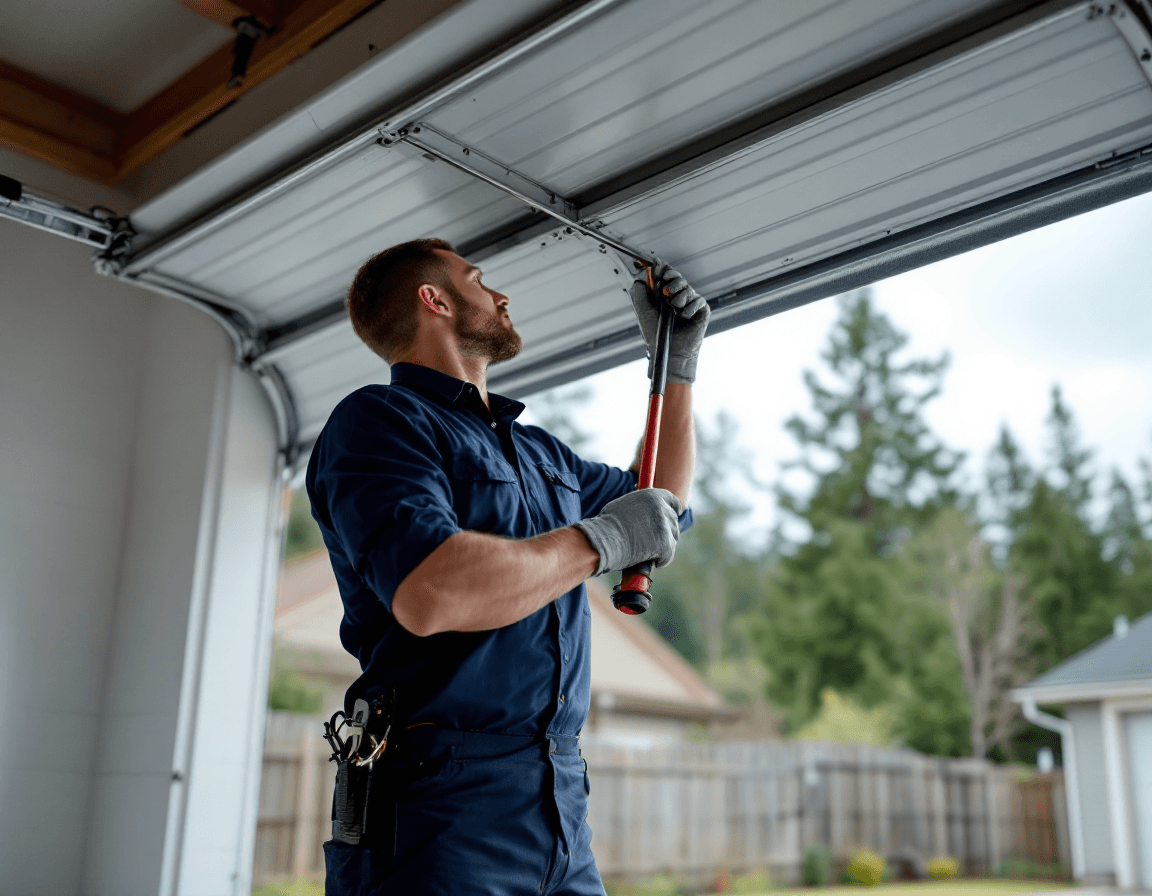
Garage Door Spring Replacement in Mountlake Terrace, WA is one of the most common repairs our technicians handle for homeowners in this part of Snohomish County, and it is also one of the most important to get right. The springs carry most of the weight of your door, so when one fails the door can stop working entirely, bind on its tracks, or drop with enough force to damage the opener. Whether you live near the Lake Ballinger shoreline, in one of the quieter neighborhoods off 236th, or within walking distance of the MLT Town Center, the basic problem is the same: a spring that has reached the end of its cycle life.
This page explains what a broken spring looks and sounds like, how the two main spring types differ, what high-cycle upgrades offer, and what a proper replacement involves. We also cover pricing, cable and track damage that often accompanies a spring failure, and the safety rules our crews follow on every job. The goal is to help you understand the repair before a technician arrives, so you can ask the right questions and recognize a sound job from a careless one.
Nothing here replaces an on-site inspection. Every door is different in weight, width, track geometry, and age, and the only reliable way to know what your door needs is to have a licensed technician measure it. If you are reading this because your door is stuck, sagging, or making a frightening noise, the most useful step you can take right now is to keep people and pets clear of the door and call for help.
Recognizing the Sounds and Signs of a Snapped Spring
Most homeowners first learn that a spring has broken from a sound they will not forget. A snapping torsion spring usually produces a sharp, loud bang that many people describe as a gunshot or a car backfiring, and it often happens when the door is closed and the springs are under the most tension. The noise tends to echo through an attached garage and sometimes into the living space above or beside it. If you hear that sound, do not assume the door is fine because it still moves; the other spring on the same shaft may now be carrying the entire load.
Less dramatic failures are just as telling. A door that opens a few inches and then stops, or one that lifts unevenly so one side climbs faster than the other, often has a spring problem that has been developing for weeks. An opener that strains, hums, or clicks while the door barely shifts is a classic sign that the motor is fighting a weight it cannot lift. Many people blame the opener first, but the opener is frequently working correctly and simply reporting an unbalanced load that the springs no longer provide.
Visual clues matter too. On a torsion system, look at the spring mounted on the horizontal shaft above the door. A healthy spring has tightly wound, evenly spaced coils, while a broken one often shows a visible gap, a stretched section, or coils that have separated and no longer sit flush. On extension springs, look for stretched or elongated coils, or for a spring that has pulled free from its hook. Any of these signs means the door should stay closed until a professional has looked at it.
Why Mountlake Terrace Garages Put Springs Under Extra Strain
Springs wear out for predictable reasons, but local conditions influence how quickly that happens. Mountlake Terrace sits in the Puget Lowland, where the weather is mild by national standards yet persistently damp. Long stretches of gray, wet months mean that moisture finds its way into garages through door seals, slab cracks, and the gaps around openers and weatherstripping. Over time that moisture encourages surface rust on steel springs, and rust is a quiet enemy because it weakens the metal without always changing how the spring looks from the outside.
Temperature swings also play a role. Cold mornings stiffen the lubricant on springs and bearings, which can increase the load the spring must overcome on the first lift of the day, while the metal itself contracts and expands with each seasonal change. Many homes in the area were built with detached or attached garages that are not heated, so the door experiences a wide range of conditions over a single year. These repeated cycles add up.
Usage patterns matter as much as climate. Families in this part of Snohomish County often use the garage as a primary entrance, with bikes, strollers, recycling bins, and vehicles going in and out several times a day. Every open and close is one cycle, and a standard torsion spring is typically rated for a finite number of cycles. A household that opens the door four or five times daily may reach that rating sooner than expected, even if the door looks and sounds fine. Knowing your approximate daily use helps set realistic expectations for when a replacement may be due.
Torsion Springs Versus Extension Springs: Knowing Which You Have
Before any repair begins, a technician needs to identify the type of spring system on your door, because the two designs are installed, tensioned, and replaced in different ways. Torsion springs mount on a steel shaft above the opening, usually a few inches above the top of the door track. They twist to store energy and wind the door upward through a drum and cable arrangement. Most modern residential doors in the region use torsion systems because they tend to be quieter, smoother, and more balanced across the full width of the door.
Extension springs run parallel to the horizontal tracks on either side of the door, often attached to a cable and pulley setup. They stretch to store energy and are common on older doors and on some lighter-weight designs. A single broken extension spring can cause a door to drop unevenly, which is why many systems use a pair with safety cables running through the center of each coil. If a cable is visible through a broken spring, the safety cable has done its job by preventing the spring from whipping across the garage, but the door still needs prompt attention.
Identifying the system also clarifies the cost. Torsion replacements usually involve a matched pair of springs sized to the door's weight, and the technician must measure the door and confirm the wire size, inside diameter, and length before ordering parts. Extension replacements may be simpler in some cases but still require correct sizing and safe handling. In either case, the correct replacement depends on the door's weight and dimensions, not on guesswork or a part pulled off a shelf.
High-Cycle Springs and What the Upgrade Really Offers
Many homeowners who replace a spring ask whether a high-cycle version is worth the extra expense. A high-cycle spring is manufactured from a specific wire and wound with a process designed to extend its rated cycle life, often well beyond that of a standard spring. For a household that uses the garage heavily, that longer life can translate into fewer future service visits and a more predictable replacement schedule. The tradeoff is cost, since high-cycle options are priced above standard springs.
It helps to be clear about what the upgrade does and does not do. A high-cycle spring does not make a heavy door lighter, and it does not solve a problem caused by a misaligned track, a worn bearing, or a broken cable. It simply offers a longer service life under the same load. If the door has other issues, installing an expensive high-cycle spring on an unbalanced system can waste money and may leave the real problem in place. Our technicians check the whole system first, then recommend a spring class that matches how the door is used.
We also consider the frequency of use and the climate. A door that is opened only a few times a week in a dry, heated space has different needs from one that cycles many times daily in a cold, damp garage. For many Mountlake Terrace homeowners, a mid-range or high-cycle option makes sense when the garage functions as a daily entry point. For a rarely used storage door, a standard spring may be the more economical choice, provided the sizing and balance are correct.
Balancing the Door: The Step Many Quotes Leave Out
A spring replacement is only half the job. The other half is balancing the door so that it stays put when released at the halfway point, lifts smoothly with little effort, and closes without slamming. A properly balanced door should be able to rest at roughly waist height with the opener disengaged, which tells the technician the springs are carrying the right share of the weight. A door that drifts down or shoots up when released is out of balance, and that imbalance stresses the opener, the cables, and the spring itself.
Balancing requires adjusting the winding tension and checking the cable drums, which is precision work. Torsion springs are wound with specific turns that must be set to the door's exact weight and height, and both springs on the shaft need to be wound to the same tension. An uneven winding can cause the door to lean, which in turn can jam the rollers or cause the cable on one side to slacken. This is why a technician should measure the door and check the balance after installation rather than simply bolting in new parts and moving on.
Balance also affects the door's future. A carefully balanced door places less load on the opener, which reduces the chance of premature motor failure and keeps the operating noise lower. It also reduces the chance that a newly installed spring will fail early. If a quote for a spring replacement does not mention balance testing, ask the technician how they plan to verify it before the job is considered complete.
Cables, Drums, and the Damage a Spring Break Can Cause
When a torsion spring snaps, the sudden release of stored energy can do more than stop the door. The lifting cables, which wrap around the drums at each end of the shaft, can come loose from their drums, fray, or kink. A cable that has slipped off its drum may look intact at first glance, but it will not lift the door evenly and can jump off its track or bind during the next cycle. Cable damage is one of the most common reasons a spring replacement turns into a larger repair.
Drums themselves can crack or strip, especially on older systems. The drum's grooves hold the cable in position, and if the cable has been pulled hard during the break, the drum can be damaged. Brackets and bearings can also bend or shift when the shaft is suddenly released. Technicians should inspect each of these components while the door is down and the tension is off, because replacing a spring without addressing a damaged cable or drum leaves the door vulnerable to a second failure.
Tracks and rollers should be checked as well. A door that dropped unevenly during a break can leave a track bent or out of alignment, and worn rollers can cause the door to hop or stick. Addressing these parts during the spring visit saves a second trip and reduces the chance of an unexpected failure a few weeks later. A thorough technician will note any damage clearly and explain which repairs are essential and which can wait.
Safety Rules We Hold Ourselves To on Every Spring Job
Spring work is one of the more hazardous jobs in residential garage door service, and it should never be attempted by an untrained homeowner. Torsion springs store a large amount of energy, and the winding bars used to tension them can slip and strike with serious force. Extension springs under tension can also release violently. The danger is not theoretical, which is why professional training and proper tools matter so much. Our licensed, bonded, and insured technicians follow strict procedures on every spring replacement.
Those procedures start with securing the door before any work begins. The technician locks the door in position, relieves tension in a controlled manner, and uses correctly rated winding bars rather than improvised tools. Safety cables are checked and installed where appropriate, and the work area is kept clear of bystanders, including children and pets. Each step is planned so that no single person is exposed to a sudden release of stored energy.
We also recommend that homeowners keep their distance during any spring work and avoid attempting repairs themselves, even when a video or forum post makes the process look simple. Turning a torsion spring with improvised bars or removing a spring from its hook without the correct method can cause serious injury. If you are unsure whether a spring is safe to approach, the answer is to wait for a licensed professional. The cost of a service call is small compared with the cost of an injury.
Here are a few safety practices we recommend while you wait for a technician:
- Keep the door closed and do not attempt to lift it by hand once a spring has broken.
- Disconnect the opener power if you can do so safely, so the motor does not keep straining against the weight.
- Keep children, pets, and vehicles clear of the garage until the spring has been replaced and the door has been tested.
- Do not attempt to adjust, wind, or remove any spring yourself, even if it looks loose or detached.
What a Typical Spring Replacement Costs in the Lake Ballinger Area
Pricing for spring replacement depends on the type of spring, the size and weight of the door, the required cycle rating, and whether additional repairs are needed. For most spring replacements, our pricing falls in the range of $180 to $450. That range generally covers the spring itself, the labor to install and balance it, and the inspection of related parts. Doors that require specialty springs, unusual sizing, or extensive cable and drum work may fall outside that range, and a technician should explain those factors before starting.
Several variables push the price up or down. A standard spring on a single-car door with straightforward hardware is usually at the lower end, while a heavy double-car door, a high-cycle upgrade, or a system with multiple damaged components may land toward the top. Access can also matter; a garage with limited working space or an unusual track layout may take more time. Homeowners near the Lake Ballinger area and across the wider Mountlake Terrace neighborhoods generally see similar pricing, since the same parts and procedures apply regardless of the exact street.
When you request a quote, ask the technician to itemize the spring type, the cycle rating, the balancing work, and any cable or drum replacement. A clear estimate helps you compare options and avoid surprises. Be cautious of any quote that is dramatically lower than the typical range without explanation, since it may indicate a standard spring that is not sized correctly for your door or a job that skips balance testing.
Preparing Your Garage Before the Technician Arrives
A little preparation makes the visit smoother and helps the technician work efficiently. Start by clearing the area around the door, both inside and outside the garage. Stored items, shelving, bikes, and tool chests should be moved so the technician has room to access the track, the shaft, and the opener. If a vehicle is parked in the garage, move it outside if it is safe to do so, since the door's full range of motion needs to be checked.
Next, gather information about your door. Note the make and model if you know it, the approximate width and height, and whether the door is a single or double unit. Take photos of the spring, the cables, and any visible damage, since these images help the technician prepare the right parts. If the door has been making unusual noises, write down when they happen, such as on the first morning lift or after a rainy night, because those details can point toward the cause.
Finally, plan for the visit to take some time. A spring replacement with proper balancing and inspection is not a rushed task, and a technician who takes care with the work will want to test the door several times before signing off. Keep the door closed until the technician arrives, and ask questions as the work proceeds. A knowledgeable technician will explain what they are doing and why, which is a good sign of the quality you can expect.
Keeping New Springs Healthy Through Western Washington Winters
Once a new spring is installed, a few simple habits can extend its life and keep the door running smoothly through the wet and cold months. Lubrication is the most important. Springs, bearings, rollers, and hinges benefit from a light application of a silicone-based or garage-door-specific lubricant, applied sparingly to avoid collecting dust. Avoid heavy grease on the springs themselves, since it can attract grit and does not provide much benefit. Your technician can recommend the right product for your door.
Moisture control matters too. Check the weatherstripping along the bottom of the door and the sides and top of the frame, and replace any strips that have cracked or compressed. Keeping water out of the garage reduces rust on steel components and helps prevent the subtle corrosion that weakens springs over time. If your garage floor slopes toward the door or has standing water after heavy rains, a drainage fix or a sealed threshold may be worth discussing with a professional.
Finally, schedule a periodic inspection. A technician can check the spring winding, cable condition, and balance during a routine visit, often catching small problems before they become emergencies. Pay attention to changes in how the door sounds or moves, and address them early. A door that begins to strain or drift is telling you something, and a quick look can prevent the sudden bang that many homeowners remember all too well.
If your garage door is stuck, sagging, making a loud bang, or refusing to lift, call Seattle Garage Door Fix at (888) 799-3819. Our licensed, bonded, and insured technicians serve Mountlake Terrace and surrounding Snohomish County communities, and we will inspect the springs, cables, and balance before recommending the right replacement for your door. Please keep the door closed and clear the area until a professional arrives, and let us help you get your garage back to safe, reliable operation.