
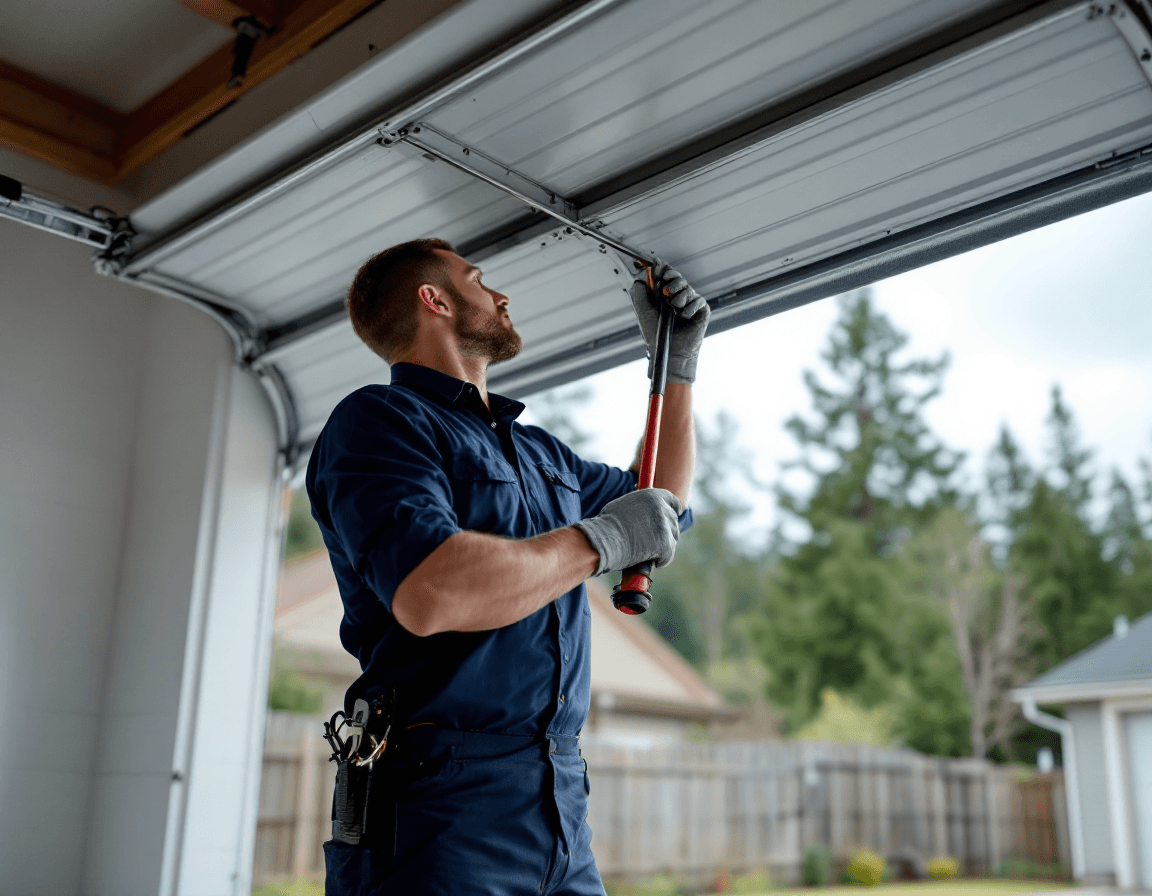
Garage Door Spring Replacement in Shoreline, WA is one of the most common repairs we handle for homeowners across north King County, and it is also one of the most time-sensitive. The springs carry most of the weight of your door, so when one fails, the rest of the system can quickly go from inconvenient to unsafe. Seattle Garage Door Fix works with households in Shoreline and the surrounding communities to restore safe, balanced operation after a break, usually on the same day we are called.
Shoreline sits in a microclimate that is hard on metal, with long damp winters, salt-tinged marine air that drifts in from Puget Sound on the west side of the city, and frequent temperature swings between cold mornings and mild afternoons. Garages here are often attached to older single-story houses or split-levels, and many of them have seen decades of use without a full spring inspection. If your door has started behaving differently, or you heard a sharp crack from the garage recently, this page explains what is probably happening, what your options are, and why spring work should always go to a licensed technician.
Whether you live near the bluffs in Richmond Beach, close to the lake in the Echo Lake area, or in the residential streets of North City, the core principles are the same. The sections below walk through how springs fail in this region, how to recognize trouble early, what the repair involves, what it typically costs, and how to keep your system in good shape afterward. Our goal is to give you enough background to make a confident decision and to know when to pick up the phone.
Why Springs Wear Out Faster in the Shoreline Climate
Garage door springs are steel, and steel fatigues under repeated stress. Every time your door opens and closes, the springs wind or unwind, storing and releasing the energy that lifts the door's weight. Over thousands of cycles, microscopic stress builds up in the metal, and eventually a coil weakens or snaps. Climate speeds that process in ways that are very noticeable in Shoreline.
Moisture is the first factor. Western Washington winters bring extended periods of rain and high humidity, and a garage that is not fully insulated or ventilated can hold dampness against the springs for months at a stretch. Surface rust forms in small pits, and those pits act as stress concentrators where cracks begin. Homes closer to the Sound, including parts of Richmond Beach, can also experience a faint salt presence in the air, which accelerates corrosion on exposed metal hardware if it is not coated or maintained.
Temperature swings add another layer of strain. The metal expands and contracts a little with each change, and on cold mornings a spring that is already weakened is more likely to let go when you first operate the door. Many homeowners notice that their spring fails during the first cold snap of the season, not because the cold alone caused the break, but because the spring was already close to its limit. Recognizing that pattern helps explain why a door that seemed fine in August can suddenly stop working in January.
Recognizing the Warning Signs Before a Spring Lets Go
Springs rarely fail without warning, although the warning can be subtle. A good habit is to pay attention to how your door moves through its full cycle, especially at the start of each opening. Small changes in sound or effort often show up weeks before a complete failure, and catching them early can turn an emergency call into a scheduled repair.
Common symptoms that point to a spring problem include:
- A door that opens a few inches and then stops or reverses, which often means one side is carrying less tension than the other.
- A door that feels unusually heavy when you lift it manually, or a door that seems to drop quickly when you release it.
- An opener that strains, hums, or clicks but barely moves the door, sometimes accompanied by the automatic reverse engaging.
- A visible gap in a torsion spring coil, or a spring that looks stretched, separated, or noticeably looser than its neighbors.
- A door that closes faster than normal, drifts downward, or sits crooked in its tracks.
If you notice any of these, avoid trying to force the door open or closed. Disconnect the opener by pulling the emergency release cord, and keep people and pets away from the door's path until a technician has inspected it. Manually lifting a door with a suspected spring problem is one of the most common ways homeowners get hurt, because the door can move unexpectedly once the tension shifts.
The Loud Bang and What a Snapped Spring Looks Like
A broken garage door spring is one of the most startling household noises you can experience. Homeowners often describe a sharp crack or a loud bang that sounds like a gunshot or a heavy object dropping inside the garage. The sound is the spring releasing its stored energy all at once, and it can be loud enough to be heard clearly from inside the house or from the driveway.
After the bang, the door may still look intact, but the broken spring will show clear signs of failure. On a torsion system, the spring is mounted on a steel shaft above the door opening, and a break often leaves a visible gap in the coil or a spring that has pulled loose from its cone. On an extension system, one or both springs along the horizontal tracks may be stretched, detached, or hanging. Cables may also be slack, frayed, or pulled out of their drums, which is a sign that the door has lost the tension that normally keeps the cables seated.
Do not try to inspect the spring by climbing on a stepladder and touching the coils, and do not attempt to tighten or remove them yourself. Torsion springs are wound under very high tension, and a spring that appears broken can still hold enough energy to cause serious injury. A licensed technician has the proper winding bars, safety equipment, and training to handle the spring correctly, and that is one reason we always recommend calling a professional for this type of repair.
Torsion Versus Extension: Knowing Which System Your Door Uses
Before any repair, it helps to know which spring system your door uses, because the replacement process and the price can differ. Most residential doors in Shoreline use either torsion springs or extension springs, and the difference is easy to spot once you know what to look for.
Torsion springs are mounted horizontally on a steel shaft above the garage door opening. They wind and unwind to lift the door, and they tend to be the more modern and more durable option for most households. Extension springs run parallel to the horizontal tracks on each side of the door, and they stretch as the door opens. Many older garages in established neighborhoods still have extension systems, and they can be perfectly serviceable when they are maintained and correctly sized.
Knowing your system matters for a few reasons. A torsion spring break usually requires replacing the springs as a matched pair, along with checking the shaft, bearings, cable drums, and center bracket. An extension spring break may only require replacing the affected spring or springs, though a thorough technician will also inspect the others because they were installed at the same time and under the same load. Your technician will also check whether the door has safety cables running through the springs, which help prevent the spring from flying loose if it ever breaks.
High-Cycle Springs for Busy Households
Standard residential springs are typically rated for a certain number of cycles, and that rating reflects the expected life of the spring under normal use. For households that open and close the garage many times a day, such as families with teenagers who come and go, home-based businesses that load and unload vehicles, or anyone who uses the garage as a main entrance, a standard spring can wear out well before its expected life. High-cycle springs are engineered to handle more repetitions and are a sensible upgrade in these situations.
High-cycle options are usually made from higher-grade steel and may be wound to a different tension profile. They are often a good fit for doors that see heavy daily use, or for households that want to extend the time between replacements. Your technician should measure the door's weight, height, and track configuration before recommending any spring, because a spring that is mismatched to the door can cause uneven lifting, premature wear, or a door that does not balance properly.
It is worth discussing high-cycle options during the repair visit rather than deciding on your own. A technician who understands your door's weight and your household's usage pattern can recommend the right spring for your situation, whether that means a standard replacement or an upgrade. Choosing the wrong spring to save a few dollars can lead to repeat failures, which costs more in time and frustration over the long run.
Balance, Cables, and the Hidden Work After a Break
Replacing a spring is only part of the job. A broken spring usually means the door has lost its balance, and a door that is out of balance will strain the opener, wear out rollers and hinges, and may stop working altogether. Balancing is the process of adjusting spring tension so the door stays at any height when released, and it is one of the most important steps in a proper repair.
Cables are closely tied to the spring system. When a torsion spring breaks, the cables on the drums can go slack or come loose, and if they are not properly seated, the door can become crooked or jam. A technician will inspect the cable condition, check that the drums are secure, and confirm that each cable is wound correctly. Frayed or stretched cables should be replaced rather than reused, because a cable that has already been stressed is unlikely to hold reliably.
After the spring and cables are replaced, a careful technician will test the door through several full cycles. They will check that the door lifts and lowers evenly, that it stays put when released halfway, that the opener engages without strain, and that the safety reverse functions correctly. A thorough final check is what separates a repair that holds from one that needs to be revisited.
- Confirm the door stays level and does not sag or lift unevenly during the test cycles.
- Check that cable drums are secure and cables are seated in their grooves.
- Verify the opener's auto-reverse and safety sensors respond correctly.
- Inspect rollers, hinges, and tracks for wear that could affect balance.
- Test the door at multiple heights to confirm it holds position when released.
What Influences the $180–$450 Price Range
Most spring replacements we perform fall in a price range of $180 to $450, though the final cost depends on several factors. Understanding what drives the price can help you make an informed decision and avoid surprises when the technician arrives.
The type of spring system is one major factor. Torsion spring replacements usually involve a matched pair of springs, plus the labor to wind them correctly and balance the door. Extension spring jobs may cost less if only one or two springs need replacing, but a complete system refresh will increase the cost. The door's weight, size, and construction also matter, because heavier and wider doors require springs with higher tension ratings.
The condition of related hardware affects the total as well. If the cable drums, bearings, center bracket, or shaft show wear, the technician may recommend replacing those parts during the same visit. Choosing high-cycle springs will also change the price, usually upward, though many homeowners find the added durability worthwhile. A reputable technician should explain the options clearly before any work begins and should never pressure you into upgrades you do not need.
Serving Shoreline Neighborhoods from Richmond Beach to North City
Seattle Garage Door Fix serves more than sixty cities across the greater Seattle and Western Washington area, and Shoreline is one of the communities we visit regularly. Our technicians are familiar with the layout of the city, from the western edge near Richmond Beach Road, where bluff-top homes and older garages face weather off the Sound, to the Echo Lake area, where a mix of ranch-style houses and newer infill builds share the same wet-season challenges. North City, with its established streets and mid-century homes, presents its own mix of extension and torsion systems, and many of those doors have been working for a long time without a major service.
We regularly help households in ZIP codes 98133, 98155, and 98177, which cover much of Shoreline and its surrounding areas. If you are unsure whether your address falls within our service zone, call and a team member can confirm it. Scheduling is often flexible, and many spring emergencies can be addressed the same day when the technician is able to reach your home promptly.
Because Shoreline is a commuter-friendly city with access to Interstate 5, Highway 99, and Aurora Avenue, traffic patterns can affect how quickly a technician reaches your door during peak hours. Mentioning your neighborhood landmarks when you call, such as a nearby park or a main cross street, helps the scheduling team plan the most efficient route and give you a realistic arrival window.
Why Spring Work Belongs in Licensed Hands
Garage door springs store a significant amount of energy, and working with them incorrectly can cause severe injury or property damage. That is why we always recommend a licensed, bonded, and insured professional for any spring or cable work. The risk is not limited to the moment a spring is removed or installed. A door that is improperly balanced can fall unexpectedly, a cable that is not seated correctly can snap under tension, and a spring that is wound incorrectly can release without warning.
Licensed technicians follow established safety procedures, including locking the drum before loosening tension, using the correct winding bars, and checking the door's balance before leaving the site. They also carry insurance that protects your home if an unexpected problem occurs during the repair. When you hire a professional, you are paying for training, equipment, and accountability, not just for the replacement part.
If anyone suggests that you can replace a spring yourself to save money, it is worth pausing to consider the potential cost of an injury or a damaged door. A few hundred dollars for a professional repair is a small price compared with a hospital visit or a repair bill for a door that has been damaged by an improper installation. Your safety and your home are worth the investment.
Keeping Springs Healthy Between Service Visits
Good maintenance can extend the life of your springs and reduce the chance of a surprise failure. You do not need specialized tools to care for your system, but a few simple habits make a real difference, especially in a climate as damp as Shoreline's.
Start by inspecting the springs and cables every few months. Look for visible rust, gaps in the coils, stretched or frayed cables, and loose hardware. Wipe away dust and debris, and use a light lubricant recommended for garage door components on moving parts such as rollers, hinges, and bearings. Avoid spraying lubricant directly onto the springs themselves, because it can attract dirt and does not solve the underlying fatigue problem.
Pay attention to how your garage is ventilated. Good airflow reduces condensation and helps keep metal dry during the wet months. If your garage is damp, consider a dehumidifier or improved ventilation. Finally, schedule a professional inspection every year or two, particularly if your door is more than a decade old or if you have noticed any of the warning signs described earlier. A technician can catch small problems before they become emergencies.
Calling Seattle Garage Door Fix for Shoreline Spring Repairs
A broken spring is a disruptive problem, but it is also one of the most straightforward repairs when handled by experienced, licensed technicians. If your garage door has made a loud bang, will not lift, shows a visible gap in a torsion coil, or closes unevenly, the safest step is to stop using it and call for help. Seattle Garage Door Fix serves Shoreline and the surrounding communities, and our team can assess your door, recommend the right spring and balance solution, and restore reliable operation. Call (888) 799-3819 today to schedule your Shoreline spring replacement and get your garage door moving safely again.