
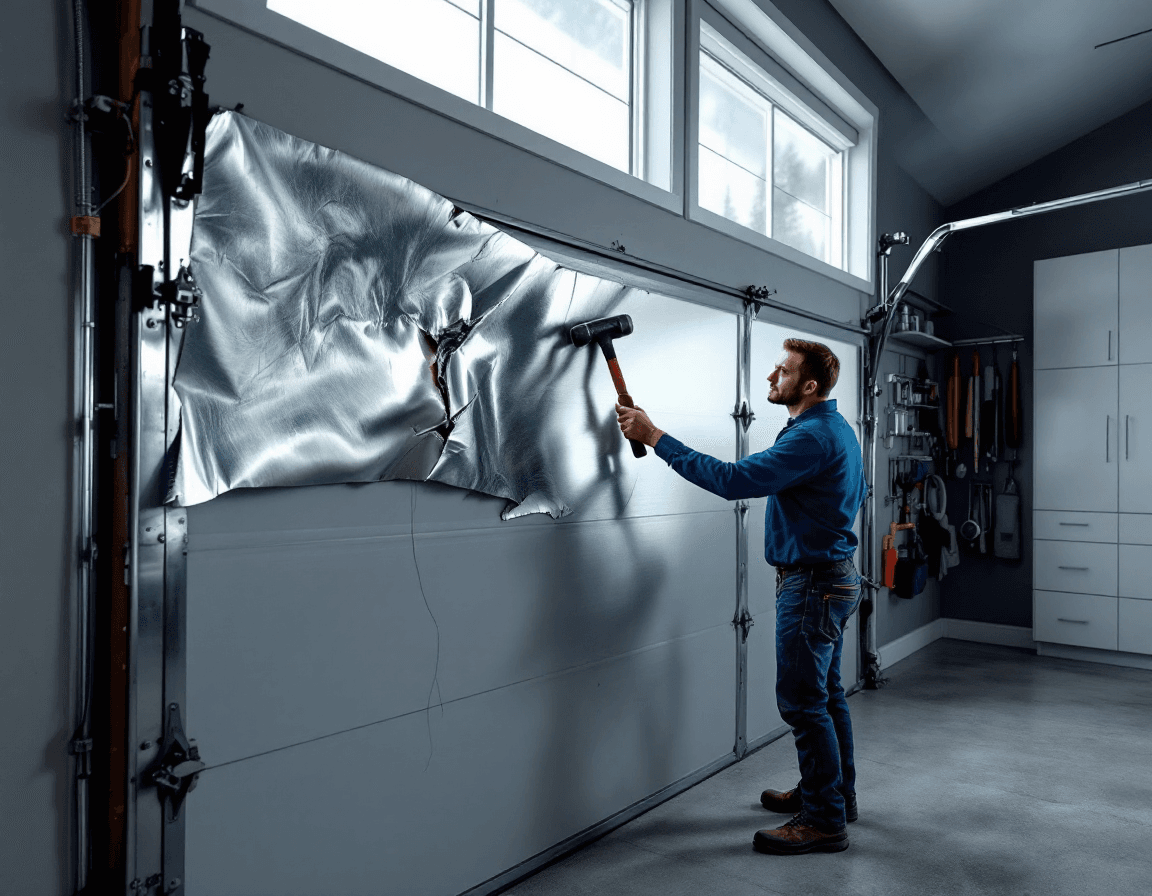
Garage Door Panel Replacement in Shoreline, WA is often the most cost-effective fix for a door that works perfectly but looks worn, dented, or broken at one spot. Shoreline homeowners deal with a particular mix of problems: wet winters, salty air on the north end near the Sound, busy streets, and driveways that get tight when a delivery truck or a teenager backs out too quickly. A single cracked or crushed section can make an otherwise sound door look neglected, and it can let water and drafts into the garage. This page explains how panel replacement works, what drives the cost, and how to decide between patching the damage and swapping the section entirely.
Most of the calls we hear from Shoreline households start with a simple observation. Someone notices a bulge in the bottom panel, a crease running across the middle of the door, or a rust bloom near the hardware that wasn't there last year. The door still opens, the opener sounds normal, and the homeowner wonders whether it really needs attention. The honest answer is that a damaged panel is a repair in its own right, even when nothing else is wrong, because the panel carries structural strength, insulation value, and weather resistance that a flat, undamaged section provides. Catching the problem early keeps a small job small.
Our team serves neighborhoods across the city and nearby communities, including homes in the 98133, 98155, and 98177 ZIP codes. Whether your home sits close to the beach bluffs around Richmond Beach, near the quieter streets by Echo Lake, or in the older residential blocks of North City, the core process is the same: identify the damage, confirm the door type, source a matching section, and install it cleanly. The details, however, shift with local conditions, and this guide focuses on those details so you can make an informed decision before you call anyone.
Reading the Damage Before You Decide Anything
A dent is not always just a dent. Steel panels on many residential doors are formed with ribs and stiffening channels, and a hard impact can kink the metal along a seam, crack the paint, or bend the internal insulation core. When you look at a dented panel, run your hand along the surface and note whether the edges still sit flush with the neighboring sections. If the gap at the seam has widened, the panel may be pulling away from its track rollers or hinges, and that movement can wear out hardware faster than you would expect.
Cracks deserve more attention than dents. A hairline crack in the paint that does not penetrate the metal can often be cleaned, primed, and touched up, but a split that runs through the skin of the panel usually means the section has lost its integrity. Cracks in older wood doors tend to follow the grain and widen with every freeze-thaw cycle, while cracks in steel and aluminum panels often start at a fastener hole or at the point where a bump concentrated the force. Either way, a cracked panel is a candidate for replacement rather than repair.
Take a few photographs and make a rough note of where the damage sits relative to the door's sections. A crumpled panel in the middle of a three-section door is a different job from a bottom section that has taken repeated water exposure. Those photos will help a technician quote more accurately, and they give you a record if you later need documentation for an insurance claim or a warranty question.
Coastal Damp and Corrosion Along the Richmond Beach Corridor
Homes closer to the water in north Shoreline experience a damp, salt-tinged environment that works against garage doors in ways that inland homes may not notice. Salt particles carried on onshore breezes settle on exterior surfaces, and when rain or morning fog keeps those surfaces wet, corrosion can start at scratches, chips, and the cut edges of steel. On a steel door, that process often shows up first at the bottom panel and at the lower corners, where water pools and sits longest. Galvanized steel and factory-applied coatings resist this well for years, but a dent that breaks the finish gives corrosion a foothold.
Shoreline's wet winters add another layer to the problem. Long stretches of drizzle and overcast weather keep garage doors damp, and an attached garage that is not well ventilated can trap humidity against the back of the panels. Insulated doors are especially prone to moisture trapped between the outer skin and the foam core, where it can cause the insulation to sag or the panel to bulge from the inside. When a homeowner describes a panel that looks "puffy" or feels soft when pressed, that is often a sign of trapped moisture or a failed bond between layers.
If you live near the bluffs or in a home with a garage facing the prevailing wind, consider rinsing the lower section of your door with fresh water every few weeks during the wetter months. A gentle wash removes accumulated salt and grit before it can work into seams and edges. Keeping the bottom of the door clear of leaf litter and debris also helps, because wet organic material holds moisture against the metal and invites rust. These habits do not replace repair when a panel is already compromised, but they extend the life of the sections that are still sound.
Bottom Section Damage from Water, Splash, and Curb Impact
The bottom panel of a garage door takes more abuse than any other section. It sits closest to the driveway, where rainwater splashes up during downpours and where tires, snow shovels, and wheelbarrows make contact. In Shoreline's older driveways, which may slope toward the garage or have uneven concrete near the threshold, water can collect at the base of the door and soak the lowest section every time it rains. Over several seasons, that exposure can cause swelling in wood panels, rust perforation in steel, and softening of the seal along the bottom edge.
Impact damage is common at the bottom as well. Garbage bins, bicycles, car bumpers, and moving equipment all find the lower panel at a height where it is easy to strike. A small bump may only scuff the finish, but a harder hit can push the panel inward, separate it from its end caps, or crack the edge where the section meets the bottom seal. If the bottom panel has been damaged, check the weatherstrip as well, because a bent panel can prevent the seal from making full contact with the floor and let rain, leaves, and pests into the garage.
Water intrusion from the bottom can also mask itself as a different problem. Homeowners sometimes notice a wet strip on the garage floor, a musty smell, or a corroded bottom bracket and assume the threshold is the culprit. A technician should inspect the panel, the seal, and the bottom bracket together, since a compromised bottom section often explains all three symptoms at once. Replacing only the seal in that situation may leave you with the same leak within a season.
Matching a Panel That Has Been Discontinued
One of the most common frustrations with panel replacement is finding a section that matches the rest of the door. Garage door manufacturers update their designs, change paint colors, and adjust panel profiles over time, so a door that is fifteen or twenty years old may not have a current equivalent in stock. Even when a manufacturer still produces the same model, the factory color may have shifted slightly in the years since the original installation, and sun exposure can fade the existing finish unevenly. The result is a replacement panel that looks almost right in the shop and noticeably different in the driveway.
Matching starts with identifying the door's make, model, and installation date if you can find the label or the original paperwork. The manufacturer's serial plate is often located on the inside of a section or along the track side of the door frame. If that information is unavailable, a technician can usually work from panel width, rib spacing, embossing pattern, and insulation thickness to narrow down the likely source. Measuring the panel height and width precisely is important, because even a quarter-inch difference can cause a section to fit poorly against its neighbors.
When an exact match is not available, there are practical options. Some suppliers can produce a close equivalent, a sectional replacement from a related model may work if the hardware and panel dimensions align, or the homeowner may choose to refinish the full door so that all sections share a consistent color. Each approach carries trade-offs in cost, appearance, and long-term durability. A straightforward conversation about what you want the door to look like, and how much visual variation you can accept, usually leads to the best result.
Repair or Replace: Weighing a Single Section Against the Whole Door
The decision to repair a panel or replace it depends on how deep the damage goes, how old the door is, and whether other components show wear. A dented panel with intact paint, no cracks, and a flush fit with its neighbors may simply need the surface straightened or the finish touched up. A cracked, rusted, or water-damaged section usually calls for replacement because patching does not restore the strength or insulation the panel once provided. Many homeowners find that replacing one section restores the door's appearance and performance for years at a much lower cost than replacing the entire door.
Several factors tip the balance toward replacing the whole door instead. If multiple panels are damaged, if the frame or track is bent, or if the door is an older model with worn springs and rollers that would soon need attention anyway, a full replacement may give you better value. Doors that are no longer producing matching panels also become harder to repair over time, and a mismatched door can reduce curb appeal and resale impression. A technician who is honest about these trade-offs will walk you through each option rather than pushing the most expensive path.
- Single panel, surface damage only, paint intact: often suitable for straightening or refinishing rather than full replacement.
- Single panel, cracked, rusted through, or water-soaked: usually a strong candidate for sectional replacement.
- Two or more adjacent panels damaged: compare the cost of sectional replacement against a new door, factoring in the age of the existing hardware.
- Damage accompanied by a bent track, frame damage, or failed rollers: address the structural and hardware issues first, then decide on panels.
- Door older than its expected service life with other wear showing: a full replacement may be the more sensible long-term investment.
What a Panel Replacement Typically Involves on a Shoreline Driveway
A standard sectional panel replacement follows a predictable sequence, though the specifics vary by door design. The technician first confirms that the door is in a safe, stable condition and that the springs are not in need of separate service. The door is then secured so that it cannot move unexpectedly while the damaged section is removed. Hinges and roller connections holding the affected panel are unfastened, and the damaged section is slid or lifted out of the track assembly, depending on the door type.
Once the old section is removed, the replacement panel is checked against the neighboring sections for width, height, and hinge alignment before installation. The new panel is fitted into place, the hinges and rollers are reattached, and the hardware is tightened to the manufacturer's specifications. The technician then checks the door's balance and operation by running it through a full cycle, looking for binding, uneven movement, or rubbing along the weatherstrip. Finally, the finish is inspected in daylight, since color differences are much easier to see outdoors than under garage lighting.
Shoreline homes sometimes present challenges that affect this process. Narrow driveways and close neighboring structures can limit how far the door can be opened for access, and older garages may have uneven slabs that complicate alignment. Attached garages in older neighborhoods may also have low ceilings or tight headroom, which affects how a damaged section can be maneuvered out of the track. A good technician plans around these constraints and explains the steps before the work begins.
Price Expectations for a Section Swap in Your Neighborhood
Panel replacement is generally priced per section, and the range typically falls between $250 and $800 depending on the door. Several factors determine where a particular job lands. A standard steel panel on a common residential door sits toward the lower end, while an insulated section, a specialty finish, a window insert, or a discontinued profile that requires sourcing can push the price higher. The size and weight of the section, the number of hinges and rollers that need to be replaced, and whether the door is a wood, steel, aluminum, or composite model all play a role.
It is worth asking for an itemized estimate that separates the panel cost from labor, hardware, and any inspection or alignment work. An honest quote should explain what is included and what might change once the old section is removed. Sometimes a damaged panel reveals a bent track or worn roller that was not visible from the outside, and a responsible technician will explain the added cost before proceeding. Clear communication up front protects both the homeowner and the technician from surprises.
Keep in mind that a panel replacement quote is a snapshot of the work needed on a specific door. If you are comparing bids, make sure each one describes the same scope: the same number of sections, the same finish approach, and the same handling of any hardware that is near the end of its life. A lower price that omits inspection or excludes matching may cost more in the long run if the new panel does not fit or blend in.
Backing Accidents and Insurance Paperwork in Shoreline Homes
A single panel damaged in a backing accident is one of the most common reasons homeowners call for panel work, and it is also one of the situations where documentation matters most. Shoreline's residential streets and tight driveways can turn a quick reverse into a collision with a garage door, and the damage often looks minor until the panel is inspected closely. Taking photographs immediately, noting the time and circumstances, and keeping any repair receipts can make a claim process far smoother.
Whether a backing accident is covered by your insurance depends on your specific policy, the type of coverage you carry, and the details of the incident. We are not able to tell you what your policy will pay, and you should check with your insurer directly about deductibles, coverage limits, and any claim requirements. What we can do is provide a written, itemized description of the work performed, the sections replaced, and the reason for replacement, which many insurers request when reviewing a claim. Keeping the damaged panel for inspection, if your insurer asks for it, is also worth considering before it is discarded.
If the accident involved another vehicle, or if the damage resulted from a neighbor's property or a delivery vehicle, report the incident according to your local practices and your insurer's guidance. Document everything as clearly as you can, and avoid making statements about fault until you have spoken with the appropriate parties. The priority is to protect the garage, secure the opening, and get the door safely operational again.
Keeping New Panels Looking Right: Finish, Weather Sealing, and Seasonal Checks
Once a replacement panel is installed, a few simple habits will help it blend with the rest of the door and hold up through Shoreline's wet seasons. Begin by cleaning the new section and the surrounding panels with a mild, non-abrasive soap and fresh water to remove any installation dust, fingerprints, or residue. Avoid harsh solvents on painted or coated surfaces, since they can dull the finish or lift the protective layer. A soft cloth and patience produce the best long-term appearance.
Weather sealing deserves regular attention after any panel work. Check the bottom seal, the side seals, and the top weatherstrip for gaps, flattening, or brittleness, especially after a winter of rain and temperature swings. Small gaps around the new section can let in wind-driven rain, so a quick visual check after each major storm is worthwhile. If you notice daylight showing around the edges when the door is closed, call for an inspection before the gap grows into a leak.
A seasonal routine can make a significant difference. In late summer, before the wetter months begin, inspect the paint for chips and touch them up promptly with a matching repair product. In late fall, clear the track area of debris, confirm that drainage paths near the garage are not blocked, and make sure the door is closing fully and sealing properly. These small tasks cost little time and help prevent the kind of water damage that leads to another panel replacement down the road.
When a Panel Job Turns into a Spring or Cable Job
Panel replacement itself is generally a straightforward task, but it can reveal problems that require different expertise. Garage doors are counterbalanced by torsion springs or extension springs, and those springs store a large amount of energy even when the door appears to be at rest. Torsion springs in particular can cause serious injury if they are adjusted, wound, or removed without the proper tools and training. For that reason, any work involving springs, cables, drums, or the tension system should be handled only by a licensed, trained professional.
During a panel job, a technician may notice a frayed cable, a cracked spring, a loose drum, or a damaged center bearing. When that happens, the appropriate response is to stop, secure the door, and address the tension system with a qualified technician before continuing. A homeowner should never attempt to loosen, wind, or remove a spring on their own, and a door that is out of balance or whose springs are failing should not be operated more than necessary. Safety comes first, and a professional can explain whether the spring and cable issues should be resolved at the same visit.
If your panel is damaged and you also suspect the springs are worn, do not assume that replacing the panel will fix the door's operation. A door that is sagging, slamming, or lifting unevenly may need spring service before any panel work will sit properly. Scheduling the spring evaluation alongside the panel replacement often saves a second service call and gives you a clear picture of the door's overall condition.
Garage Door Panel Replacement in Shoreline, WA can restore your door's appearance, protect your garage from the weather, and avoid the larger expense of a full door replacement when the damage is limited to one or two sections. If you have a dented, cracked, rusted, or water-damaged panel, or if a backing accident has left a section out of line, call Seattle Garage Door Fix at (888) 799-3819 for a clear assessment. Our licensed, bonded, and insured technicians will look at the damage, explain your repair-or-replace options, and give you an itemized estimate before any work begins.