
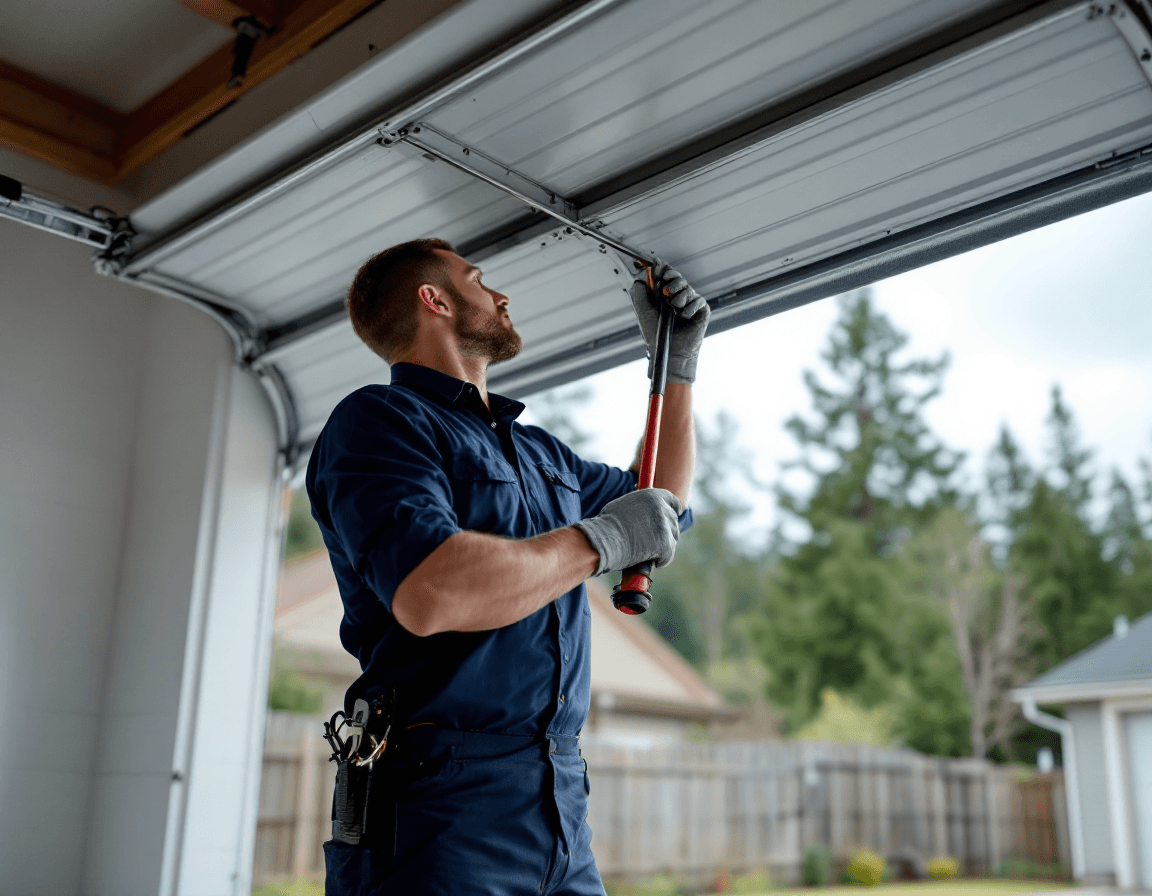
Garage door spring replacement in Brier, WA is one of the most common repairs we handle for homeowners in north Snohomish County, and it is also one of the most important to get right. The springs carry most of the weight of your door, so when one fails, the door can go from smooth to stuck, crooked, or dangerous in a moment. Many Brier households first notice the problem with a sharp crack from the garage, while others see a door that rises a few inches and then refuses to go further.
This page explains what a failed spring looks like, why it happens so often in our part of the Pacific Northwest, and how the repair is done by a licensed technician. We also cover the difference between torsion and extension springs, what high-cycle options mean for a busy household, and what a typical job costs. The goal is to help you make a clear decision about your door rather than guessing from a noise or a stuck panel.
Whether your garage is attached to a home near Brier Park or tucked into a quieter street on the edge of town, the principles are the same. A spring that has broken or is near the end of its life needs to be replaced as a complete, balanced system, not patched with a temporary fix. Read on for the details, and call (888) 799-3819 if you would like someone to look at your door in person.
Reading the Bang: What a Snapped Spring Sounds Like
A broken spring usually announces itself with a loud bang that sounds like a gunshot or a heavy metal bar hitting the floor. Many homeowners hear it while they are inside the house, and some think a car has hit the garage or that something has fallen from a shelf. If the sound came from the garage and the door looked fine afterward, it is still worth checking the springs before you use the door again. A spring can split without the door visibly collapsing, especially when the opener is still pulling on the panels.
After the bang, look at the spring mounted on the horizontal shaft above the door, or the pair of extension springs running along the tracks on each side. A torsion spring that has failed often shows a visible gap in the coil, a wide space where the wire used to be continuous. Extension springs may hang slack, pull away from their hooks, or show a stretched, unevenly coiled look. Do not stand directly beneath a spring while you inspect it, because stored tension can still be present even after a break.
If you cannot tell what happened, the safest step is to leave the door closed and avoid operating it with the opener. Running the opener on a door with a broken spring can damage the opener, twist the track, and put strain on the remaining hardware. Call a licensed technician who can confirm the break, check the drums and cables, and tell you whether the door can be moved safely by hand. Quick diagnosis prevents a single broken part from becoming a costly multi-part repair.
Why Brier Garages Put Springs Under Pressure
Our climate plays a bigger role in spring wear than many homeowners expect. Western Washington winters bring long stretches of rain, heavy dampness, and cool temperatures that can stiffen metal and make tension changes more pronounced. In Brier, where many garages sit on sloped driveways or near tree-lined lots, moisture can settle into door hardware and promote surface rust on the springs and their mounting brackets. Over time, that corrosion weakens the steel and makes a spring more likely to fatigue at the point where it is already under stress.
Cycle count matters as well. Every time the door opens and closes, the springs flex through a complete cycle of tension. Households that leave for work early, use the garage as the main entry, or run a home business with frequent deliveries can rack up far more cycles than a retired couple who drives out twice a week. A spring that lasts many years for one household may wear out in a fraction of that time for another. When we inspect a door, we pay attention not only to age but also to how the door is actually used.
Seasonal temperature swings add another layer of stress. Cold mornings can make a door feel heavier, and that extra resistance tends to push the spring to its limit when it is already weak. Because our winters are damp rather than extremely cold, the signs can be subtle, such as a door that drags a little more on wet days or a spring that sounds slightly different when the weather turns. Noticing these small changes early gives you a chance to schedule a repair before a full break leaves you without a usable garage.
Torsion Versus Extension: Matching the Spring to Your Door
Most garage doors in our service area use one of two spring systems, and identifying the right type is the first step in any replacement. Torsion springs are mounted on a steel shaft above the door opening. They wind and unwind to lift the door and are generally considered the more durable and balanced option for standard residential doors. When a torsion spring breaks, the door often stops suddenly, and the opener may simply hum without lifting the panels.
Extension springs run parallel to the horizontal tracks on each side of the door. They stretch as the door is lowered and pull the door back up when it opens. Many older garages in Brier and nearby neighborhoods still use extension springs, and they are sometimes paired with safety cables that run through the springs. Extension springs can be replaced with a matched pair, but the choice should always account for door weight, track configuration, and the cable system that supports it.
A reliable technician will confirm the spring type, wire size, inside diameter, length, and cycle rating before ordering parts. Guessing at specifications can lead to a spring that is too strong or too weak for the door, which causes uneven lifting and extra wear on the opener. Consider these points when you talk to your technician about your door:
- Check whether the spring is mounted above the door on a shaft, or along the tracks on each side.
- Note whether any cables are visible, frayed, or hanging loose near the drums.
- Ask whether the replacement springs match the original weight and lift height of your door.
- Confirm the cycle rating you are being quoted so you can compare it with your household's use.
High-Cycle Springs and What the Cycle Rating Really Means
Spring cycle ratings are one of the most misunderstood parts of a garage door repair. Standard residential torsion springs are often rated for around 10,000 cycles, which means a full open and close counts as one cycle. High-cycle springs are designed to last longer under repeated use, and they are often a good choice for families who open the door many times a day or for garages that serve as a workshop or shared entry. The rating is an estimate of service life under normal conditions, not a guarantee, and it depends on proper installation and balance.
High-cycle options do not mean you should buy the most expensive spring available without a reason. A household that uses the door a few times a week may be well served by a standard spring installed correctly and balanced precisely. On the other hand, a home where the door cycles several times daily may benefit from a higher-rated spring that spreads the workload over a longer period. Your technician should explain the tradeoffs in plain language and help you choose based on how you actually use the garage.
It also helps to understand that cycle life depends heavily on the door's weight and hardware. A heavy insulated door with a solid wood core, or a door with glass panels and an added opener, places more demand on the spring than a lightweight single-layer door. If the door has been upgraded or the old springs were undersized, the replacement should be sized to the door as it exists now. Ask whether the quoted spring is matched to the door's current weight rather than simply duplicating what was there before.
Balancing the Door After the Swap
Replacing a spring is only part of the job. The springs must be adjusted so the door stays balanced, meaning it will hold partway open without drifting up or down when released. A properly balanced door is easier on the opener, safer for everyone in the household, and less likely to damage tracks or cables. When a spring is replaced without balancing, the door may close too fast, rise unevenly, or sag on one side even though the new spring itself is fine.
Balancing involves checking the tension, the lift height, and the alignment of the drums and cables on both sides of the door. A technician will often test the door by disconnecting the opener and lifting the door by hand to see whether it stays put at roughly waist height. Small corrections may be needed to align the panels, tighten the tracks, or confirm that the rollers move freely. Doors that close crooked or hit the floor hard often need this fine-tuning to fix the problem completely.
Balancing is also where experience makes a noticeable difference. A door that appears level can still have hidden tension differences that show up only after several cycles. We recommend asking your technician to run the door through a full open and close after the work is finished, and to explain what they observed. If the door still hesitates, shudders, or rises unevenly, the job is not finished, and you should not accept it as complete until the door moves smoothly.
Cables, Drums, and the Hidden Damage After a Break
When a torsion spring breaks, the cables attached to the drums can be stressed, kinked, or pulled out of their fittings. Drums may be cracked or slip on the shaft, and cable ends can unravel where they meet the bottom bracket. Many homeowners focus only on the spring and miss these secondary problems, which can cause a second failure soon after the first. A thorough inspection should check every cable, drum, bracket, and set screw before the door goes back into regular use.
Cables that have come loose after a spring break are especially important to address quickly. A loose cable can slip off the drum, leaving one side of the door without support, and that can lead to a dangerous drop or a twisted track. Do not attempt to re-thread or reattach cables yourself, because they are under significant tension even when they appear slack. A licensed technician uses the right clamps, drum alignment tools, and safety procedures to restore the cable system correctly.
Track damage can also follow a spring break, particularly when the door dropped suddenly or the opener kept pulling after the spring failed. Bent track sections, loose bolts, and worn rollers may need attention in the same visit. Replacing a spring while ignoring these related parts can lead to repeated service calls and a door that never runs smoothly. A complete inspection costs a little more time upfront but usually saves money over the life of the door.
What a Typical Spring Job Costs Around Brier
For most spring replacements, the price in our service area falls between $180 and $450. That range reflects the typical scope of work, including removing the failed spring, installing a matched replacement, checking the hardware, and balancing the door. The final cost depends on the type of spring, the size and weight of your door, whether you need one spring or a pair, and whether any cables, drums, or brackets also need repair. Always ask for an itemized explanation before work begins so there are no surprises.
Several factors can push the price higher or lower. High-cycle springs usually cost more than standard options, while a door that needs extra hardware or track alignment may require additional time. Extension spring systems with safety cables can be more involved than a single torsion spring, and older doors sometimes need brackets or fasteners replaced to match modern parts. A clear quote should explain what is included, what is optional, and what may come up once the old components are removed.
It is also worth comparing the cost of replacement against the cost of ignoring a failing spring. A door that is stuck or unbalanced can strain the opener, damage the tracks, and create a safety risk for people and vehicles. Waiting too long can turn a manageable repair into a larger job involving the opener, rollers, or panels. Addressing the spring promptly is usually the more economical choice, and it keeps the door reliable through the wet months ahead.
Safety Rules Every Brier Homeowner Should Follow
Garage door springs store enormous amounts of energy, and that is why spring work should be left to licensed, insured professionals. A spring under tension can cause serious injury if it releases unexpectedly, and standard household tools are not designed for the task. We strongly recommend that homeowners never attempt to wind, unwind, or remove a torsion spring or extension spring on their own, even if they have watched a video or helped with a previous repair. Our technicians are licensed, bonded, and insured, and they follow established safety procedures on every call.
There are simple precautions you can take while you wait for a technician. Keep children and pets away from the garage door area, and do not stand beneath a door that appears unstable. If the door is stuck or hanging unevenly, avoid pulling on it or forcing it with the opener. Disconnecting the opener can prevent accidental operation, but the door should still be handled carefully because it may be heavier than it looks.
Here are a few practical safety habits to follow until the spring is replaced:
- Do not operate the opener if you hear a loud bang or see a visible gap in the spring.
- Keep hands, tools, and vehicles clear of the door path until the door has been inspected.
- Avoid climbing on ladders or shelves near the spring hardware.
- Schedule professional service promptly rather than attempting a temporary fix.
Preventive Habits for Our Wet, Mild Winters
Preventive care can extend the life of your springs, particularly in a climate where moisture is a constant factor. Keep the garage door's moving parts clean and lightly lubricated with a silicone-based or garage-door-specific lubricant, following the manufacturer's guidance. Avoid heavy grease on springs and rollers, since it can collect dust and grit in damp conditions. Wipe down the tracks periodically to remove debris that can stiffen rollers and add strain to the door.
Watch for early signs of corrosion and wear. Surface rust on springs, flaking paint on brackets, or stiff rollers are all reasons to schedule an inspection. Many homeowners in Brier notice these changes after a wet season, when the garage has been damp for weeks and the door has been working harder than usual. A quick check each spring and fall can catch small issues before they become emergencies.
Good habits also include paying attention to how the door sounds and moves. A door that hesitates, rises unevenly, or makes a new grinding noise deserves a closer look. Testing the door's balance once or twice a year, by lifting it partway by hand with the opener disconnected, can reveal developing problems. If the door does not hold steady, it is time to call a professional rather than waiting for a break.
When the Opener Is Blamed but the Spring Is Guilty
Many homeowners assume the opener has failed when the door will not move, but a broken or weakened spring is often the real cause. An opener that hums, strains, or clicks without lifting the door may be working hard against a spring that cannot support the weight. Replacing the opener in this situation wastes money and leaves the underlying problem in place. A technician should test the spring and balance before recommending any opener replacement.
Sometimes both parts are involved. A worn spring can overload the opener over time, causing the motor or gears to wear faster than normal. In those cases, the spring should be replaced first, and then the opener can be checked to confirm it is still operating within its normal range. This sequence protects your investment and avoids unnecessary parts replacement.
If the door opens a few inches and stops, that pattern strongly suggests a spring problem, although a track obstruction or cable issue can produce similar symptoms. A careful inspection will separate these possibilities quickly. Accurate diagnosis is the difference between a focused repair and a series of guesses that cost more time and money.
Booking a Spring Visit Near Brier Park
If you live near Brier Park or elsewhere in the 98036 area, scheduling a spring replacement is straightforward. Start by describing what you have seen or heard, including whether the door moves at all, whether there was a loud bang, and whether any cables appear loose. This information helps the technician arrive prepared with the right spring type and tools. Keep the garage clear of vehicles and stored items so the technician has room to work safely.
When the technician arrives, ask them to identify the spring type, explain the cycle rating options, and review the cables and drums before work begins. Request a clear written estimate that shows what is included in the price range and what may change after the old parts are removed. After the replacement, ask for a demonstration of the door's balance and smooth operation. A good repair should leave you confident in how the door performs, not just relieved that the noise has stopped.
For a licensed, bonded, and insured technician who can diagnose a broken spring, recommend the right high-cycle option, and balance your door correctly, call Seattle Garage Door Fix at (888) 799-3819. We can help Brier homeowners get their garage doors safely back into service before the next wet week arrives.