
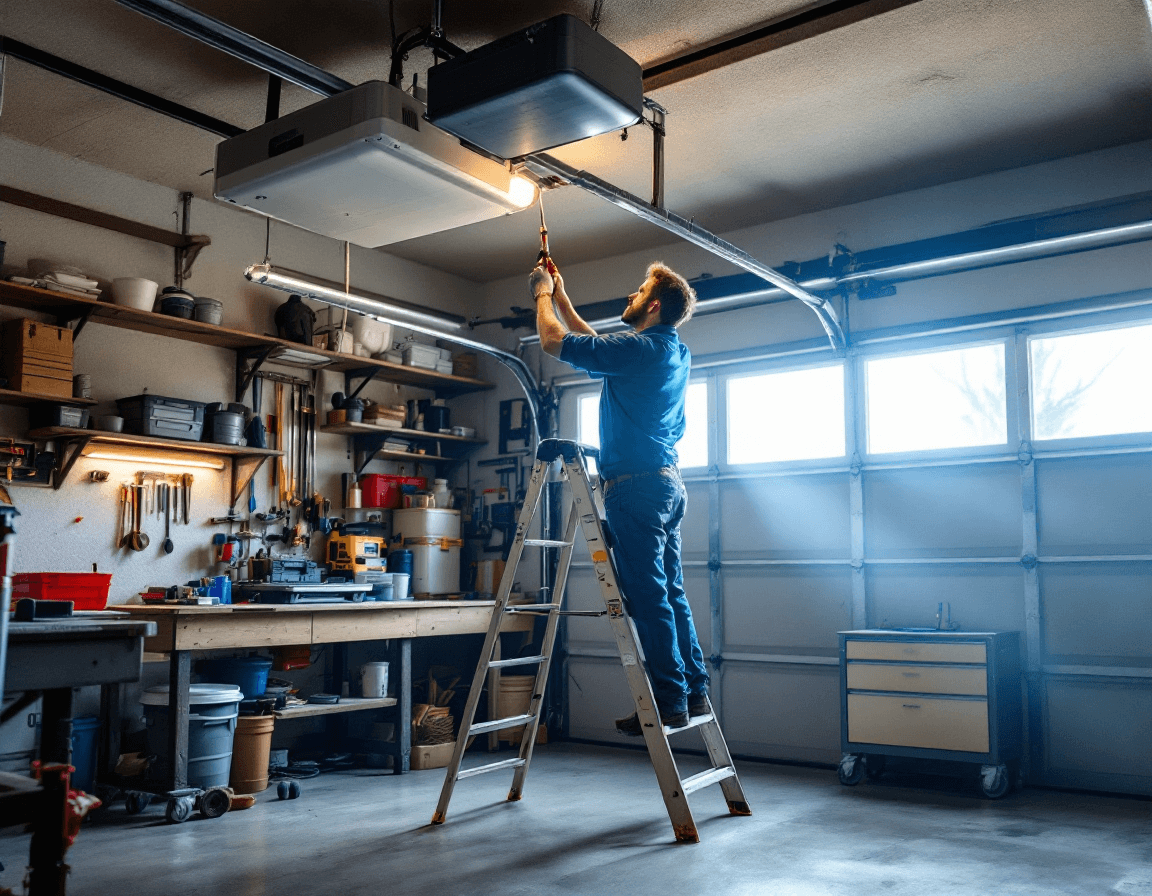
Garage Door Opener Repair in Brier, WA is a common need for homeowners across the city, whether the trouble is a motor that hums without moving the door or a remote that suddenly stops working. Brier sits in the hills and flats of south Snohomish County, where the mix of wet winters, cool summers, and frequent cloud cover puts steady wear on every part of a residential opener. Many of the calls we answer in 98036 start the same way: the homeowner noticed something odd a few weeks earlier and hoped it would go away on its own. Usually it doesn't, and a small adjustment or a worn component turns into a door that won't open when you need it most.
This page walks through the failures we see most often in Brier garages and explains what each symptom usually means. We cover openers from the major manufacturers, including the motor, gear, circuit board, and travel-limit problems that cause most service calls. Typical opener repairs in this area run from $95 to $375, depending on the fault and the parts involved. The goal here is practical: help you describe what you're seeing, understand what a technician will check, and know when a repair is a reasonable fix versus a sign the unit is nearing the end of its life.
Nothing here replaces an in-person inspection. Each garage has its own wiring, door weight, track alignment, and history, and a technician needs to see those details before recommending a specific fix. Use the sections below as a guide to narrow down the problem, then call us so a licensed technician can confirm the diagnosis and handle the repair safely.
Reading the Warning Signs Before a Full Failure
Most opener failures announce themselves well before the door stops responding altogether. A slight hesitation at the start of travel, a door that seems heavier than it used to be, or a faint new click at the end of the cycle are all early clues. In Brier, where a damp garage can slowly corrode contacts and where cold mornings thicken lubricants, these small changes often show up first during the fall and winter months. Paying attention to the pattern of behavior, rather than a single event, gives a technician far more to work with.
It helps to notice when the problem happens. Does the door act up only on the first cold morning of the season, or does it misbehave after a heavy rain? Does it work fine from the remote but fail at the wall button, or the other way around? Writing down the time, the weather, and the exact behavior takes a minute and can shorten a service visit considerably. Technicians rely on these details to separate a loose connection from a failing motor.
Ignoring early signs also carries a cost beyond inconvenience. A strained motor running on a worn gear can overheat, and an opener that repeatedly reverses can put unusual stress on the door panels and hinges. Catching the issue while it is still minor usually keeps the repair in the lower end of our typical range. Waiting until the unit stops entirely often means a larger bill and a rushed decision.
When the Motor Hums but the Door Stays Put
One of the more puzzling symptoms is an opener that clearly powers up, with the motor humming or the lights coming on, yet the door doesn't travel. Homeowners often assume the motor has died, but the cause is frequently somewhere else in the drive system. A disconnected trolley arm, a broken or slipping drive chain or belt, or a release cord that has been pulled can all produce this exact behavior. Each of these leaves the motor free to spin while the door sits still.
Technicians start by checking whether the trolley is still connected to the door arm and whether the release mechanism is set correctly. They look at the rail for debris, a bent section, or a spot where the carriage has jammed. On many residential units, a door that has been manually operated during a power outage will simply need to be reconnected. That's a quick fix, but it's worth doing carefully, because a trolley that is only partly engaged can drop the door unexpectedly.
If the drive components check out, the next suspect is the motor coupling or the internal drive gear. Motors in Brier garages can run warm during long summer evenings when the door cycles repeatedly, and that heat accelerates wear on the coupling. Our technicians test the motor's output and confirm whether the gearbox is transferring power. Depending on the brand and model, the repair may involve replacing a gear assembly, a drive coupling, or the motor itself, which is why a proper diagnosis matters before anyone orders parts.
Remote Silence and Dead Wall Buttons
When the remote stops working, the first instinct is often to blame the batteries, and that is sometimes correct. But Pacific Northwest humidity has a way of making things more complicated. Moisture can creep into remote housings, corrode battery contacts, and weaken the signal, so a remote that works in July may fail intermittently in January. Before calling for service, it is worth replacing the batteries and checking whether the remote works from a few feet away and from the other side of the garage.
If the wall button also fails, the problem usually sits in the wiring, the control panel, or the receiver. A wall button that has been exposed to damp air or a cracked wire at a staple point can cause the same symptom as a failed board. Technicians test voltage at the button, inspect the low-voltage run, and check for corrosion at terminals. Many of these faults are inexpensive to correct once located, but they can be hard to find without methodical testing.
A less obvious cause is interference. Newer smart-home devices, garage-area Wi-Fi equipment, and even certain LED lighting can affect how a receiver reads a signal. Our technicians will check whether the receiver is picking up the remote consistently and whether the antenna wire is positioned correctly. In some cases, re-learning the remote codes or updating the receiver's programming restores reliable operation without replacing any hardware.
Grinding Sounds and Stripped Gears
A grinding or clicking noise from the opener head is one of the sounds homeowners should not ignore. In most residential openers, the drive gear is made from nylon or a similar material meant to wear gradually. Over years of use, teeth can strip, shear, or develop flat spots, and the result is a rough, uneven noise that changes as the door moves. Once a gear starts to slip, the motor may still run but the door can stall, reverse, or jerk during travel.
Our technicians pull the cover, inspect the gear train, and check the worm gear or drive sprocket for wear. We also look at the lubrication. In a region where garages stay cool and damp for much of the year, old grease can thicken, pick up grit, or wash out entirely. Clean, appropriate lubrication can extend the life of a healthy gear, but it cannot restore teeth that are already broken. If the gear is stripped, replacement is the only reliable fix.
It's important to know that grinding can also come from a worn bearing, a loose mounting bracket, or a rail that is out of alignment. A technician will rule these out before recommending a gear replacement. Ask for a clear explanation of what is worn and why, and compare the quoted repair against the age and condition of the rest of the unit. Sometimes a gear repair makes excellent sense, and sometimes the better value is a newer opener with a warranty.
Doors That Close Partway or Reverse Immediately
A door that starts to close and then stops or reverses can be frustrating, especially when it happens every evening. This behavior is often tied to the safety system or the travel limits. Modern openers use photo-eye sensors near the floor and, in many models, a force setting that detects resistance. When the sensors are misaligned, dirty, or blocked, the opener assumes something is in the path and sends the door back up.
Start with the photo eyes. Check that both sensors are mounted at roughly the same height, usually a few inches off the floor, and that their indicator lights are steady. Cobwebs, dust, a bent bracket, or sunlight glare can all interrupt the beam. Our technicians clean the lenses, realign the sensors, and confirm the wiring is intact. Many homeowners are surprised how often a simple realignment resolves the issue.
If the sensors are fine, the force or travel settings may need adjustment. Over time, a door can develop slightly more friction in the tracks or rollers, especially after a damp winter. That extra resistance can trip the force limit even though nothing is physically wrong. A technician will check the door balance, the track alignment, and the limit settings together. Adjusting only the opener without addressing a binding track is a short-term fix, so we look at the whole system.
Blinking Lights and What the Patterns Mean
Many openers use the lamp or a status light to communicate basic faults through repeating flash patterns. The exact meaning varies by manufacturer and model, so the owner's manual is the best starting point. Generally, a steady pattern of quick blinks points to a sensor or safety circuit issue, while slower or irregular flashing can indicate a control board fault, a memory problem, or a remote that is being read incorrectly.
Homeowners in Brier often notice these patterns after a power flicker or a windstorm, when the opener loses power briefly and then reinitializes. In some cases the light is simply reporting that the travel limits need to be set again, or that a sensor was blocked during startup. Recording the number of flashes and the timing before calling makes it much easier for a technician to identify the fault. A quick phone description can help us bring the correct parts to the first visit.
Repeated flash codes that persist after a power cycle should be checked, not reset over and over. Resetting a board repeatedly can mask a failing component and occasionally cause unnecessary stress on the motor. Our technicians will read the fault history where the model allows it, verify the sensors and wiring, and confirm whether the circuit board is actually at fault. If the board does need replacement, we will explain why and what the new unit covers.
Loose Chains, Slipping Belts, and Rail Tension
Chain-drive and belt-drive openers are common in Brier homes, and both can develop slack or come off the track. A chain that sags will often rattle or skip, while a belt that loosens may slip on the pulley and cause the door to stall. Either situation can put strain on the trolley and the motor, and a chain that comes off entirely can leave the door disconnected and unpredictable.
Tension matters because the Pacific Northwest climate affects the rail, the chain, and the mounting hardware alike. Temperature swings change the metal slightly, and damp conditions encourage corrosion on fasteners. A technician will check the tension, inspect the chain or belt for stretching or cracks, and look at the rail for bends or loose brackets. Proper tension keeps the opener from overworking, and it also reduces noise and vibration through the ceiling.
Please do not attempt to force a chain back onto its sprocket or remove the rail in a rush. These components are under tension and can cause injury if released suddenly. Our technicians handle chain and belt replacement with the correct tools and the drive fully de-energized, and they will tell you if the rail or bracket needs attention before the new parts go on. A correct adjustment is quieter, safer, and far less likely to fail again.
Intermittent Problems and the Damp-Weather Factor
Some of the most stubborn calls involve openers that work reliably most of the time but fail unpredictably. A door might open perfectly for days, then refuse to respond on a rainy morning. These intermittent faults are often caused by moisture, loose connections, or a component that is beginning to fail under certain temperatures. The challenge is that the problem may not appear during a visit, which makes careful documentation even more valuable.
Brier's damp season can be hard on electrical connections, especially near the wall control, outlets in unfinished garages, and low-voltage wiring that runs through cold spaces. Water can wick along conductors, corrode terminals, and create high-resistance connections that behave well in dry weather and poorly in wet weather. Technicians check connectors, look for green or white corrosion, and test voltage under load. They also consider whether a nearby garage door, gate, or outdoor light is drawing enough power to cause a brief dip.
Intermittent failures sometimes point to a circuit board or a safety sensor that is starting to degrade. Those parts can work normally until a particular condition triggers them. Our approach is to test the system under the conditions where the problem occurs, whenever possible, and to replace only the component that is actually at fault. If the fault cannot be reproduced during the visit, we will tell you what we checked and what to watch for, so you are not left guessing.
What a Typical Brier Opener Repair Visit Covers
Homeowners often want to know what they are paying for before a technician arrives, so it helps to understand the usual flow of a service call. A typical visit begins with a conversation about the symptoms, the age of the opener, and any recent changes such as power outages or new remotes. The technician then inspects the door, the tracks, the opener head, the wiring, and the safety sensors. Only after this inspection does a repair recommendation come forward.
Most opener repairs we perform fall between $95 and $375, depending on the fault and the parts required. Lower-cost visits often involve sensor realignment, remote programming, travel-limit adjustments, or a minor wiring correction. Higher-cost repairs usually involve a motor, gear assembly, circuit board, or a combination of major components. We recommend discussing the diagnosis and the estimate before any work begins, so there are no surprises at the end of the visit.
It is also reasonable to ask how the repair was verified. A good technician will run the door through several complete cycles, check reversing behavior, test the remote and wall button, and confirm the travel limits. That final testing is what separates a repair that holds from one that returns in a week. Our technicians take that step on every opener repair, and they will walk you through the results before they leave.
Brand Coverage, Parts Choices, and Repair-or-Replace Decisions
Garage door openers come from several major manufacturers, and each has its own parts, programming methods, and diagnostic codes. Our technicians work on openers from the most common brands sold in the Seattle area, and we match the repair to the specific model rather than applying a one-size approach. That matters because a board or gear that fits one line may not fit another, even when the outside looks similar.
Choosing between a repair and a replacement is one of the most important decisions a homeowner can make. A relatively young opener with a single failed sensor, a worn gear, or a damaged control board is often worth repairing. An older unit with multiple failing components, outdated safety features, or parts that are no longer readily available may be a better candidate for replacement. Consider the age of the unit, the cost of the repair, and how much you rely on the door day to day.
When we recommend replacement, we will explain why in plain terms and show you what the repair would cost compared with a new opener. We do not believe in pushing expensive upgrades that you do not need. Our goal is to give you an honest recommendation that fits your garage, your budget, and the way your household uses the door.
Safety Limits: What to Leave to a Licensed Professional
Some garage door work is genuinely dangerous for homeowners, and it is important to know where that line sits. Torsion springs and extension springs store enormous amounts of energy, and a spring that releases unexpectedly can cause serious injury. Cable repairs, drum issues, and any work that involves the door's counterbalance system should always be handled by a licensed, insured professional. We are licensed, bonded, and insured, and our technicians follow strict safety procedures for every spring and cable job.
Homeowners can safely take a few simple steps before calling for service. Check that the opener is unplugged before inspecting the head, look for obvious debris in the track, and confirm that the photo eyes are clean and aligned. Test the remote batteries and note the exact symptoms. Those basic checks help us diagnose faster and reduce the time the door is out of service.
Please avoid these actions without professional help:
- Attempting to adjust or replace torsion springs or extension springs
- Removing or loosening cables under tension
- Forcing a stuck door open or closed by hand while the opener is engaged
- Disassembling the motor or gearbox without the correct training and tools
- Bypassing safety sensors or reversing mechanisms to make the door close
If you are unsure whether a task is safe, stop and call us. A quick conversation can prevent an injury and often saves time and money.
Garage Door Opener Repair in Brier, WA is best handled by someone who can see the whole system, from the opener head to the springs and safety sensors. If your door is acting up, call Seattle Garage Door Fix at (888) 799-3819 to schedule a diagnostic visit for your Brier home in the 98036 area. We will explain what we find, give you a clear estimate, and get your door moving again safely.