
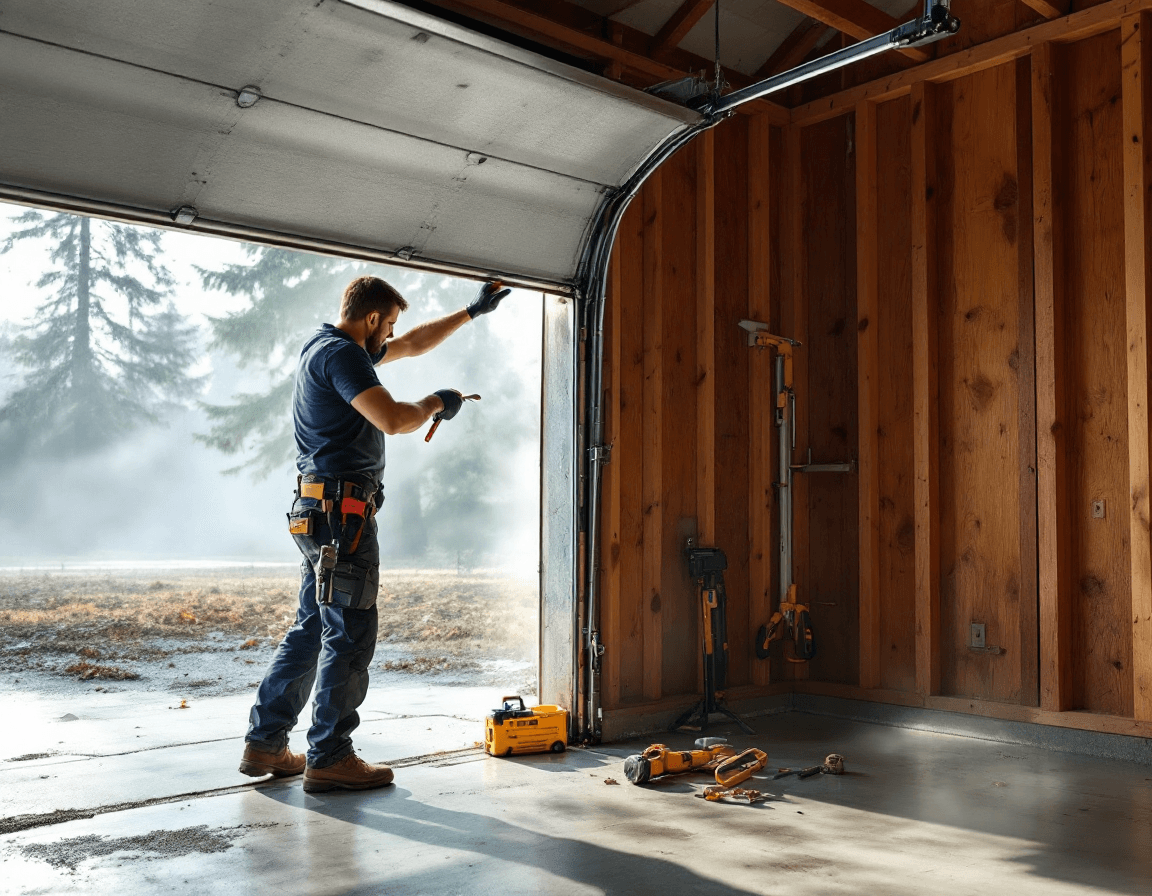
Off-track garage door repair in Snohomish, WA is a call we get often from homeowners in the historic downtown core and the residential streets that stretch out toward Clearview. A door that has jumped its track rarely gives much warning. One morning it is sitting a little crooked, or it stops halfway up with a grinding sound and refuses to budge in either direction. Older homes here, many built decades before modern door hardware became standard, often have tracks that have shifted slightly over time, so a small problem can turn into a stuck door quickly.
This page explains what usually causes a door to come off its track, what you can safely check yourself, and what a proper realignment involves. We also cover typical pricing, since most off-track repairs we handle fall in the $125 to $400 range depending on the damage and how much labor is required. Our goal is to help you understand what you are looking at before you decide how to proceed, whether you live in ZIP 98290, ZIP 98296, or anywhere else in the Snohomish area.
Nothing here replaces a hands-on inspection. Garage doors are heavy, the springs and cables are under serious tension, and a door that is partly off its track can shift without notice. Read through the sections below for background, and then call a licensed, bonded, and insured technician to do the actual work.
Why Snohomish Doors Tend to Drift Off the Track
The Pacific Northwest climate is hard on garage door hardware. Our long wet winters, damp spring mornings, and humid stretches in late fall cause steel tracks to collect moisture and surface rust, while wood and composite doors can swell and warp along their edges. A door that swells even a little can rub against the track rollers or bind in the curve, and over time that friction pushes the rollers out of their channels. Homes near the Snohomish and Pilchuck river corridors often sit in areas with higher ground moisture, which adds to the problem.
Age matters too. Many single-car and two-car garages in the older parts of town still run original or early replacement hardware, and the bolts that hold track brackets to the framing can loosen after years of vibration. When a bracket works loose even slightly, the track no longer holds its shape under load, and the door begins to ride out of alignment. We often find that what looked like a sudden failure was actually a slow loosening that had been building for a long time.
Vehicles bumping the door are another common cause, especially on driveways where parking space is tight. A side-mirror brush or a backing-up bumper can dent a track section or push a roller out of the channel in a single moment. These impacts are easy to overlook until the door starts making a new noise or sitting unevenly.
Recognizing When Your Door Has Come Off the Track
The most obvious sign is a door that is visibly out of its channel. Look at the vertical track on each side of the door and check whether the rollers are still seated inside the metal channel. If one side of the door sits lower than the other, or if there is a noticeable gap between the door edge and the track, the door has likely shifted out of position. Pay attention to any wobble when the door moves, because that often indicates a roller that has popped partly free.
Sound is another clue. A door that scrapes, clunks, or squeals as it travels is often rubbing against a bent track or a roller that is no longer riding in the groove. A jam, where the door stops and will not move up or down, usually means the track is pinching a roller or a section has separated from the bracket. Do not keep forcing the opener to push through a jam, since that can strip gears, burn out the motor, or put extra strain on the door panels.
Here is a quick checklist of the symptoms we see most often on off-track doors:
- The door is visibly crooked or sits lower on one side than the other
- Rollers have popped out of the vertical or horizontal track
- A gap has opened between the top or side edge of the door and the track
- The door jams partway through its travel and will not move in either direction
- A track section is bent, dented, or pulled away from its mounting bracket
- The door was recently struck by a vehicle or heavy object
If you notice any of these, avoid operating the door with the opener until it has been looked at.
Safety First: What Not to Do When a Door Is Off Track
Garage door springs and cables are the most dangerous components in the entire system. Torsion springs above the door hold enormous tension, and a spring or cable under load can cause serious injury if it fails or is handled incorrectly. A door that is partly off its track may also be hanging on cables or rollers in ways that are not obvious, and it can drop unexpectedly once you disturb it. For these reasons, nothing in this section should be read as a do-it-yourself guide to lifting, prying, or resetting a heavy door.
Please do not stand under a door that is off track, and do not try to lift it by hand to force it back into the channel. Do not attempt to adjust, loosen, or wind springs, and do not cut or remove any cable. If the door is stuck open or closed, keep children and pets away from the area and leave the manual release alone until a technician is on site. Disconnecting the opener and placing the door in a safe position is generally the most you should attempt on your own, and even that should be done carefully.
Spring and cable work must be handled by a licensed professional. A technician needs proper tools, training, and an understanding of how tension is distributed across the system before attempting any repair that involves those parts. Calling a licensed, insured technician protects you, your vehicles, and anyone who walks into the garage.
What a Professional Realignment Actually Involves
When a technician arrives for an off-track call, the first step is usually a full inspection of the door, tracks, rollers, hinges, brackets, and cables. The technician will check whether the door panels are intact, whether any hinges have torn free, and whether the track is still square to the opening. Many repairs are straightforward, but a thorough inspection helps identify whether the root cause is a single popped roller or a broader alignment issue.
For a simple roller that has popped out, the technician will safely support the door, guide the roller back into the track, and check that it turns freely and sits fully in the channel. A bent track section is handled differently. The technician may gently straighten the steel by hand with the right tools, or replace the section if the damage is too severe to restore safely. Loose brackets are tightened or replaced, and the vertical and horizontal runs are checked with a level and a measuring tape to confirm the door will travel smoothly.
Once the door is back on track, the technician will test the full range of motion several times. A proper realignment should produce a door that rises and lowers evenly, stays level, and does not rub or pull to one side. If the opener is involved, the technician will also confirm that the door is balanced and that the opener's force and travel limits are set correctly so the system does not strain when it runs.
Typical Pricing for Off-Track Repairs in Snohomish
Most off-track repairs we complete in the Snohomish area fall between $125 and $400. Where a job lands in that range depends on several factors: how far the door has come off the track, whether one roller or multiple rollers are involved, whether a track section needs straightening or replacement, and whether any brackets or hinges have been damaged. A simple re-seating of a popped roller on a standard residential door is usually at the lower end, while a jammed door with a bent track and damaged hardware will generally cost more.
It is worth understanding what can push a quote higher. If the door panels themselves are cracked, or if a section must be replaced to restore proper alignment, the final cost will reflect those parts. Likewise, if the spring or cable system has been damaged in the same incident, the technician will need to address that safely, and the scope of work will grow accordingly. A reputable technician will explain these details before starting the work so there are no surprises.
Keep in mind that the earlier you call, the more likely the repair will stay in the simpler range. A door that has been dragged or forced repeatedly can bend tracks, damage rollers, and stress the opener, which turns a modest realignment into a larger project. Addressing the problem promptly is usually the most cost-effective choice.
Choosing the Right Track Repair: Straightening Versus Replacing
Not every bent track needs to be replaced. Light dents and gentle bends in steel track can often be carefully straightened if the metal has not cracked or torn at the seams. This approach preserves the original hardware and keeps costs down, but it only works when the technician can restore the track to a true, consistent alignment. A track that has been straightened poorly may continue to cause binding or noise, so the quality of the work matters as much as the decision itself.
Replacement becomes the better choice when the track has cracked, when a seam has separated, or when the damage is severe enough that straightening would leave the metal weak. Replacing a section also makes sense when the existing track is badly corroded from years of moisture exposure, which is a common concern for homes that see sustained rain through the wet season. In those cases, a new section gives the door a reliable path and reduces the risk of a repeat failure.
When a technician recommends one approach over the other, ask why. A good explanation will reference the specific condition of the metal, the mounting points, and how the door has been moving. You should feel comfortable asking questions before approving any work on your door's tracks.
Preventing Future Derailments in a Wet Northwest Climate
Prevention starts with a simple habit: watch and listen to your door. Once a month, with the door closed and the opener disconnected, look at the tracks and rollers for visible gaps, debris, or rust spots. Gently test the door's balance by lifting it partway by hand and checking whether it stays put. If it drifts or feels unusually heavy on one side, the door may need professional attention before a derailment occurs.
Moisture management also helps. Keep the tracks clean and free of grit, since sand and debris tracked in from wet driveways can grind into the rollers and slowly wear the channel. A light coat of appropriate lubricant on the rollers and hinges, applied as directed for your hardware, can reduce friction, but avoid spraying lubricant directly onto the door panels or into the opener. Check the weatherstripping along the bottom and sides as well, since a swollen or stiff seal can add resistance.
Finally, plan for regular professional maintenance. A licensed technician can tighten brackets, check roller condition, inspect springs and cables, and confirm that the door balances properly before a small issue becomes an off-track emergency. Routine service is especially valuable for homes with older doors or for households that rely on their garage daily.
Protecting Your Door and Vehicles From Accidental Impacts
Vehicle impacts are one of the most avoidable causes of off-track doors. Driveways in Snohomish can be narrow, and vehicles backing in or out in the dark or in heavy rain may not judge the door's position accurately. A simple habit of marking the approximate stopping point on the driveway or garage floor can help drivers stay clear of the door's edge and tracks.
Consider adding a visible bollard, a floor marker, or a reflective strip at the bottom of the track area. These low-cost measures give drivers a clear reference point without changing the look of your home. If you have children or teenagers who park in the garage, talk through the risks, since a door that has been struck can drop or shift at any moment.
If your door has already been hit, do not assume it is fine just because it still moves. Impacts can bend tracks or pull brackets slightly out of line in ways that appear minor but cause binding later. A quick inspection after any collision, even a small one, can catch problems before they lead to a full derailment.
When to Call a Licensed Technician in Snohomish
You should call a licensed, bonded, and insured technician promptly if your door has come off a track, if a roller has popped out, if the door is jammed, or if you see visible bending or separation in a track section. Any situation involving springs or cables should be handled only by a professional, so if you are unsure whether the problem involves those parts, make the call and let a technician confirm. Waiting can allow a small misalignment to become a larger, more expensive repair.
Calling early also keeps your household safer. A door hanging partly off track can drop, and a jammed opener can overheat or fail. A technician can safely secure the door, diagnose the problem, and recommend the right repair, whether that is a simple roller re-seat or a track replacement.
For homeowners in Snohomish, ZIP 98290, ZIP 98296, and nearby neighborhoods including the blocks around Historic Downtown Snohomish and the Clearview area, our team is ready to help. We will walk you through what we found, explain the options, and give you a clear picture of the work before it begins.
Ready to Get Your Door Back on Track?
If your garage door has come off its track, is jammed, or looks crooked, do not try to force it. Call Seattle Garage Door Fix at (888) 799-3819 to speak with a licensed, bonded, and insured technician who can safely inspect your door, explain your repair options, and realign it so it runs smoothly again.