
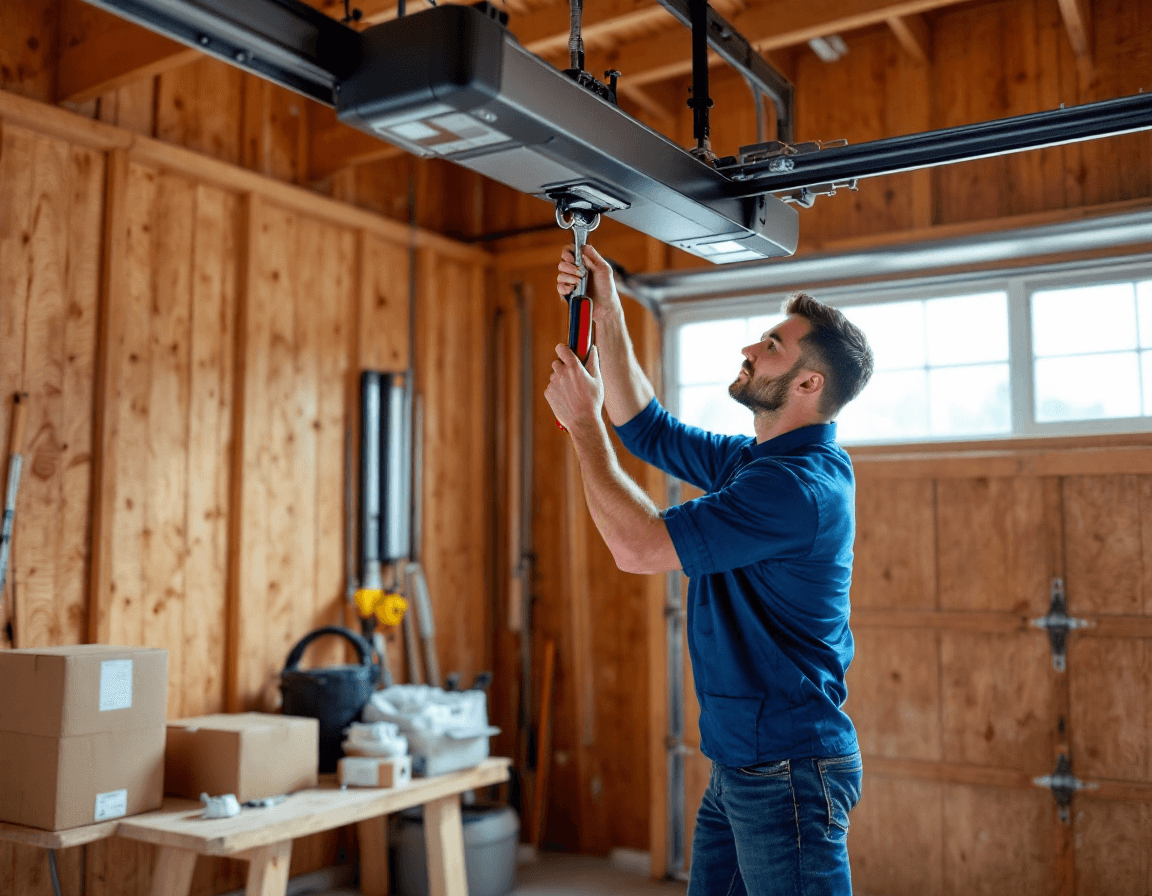
Garage door opener installation and replacement in Bothell, WA is one of the most practical upgrades a homeowner can make, and it is often more affordable than people expect. Whether your current opener has become loud enough to wake the kids, slow enough to make you wait on the driveway in the rain, or unreliable enough to leave you stranded, a properly sized new unit can restore smooth, secure operation. Installed pricing for our openers generally runs from $275 to $650, with the final number depending on the drive style, horsepower, features, and battery backup you choose.
Bothell sits in a part of King County where garage doors work hard. Winters bring long stretches of drizzle, cold mornings that dip near freezing, and humidity that lingers well into spring. Those conditions slowly stiffen lubricants, corrode hardware, and strain older motors that were never designed for the daily cycling many families now put on them. If your opener is more than a decade old, or if it has started behaving differently since the last cold snap, it is worth taking a close look at what it is telling you.
This page explains how we approach opener installation for homes in Bothell and nearby communities, including the ZIP codes 98011, 98012, and 98021. We cover the signs that replacement makes more sense than repair, the differences between belt, chain, and wall-mount designs, what rolling-code security actually does for you, and how battery backup and smart controls fit into daily life. Our goal is to help you make an informed decision before a technician ever touches your ceiling bracket.
Recognizing When an Old Opener Is Telling You It's Time
Most openers do not fail overnight. They give warning signs over months, and homeowners often adjust to those signs without realizing how much the performance has slipped. A unit that once lifted the door smoothly may now hesitate at the top of its travel, groan during startup, or shudder in the middle of a cycle. Each of those symptoms points to worn gears, a tired motor, or a trolley that has lost its alignment, and the cumulative wear is usually more than a single part can fix economically.
Noise is one of the most common complaints we hear from households in Bothell's denser subdivisions, where garages often share a wall with a bedroom or sit close to a neighbor's property line. A chain-drive opener running on worn bearings can sound like a metal cart rattling down a staircase every time it moves. If that noise has reached the point where you dread using the door before work or after a late night, the sound alone may justify replacement, especially when a modern belt-drive model can run at a fraction of the volume.
Reliability problems deserve just as much attention. If the door stops mid-travel, refuses to respond to the remote on certain days, or requires repeated button presses before it starts, the opener's logic board, limit settings, or force sensing may be failing. Repairs are sometimes possible, but when several components are close to the end of their life, paying for multiple service calls can quickly approach the cost of a new, better-protected unit. We will always give you a straight assessment of which path makes sense for your specific setup.
Belt-Drive, Chain-Drive, and Wall-Mount: Choosing the Right Style
The drive style determines how the opener moves the door, and it has a direct effect on noise, maintenance, and cost. Chain-drive openers are the most budget-friendly and handle heavy doors well, which is why they remain popular for detached garages in the area. They are also the loudest option, because metal links rattle against the rail as they pull the trolley back and forth. A properly lubricated chain-drive unit is perfectly serviceable, but homeowners who share a wall with living space often find the noise difficult to live with.
Belt-drive openers use a reinforced rubber or polymer belt in place of a metal chain. The result is a much quieter run, which many Bothell homeowners prefer when the garage is attached to the house or sits under a bedroom. Belts also require less lubrication and tend to hold up well in damp conditions, though they should still be inspected for tension and fraying during routine service. For most attached garages in our service area, a belt-drive model offers the best balance of comfort and long-term value.
Wall-mount openers attach to the side of the garage rather than hanging from the ceiling. They are a useful solution when ceiling clearance is limited, which happens often in older homes with low garage ceilings, or when the ceiling joists cannot safely support a traditional bracket. Wall-mount units also keep the motor out of the way of storage racks and bicycles. Because the installation geometry is different, a wall-mount system must be planned carefully so the arm and rail alignment stay true over many thousands of cycles.
Understanding Rolling-Code Security and Why It Matters
Older openers often use fixed-code remotes, meaning the signal from your transmitter is the same every time you press the button. That simplicity is part of the problem, because a fixed code can be captured and replayed by someone with inexpensive radio equipment. Rolling-code technology changes the signal with every use, so a captured code is useless the next time the door is opened. If your opener predates this standard, upgrading is one of the most meaningful security improvements you can make without touching the door itself.
Rolling-code systems do more than block casual interference. They also make it harder for an old remote left in a vehicle or a lost transmitter to keep working indefinitely. When you replace an opener, we can clear out outdated remotes, program new keypads or transmitters, and set up any secure access features your household needs. This is especially helpful for families who have had several moves, shared cars, or hired house sitters over the years.
It is important to be realistic about what security upgrades can and cannot do. A rolling-code opener does not replace good habits such as locking the door between the garage and the house, keeping vehicle doors locked, and never leaving remotes visible in a parked car. Think of the opener as one layer in a broader approach to home protection. We will walk you through the settings that matter most and explain how to keep the system current over time.
Smart Wi-Fi Control and Mobile App Integration
Smart openers have become popular with busy households in Bothell, Canyon Park, and the surrounding neighborhoods, largely because they let you check and operate the door from your phone. Many modern units connect to a home Wi-Fi network and work with mobile apps that send alerts when the door opens or stays open longer than expected. Some systems also support voice assistants, timed closing, and temporary access codes for delivery drivers or family members.
Connectivity deserves some planning. Garages are often at the far edge of a home's Wi-Fi coverage, and steel doors and concrete walls can weaken the signal. Before we install a smart unit, we will check how strong your network reaches the garage and recommend a mesh node or extender if needed. We also help you set up accounts, pair devices, and choose notification settings that do not overwhelm you with alerts every time the kids come home from school.
Smart features should be enabled with care. Remote access is convenient, but it works best when your phone, router, and app accounts are protected with strong passwords and updated software. We recommend turning on two-factor authentication where the app supports it and reviewing which users have access to the system. A few minutes of setup discipline makes smart control both convenient and responsible.
Battery Backup Options for Power Outages in Western Washington
Power outages are an occasional but real part of living in the Pacific Northwest. Windstorms, heavy rain, and falling branches can knock out electricity for hours, and in some cases longer. When the power goes down, a standard opener cannot lift or lower the door, which can leave you stuck inside or unable to get the car out. A battery backup system keeps the opener running during these interruptions so you can still operate the door manually or with the remote for a limited number of cycles.
Battery backup units are typically installed as an add-on or built into certain opener models. The capacity varies, so the number of cycles you get during an outage depends on the battery, the door weight, and how often you use it. For households with frequent outages or medical equipment that relies on the garage for access, backup power can provide real peace of mind. For others, it is a useful convenience that avoids the frustration of being trapped during a storm.
Backup batteries also have a lifespan, and they need periodic testing. We recommend checking the battery indicator during routine maintenance and replacing it when it begins to lose capacity. Keep in mind that a battery backup is not the same as a generator, and it will not power your lights or appliances. Its purpose is limited to keeping the garage door functional, which is exactly what most homeowners need.
Quieting Your Garage: Practical Steps for Noise Reduction
Even a new opener can be louder than expected if the installation is not optimized. We have seen homeowners in attached garages report that the sound travels through the framing and into living spaces, especially when the opener is mounted directly to a shared wall or a light ceiling. Good installation practices, such as using vibration isolation at the mounting points and ensuring the rail is properly supported, make a noticeable difference in how the system sounds indoors.
Door hardware also plays a role. Worn rollers, loose hinges, and a warped door panel can create rattles that people mistake for opener noise. During installation, we inspect the rollers, track alignment, and balance so the opener is not working harder than it needs to. A smoothly running door reduces the strain on the motor and keeps the sound level lower over the long term.
Simple maintenance helps too. Lubricating the track rollers and hinges, tightening loose fasteners, and checking the belt or chain tension once or twice a year keeps everything running quietly. Our technicians can show you exactly what to inspect so you know when something has changed. We always emphasize that these tasks should stop at the point where anything involving springs or cables begins.
Safety Features Every New Opener Should Include
Modern openers are built with safety systems that protect people, pets, and property. Photo-eye sensors mounted near the floor detect objects in the door's path and stop or reverse the door before it closes on something. Auto-reverse force sensing adds another layer by sensing resistance and reversing the door if it meets an obstruction. These features are essential, and they should be tested regularly to confirm they respond correctly.
Our installation process includes testing both the photo eyes and the force settings. We place a test object in the door's path and confirm that the door reverses within the proper distance. We also verify that the release mechanism works and that the emergency disconnect can be operated safely. These checks take time, but they are the difference between a reliable installation and a risk you might not notice until something goes wrong.
Here are several safety points we review with homeowners during every opener installation:
- Confirm that the photo-eye sensors are aligned, clean, and free of obstructions such as cobwebs or stored items.
- Test the auto-reverse function with a safe test object on a regular schedule, at least monthly.
- Keep the emergency release cord within reach, and make sure everyone in the household knows how to use it.
- Never allow children to operate remotes or wall controls near a moving door.
- Keep the wall-mounted control button out of reach and out of sight from the outside of the garage.
Please remember that spring and cable work is not a do-it-yourself task. Torsion springs and extension springs store enormous energy, and improper handling can cause serious injury. If your door needs spring adjustment, cable repair, or panel replacement, contact a licensed professional rather than attempting the work yourself.
Matching the Opener to Your Door Size and Usage
An opener is only as good as its match to the door it moves. Heavy insulated doors, oversized two-car doors, and doors with glass panels require more horsepower than a lightweight single-car door. Choosing an underpowered unit leads to strain, slow travel, and early failure, while an appropriately sized motor runs more smoothly and lasts longer. We measure the door's weight and dimensions during the consultation so the recommended model fits the actual load.
Usage patterns matter as well. A household that opens the garage several times a day, including multiple family members commuting in different directions, places more demand on the motor than a single driver who uses the door occasionally. Duty cycle ratings and build quality become more important in those situations. We will talk through how often your door is used and recommend a unit that can handle the real workload without running hot.
Some Bothell homeowners also use their garages as workshops, gyms, or additional living space. In those cases, the opener may be cycled far more often than typical, and it may need extra attention during maintenance. Let us know how you use the space so the recommendation reflects your daily routine rather than a generic average.
What Installation Day Looks Like and How to Prepare
A typical opener installation begins with removing the old unit, checking the door hardware, and confirming the mounting location. We inspect the ceiling joists or wall mounting surface to make sure they can support the new opener safely. If additional bracing is needed, we discuss the options before proceeding. Clear communication at this stage prevents surprises and keeps the project on schedule.
Once the mounting is secure, the rail is assembled, the trolley is connected to the door arm, and the power is wired to a properly located outlet. We then program the travel limits, test the force settings, and set up the remote controls and any smart features you selected. The final step is a walkthrough where we show you how the opener works, how to use the emergency release, and what routine care it needs.
To help the visit go smoothly, we suggest clearing the area around the garage door, moving vehicles out of the way, and letting us know about any preferences for remote placement or wall control location. If you plan to use a smart app, having your Wi-Fi password and account details ready will speed up setup. Our team handles the technical details so you can focus on getting back to your normal routine.
Frequently Asked Questions About Opener Replacement
Homeowners often ask how long a new opener lasts. Lifespan depends on the drive style, the quality of the unit, the door's weight, and how frequently it is used. With consistent maintenance and proper installation, many openers serve a household for many years, and belt-drive models often hold up especially well in attached garages. We are happy to discuss realistic expectations for your situation rather than promise a fixed number of years.
Another common question is whether the existing door will work with a new opener. In most cases, yes, because modern openers are designed to fit standard residential doors. However, the door must be in good mechanical condition, with balanced springs, sound tracks, and smooth rollers. If the door itself is the source of the problem, we will tell you that plainly and recommend the right repair before installing new hardware.
Finally, homeowners ask whether they can keep their existing remotes. That depends on the old system. Some fixed-code remotes will not work with a rolling-code receiver, and we can supply compatible transmitters during installation. We will explain your options and help you avoid buying hardware that will not match the new system.
Replacing an aging opener is a meaningful upgrade for any Bothell household, whether your priorities are quieter operation, reliable performance, stronger security, smart control, or backup power during outages. The right choice depends on your garage, your door, your daily routine, and your budget. If you are ready to talk through options or schedule an evaluation, call Seattle Garage Door Fix at (888) 799-3819. Our team serves Bothell, Canyon Park, North Creek, and surrounding communities, and we will help you find an opener that fits your home and your life.