
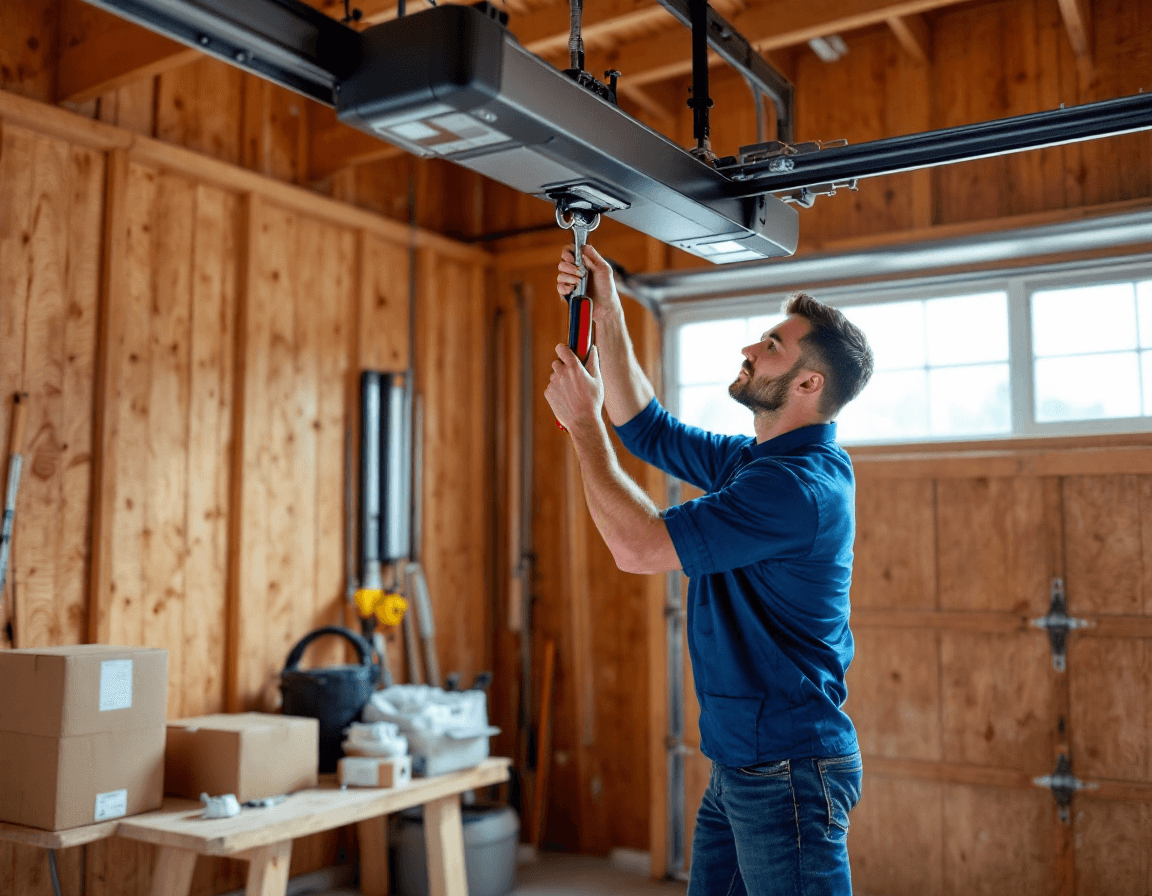
Garage Door Opener Installation & Replacement in Kenmore, WA is one of the most practical upgrades a homeowner can make to a garage that sees daily use. Kenmore sits on the northeastern shore of Lake Washington, where the Sammamish River meets the lake, and many homes here have attached garages that double as the main entry for families coming and going. When the opener fails, that entry point becomes a daily frustration, and a worn-out unit can leave you stranded in the driveway on a wet December morning. A modern opener solves more than the immediate breakdown. It also brings quieter operation, stronger security, and battery backup that keeps the door usable when the power goes out.
Our technicians serve Kenmore and the surrounding neighborhoods from our Western Washington service area, including homes within the 98028 ZIP code. We are licensed, bonded, and insured, and we handle both straightforward swap-outs and more involved jobs where the rail, header bracket, or door balance needs attention before a new opener can run safely. Installed pricing for most homes falls between $275 and $650, with the final number depending on the opener type, the features you choose, and whether any hardware needs replacing at the same visit. We will walk through those options with you before any work begins, so you know exactly what you are paying for.
This page explains how to tell when replacement makes more sense than repair, how the three main drive styles compare, why rolling-code security matters, and what to expect on installation day. It also covers smart control, battery backup, and the safety features that protect people and pets. Read through the sections that fit your situation, and call us at (888) 799-3819 if you would like a second opinion on your existing equipment.
Why Kenmore Garages Put Openers Under Pressure
Kenmore's climate is mild by most American standards, but it is persistently damp. Winters bring long stretches of drizzle and fog off the lake, and the humidity that settles into garages during those months is hard on electrical contacts, circuit boards, and the metal rails that carry the trolley. Many Kenmore garages are also unheated, so the temperature swings between a cold February night and a milder afternoon cause condensation on the inside of the door and on the opener housing. Over several years, that moisture works its way into wiring junctions and limit switches, which is one reason openers in this area often fail in intermittent ways before they quit altogether.
Homes near Kenmore Waterfront and along the lake's shoreline tend to see more moisture in the air than inland neighborhoods, and older garages in the area frequently have modest ceiling heights or sloped rooflines that limit where a rail can be mounted. Some homeowners also park vehicles with roof racks, kayak carriers, or bike hitches that change the weight the opener must lift. A unit that was sized for a compact sedan may struggle with a loaded SUV or a work truck, and the motor can overheat when asked to cycle repeatedly. These conditions do not make an opener defective, but they do shorten the life of a unit that was chosen without them in mind.
Wind is another local factor worth planning around. Kenmore neighborhoods are wooded in places, and during winter storms falling branches and utility disruptions can cut power for hours at a time. When that happens, a standard opener is just a dead box on the ceiling until the lights come back on. Thinking about how the garage will function during those outages is a good reason to revisit your opener, even if the current one still runs.
Reading the Warning Signs That Your Opener Is Finished
Most openers do not fail without warning. The first sign is often noise: a grinding, rattling, or whining sound during travel that was not present a few years ago. Loud operation can point to worn gears in a chain-drive unit, a stretched or cracked belt, or loose hardware that has been vibrating against the rail. Noise alone does not always mean the opener must be replaced, but when it comes with the other signs below, it usually indicates that the drive system is near the end of its useful life.
Slow or hesitant travel is another common symptom. If the door pauses halfway up, starts and stops, or takes noticeably longer to close than it used to, the motor may be struggling under load, or the force settings may have drifted. Unreliable behavior is more troubling. A door that opens from the remote one time and ignores it the next, or that reverses for no visible reason, can indicate a failing logic board, a remote receiver that is wearing out, or a safety sensor problem that a technician needs to diagnose before the next use.
Replacement also makes sense when repair costs begin to approach the price of a new unit. A circuit board, a motor, or a drive assembly may cost less to replace than the entire opener, but if the unit is more than ten years old, has several separate problems, or uses outdated components, investing in a new opener often gives you more reliability per dollar. We will give you an honest comparison, and if a repair is the sensible choice, we will tell you that as well.
- Grinding, rattling, or whining noise that is new or getting worse
- Door stopping midway, reversing without cause, or closing unusually slowly
- Remote controls that work only sometimes, or work only when you stand in one spot
- Visible wear on the belt or chain, or stripped and loose hardware on the rail
- An opener older than roughly a decade, or one whose manufacturer no longer supplies replacement parts
Belt Drive, Chain Drive, or Wall Mount: Matching the Hardware to Your Home
Choosing a drive style is the first real decision in an opener replacement, and each design suits different garages. A chain-drive opener uses a metal chain running along the rail to move the trolley. It is generally the most affordable option and handles heavy doors well, but it is the loudest of the three, and it can be noticeably noisy when the garage is attached to living space. Chain drives are a practical choice for detached garages, workshops, or homes where noise is less of a concern and budget is the main factor.
A belt-drive opener replaces the metal chain with a reinforced rubber belt. The belt runs quietly and smoothly, which makes it a popular choice for attached garages in Kenmore where a bedroom or home office sits on the other side of the wall. Belt-drive units usually cost somewhat more than chain drives, and the belt itself should be inspected periodically, since rubber can stretch or crack over time in the damp and temperature swings typical of the Puget Sound region. For most homeowners who want quiet operation without giving up reliability, a belt drive is the best all-around fit.
A wall-mount opener attaches to the wall beside the garage door rather than the ceiling, using a bracket and a mounted arm. This approach frees up ceiling space, which is valuable in garages where storage racks, bike hoists, or a ceiling-mounted heater already occupy the overhead area. Wall-mount units are also useful when the ceiling is too low for a conventional rail or when the header area is not strong enough to hold a ceiling bracket. Not every door and garage layout is compatible with a wall mount, so we will confirm that during an on-site inspection before recommending one.
Rolling-Code Security and Why an Old Unit Is a Liability
Older garage door openers often rely on fixed-code remotes, meaning the signal sent from the transmitter to the opener is the same each time. That predictability makes the system vulnerable, because a device that records the signal can later replay it to open the door. Rolling-code technology changes the code every time the remote is used, so a recorded signal is useless. If your opener predates rolling-code systems, upgrading is one of the most meaningful security improvements you can make, particularly if your garage door is visible from the street or if the house sits on a quiet residential lot.
Security is only part of the picture. A rolling-code opener also tends to be more dependable because it uses more modern receivers and logic boards. The remotes, keypads, and wall controls that come with newer units can be programmed to work together, and many models allow you to delete lost remotes from the system so that a misplaced transmitter cannot be used by someone who finds it. If your household has changed over the years or you have had a remote go missing, a new opener gives you a clean slate with fresh access codes.
When we replace an older opener, we set up the new unit with rolling-code protection, register your remotes and keypad, and show you how to remove any old devices from memory. We also check the condition of the door's hardware, since a loose bracket or worn hinge can interfere with a secure, smooth close even when the opener itself is working well. Security depends on the whole system, and we treat the door, the rail, and the opener as a single assembly during installation.
Smart Control, Wi-Fi, and Living With a myQ-Style App
Smart garage door openers connect to your home network so you can open, close, and monitor the door from a phone. Many homeowners appreciate being able to check whether the garage closed after a trip to the lake or Saint Edward State Park, or to let a delivery driver or family member in while you are away. Wi-Fi-enabled models typically pair with a manufacturer app, and some systems, including myQ-style platforms, support notifications when the door opens or stays open longer than expected.
Smart control is convenient, but it works best when the basics are right. A Wi-Fi signal needs to reach the garage, and in homes with thick walls, brick, or distant routers, a signal extender or a mesh node may be necessary. We check signal strength during installation and tell you honestly whether the garage location will support reliable connectivity. We also help you set up the app, create user accounts for other household members, and configure alerts so they are useful rather than noisy.
Smart features do introduce a few considerations. You will want a strong, unique password on your home network and on the opener app, and you should keep the firmware updated when the manufacturer releases improvements. If you prefer to keep the opener off the internet entirely, most smart models still work with standard remotes and wall controls, so you do not have to rely on the app for everyday use. We will recommend the setup that fits your habits rather than pushing features you will never use.
- Remote open and close from a phone, with alerts when the door is left open
- Shared access for family members, cleaners, or trusted neighbors, with the option to revoke it
- Compatibility checks for your Wi-Fi network, router band, and garage signal strength
- Standard keypad and wall-button backup so the door still works if the app or internet is down
Battery Backup When the Lights Go Out Near the Lake
Power outages in the Seattle area are often caused by windstorms that bring down limbs and lines, and Kenmore's tree-lined streets are no exception. When the power fails, a standard opener cannot move the door, which can leave you unable to pull a car in or out of the garage. Many modern openers offer a battery backup option that keeps the motor running for a limited number of cycles during an outage. The exact runtime depends on the model, the battery size, and the weight of the door, so we will confirm what a given unit can deliver before you buy.
Battery backup is especially useful for households that depend on the garage as their main entrance, for homes with medical equipment that requires moving in and out of the vehicle, or for anyone who wants to leave during a storm without the door becoming a barrier. Some backup systems also include a charging indicator and low-battery alert, which helps you keep the battery ready between outages. A backup battery needs occasional replacement, and we recommend checking it at least once a year, ideally before the wet season sets in.
A battery backup is not a substitute for a manual release. Every opener should have a red emergency release cord that lets you disconnect the trolley from the rail and operate the door by hand. Make sure everyone in the household knows where the cord is and how to use it safely. If the door is heavy or the springs are worn, do not attempt to force it open. Call a professional instead, because a door that has lost its balance can fall suddenly.
What Installation Involves, Step by Step
A typical opener installation begins with an inspection of the existing door, the tracks, the springs, and the header structure above the door. We confirm that the door is balanced and moves freely by hand, because an opener cannot compensate for a door that is binding, rusted, or out of level. If the door needs repair, we explain what is required and what it will cost before going further, since a new opener on a poorly balanced door will simply wear out faster.
Next, we select the right drive style and motor size for the door's weight and dimensions, then mount the rail and the motor unit. The rail must be aligned precisely with the door's center, and the header bracket must be secured to solid framing, not just drywall or thin trim. We install the trolley arm, connect the door arm to the door's bracket, and wire the power supply, which may require a dedicated outlet on a properly grounded circuit. Wall controls, keypads, and the safety sensors are mounted and aligned at this stage.
Once the hardware is in place, we program the travel limits so the door stops at the correct open and closed positions, set the force settings, and test the reversing function. We then register remotes and any smart features, confirm that the emergency release works, and walk you through the operation. A new opener should run quietly and smoothly from the first use, and if anything sounds or behaves unexpectedly, we return to adjust it before we leave.
Realistic Pricing Between $275 and $650
Installed pricing for garage door opener replacement in the Kenmore area generally falls between $275 and $650, depending on the model and features. Entry-level chain-drive units sit at the lower end of that range, while belt-drive, wall-mount, and smart models with battery backup tend to cost more. The final number also reflects any additional work the door needs, such as replacing a worn bracket, adjusting the balance, or upgrading the header hardware so the new opener can mount securely.
Some costs are easy to predict, and others depend on what we find during the inspection. A standard replacement on a sound door with an existing outlet is usually the simplest scenario. A garage that needs a new circuit, a relocated outlet, or a Wi-Fi extender will add time and materials, and we will quote those separately so you can decide what makes sense. We do not recommend upgrades you do not need, and we will tell you when a basic model will serve your household well.
We will provide a clear written estimate before any work begins, and we will explain the difference between the models so you can weigh the trade-offs. If you are comparing us with other options, ask what is included, whether the door's safety sensors and reversing system are tested, and whether the warranty covers both the parts and the labor. A fair quote should answer those questions without leaving you guessing.
Safety Systems, Sensors, and Reversing Protection
Every modern garage door opener is required to include entrapment protection, which means the door must reverse if it contacts an object while closing. Openers manufactured since the early 1990s use either a force-sensing system or photoelectric sensors mounted near the floor on each side of the door. These sensors send an invisible beam across the opening, and if the beam is interrupted during closing, the door stops and reverses. Keeping the sensors clean, aligned, and free of obstructions is one of the most important maintenance tasks a homeowner can perform.
Sensor problems are common in damp garages. Cobwebs, dust, and salt-laden grime from winter roads can block the lens, and a bump from a bicycle or a shifted sensor bracket can knock the alignment off. When the sensors are misaligned, the door may refuse to close or close and then reverse for no apparent reason. Our technicians test the reversing function as part of every installation, and we will adjust or replace sensors that are not working correctly. Never bypass the sensors to make a door close, since that defeats a safety system designed to protect children and pets.
Spring and cable work deserves special caution. Torsion springs and extension springs store a large amount of energy, and cables can fail under tension. Adjusting, replacing, or repairing these components is dangerous and should only be handled by a licensed professional with the proper tools and training. If your opener installation reveals a broken spring or frayed cable, call us so the door can be repaired safely before the new opener goes in.
Choosing a Technician and Keeping Your Opener Working Year-Round
Choosing the right technician affects how well your new opener performs for years. Look for a company that is licensed, bonded, and insured, and that will inspect the door before recommending equipment. A good technician explains the difference between drive styles, shows you how the safety features work, and gives you a straightforward estimate. They should also be willing to answer questions about the warranty and what happens if something goes wrong after installation.
Routine care helps a new opener last. In the Kenmore climate, it is worth wiping down the rail and door tracks a couple of times a year, checking the belt or chain tension, and inspecting the safety sensors for dirt or misalignment. Lubricate the moving hinges and rollers with the type of lubricant the manufacturer recommends, and avoid using household products that can attract grit or damage plastic components. Testing the emergency release and the battery backup at least once a year will confirm that both are ready when you need them.
Keeping the garage dry also protects the opener. Good weather sealing around the door, a dehumidifier if the space stays damp, and prompt attention to water intrusion will reduce corrosion and electrical problems. If you notice new noise, slow travel, or erratic behavior after installation, call us early rather than waiting for the problem to grow. A quick adjustment often prevents a larger repair later.
If your garage door opener is loud, slow, unreliable, outdated, or unable to run during a power outage, Seattle Garage Door Fix can help you choose and install the right replacement for your Kenmore home. Our licensed, bonded, and insured technicians will inspect your door, explain your options in plain terms, and provide a clear quote between $275 and $650 installed, depending on the model you select. For spring, cable, or any other high-tension door work, always rely on a licensed professional rather than attempting it yourself. Call (888) 799-3819 today to schedule your inspection and get your garage working safely and reliably again.