
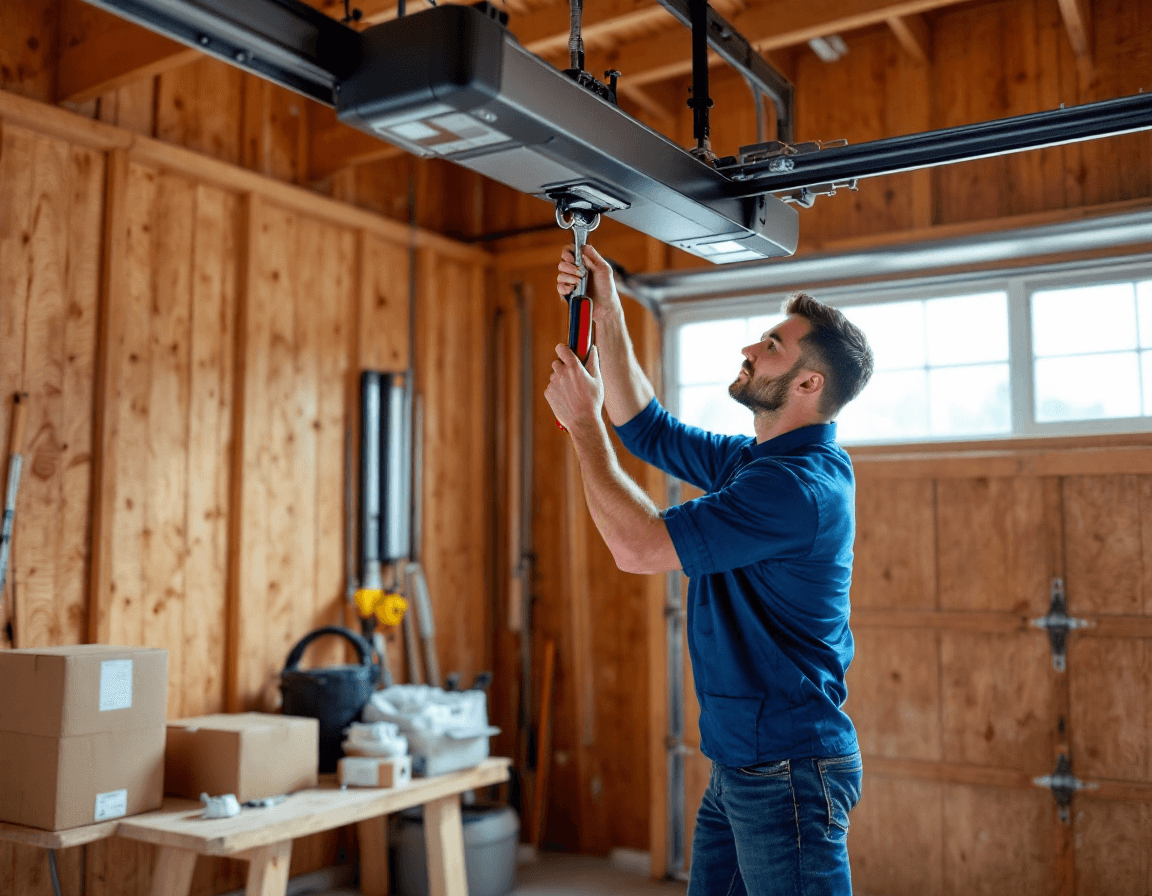
Garage Door Opener Installation & Replacement in Lake Forest Park, WA is one of the most practical upgrades a homeowner can make to the garage, and it often gets overlooked until the old unit fails at the worst possible moment. Many houses in Lake Forest Park, including homes near the 98155 ZIP code, still run openers that were installed a decade or more ago. Those units may still lift the door, but they often do it loudly, slowly, or with a hesitation that tells you something has changed inside the motor, the logic board, or the rail. A replacement opener solves those problems and adds features that did not exist when the old unit was built.
This page explains how we approach opener installation and replacement for Lake Forest Park homeowners, from diagnosing whether repair still makes sense to choosing a drive style that suits your garage. We work across the greater Seattle and Western Washington area, and we know how our local weather, older housing stock, and daily driving patterns affect the equipment. If you are reading this because your opener is making a grinding noise, refusing to close, or leaving you locked out during a power outage, the information below should help you decide your next step with confidence.
We are a licensed, bonded, and insured garage door company, and we treat every opener job as a combined electrical, mechanical, and safety task. Whether you are replacing a single unit or upgrading an entire household's access setup, our goal is a quiet, dependable system that you understand well enough to operate without frustration. Call (888) 799-3819 if you would like a technician to look at your current setup.
Why Lake Forest Park Garages Put Extra Strain on Openers
Lake Forest Park sits in a part of King County where rain is a near-constant companion for much of the year, and that moisture reaches the garage in ways homeowners do not always notice. Humidity swings between damp winter weeks and drier late summers can cause metal rails to develop surface corrosion, and it can soften or swell the weatherstripping that keeps water from creeping under the door. When the door track picks up grit from wet driveways, the opener has to work harder to start and stop the door, which shortens the life of gears, limit switches, and the carriage that rides along the rail. Many local garages are also detached or tucked beside older homes where the wall is shared with a damp crawlspace or a shaded side yard, and those conditions keep the mounting surfaces cold and moist.
Temperature matters too. On the coldest mornings, lubricants stiffen and the door can feel heavier, which pushes the motor toward its limit. Some owners see a fresh opener strain only in winter and assume the unit is defective, when the real problem is an aging drive that has lost efficiency. A proper inspection looks at the entire system, including door balance, track alignment, and the condition of the rollers, before deciding whether the opener is the true culprit.
Seasonal rain also introduces electrical considerations. Outlets in older garages may lack proper weather protection, and a damp receptacle can cause intermittent resets that look like opener failure. We check the power supply, the outlet, and the wiring path as part of any replacement so that a new unit does not inherit an old problem.
Reading the Signs That Your Current Opener Is Finished
Not every noisy opener needs replacing, but certain patterns strongly suggest that repair costs will climb faster than the value of the unit. Homeowners often describe their openers as "acting up" when what they really mean is that the motor runs hot, the door stops partway through its travel, or the remote no longer responds consistently. Paying attention to these details helps you separate a fixable adjustment from a unit that has reached the end of its service life. Here are the signs we see most often in Lake Forest Park homes:
- The opener is loud enough that neighbors notice it, often with a rattling or clicking that changes as the door moves.
- The door opens or closes noticeably slower than it used to, or it pauses mid-travel before finishing.
- The unit overheats, shuts off after a few cycles, or needs several minutes to cool before it will run again.
- The safety reversal sensors work intermittently, or the door reverses for no clear reason.
- Replacement parts are no longer manufactured for the model, which makes repair expensive or impossible.
When two or three of these symptoms appear together, the opener is usually nearing the end of its useful life. Repairing one component may keep the door working for a while, but the remaining parts tend to fail in turn. Replacement gives you a known warranty, current safety features, and a motor sized for the door you actually have. We will always walk you through the diagnosis before recommending a new unit, so you can compare the cost of repair against the cost of a fresh installation.
Belt-Drive, Chain-Drive, or Wall-Mount: Matching the Drive to Your Garage
Choosing the right drive style is the most important decision in an opener replacement, and it depends on how your garage is built and how you use it. Chain-drive openers are the traditional choice. They are durable, relatively affordable, and handle heavier doors well, but they are louder because metal links run over a metal sprocket. Belt-drive openers use a reinforced rubber belt, which runs much more quietly and smoothly. For homes where the garage shares a wall with a bedroom, a home office, or a neighbor's yard, belt-drive is often the best upgrade. The quieter operation is especially noticeable in the early morning or late evening, when the rest of the house is still.
Wall-mount openers are a different category. Instead of hanging from the ceiling, the motor mounts to the wall beside the door, which frees up overhead space in garages where ceiling height is limited or where storage racks and bike hoists occupy the rafters. Wall-mount units can be a good match for tall doors in older Lake Forest Park homes that have only modest headroom, but the mounting surface must be solid and properly braced. We inspect the wall and the framing before recommending a wall-mount unit so that the motor is not asked to vibrate against drywall or a weak header.
Our advice is simple: if the garage is attached and shares a living wall, lean toward belt-drive. If the garage is detached and noise is less of a concern, chain-drive may give you the best value. If ceiling space is the limiting factor, a wall-mount model is worth discussing in detail. Each option can be paired with smart controls and battery backup, so the decision is mostly about sound, space, and budget.
Rolling-Code Security and What an Older Unit Leaves Exposed
Security is one of the strongest reasons to replace an older opener. Units manufactured before rolling-code technology used fixed codes, meaning the same signal was sent every time you pressed the remote. A determined person with inexpensive equipment could capture that signal and reuse it. Rolling-code systems change the transmitted code with every use, so a captured signal becomes useless almost immediately. If your opener is old enough that it still relies on fixed-code remotes or hardwired keypads with simple dip switches, replacing it is one of the most effective security upgrades you can make without touching the door itself.
Beyond the remote, consider the other openings into your garage. Many homeowners forget about the wall-mounted keypad, the vehicle visor remote, and any programmed buttons inside the house. A modern opener lets you audit and reprogram these devices, delete old remotes that belonged to former tenants or family members, and set a PIN for keypad access. We walk every customer through clearing outdated remotes during installation so that nothing from the old system remains active by accident.
We also discuss the physical side of security, including the emergency release cord, which should be checked for wear and kept at a height that does not allow someone to reach it through a gap or open window. The emergency release is a useful tool during outages, but it should be accessible only to the people who live in the home, and it should never be left dangling where it can be pulled from outside.
Bringing the Door Onto Wi-Fi and myQ Without the Guesswork
Smart control has become one of the most requested features in opener replacements. Wi-Fi-enabled openers and compatible smartphone apps let you see whether the door is open, close it from the car, and receive alerts when it moves. Many systems are compatible with myQ-style ecosystems, which can also connect with certain voice assistants and smart home routines. For households where people come and go on irregular schedules, the ability to confirm a closed door from a phone is often the feature homeowners value most.
Setting up smart control involves more than downloading an app. The opener must sit within reliable range of your home network, which can be a challenge in garages that are far from the router or that sit beneath a thick-walled portion of the house. We test signal strength during installation and recommend a Wi-Fi extender or a relocated router when the connection is weak. We also help you create a secure account, enable two-factor authentication where available, and confirm that guest access is limited to people you trust.
Our technicians set up each smart opener on site and confirm that the app, the keypad, and the remotes all function as expected. We explain what happens when your internet goes down, because the opener should still operate with its physical remotes and keypad even when the cloud connection is unavailable. Smart features are a convenience, and the basic mechanical function of the door should never depend on them.
Keeping the Lights On: Battery Backup for Outage Days
Power outages are a regular part of life in the Pacific Northwest, especially during windstorms that bring down branches across roads and lines. When the power goes out, a standard opener cannot lift the door, which leaves you stuck inside or unable to get the car out without manual effort. Battery backup units solve this by keeping the opener running for a limited number of cycles during an outage. They also keep the keypad and remote receiver active, so you can operate the door without walking outside into the dark or the rain.
The amount of runtime depends on the backup model, the weight of the door, and how often the door cycles while the battery is in use. We are careful not to overpromise here, because actual performance varies by installation and by how the battery is maintained. What we can say is that battery backup gives you a meaningful margin during short outages, and that it is far easier to add during a new installation than to retrofit later. Batteries also need periodic checks, so we show customers where the battery sits, how to test it, and when it should be replaced.
Backup power is especially valuable for households with elderly family members, people who rely on medical equipment that charges in the garage, or anyone who parks an electric vehicle in the garage and needs to leave on short notice. When the power is out, the battery keeps the door usable without requiring an extension cord, a generator, or a ladder.
What a $275 to $650 Installed Price Actually Covers
Our installed opener pricing generally falls between $275 and $650, depending on the model you select and the features it includes. The lower end of that range typically covers a reliable chain-drive unit with standard remotes and a basic keypad, while the higher end reflects belt-drive or wall-mount models, smart Wi-Fi control, and battery backup options. Those are the ranges we quote, and the final figure depends on the equipment you choose and the conditions we find when we arrive. We always explain the options before any work begins, so there are no surprises on the invoice.
A typical installed price includes removing the old opener, mounting the new unit, connecting power, aligning the door's safety sensors, programming remotes, and testing the full cycle. It also includes verifying that the force settings and auto-reverse function meet safety requirements. If the door needs adjustment, the balance or track alignment may require additional work, and we will tell you before proceeding. Replacement hardware such as brackets, a new rail section, or updated sensors may also be quoted separately when the existing parts cannot be reused.
When comparing estimates, look for a written description of what is included, the warranty terms on both the opener and the labor, and the features listed by model name. A low quote that leaves out sensor alignment, remote programming, or disposal of the old unit is not really a low quote. We would rather give you a clear, complete estimate that you can compare fairly with any other proposal you receive.
Our Installation Sequence, Step by Step
A well-run opener installation follows a sequence that protects both the equipment and the people using the garage. We begin with a visual inspection of the door, the tracks, the springs, and the existing wiring. This step tells us whether the door is balanced and whether the new opener can be mounted safely. We also confirm that the ceiling or wall can support the motor and that the rail is straight enough for smooth travel. If we find a problem that affects safety, we stop and explain it before continuing.
Next, we disconnect the old opener and remove it carefully. The new unit is assembled, hung or mounted according to the manufacturer's instructions, and connected to the power supply. We then install the door brackets, check the rail alignment, and adjust the travel limits so the door stops at the correct open and closed positions. Safety sensors are mounted near the floor on each side of the door, aligned so their beams cross cleanly, and tested to confirm that the door reverses when the beam is interrupted.
Finally, we program the remotes, keypad, and any smart control features, and we run the door through many complete cycles to confirm smooth operation. We also test the battery backup if one is installed, and we walk you through the emergency release, the reset steps, and the basic maintenance schedule. Before we leave, you should know exactly how the system works and feel comfortable operating it on your own.
Matching Horsepower and Door Weight to the Right Motor
Choosing an opener with enough power is essential, and this is an area where guesswork causes problems. A motor that is too weak will strain under the door's weight, overheat, and wear out quickly. A motor that is far too powerful is not necessarily a problem, but it may cost more than the job requires. We evaluate the door's size, material, insulation, and any added hardware such as windows or decorative trim. Insulated steel doors, wood doors, and heavier custom panels all demand different levels of lifting force.
Door balance matters just as much as motor horsepower. A door with worn or improperly tensioned springs can place a far heavier load on the opener than the door should carry. In that situation, a new opener will still struggle, and it may fail early. Our installers check the balance of the door before recommending a motor, because the most accurate way to size an opener is to confirm how the door behaves when it is lifted manually. If the springs are the problem, we explain that the repair is a separate task and should be handled by a licensed professional.
We also consider how often the door cycles. A household that opens the garage several times a day, or that uses the garage as the main entry, benefits from a motor rated for frequent use. Choosing the right rating prevents overheating and extends the life of the unit.
Safety Limits: What We Handle and When a Pro Must Take Over
Garage doors are heavy, and the springs that counterbalance them store enormous tension. Our policy is clear: spring replacement, cable repair, and any work on the torsion or extension springs must be handled by a licensed professional with the right tools and training. Attempting these repairs without proper equipment can cause serious injury. Even experienced homeowners should not adjust spring tension or pull on cables that are frayed, stretched, or off the drum. If you hear a loud bang from the garage or notice the door hanging unevenly, stop using it and call for help.
Opener installation itself involves electrical connections, mounting hardware, and programming, and it should be completed by a qualified technician who follows the manufacturer's instructions and local electrical requirements. We recommend against DIY wiring, particularly in garages where moisture can reach outlets or junction boxes. A properly grounded circuit, correct breaker sizing, and weather-appropriate fittings all matter in Lake Forest Park's damp climate.
Safety sensors and auto-reverse testing are non-negotiable. After any installation or adjustment, the door must reverse when an object is placed in its path and stop safely. We test this function before we leave every job, and we recommend that you test it periodically on your own by placing a piece of wood on the floor under the closing door. If the door does not reverse, do not use it until it has been inspected.
Booking Your Lake Forest Park Opener Upgrade
If your opener is loud, slow, unreliable, or lacking modern security, the best next step is a professional assessment. We will check the door balance, test the existing opener, confirm whether repair is practical, and recommend a drive style and feature set that fits your home. Lake Forest Park homeowners near the Towne Centre, the Sheridan Beach area, and throughout the 98155 ZIP code can schedule a visit with a licensed, bonded, and insured technician who knows how Pacific Northwest weather affects garage equipment. Expect a clear explanation of your options, a written estimate in the $275 to $650 installed range depending on the model, and a full test before we leave.
To get started, call Seattle Garage Door Fix at (888) 799-3819 and describe what your opener is doing. We can talk through your symptoms, your garage layout, and whether you want belt-drive quiet, wall-mount space savings, smart control, or battery backup for outage days. A single call can save you from a stuck door on a rainy morning.