
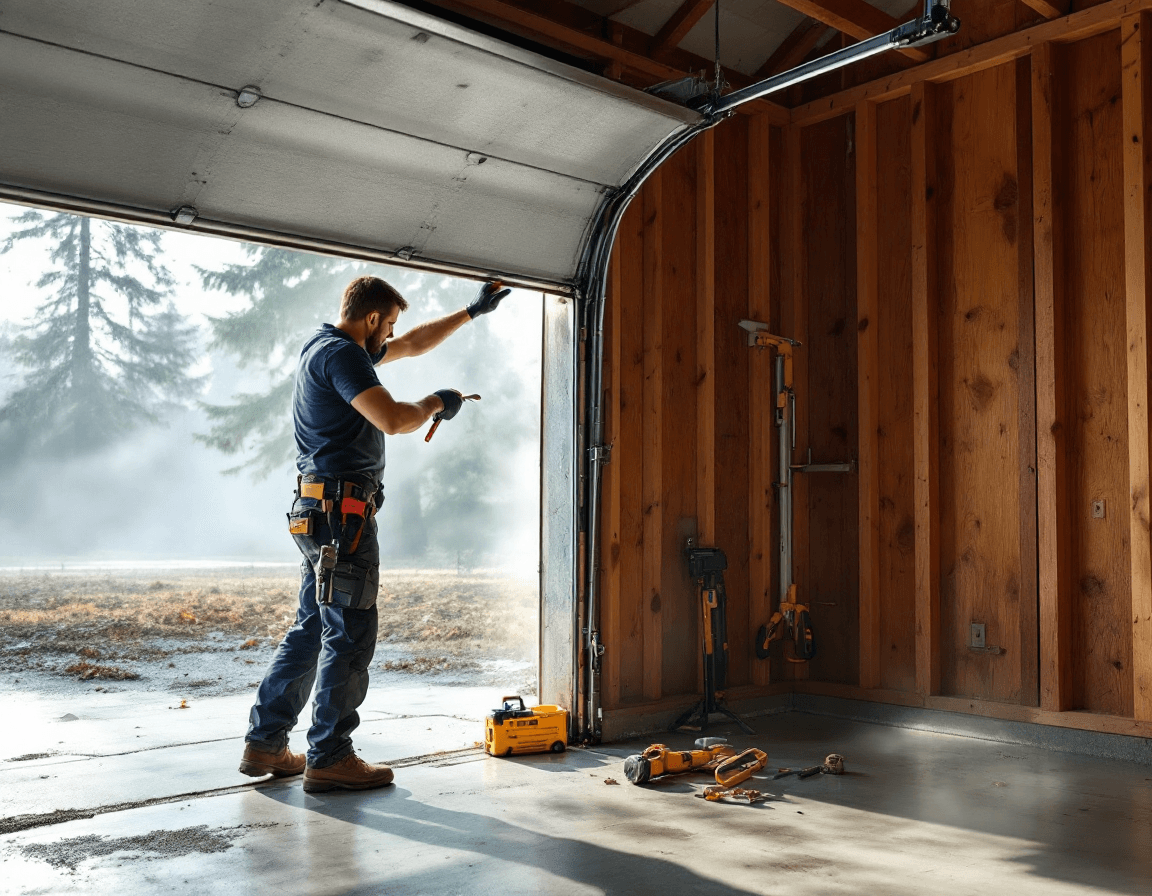
Off-track garage door repair in Lake Forest Park, WA is one of the most common calls we take from homeowners on the north end of King County, and it is rarely a sign that a door is beyond saving. When a door jumps a track, the usual causes are a roller that has slipped out of its channel, a track section that has been knocked out of plumb, or a panel that has shifted enough to bind. Most of these problems can be corrected in a single visit, often for a cost in the $125 to $400 range, provided the work is done carefully and the door's springs and cables are left alone. A door that is hanging crooked, stuck halfway up, or sitting visibly away from one side of its track is telling you something specific, and the sooner you listen, the less likely a small problem turns into a damaged panel or a burned-out opener.
Lake Forest Park sits in a part of Western Washington where the weather rarely gives a garage door a rest. Winters bring long stretches of rain, damp air rolls in off Lake Washington and the surrounding hills, and the ground stays soft enough that vehicles and yard equipment get parked, bumped, and driven in ways that a rigid steel track was never designed to absorb. Homes near the Burke-Gilman corridor, in the neighborhoods that stretch toward Sheridan Beach, and along the arterials that connect to Ballinger Way all face the same mix of moisture, road traffic, and seasonal swings. This page explains what causes off-track doors in 98155 and the surrounding area, how a technician approaches the repair, what it typically costs, and when you should stop and call in a professional rather than attempting a fix on your own.
If your door has already come off, the most important thing you can do is stop operating it. Do not keep pressing the opener to see whether it will "catch," and do not try to lift the door by hand from the middle while the springs are under load. The sections below walk through what we look for, what we do, and what is best left to a licensed technician. For immediate help, call Seattle Garage Door Fix at (888) 799-3819.
Why Doors in Lake Forest Park Leave the Track More Often in Wet Seasons
Garage doors do not usually jump their tracks without warning. In the Pacific Northwest, the slow accumulation of moisture, temperature swings, and soft ground conditions tends to loosen hardware and shift alignment long before a door actually comes off. Wood framing around the opening can swell after a wet January and then dry out unevenly by summer, which slightly changes the distance between the track mounts and the door edges. Steel tracks themselves expand and contract a little with temperature, and a track bolted to a frame that has moved will sit at a new angle even though nothing looks obviously wrong.
Rollers are the other big factor. The nylon or steel-tire rollers that ride inside each track wear down over years of opening and closing, and once the stem or the bearing becomes loose, the roller can wander sideways and eventually pop out at the bend where the track curves from vertical to horizontal. Many homes in the area have doors that have seen more than a decade of daily use, and a roller that was perfectly fine during a dry summer can start to bind when the hinges and bearings are stiff from damp weather. We often find that what looked like a sudden derailment was really a slow drift that finally crossed a tolerance threshold.
Lake Forest Park also has its share of older detached garages and converted outbuildings where the door opening was never perfectly square to begin with. A garage that was framed on a slight slope, or where the concrete apron has heaved from tree roots, can put uneven stress on one side of the door every time it opens. Over time that imbalance pulls one roller harder against the track than the other, and the door begins to skew. Recognizing that the problem started with the building, not just the door, helps us decide whether a simple realignment will hold or whether the track mounts need to be reset as well.
Reading the Early Signals Before a Door Fully Derails
Most homeowners notice an off-track door only after it has gone fully sideways, but there are usually earlier clues. A door that rises with a scraping or grinding noise on one side, or a door that seems to pause briefly before finishing its travel, is often showing that one roller is starting to ride up against the lip of the track. Watch the gap between the bottom weatherstrip and the floor as the door closes. If one end sits noticeably lower or higher than the other, the door is already out of level and the rollers on the low side are carrying more of the load.
Visual inspection from the outside can reveal a lot. Stand in the driveway or on the walkway and look at the top edge of each section where it meets the header and the sides of the opening. Panels that have started to bow outward, gaps that widen at the top corners, or a visible tilt in the vertical track when compared to the door edge are all signs that alignment has slipped. Some homeowners also notice that the door no longer seals cleanly against the weatherstrip during the rainy months, which can mean the bottom panel has rotated slightly under uneven tension.
Listen for changes in the sound the opener makes. A motor that strains, clicks, or runs for several seconds before the door starts to move may be fighting a binding roller or a track that has come out of plumb. Some openers will also reverse or stop partway through a cycle when they sense resistance, which is a safety feature doing exactly what it was designed to do. If you notice any of these patterns, shut the door, avoid repeated cycling, and schedule a service call before the next storm. Catching the problem at this stage often means a repair that is quicker, simpler, and well within the typical $125 to $400 range.
What a Technician Checks First on an Off-Track Call
When we arrive at an off-track call, the first step is not to touch the door. We start by observing the door in its current position and comparing it to the track on both sides. We look at which rollers have left the track, whether the door is resting on its bottom bracket or hanging from a single point, and whether any panel has separated from its neighbor. We also check the position of the spring system and the cables, because those components determine how the door will behave the moment it is moved, and we confirm that the door is fully disengaged from the opener before anything is lifted or repositioned.
A thorough off-track inspection usually covers several specific points. We look at each of these before deciding what the repair will involve:
- Roller condition, including worn tires, cracked stems, and bearings that have lost their smoothness
- Track alignment at the vertical run, the curve, and the horizontal run, measured for plumb and level
- Mounting brackets and bolts for loosening, stripping, or pulling out of the wall framing
- Hinges between panels for bending, separated rivets, or missing fasteners
- The bottom bracket and bottom panel for distortion that might be dragging the door off the track
- Cable and drum condition, observed only visually and never adjusted without the proper tools
- Opener travel limits and safety reversal settings, to confirm the electronics are not making the problem worse
Once we know what has happened, we can outline the repair. In many cases the fix is a matter of re-seating a roller, loosening and re-tightening a track bracket, or tapping a track section back into line. In other cases, particularly after an impact, a track or panel may need to be replaced or reshaped. We explain each step before we begin, and we tell you if the repair will involve work on the spring system, which is always handled by a licensed technician with the correct equipment.
Re-Seating Popped Rollers Without Forcing the Door
Re-seating a roller that has popped out of the track sounds simple, and in some cases it is. The roller has a stem that rides in a slot, and the roller wheel sits in the track channel. When the door has been pushed or pulled hard enough to lift that wheel over the lip, the roller can be guided back in, but only if the door is supported and the weight is taken off the affected roller. Forcing a roller back by pushing the door upward can bend the track or crack the roller stem, turning a quick service into a parts order.
Our technicians support the door with a proper clamp or a temporary brace before adjusting any roller, so the panel does not drop suddenly and so the spring tension is not disturbed. We then ease the roller back into the track, check that it rolls freely by hand, and confirm that the stem is seated fully in the bracket. If the roller tire is flattened, cracked, or has a flat spot from grinding, we replace it, because a damaged wheel will simply come out again under the next cycle. Replacing rollers is a common and reasonably priced part of an off-track visit, and it tends to be the single most effective fix for doors that have been popping out repeatedly.
We also pay attention to the hinges and the panels they connect. If a roller popped out because a hinge loosened and let one section sag, re-seating the roller alone will not hold. Tightening or replacing hinge hardware and confirming that each panel is square with its neighbors are part of doing the job correctly. A door that has been working loose for months rarely fails at just one point, and a complete check gives you a much better chance of smooth operation through the next season of rain and temperature changes.
Straightening Bent Track Sections and Dented Steel
Steel tracks take a surprising amount of abuse in a typical driveway. A tall vehicle with a roof rack, a moving truck making a tight turn, or a pressure washer dragged across the threshold can all leave a bend in a track section that is nearly invisible at first glance. Even a slight dent near the bottom of the vertical run can cause the rollers to catch as they pass, which then forces the door to ride off line. When the track is out of plumb, every cycle works the rollers against the bend, and the wear accelerates quickly.
Straightening a track is precise work. A technician loosens the mounting brackets, checks the track against a level and a straightedge, and gently works the metal back to its original profile using tools designed for the purpose. Overcorrecting a dent can create a new kink, so we make small adjustments and recheck the alignment repeatedly. In some cases the track bends in a way that cannot be restored without stressing the metal to the point of cracking, and in those cases we recommend replacing the affected section. Because track pieces come in standard profiles, a replacement is often a practical option, but it does require matching the gauge and the radius of the curve.
Separated track sections are another common issue, particularly where a horizontal run joins the vertical run at the curve. A section can pull apart at its joint if the bracket fastener loosens or if the wall has shifted. When that happens, we reattach the sections securely, confirm that the joint is smooth to the touch, and verify that the rollers pass through without hesitation. Track work is one of the areas where accuracy matters most, because even a small misalignment will show up as noise, wear, and eventually another off-track event.
When a Vehicle Strike Changes the Whole Picture
A door that has been hit by a car, a pickup, or a delivery van needs a different kind of attention than a door that drifted over time. Impacts can bend the bottom panel, twist the sections out of alignment, crack the track, and damage the bracket that holds the track to the framing. Sometimes the damage is obvious, with a visible crease or a torn panel edge. Other times the only symptom is that the door now refuses to close evenly, and the homeowner assumes the opener is at fault.
After a strike, we examine the entire door assembly rather than only the area that looks damaged. The force of an impact travels through the panels, hinges, and rollers, and a dent at the bottom can mean that the top section has also shifted in ways that are not visible from the outside. We check the framing around the opening as well, because a vehicle that pushes into the header or jamb can move the track mounts. If the structure has been compromised, the repair may involve shimming or re-anchoring brackets, which is a job that improves both function and long-term reliability.
Homeowners sometimes wonder whether an insurance claim applies to a vehicle strike. We can document the damage and describe the repairs we perform, but coverage decisions belong to the insurer and the policy terms, and we cannot make representations about either. What we can do is leave you with a clear written summary of what was damaged, what was repaired, and what might need follow-up, which can be useful if you decide to file a claim or if the other driver's insurer asks for details.
Spring and Cable Safety: Why Off-Track Jobs Stop Short of the Drum
Nearly every off-track door involves a question about springs and cables, and this is where safety must come first. Torsion springs and extension springs store enormous amounts of energy when they are wound, and a spring that releases unexpectedly can cause serious injury. Cables can snap under load, and a drum that is improperly tensioned can unwind rapidly. For this reason, we do not recommend that homeowners adjust, tighten, or remove springs or cables, even when the off-track problem appears to be caused by a cable that has come loose from its drum.
Our licensed technicians are trained to handle spring and cable work with the correct winding bars, safety stands, and procedures, but even for us this is not a casual task. When an off-track repair requires spring or cable work, we explain what needs to happen, confirm the scope of the repair before starting, and only proceed with the tools and methods appropriate to that component. If a cable has jumped its drum, we secure the door, relieve tension according to the correct procedure, and reseat the cable. We will not use makeshift methods that might appear faster but that place the homeowner or the technician at risk.
If you are unsure whether your door involves a spring or cable issue, treat it as one until a professional confirms otherwise. Signs that a spring or cable problem may be involved include a door that drops suddenly when it is partly open, a visible gap between the cable and the drum, a loud snap or bang that you heard recently, or a door that will not stay in place when released manually. In each case, keep everyone clear of the door, do not attempt to lift it by hand from the middle, and call a licensed technician. Your safety is worth far more than the time you might save by trying a repair yourself.
Honest Price Expectations and What Changes the Cost
Most off-track repairs we perform fall in the range of $125 to $400, but that range reflects a wide variety of situations. A door that has simply popped a single roller out of its channel, with no track damage and no spring involvement, will usually land at the low end. A door with multiple rollers replaced, a bent track section straightened, and hinge hardware tightened will land higher. Doors that need a track section replaced, or that require spring or cable work, may fall outside this range, and we will give you a clear estimate before any additional work begins.
Several factors influence the final cost. The number of rollers that need replacement is one. The condition of the track is another, because a bent section that can be straightened costs less than one that must be replaced. The type of door matters as well, since insulated steel doors, wood carriage-style doors, and older panel doors each have different hardware and different tolerances. Access to the track mounts, the age of the opener, and whether the framing has shifted all play a role in how long the job takes and what materials are needed.
We believe homeowners should know what they are paying for. A typical off-track visit includes diagnosis, the repair itself, and a check of the door's balance and operation after the work is complete. If we find an additional problem that was not part of the original call, such as worn hinges or a failing opener component, we will explain the issue and let you decide how to proceed. We do not pressure homeowners into unnecessary work, and we do not quote prices we cannot stand behind.
Moisture, Moss, and Track Corrosion in the 98155 Area
The 98155 ZIP code and its surrounding neighborhoods see enough rain that metal hardware and track surfaces are constantly exposed to moisture. Over time, that moisture can lead to surface rust on track brackets, corrosion on bolt threads, and a buildup of grit and moss in the bottom of the track channel. Gritty buildup in particular can increase roller resistance and cause the door to stick at certain points, which can look like an alignment problem even when the track itself is straight. Cleaning and lubricating the track is one of the simplest ways to reduce the chance of an off-track event.
Garages in shaded lots tend to stay damp longer after storms, and that slow drying can encourage corrosion on the lower brackets and the floor-level track mounts. Homeowners near mature trees may also find leaf debris and moss collecting in the track curve, where it can hold moisture against the steel. We recommend a periodic visual check of these areas, especially in late fall, when the rainy season begins in earnest. A quick brush-off and a light application of a silicone-based lubricant on the roller bearings and hinges can make a noticeable difference in how smoothly the door runs.
Lubrication needs care, though. Heavy grease can attract grit and create a sticky film that holds debris in the track, so we generally recommend a light lubricant designed for garage door components and avoid spraying products onto the track surface itself. Keep the track clean and dry, and apply lubricant only to the moving parts that need it. This approach keeps the door running quietly through the wet months while avoiding the buildup that can contribute to derailment.
Keeping Your Door Aligned Through the Next Season
Preventing an off-track event is far easier than repairing one, and most of the work is simple. Once or twice a year, close the door and observe whether it moves evenly from both sides. Check that the bottom seal still touches the floor across the full width, and listen for new noises during operation. Look at the rollers and hinges for signs of wear, and make sure the track mounts remain tight. A few minutes of attention can reveal a problem while it is still small.
We also recommend limiting the forces that can throw a door off track. Avoid using the opener to pull a door down when it is stuck, because the motor can strain and the panels can flex in ways that loosen hardware. If the door struggles to open or close, schedule a service visit rather than repeatedly cycling it. Keep vehicles and equipment clear of the door's travel path, and consider a bollard or a stop block if cars regularly park close enough to strike the lower panel. These simple habits extend the life of the door and reduce the likelihood of a costly repair.
Finally, remember that a door is a large mechanical system, and its components age together. A roller that is worn today may be the same age as the track that is slightly bent, and the spring that is nearing the end of its cycle may be placing uneven load on one side. A professional inspection every few years, or whenever the door starts to behave differently, gives you a clear picture of what is happening and helps you plan repairs before they become emergencies. If your door has come off its track, is binding, or shows any of the signs described above, do not wait for the next storm to find out how serious the problem is.
If your garage door is off track, crooked, or stuck anywhere in Lake Forest Park or the surrounding 98155 area, Seattle Garage Door Fix is ready to help. Our licensed and insured technicians will diagnose the problem, explain your options, and keep spring and cable work where it belongs, in trained hands. Call us today at (888) 799-3819 to schedule an off-track repair and get your door moving safely again.