
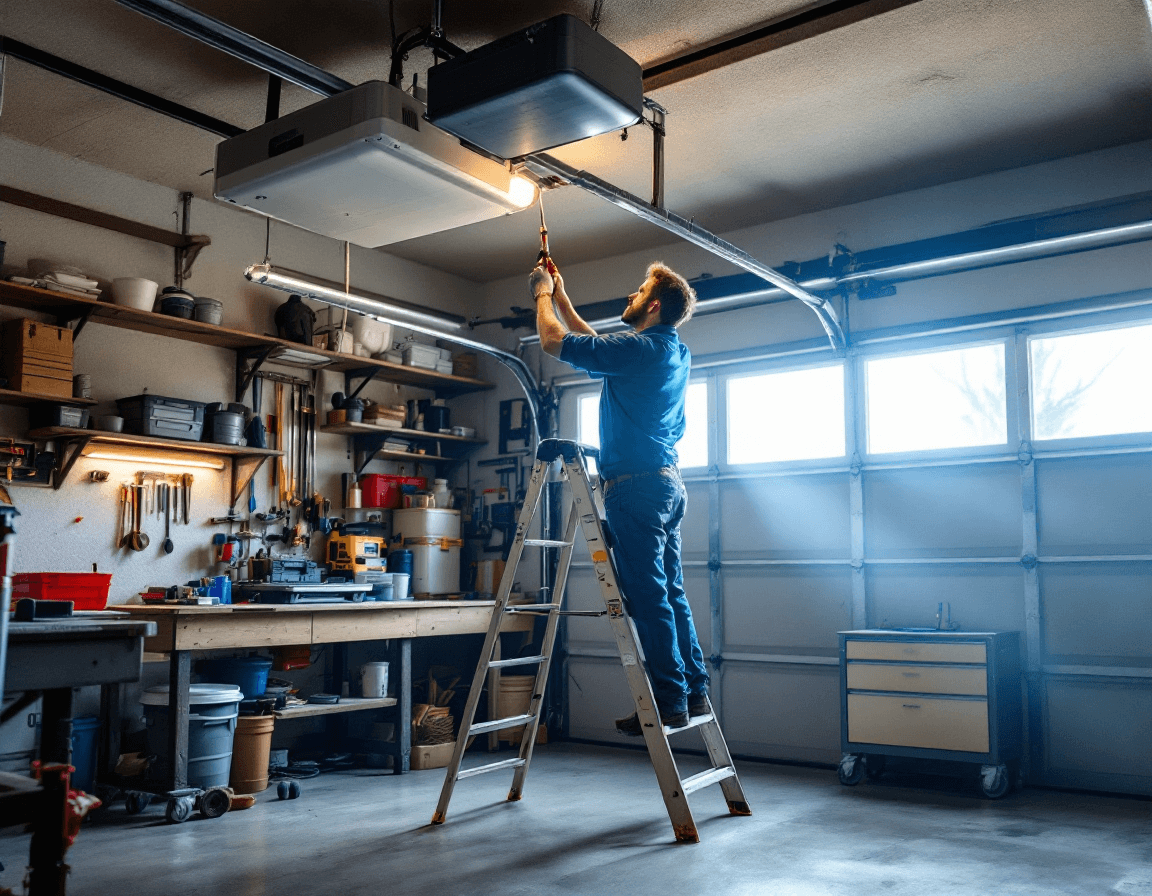
Garage door openers in Mukilteo tend to fail in ways that reflect the place itself. Homes near the Mukilteo Waterfront and the ferry terminal sit in damp, salt-tinged air, while homes up the hill in Harbour Pointe and around the older blocks of Old Town see their own mix of rain, cool nights, and long stretches of gray. Whether your opener is a decade old or was installed last spring, a motor that stops responding, a remote that goes quiet, or a door that refuses to close all point to a problem that can usually be diagnosed and fixed without replacing the whole unit. Seattle Garage Door Fix handles opener repair across Snohomish County and the wider Western Washington area, including the 98275 ZIP code, and our technicians work on the motor, gear, circuit board, and travel-limit systems of most major opener brands.
Most opener repairs we perform in Mukilteo fall within a range of $95 to $375, depending on what has failed and which parts the unit needs. A dead remote or a misaligned safety sensor is often at the low end, while a worn drive gear or a failed logic board costs more. The goal of this page is to help you understand what your opener is telling you before you call, so you can describe the problem clearly and recognize when a repair is reasonable. It also explains where the line sits between a reasonable homeowner check and work that belongs in the hands of a licensed professional.
How Puget Sound Weather Wears Down Openers
Western Washington's wet, mild winters and cool, humid springs create conditions that opener manufacturers did not always design around. Moisture works its way into wall-button wiring, outdoor-facing receiver antennas, and the low-voltage connections that run from the power head to the door's safety sensors. Over time, that moisture corrodes small terminals and causes intermittent contact that can make an opener behave perfectly one morning and not at all the next. Homes close to the water often see this faster because the salt-laden air that drifts in from Possession Sound accelerates corrosion on exposed metal hardware.
Temperature swings matter too. A damp garage that warms during a sunny afternoon and drops sharply overnight produces condensation on cold metal surfaces, including the rails, the bearing plates, and the inside of the opener housing. Lubricant that has thinned or washed away leaves gears and chains running dry, which increases resistance on the motor and shortens its life. Dust and fallen fir needles can also collect in the track during the autumn months, adding friction that the opener was never meant to fight for long.
Because so many local failures trace back to moisture, our technicians often check connections, grounding, and sensor wiring before replacing any major component. A clean, dry, properly seated connection can solve a problem that looks like a failing board. Homeowners in Mukilteo can help by keeping the garage door tracks clear, avoiding heavy spraying of water-based cleaners near the opener head, and noticing when a fault seems to appear only after a damp stretch of weather.
When the Motor Runs but the Door Stays Put
One of the most common calls we receive is that the opener motor clearly turns on, you can hear it humming or whining, but the door does not move up or down. This symptom usually points to a disconnection somewhere between the motor and the door, rather than a dead motor. The most frequent culprit is a disengaged drive: the trolley carriage may have come loose from the rail, or the release cord may have been pulled and left in a position that disconnects the door from the drive system.
Another frequent cause is a stripped or slipping drive component. If the drive gear inside the head has lost teeth, it can spin freely without transmitting force to the chain or belt. You may notice the motor running longer than usual, or hear a clicking pattern as the gear slips. Before you assume the worst, check whether the door is manually balanced and moves freely by hand when disconnected. A door that is heavy, sticky, or out of balance will overload any opener, and that load can make the motor strain without lifting.
A reasonable first check is to confirm the emergency release is in the locked (engaged) position and that the trolley arm connects firmly to the door bracket. If the door still will not move, stop and call for service rather than forcing it. Continued operation with a slipping gear or a disconnected carriage can damage the motor, the track, or the door panels, which turns a modest repair into a larger one.
Remote and Wall Button Silence: Following the Signal
When the remote and the wall button both fail to respond, the first thing to determine is whether the problem lies with the transmitter or with the opener's receiver. Replace the batteries in the remote before anything else, since the small coin cells used in many transmitters can drain without any visible sign. If a second remote also fails, the receiver or its antenna is more likely to be involved. If the wall button also does nothing, the issue may be the wiring between the button and the opener, or the power supply at the head.
Mukilteo homes built in different decades use different receiver setups, and some older openers have antenna wires that have become damaged or detached from the head. Look for a thin wire hanging from the power unit; it should be fully extended and not kinked, bundled tightly with power cables, or pinched behind a shelf. Interference from nearby electronics, new smart-home devices, or even a neighbor's transmitter on a similar frequency can sometimes cause intermittent remote failure. Repositioning the antenna or resyncing the remote according to the manufacturer's instructions often resolves these cases.
If the opener lights are on but nothing responds, the logic board may have a fault, or a safety-reverse circuit may be holding the door in a locked state. A flashing status light, discussed later in this guide, often explains exactly what the board is reporting. Avoid repeatedly pressing the button while the system is in a fault state, since that can sometimes lock the logic into a longer error cycle.
Grinding From the Opener Head and Stripped Gears
A grinding, rough, or metallic scraping sound from the opener head is one of the clearest warnings that the drive gear or its supporting parts are wearing out. Many residential openers use a plastic or nylon drive gear that is designed to be a wear point. Over time, teeth can crack, flatten, or strip, which causes the gear to skip under load. You may hear a chattering noise when the door begins to move, or the door may start and stop as the gear catches and slips.
Grinding can also come from a worn trolley, a misaligned chain, or a motor shaft that has lost its bearing support. Because these parts interact, it is not always obvious which one has failed without a hands-on inspection. We recommend stopping regular use of the opener once you hear persistent grinding, because continuing to run a damaged gear can throw metal fragments into the housing and damage the motor. Keeping the door closed until service is reached is usually safer than forcing it open and closed several times to see whether the noise goes away.
Replacing a stripped drive gear is one of the more common and cost-effective opener repairs, typically falling within our standard range when the motor and board are otherwise sound. The technician will check the motor shaft, the gear mounting, and the rail alignment to ensure the new gear is not simply going to wear out again. Do not attempt to disassemble the opener head unless you are comfortable with the tension and electrical components involved.
Doors That Stop Short or Reverse Right Away
A door that closes partway and then reverses, or one that will not close fully at all, is usually a safety response rather than a mechanical failure. Modern openers are required to have an automatic reverse function that stops the door when it meets resistance, and that same system can be triggered by misaligned photo-eye sensors, a dirty sensor lens, or a travel-limit setting that has drifted out of range. Check the two small sensors mounted near the bottom of the door tracks on either side. Their indicator lights should be steady, and their beams should face each other without obstruction.
Spiderwebs, dust, and road grime are common in Mukilteo garages, and a sensor lens that has been splashed with rain or dirt can read as an obstruction even when the path is clear. Gently wipe the lenses with a dry cloth, and make sure the mounting brackets have not been bumped out of alignment. If the sensors are fine, the travel limits may need adjustment. Limits tell the opener where the fully open and fully closed positions are, and when they drift, the door may stop early or attempt to continue past the floor.
Adjusting travel limits and force settings requires care, because incorrect settings can prevent the auto-reverse from working properly. Safety reverse is one of the most important protections on a residential garage door, and a technician should verify it after any adjustment. We test reversal force and sensor response as part of every relevant repair, so the door will stop safely if a child, pet, or object is in its path.
Reading the Blinking Lights as a Code
Many openers use a status light on the motor housing or control panel to communicate with the homeowner. A slow, steady blink usually means normal standby, but a repeating pattern of flashes often indicates a specific fault. Counting the blinks and comparing them to your manufacturer's chart is the quickest way to narrow the problem before calling. Some common patterns point to sensor obstructions, travel-limit errors, overheating from excessive cycling, or communication faults between the wall panel and the head.
Because codes vary by brand and model, there is no single universal chart that applies to every opener. We recommend photographing the light pattern or writing down the number of flashes and the time between sequences, then checking the owner's manual or the manufacturer's support page. Include the brand and model label, which is usually printed on the side or back of the motor housing. This information helps a technician arrive with the right parts and tools on the first visit.
Repeating fault lights do not always mean something is broken permanently. Sometimes the opener has entered a protection mode after several rapid cycles, and it will reset after it cools and receives a clean power cycle. Still, if the same code returns after a reset, the underlying cause is still present. Continuing to press the button in an attempt to clear it can cause additional strain, so a service call is the better step.
Chain and Belt Problems on Trolley Drives
Chain-drive and belt-drive openers each have their own wear patterns. A chain that has come off the sprocket or a belt that has slipped out of its track will prevent the door from moving even though the motor runs normally. A loose chain can also rattle, sag, or contact the rail during operation. In Mukilteo's humid conditions, chains can develop surface rust if they are not kept lubricated, which makes them stiff and increases wear on the sprocket teeth.
Belt-drive units are quieter and generally require less lubrication, but a belt that is too loose can jump its pulleys, and one that is too tight can stress the motor and bearings. Check the tension according to the manufacturer's specification if you are familiar with it, and look for cracks, fraying, or glazed spots on the belt surface. If the belt is damaged, it should be replaced rather than patched.
Tensioning or replacing a chain or belt involves working near the trolley and the door's operating hardware, and the door itself can be under significant force. If you notice the chain has come completely off the rail or the trolley is detached, leave the door in its current position and do not try to lift it manually. Call for service so a technician can reset the drive safely.
Intermittent Problems That Come and Go
Some of the most frustrating opener issues in Mukilteo are the ones that appear only occasionally. The door may work normally for days, then refuse a command once, then respond again. Intermittent faults are often linked to loose wiring, corroded terminals, a failing capacitor, a weak remote battery, or a logic board that is beginning to fail. Weather can play a role as well: a damp morning or a sudden cold snap can change how connections conduct electricity and how the motor draws power.
Keep a simple log for a week or two if your opener is unreliable. Note the date, time, weather, and what you tried, such as using the remote or the wall button. Patterns often emerge quickly, such as failures that happen only after heavy rain or only in the early morning. This record is extremely useful when you call for service, because a technician can focus on the conditions that trigger the problem instead of starting from scratch.
Do not ignore intermittent behavior, even if it seems minor. A door that sometimes fails to reverse, or a motor that occasionally stalls, can indicate a safety system that is not performing reliably. Having the opener checked while the fault is still occasional can prevent a more serious failure later.
What a Service Visit Usually Covers
When you schedule opener repair with Seattle Garage Door Fix, our technician will begin by identifying the opener brand and model, reviewing the symptoms you have observed, and checking the status of the door's balance and hardware. The inspection typically includes the power supply, wall control wiring, receiver and antenna, safety sensors and their alignment, travel-limit settings, drive gear or chain or belt condition, and motor performance under load. The technician will explain what was found and what repair options are available before work begins.
Common items we check during an opener visit include:
- Power supply, outlet, and the condition of the power head cord
- Safety sensor alignment, lens cleanliness, and wiring continuity
- Wall button wiring and remote receiver function
- Travel-limit and force settings, along with auto-reverse testing
- Drive gear, chain, or belt tension and wear
- Trolley and release mechanism engagement
- Logic board status lights and fault codes
Repairs are priced according to the parts and labor required. Most opener repairs we perform in the Mukilteo area fall between $95 and $375, and the technician will confirm the cost before proceeding with any replacement part. Many visits can be resolved in a single appointment, though some intermittent faults require additional testing to confirm the cause.
Brand Differences Homeowners Often Notice
Openers from different manufacturers use different logic boards, safety systems, and programming methods, so the same symptom can have different causes depending on the brand. Some models rely on a rolling-code remote system that must be paired with the receiver, while others use a learn button on the motor housing. Certain openers have built-in battery backups that keep the door operable during a power outage, and that battery can fail quietly over time, leaving you with a door that will not respond when the power is off.
Our technicians work across major residential opener brands and are familiar with the common failure points of each. That familiarity matters because a repair that works on one unit may not apply to another, and generic troubleshooting can waste time or lead to unnecessary part replacement. If you are not sure of your opener's brand, look for a label on the motor housing or the rail, and note the model number before calling.
Keeping your opener's manual in a dry, accessible spot can save time. Many manuals include troubleshooting tables, reset procedures, and the correct way to add or remove remotes. If the manual is missing, the manufacturer's website typically provides a digital copy for each model.
Where Homeowner Checks End and Professional Work Begins
Some garage door tasks are simple and safe for homeowners: cleaning sensor lenses, replacing remote batteries, checking that the emergency release is engaged, and observing whether the door is balanced. Other tasks involve significant hazards and should always be left to licensed professionals. Garage door springs, torsion bars, and cables store enormous amounts of energy, and a sudden release can cause serious injury. Do not attempt to adjust, remove, or replace springs or cables yourself, and do not try to loosen tension on any spring system.
Opener repair also has safety implications. Because the opener controls a heavy door, any repair that affects the reverse system, the travel limits, or the force settings must be done correctly and tested thoroughly. A door that does not reverse when it should is a hazard to children, pets, and vehicles. For this reason, we recommend that all safety-related opener work be handled by a licensed, bonded, and insured technician who can verify the system before the door is returned to regular use.
Seattle Garage Door Fix is licensed, bonded, and insured, and we encourage every Mukilteo homeowner to choose a qualified professional for spring and cable work in particular. If you are unsure whether a problem is safe to address yourself, describe the symptoms when you call and we will help you decide the next step.
If your Mukilteo garage door opener is motor-running but not moving, grinding, flashing an error pattern, ignoring the remote, or reversing before it closes, do not wait for the problem to get worse. Call Seattle Garage Door Fix at (888) 799-3819 to schedule a diagnostic visit, and we will explain what we find and what the repair will involve before any work begins.