
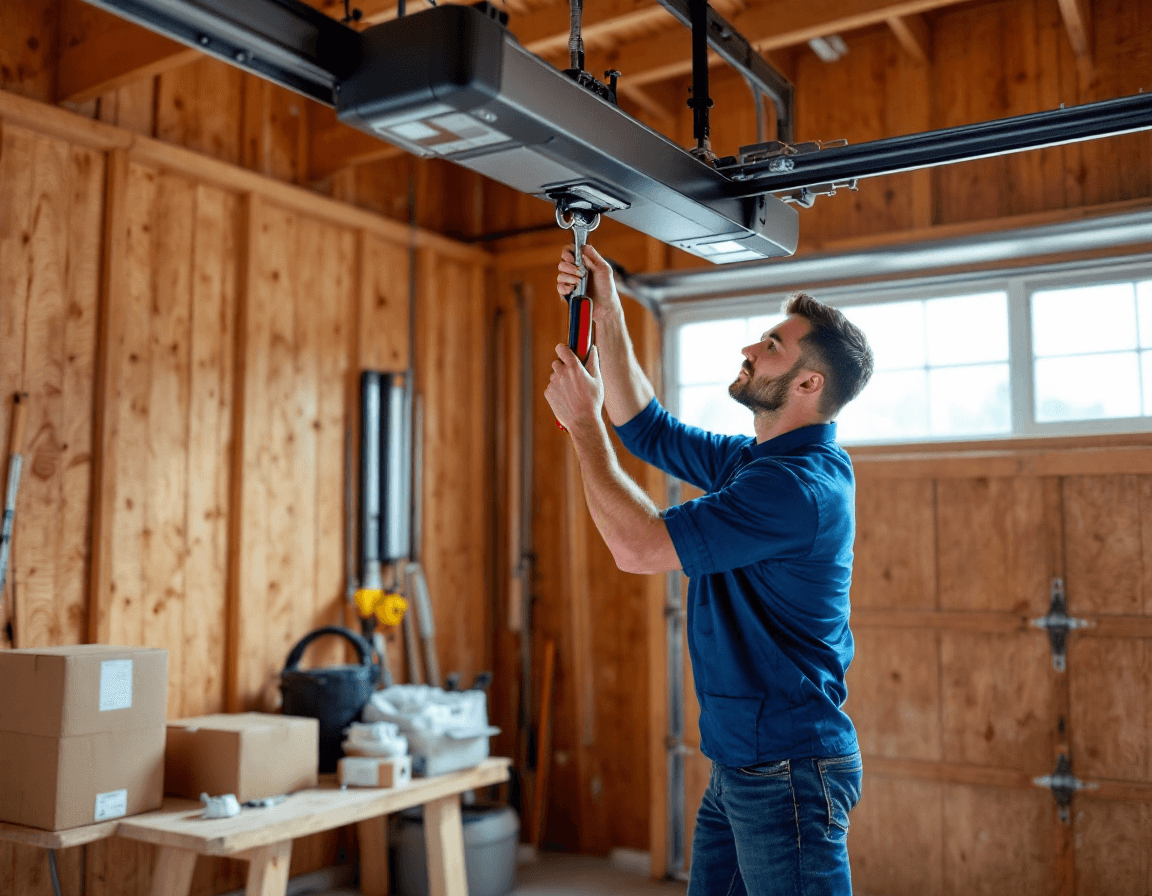
Garage Door Opener Installation & Replacement in Mukilteo, WA is a practical upgrade for homeowners who have been living with a noisy, sluggish, or unreliable opener. Mukilteo sits on the Possession Sound shoreline in southern Snohomish County, and the combination of salt-laden air, frequent drizzle, and the occasional winter windstorm puts real stress on the motors and electronics inside a garage. Many homes here still run openers that were installed a decade or more ago, and those units often work just well enough to be frustrating without being obviously broken.
Replacing an opener is different from replacing the door itself. The door panels, tracks, and springs can often stay in place, and the opener is a separate motor-and-controller system that bolts to the ceiling and connects to the door through a rail. That means a well-chosen replacement can bring modern safety features, quieter operation, and smartphone control into a garage without the cost of a full door swap. This page walks through what to look for, how the Mukilteo climate affects your choice, and what a fair installed price looks like for the work.
Whether you live near the waterfront, in a newer development up the hill, or in one of the older blocks near Old Town, the same questions apply. What kind of drive suits your space, how much noise you can live with, whether you want remote access, and how you want the door to behave when the power goes out. Working through those questions before you call anyone makes it much easier to get a quote that matches your actual needs.
Reading the Signs Your Opener Has Given Up
Most homeowners do not wake up one morning and decide their opener needs replacing. Instead, the problems creep in gradually. The door starts taking an extra second to begin moving, the motor groans or clicks at the beginning of its travel, or the door stops halfway and reverses for no obvious reason. Each of these symptoms can have several causes, so it helps to recognize the patterns that point toward the opener itself rather than a worn roller or a misaligned sensor.
An opener that is loud, slow, or unreliable is often showing its age in predictable ways. Gear wear and worn trolley components produce a rattling or grinding sound, while a motor that is losing strength may struggle to lift the door smoothly, especially on cold mornings. Units that were designed before current safety standards may also lack the features that prevent a door from closing on a child or a pet. If your remote works only when you stand in the driveway or the receiver seems to drop signal randomly, the receiver board may be failing.
- Grinding, clicking, or knocking that gets worse over time, which often points to worn gears or a loose trolley
- The door reversing unexpectedly or stopping partway through its cycle, which can indicate a failing logic board or a sensor problem
- Remote controls that need repeated presses or work only at close range
- A motor that sounds strained or runs noticeably hotter than it used to
- Repair estimates that keep climbing, with each visit fixing one component while another begins to fail
When several of these symptoms appear together, replacement usually makes more sense than continued patching. A technician can diagnose the existing unit, but once the motor and controller are both showing wear, a new opener typically delivers better value and fewer surprises.
Belt, Chain, or Wall-Mount: Matching the Drive to Your Home
The drive style is the part of the opener that moves the trolley along the rail, and it has a large effect on noise level, maintenance, and how the unit fits your ceiling. Chain-drive openers are the traditional and often the most budget-friendly option. They are sturdy and handle heavy doors well, but the metal chain running through the rail produces a distinct rattle that carries through the house, particularly if the garage shares a wall with a bedroom or a home office.
Belt-drive openers use a reinforced rubber or fiber belt in place of the chain, and the difference in sound is considerable. Because the belt runs quietly and does not stretch the way a chain can, belt-drive units are the usual choice for homeowners who want a garage door that does not announce every trip in and out. They tend to cost more upfront, but many people find the noise reduction worth it, especially in attached garages in densely built neighborhoods.
Wall-mount openers take a different approach. Instead of hanging from the ceiling, the motor mounts to a side wall, which frees up ceiling space for storage racks, bicycles, or a workshop shelf. This configuration works well in garages with low ceilings, unusual door heights, or a headroom limitation caused by a fixed beam. Wall-mount units can be paired with either belt or chain drive mechanisms, depending on the model. A technician can confirm which configuration your garage layout allows once they measure the door, the header, and the available wall space.
Salt Air, Drizzle, and the Mukilteo Microclimate
Western Washington's weather is famously mild in some respects and demanding in others. Mukilteo's position on the Puget Sound shoreline means the air carries moisture and a trace of salt for much of the year, and that combination quietly works on exposed metal, wiring, and circuit boards. A garage that is not heated or fully sealed will see wider humidity swings than a finished interior room, which can lead to condensation inside the opener housing and corrosion on electrical contacts.
The cool, wet months bring their own challenges. Long stretches of drizzle keep the door tracks and seals damp, and the motor has to work harder when the lubricant has thickened or when cold metal contracts around the rollers. Wind coming off the water can also push on a door that is not properly balanced, adding strain to the opener. A unit with a sturdier gear train and better weather-resistant components generally holds up more reliably in this environment than an entry-level model that was built for drier climates.
Good installation practice matters just as much as the hardware. A technician should check that the opener is securely anchored to the ceiling joists or header, that the rail is supported at the correct intervals, and that the safety sensors are mounted at the right height and aligned properly. Keeping the garage door tracks clean and the photo-eyes free of cobwebs and salt film helps the new system run smoothly through the wet season. These are simple habits, but they make a noticeable difference over the years.
Rolling Code Security and Why an Old Unit Is a Liability
One of the most important reasons to replace an older opener is security. Early garage door openers used fixed codes, meaning the remote sent the same signal every time. A determined person with inexpensive equipment could capture that signal and reuse it to open the door later. Modern openers use rolling-code technology, which changes the transmitted code with every use, so a captured signal becomes useless almost immediately.
If your opener was installed many years ago, there is a real chance it lacks rolling-code protection entirely. Some units from that era can be upgraded only by replacing the receiver, which often costs nearly as much as a new opener. Replacing the whole unit gives you current encryption, updated remote compatibility, and the ability to add or remove remotes cleanly if a family member moves out or a device is lost. Many homeowners are surprised to learn how simple their old system is to exploit, and this alone is a strong reason to upgrade.
Security also extends beyond the remote. Modern openers include features such as lockout modes that disable the wall button, alerts when the door opens or closes, and automatic close timers that prevent the door from being left open overnight. When these are configured correctly, they add a layer of protection that older hardware simply cannot match. A technician can walk you through the settings during installation so you understand what each one does before you leave.
Smart Control, myQ, and Wi-Fi Without the Headaches
Smartphone control has become one of the most requested opener features in the Seattle area. A Wi-Fi-enabled opener lets you check whether the door is closed from anywhere, open it for a delivery driver, or receive a notification if it has been left open. Many of these systems use a companion app, and myQ is one of the widely recognized platforms that supports this kind of remote access on compatible openers. The convenience is genuine, especially for families whose schedules change often or for anyone who has ever driven home wondering whether they closed the garage.
That said, smart features depend on a stable connection, and garages are not always friendly to Wi-Fi signals. Concrete walls, metal shelving, and distance from the router can all weaken the signal, so a good installation includes checking the strength at the opener location before the job is finished. If the signal is weak, options include relocating the router, adding a mesh extender, or in some cases choosing a model with a stronger antenna. Your home network matters as much as the opener itself.
It is also worth thinking about how you will manage access once the system is connected. Sharing app access with household members is convenient, but you should review who has permission and remove accounts that no longer need it. Setting up notifications and understanding how the app behaves when your phone loses connection will save frustration later. A brief orientation during the appointment usually covers these details and helps everyone in the house feel comfortable with the new system.
Battery Backup When the Power Drops Out
Power outages are a fact of life in the Pacific Northwest, particularly during winter storms when wind knocks lines down across Snohomish County. When the electricity fails, a standard opener stops working, and if the door is closed you may find yourself unable to get the car out or get back in without a manual release. The emergency release cord is useful, but pulling it with a heavy door and a cold garage is not always easy, and it can be a problem if you are away from home when the outage happens.
A battery backup kit provides a limited number of door cycles during an outage, which is enough to get the vehicle out or to bring the door down securely. Battery backup is an especially sensible addition for households with elderly residents, people who need to leave for medical appointments at short notice, or anyone who relies on a garage as a secondary entry point. Some kits also charge while the power is on, so the battery is ready when you need it without any extra maintenance.
Keep in mind that a backup battery has a finite life and needs periodic replacement. The unit should be checked during routine service, and the battery should be replaced according to the manufacturer's recommendation rather than left until it fails. Whether a battery backup is included, optional, or unavailable depends on the specific model, so it is worth discussing this during the quote process to make sure the opener you choose matches your priorities.
Price Ranges and What Shapes a $275 Versus $650 Quote
Installed pricing for an opener replacement in this area typically falls between $275 and $650, and where a particular job lands depends mostly on the opener model and the complexity of the installation. Entry-level chain-drive units sit at the lower end of that range, while belt-drive units with stronger motors, quieter operation, and smart connectivity land higher. Wall-mount configurations and battery backup kits also affect the final number, as do any repairs needed to the door hardware before the new opener can work correctly.
Understanding what is included in a quote helps you compare fairly. A complete installation should cover removing the old opener, mounting and aligning the new one, connecting and testing the safety reversal system, programming remotes, and verifying the force and travel settings. Some quotes also include a check of the door balance and the condition of the rollers and hinges. If a quote seems suspiciously low, ask whether the safety sensors, mounting hardware, and programming are part of the price.
Here is a simple way to think about the difference between a budget-friendly and a premium installation:
- A basic chain-drive opener with standard remotes suits a detached garage or a homeowner who mainly wants reliable, no-frills operation
- A belt-drive opener with Wi-Fi control suits an attached garage where noise matters and remote access is a priority
- A wall-mount model with battery backup suits low-ceiling garages or households that want protection during outages
- Any installation that requires door repairs, new sensors, or additional wiring will add to the total before the opener itself is considered
Installation Day in a Typical Mukilteo Garage
Knowing what happens on installation day helps reduce anxiety and makes it easier to plan around the appointment. A technician typically starts by inspecting the door, tracks, springs, and existing opener mounting points. They confirm that the door is balanced and moves freely by hand, because an opener cannot compensate for a door that is binding or heavy. If the door has problems that need professional attention, the technician will explain them before proceeding with the opener.
Next comes the mechanical work. The old opener is removed, the new rail is assembled and attached, and the motor is hoisted into position and secured to the ceiling framing or wall bracket. The door arm is connected, the trolley is engaged, and the emergency release is tested. Safety sensors are mounted on each side of the door opening at the correct height, wired to the opener, and checked for alignment. The technician then programs the travel limits, adjusts the force settings, and verifies that the door reverses when it contacts an object.
The final steps involve programming remotes, wall controls, and any smart features, then running the door through several full cycles under observation. A good technician will walk you through the controls, explain the lockout and alert settings, and make sure you know how to use the manual release safely. Most residential installations can be completed in a single visit, though timing depends on the door, the existing hardware, and whether any additional work is needed.
Repair or Replace: The Economics of an Aging Motor
Deciding whether to repair an old opener or replace it is a common question, and the answer depends on several factors. A minor repair such as replacing a worn remote, a failed wall button, or a damaged safety sensor is usually a sensible fix that costs little and extends the life of a unit that is otherwise performing well. However, when the motor, logic board, or gear assembly fails, the repair cost can approach or exceed the price of a new, more capable opener.
Age is an important signal. An opener that has been running for many years has typically completed thousands of cycles, and the wear on its gears, bearings, and motor windings accumulates over time. If the unit also lacks rolling-code security, battery backup, or the noise reduction you want, replacing it addresses several concerns at once. Spending money on a repair that buys only a short reprieve often makes less sense than putting that budget toward a unit you will rely on for years.
A useful rule of thumb is to compare the repair estimate against the installed price of a new opener in the range discussed above. If a repair costs a substantial fraction of replacement and the existing unit has other problems, replacement is usually the better long-term choice. A technician can give you an honest assessment after inspecting the unit, and a good one will tell you when repair is still the right answer.
Keeping Springs and Cables in Professional Hands
Opener replacement is often a manageable project for a licensed technician, but some related parts of the garage door system carry serious risk when handled without proper training. Torsion springs and extension springs store enormous mechanical energy, and a spring that is adjusted or released incorrectly can cause severe injury. Lift cables under tension present a similar hazard. These components should never be serviced by homeowners who lack the tools, training, and experience to do so safely.
If your opener replacement reveals that the springs are worn, the cables are fraying, or the door is unbalanced, the responsible step is to have a licensed professional address those parts before the new opener is asked to do work it cannot handle. Pushing a door that is heavy or out of balance puts unnecessary strain on the new unit and shortens its life. A technician who is equipped to handle spring and cable work can bring the door into proper balance so the opener operates smoothly from the start.
Homeowners can still take useful steps safely. Visually checking the garage door for obvious damage, keeping tracks clean, and testing the auto-reverse feature periodically are all reasonable habits. If you ever notice a spring that has visibly separated, a cable that has come loose, or a door that falls quickly when released, keep people and vehicles clear and call a licensed professional right away.
Neighborhood Notes: Harbour Pointe, Old Town, and the Waterfront Area
Mukilteo is a community with distinct neighborhoods, and the homes in each have their own garage characteristics. Homes in Harbour Pointe, with its newer construction and planned layout, often feature attached garages with ceiling heights and door sizes that suit belt-drive or wall-mount configurations well. Homeowners in these areas frequently prioritize quiet operation and smart features, especially in attached garages where the opener noise travels into living spaces.
In and around Old Town, many homes are older, and garages may be detached, smaller, or built with different framing than modern construction. These differences affect how the opener is mounted and whether the ceiling can support the motor without reinforcement. A technician working in older homes will typically pay closer attention to the header, the joists, and the clearance above the door, and may recommend a wall-mount solution where a ceiling mount is impractical. Older doors may also need hardware updates to work reliably with a modern opener.
Homes closer to the Mukilteo Waterfront and the ferry corridor experience the strongest salt and moisture exposure, so corrosion-resistant hardware and regular maintenance matter more there. Whether your home is near the water or a few blocks inland, the right opener for your garage depends on the door, the space, your noise tolerance, and how you plan to use the system day to day. An on-site evaluation is the best way to match the right unit to your particular garage.
Garage Door Opener Installation & Replacement in Mukilteo, WA can be a straightforward project when the right equipment and careful workmanship come together. If your opener is loud, slow, outdated, or simply no longer worth repairing, a professional assessment will show you what your garage needs and what you can expect to spend. Call Seattle Garage Door Fix at (888) 799-3819 to schedule an evaluation for your Mukilteo home (ZIP 98275), and let a licensed, bonded, and insured technician help you choose an opener that fits your space, your budget, and your daily routine.