
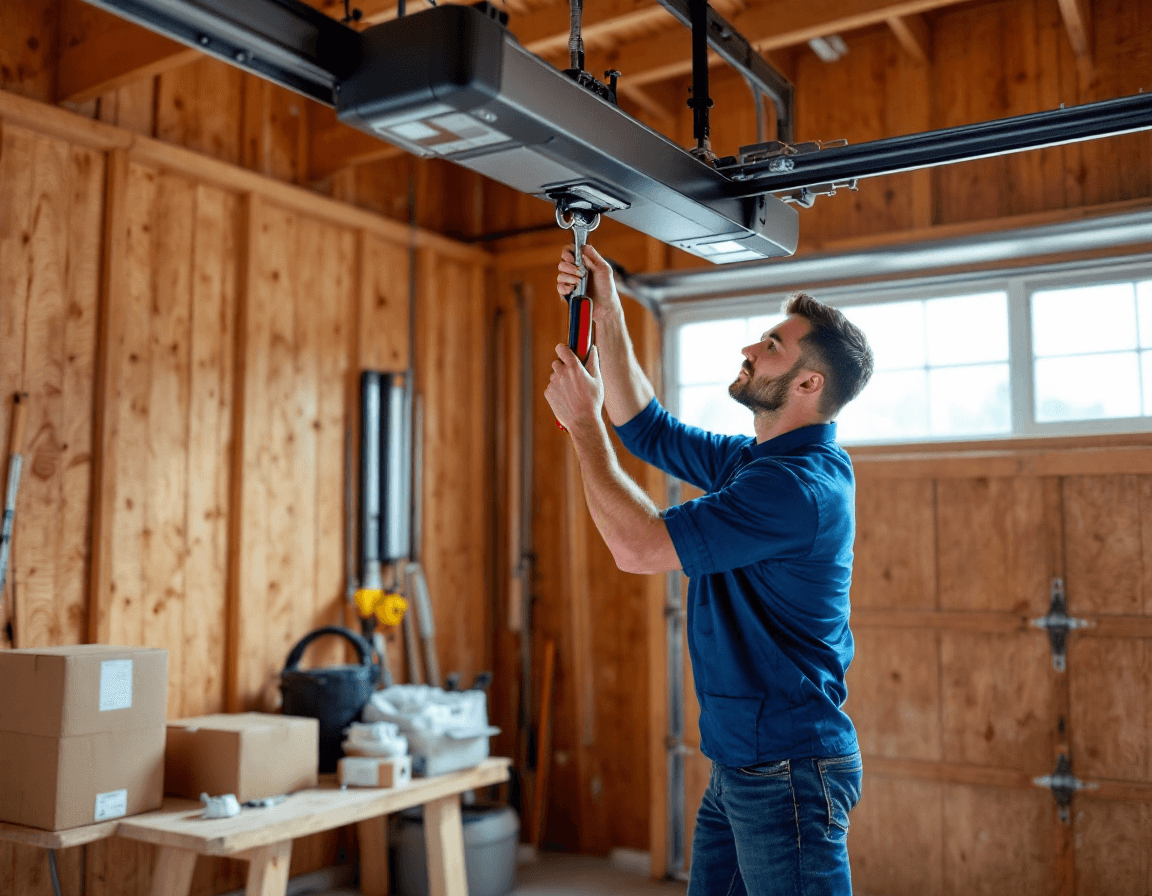
Garage door openers in Monroe face a particular mix of conditions. Winters are wet and damp, summers are usually mild, and the Skykomish River valley can hold moisture around homes for long stretches. Many Monroe garages were built decades ago with a single opener that has been running every morning and evening since. When that unit starts grinding, stalling, or failing to close, homeowners usually need a clear answer about whether to repair it or replace it, and what a replacement will actually involve. Garage Door Opener Installation & Replacement in Monroe, WA is a service we handle regularly for households from the older neighborhoods near downtown to newer subdivisions on the edges of town.
This page explains how we think about that decision. We'll cover the three main drive styles, why quiet operation and rolling-code security matter more than many people expect, how smart Wi-Fi control and battery backup fit into a practical setup, and what shapes the installed price, which typically falls between $275 and $650 depending on the opener model you choose. We'll also talk about the points where a repair stops making financial sense and where safety requires a licensed professional instead of a weekend project.
The goal is to give you enough detail to make a confident choice, whether you're replacing a unit that is simply worn out or upgrading because the garage has become the main door your family uses. Nothing here is a sales pitch for a specific model. Every garage is different, and the right opener depends on your door's weight, your ceiling height, how the room above the garage is used, and how you come and go during the week.
Reading the Warning Signs Your Opener Is Wearing Out
Most openers don't fail all at once. They give notice over months, and Monroe's damp seasons tend to speed that process along. Early symptoms include a motor that hums without lifting the door, a door that reverses for no clear reason, a unit that stops halfway and needs a second press, or a noticeable lag between pressing the remote and seeing any movement. Rust on the rail hardware, a chain that sags or clicks when it advances, and a trolley that rattles at the ends of travel are also common signs of a drive system nearing the end of its useful life.
Pay attention to how the opener behaves when the weather changes. A unit that works fine in July but struggles after a week of wet November weather may have a failing limit adjustment, a worn gearbox, or a door that has grown stiff from moisture in the rollers and hinges. Sometimes the door itself is the culprit, and a good technician should check the rollers, tracks, and balance before blaming the opener. A quick inspection can separate a tired opener from a door that is simply binding.
If your remote has stopped working even after you've replaced the batteries and the opener's learn button has been reset, the receiver board may be failing. Boards can be replaced on some models, but on older units it often makes more sense to put the money toward a complete replacement. The right decision depends on the age of the unit, the availability of parts, and how much you're spending on repeated service calls. We'll walk through that math with you before any work begins.
Belt, Chain, or Wall-Mount: Matching the Drive to Your Garage
Three drive configurations cover nearly every residential installation we do. Chain-drive openers are the traditional and most affordable option. They are robust, handle heavier doors well, and are straightforward to maintain. Their main drawback is noise, since the metal chain transmits sound into the ceiling and the framing around it. For a detached garage on a large Monroe lot where nobody sleeps nearby, that trade-off may be perfectly acceptable.
Belt-drive openers use a reinforced rubber belt in place of the chain. The result is noticeably quieter operation and smoother starts and stops, which many homeowners appreciate when the garage shares a wall or ceiling with a bedroom or home office. Belts also stretch less than chains over time, which generally means fewer adjustments. The price is usually a bit higher than an equivalent chain model, and belts should be kept clear of heat sources and moisture, which is a good reason to have the installer check the mounting and tension at the time of setup.
Wall-mount openers attach the motor to the side wall of the garage instead of the ceiling. This is useful when your ceiling is low, when you have a storage platform or overhead racks you want to keep, or when the garage ceiling is too weak to support a ceiling bracket comfortably. It's also a good fit for some Monroe homes with angled rooflines or limited headroom. Wall-mount units require a sturdy side wall and proper bracket placement, so a site visit is important before choosing this style.
Choosing between these styles is less about which is "best" and more about matching the opener to the door, the space, and how you live with the garage. A heavy insulated steel door on a double-wide opening may call for a stronger drive, while a lighter single door may not need a premium unit at all. We'll help you make that call based on what we see on site rather than a generic recommendation.
Quiet Operation for Garages That Share Walls With Living Space
Noise is the complaint we hear most often from households with an attached garage. A chain-drive opener running at six in the morning can carry through the bedroom wall, and a door that clunks at the top of its travel can disturb anyone trying to sleep in the room above. Quieter operation is not just a matter of comfort. It can make the difference between a garage door that gets used without complaint and one that everyone in the house dreads.
Several factors shape how loud an opener is in practice. Belt drives are generally quieter than chain drives, and the motor's own design matters too, including how well it isolates vibration from the rails and ceiling bracket. Installation quality also plays a major role. A bracket fastened to a thin ceiling joist, rails that aren't properly supported, or a door that's out of balance will all make even a quiet opener sound harsh. A careful installer will address these details instead of simply bolting the unit up and leaving.
Door balance deserves special attention. If the door is heavy or the springs are worn, the opener has to work harder, and that extra strain shows up as noise and vibration. Any spring work, however, must be handled by a licensed technician with the proper tools, because torsion springs store enough energy to cause serious injury. We won't adjust or replace springs as a shortcut to quieter operation, and if your door needs spring service, we'll tell you so and recommend a licensed professional for that part of the job.
Rolling-Code Security and Why an Old Fixed-Code Unit Is a Liability
Older openers often use fixed-code remotes, meaning the signal from the remote is the same every time. That predictability is a security weakness. Someone with a basic signal capture device could potentially record the code and reuse it later to open the door. Rolling-code technology solves this by changing the transmitted code with every press, so a captured signal can't be replayed. Most modern openers use rolling codes, and any unit that has been sold in the last couple of decades typically does.
If your opener is old enough to predate widespread rolling-code adoption, replacing it is one of the most practical security upgrades you can make to a home. This matters especially for garages that connect to the house through an unlocked interior door, or for households where the garage is the main entry point during the day. A newer unit also tends to include better obstruction sensing, safer reversing behavior, and a more reliable manual release, all of which improve the overall safety picture.
Security also depends on what you do outside the opener. Keep remotes out of cars parked on the street, don't leave the visor clip holding a remote where a passerby can see it, and use the opener's vacation or lock mode when you'll be away. Wall-mounted keypads with changeable codes are another option, though they should be installed where they can't be easily observed from the driveway. A good installer will walk you through the programming and explain how to delete old remotes that no longer belong to anyone in the house.
Smart Wi-Fi and myQ Control Without the Gimmicks
Smart control has moved from novelty to something many Monroe homeowners actually want. Being able to check whether the garage door is closed from a phone, open it for a delivery driver, or see a notification when it moves has real practical value, particularly for households with teenagers, frequent travelers, or anyone who sometimes forgets whether they left the door up. Wi-Fi-enabled openers and compatible smart hubs can make those tasks simple.
It's worth being realistic about what smart features do and don't do. A Wi-Fi connection depends on your home network, so a weak signal in the garage can cause intermittent problems. Some units use a dedicated bridge or hub, while others connect directly, and the setup steps differ by manufacturer. Ecosystem compatibility matters too. If you already use a particular voice assistant or home automation platform, confirm the opener supports it before buying. Subscriptions for certain features vary by brand, and you should understand those costs before you commit.
We set up smart control as part of installation whenever you want it, but we also make sure the core functions work without an app. The mechanical and safety systems should always operate correctly with a wall button or remote even if the internet is down or your phone battery is dead. Smart features are a convenience layered on top of a safe, reliable opener, not a substitute for one.
Battery Backup for Power Outages on the Valley Floor
Power outages happen in Western Washington, and wind or winter storms can knock out service for hours at a time. When that happens, a standard opener is useless, and your garage door becomes a manual job. Anyone who has tried to lift a heavy insulated door by hand knows how unpleasant that can be, and a door that won't open can leave a car stranded inside or make an evacuation or medical trip harder than it should be.
Battery backup kits are designed to keep the opener running through an outage, allowing several openings and closings depending on the battery and the unit. Some models include a backup battery as an option, while others accept an add-on kit. Battery capacity, charging behavior, and expected runtime vary by manufacturer, so ask for the specifications for the exact model you're considering rather than relying on general claims. We'll explain what a given backup can realistically handle based on your door's size and weight.
Battery backup is also useful for a manual release check. Every opener should have a clearly labeled emergency release cord, and you should know how to use it safely. Pull it only when the door is closed, and be aware that a door released while open can drop quickly if the springs are weak or broken. If the release feels unusually stiff or the door doesn't move smoothly by hand, that's a sign of a balance or hardware problem that should be addressed before the next outage.
What a Typical Installation Visit Covers
A proper installation is more than unboxing a motor and hanging it from the ceiling. Our technicians begin by checking the door's condition, including the rollers, hinges, track alignment, and balance, because the opener can only work as well as the door it's moving. We also look at the garage structure, confirm the ceiling or wall can support the bracket, and identify the best mounting point for the rail and motor. Measurements at this stage determine whether the chosen opener fits your door height and track configuration.
Once the site is assessed, the installation itself follows a careful sequence. The old opener is removed, the new rail is assembled and mounted, the header bracket and door arm are attached, and the power connection is made according to the manufacturer's specifications. The technician then sets the travel limits so the door opens and closes at the correct points, tests the auto-reverse system with an object in the path, and checks that the photo-eye sensors are aligned and working. Remotes, keypads, and any smart-control features are programmed before the visit ends.
Before leaving, the technician should walk you through the basics. That includes how the manual release works, what the safety features do, how to add or remove remotes, and what routine maintenance you can reasonably handle yourself, such as keeping the photo eyes clean and checking that the door moves freely by hand when disconnected. A good installation also includes a clear explanation of warranty coverage and what to do if something behaves unexpectedly after the work is done.
Pricing From $275 to $650: What Shapes the Number
Our installed pricing for opener replacement generally falls between $275 and $650. That range reflects the difference between basic chain-drive units and higher-end belt-drive or wall-mount models with smart features and battery backup. The exact figure depends on the opener you select, the complexity of mounting, and any additional hardware your garage needs, such as a new header bracket, a replacement door arm, or updated safety sensors.
Several things can push the price toward the higher end. A wall-mount installation requires a stronger mounting surface and sometimes additional bracing. A heavy door may need a more powerful motor. Battery backup kits add cost, and advanced smart-home compatibility may involve a separate hub. If your existing door has worn hardware that needs replacement to support the new opener safely, that will show up as an added line item. We'll show you the breakdown before work starts so there are no surprises.
Price should not be the only factor. A low-cost unit that is loud, lacks rolling-code security, or doesn't fit your door well will cost you more in frustration and service calls over time. We try to match the opener to your actual needs, which sometimes means recommending a mid-range model over the cheapest option or a premium unit over a basic one. Our goal is a reliable installation that you won't need to revisit anytime soon.
Repair or Replace: When an Opener Has Passed the Point of Sensible Repair
Not every opener problem warrants replacement. A blown fuse, a dead remote battery, a misaligned photo eye, or a loose chain that needs tensioning can often be fixed quickly and inexpensively. Replacement becomes the better choice when repairs start to pile up, when the parts are no longer manufactured, or when the unit lacks the safety and security features you need today. Age alone is not the deciding factor. The condition of the motor, the number of repeated failures, and the cost of the next repair all matter.
Certain signs suggest an opener is past economical repair. These include repeated motor failures, a logic board that keeps resetting, a rail that is bent or cracked, or a gear assembly that makes grinding sounds even after lubrication. Openers that predate rolling-code security may also be worth replacing for safety reasons alone. In many Monroe homes, a single repair visit on an old unit costs a meaningful fraction of a new installation, and the newer opener typically brings a longer service life and better features.
- A motor that overheats, stalls, or shuts off after short runs
- Repeated failures of the logic board or receiver within a short period
- Parts that are discontinued or difficult to source for the model
- A fixed-code system that cannot be upgraded to rolling-code security
- Rails, brackets, or mounting hardware that is corroded or cracked
- Noise and vibration that persist after the door has been properly balanced
If you're unsure, ask for a clear recommendation after diagnosis. A technician who explains exactly what has failed, what it would cost to fix, and how long a repair would likely last is giving you what you need to decide. We'd rather tell you a repair makes sense when it does than push a replacement you don't need.
Safety Checks Before and After Your New Opener Goes In
Garage doors are heavy, and both the door and the opener require respect. Modern openers include safety features such as auto-reverse, which should stop and reverse the door if it contacts an obstacle, and photo-eye sensors, which prevent closing when a beam is blocked. These features should be tested after every installation and periodically afterward. Place a board or similar object in the door's path and confirm it reverses. Block the photo eyes and confirm the door won't close.
Keep children and pets clear of the door during operation, and never allow anyone to play with remotes or wall buttons near the track. Do not stand under a door that is moving, and do not try to hold a door open or closed by force. If the door is unbalanced, it can fall, and that risk increases sharply when springs are worn or broken. A door that seems to slam down, creep up unevenly, or hang at an odd height should be inspected right away.
Spring and cable work is where we draw a firm line for homeowners. Torsion springs and extension springs are under high tension, and cables can snap with enough force to cause serious injury. These components must be adjusted, repaired, or replaced only by a licensed professional with the correct equipment and training. If your opener installation reveals a spring or cable problem, we'll explain what we found and recommend licensed spring service rather than attempting it ourselves or encouraging you to do it on your own.
Serving Downtown Monroe, the Fairgrounds Area, and ZIP 98272
Monroe has a mix of housing types, from older homes near downtown with detached or tucked-away garages to newer residences on the outskirts of town. Downtown properties often present tighter driveways, older door framing, and garages that have been modified over the years, so a careful measurement and site check matters before any opener is selected. Homes near the Evergreen State Fairgrounds may have larger lots, wider driveways, and sometimes oversized or workshop-style garages that call for heavier-duty openers and more robust rail support.
Our service area for opener installation and replacement includes ZIP 98272 and surrounding communities across Snohomish County and the greater Seattle region. Because Monroe sits in the Skykomish valley, we pay attention to moisture, temperature swings, and the wear that damp weather causes on steel hardware, rollers, and wiring. Those details influence which components we recommend and how we protect the installation against long-term corrosion and weather exposure.
Whether you're near Main Street, out by the fairgrounds, or in a neighborhood on the edge of town, the approach is the same. We look at your door, your garage, and how your household uses the space, then recommend a practical opener that is safe, quiet where it needs to be, and secure. If your current unit is loud, unreliable, or past its useful life, we can help you compare options and decide on a path that fits your budget and your daily routine.
Ready to talk through a new opener for your Monroe garage? Call Seattle Garage Door Fix at (888) 799-3819 to schedule an assessment, ask about belt-drive, chain-drive, or wall-mount options, and get a clear installed price for the model that fits your door. We're licensed, bonded, and insured, and we'll walk you through every step so you know exactly what to expect.