
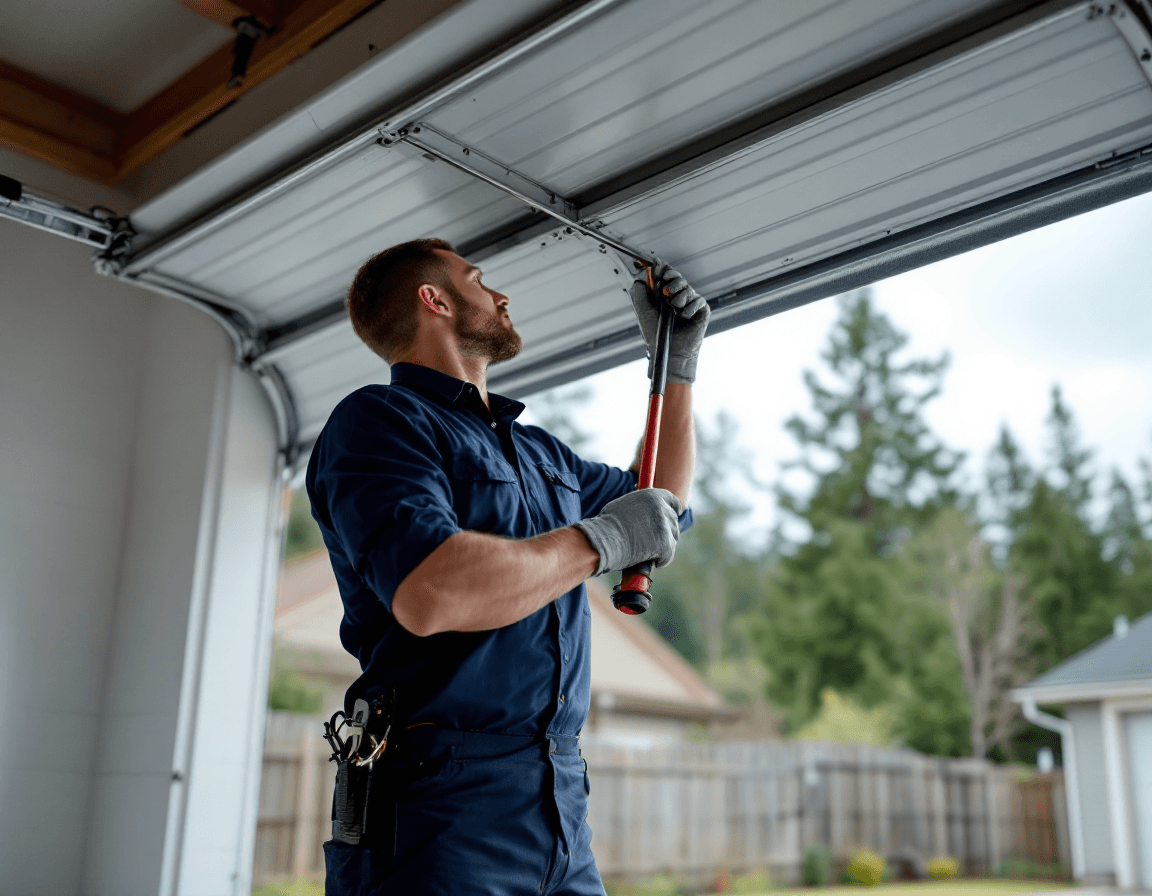
Garage Door Spring Replacement in Monroe, WA is one of the most common repairs homeowners call us about, and it is also one of the most important to handle correctly. The springs carry most of the weight of your door, so when one fails, the whole system goes out of balance. Many Monroe homeowners notice the problem only after a sharp crack echoes through the garage on a cold morning, leaving them wondering whether the door is still safe to use. Knowing what happened and what to do next can prevent damage to the door, strain on the opener, and injury to anyone nearby.
Monroe sits in the Skykomish River valley at the eastern edge of Snohomish County, and the local weather plays a real part in how quickly springs wear out. Long wet winters, damp mornings, and sudden cold snaps all put stress on galvanized steel, and moisture that sits in a garage for weeks encourages rust. Many homes in established neighborhoods and along the older streets near downtown were built with single-car garages and steel doors that have been cycling for decades. This guide walks through the warning signs, the difference between spring types, what replacement involves, what it typically costs, and when to call a professional.
Our technicians are licensed, bonded, and insured, and we strongly recommend leaving spring work to trained hands. Torsion springs store a large amount of energy, and even a small mistake during removal or winding can cause serious injury. You can still learn a lot by observing your door from a safe distance, and this page points out those checks along with the steps that should never be attempted at home. If your door is stuck or unsafe right now, the fastest route to a solution is a phone call to (888) 799-3819.
Why Monroe Garages Put Springs Under Extra Strain
Springs do not wear out on a calendar. They wear out based on how many times they are loaded and unloaded, which is why a busy household that opens the garage several times a day can see a spring fail years earlier than a home where the door rarely moves. In the Monroe area, the cold months add a second source of stress. Steel contracts when temperatures drop, and the tension in a spring changes slightly with each temperature swing, so a spring that was already near the end of its life often gives out during the first hard freeze of the season.
Moisture is the other factor. Garages in the Pacific Northwest tend to hold dampness, especially homes with unfinished concrete floors, minimal ventilation, or a door that seals loosely at the bottom. Surface rust forms on the coils, and rust pits the metal, which creates weak points that can fail under load. We often see springs that look fine from a distance but have flaking, orange-brown coils near the center where the winding is tightest.
Seasonal use also matters. Many Monroe families use their garage as a primary entrance, a workshop, or storage for outdoor gear, which means the door opens and closes far more often than the original builder may have anticipated. Homes that were built with standard-cycle springs and then used heavily are good candidates for an upgrade to high-cycle springs at replacement time. That choice can extend service life considerably, and we discuss the options in more detail below.
Reading the Warning Signs: Bang, Gap, and Sagging Coils
The most dramatic sign of a broken spring is a loud bang that sounds like a gunshot or a heavy object dropping inside the garage. That noise is the spring releasing its stored energy all at once, and it often happens while the door is closed or partially open. Many homeowners think something has fallen from a shelf or that a vehicle has bumped the wall, so they go inside expecting damage and find the door stuck in place. If you hear that noise, keep people and pets away from the door and avoid touching the springs or cables.
Other signs are quieter but just as important. A torsion spring is the coil mounted on a metal shaft above the door opening, and when it breaks, you may see a visible gap between the coils or a section that has pulled apart. Sometimes the coils look stretched or uneven, with spacing that is wider on one side. Extension springs, which run along the sides of the door near the horizontal tracks, may show a visible break, a stretched or kinked section, or a spring that has pulled loose from its anchor.
Here are the most common symptoms we hear about from Monroe homeowners:
- A loud bang from the garage followed by a door that will not move
- A visible gap or separation in the torsion spring coil above the door
- A door that feels extremely heavy when lifted by hand or refuses to rise
- A door that opens a few inches and then stops, or jerks and halts partway
- An opener that strains, hums, or clicks but barely moves the door
If you notice any of these, avoid repeated attempts to force the door with the opener. Continuing to run the opener can damage the gear, the logic board, and the rollers, which turns a single spring repair into a larger bill.
Torsion or Extension: Matching the Replacement to Your Door
Before a spring can be replaced, the technician needs to identify which type your door uses. Torsion springs are mounted horizontally above the door opening, usually on a steel shaft with cable drums on each end. They twist to store energy, and they are the most common type on residential doors in our service area. Extension springs run parallel to the horizontal tracks on each side of the door and stretch to store energy. Some older or lighter doors use extension springs, and some homes have a mix, so the first step is always a careful inspection.
Each type has its own replacement procedure. Torsion springs are sized by wire diameter, inside diameter, length, and the number of turns required to balance the door, and they must be wound with specialized tools to an exact specification. Extension springs are sized by length, wire gauge, and load rating, and they are installed with safety cables that prevent them from flying if they fail. In both cases, the correct spring must match the weight of your specific door, including any insulation, windows, or hardware that has been added over the years.
High-cycle springs are an option for homeowners who use their garage heavily or want a longer service life. These springs are manufactured with a different wire treatment and winding specification designed to handle more open-and-close cycles than a standard spring. They cost more up front, but for a busy household in a damp climate, they can be a practical choice. We will explain both options during the estimate so you can decide based on how you actually use the garage.
When the Door Is Heavy, Stuck, or the Opener Is Straining
A heavy door is one of the clearest signs that a spring has lost its ability to counterbalance the weight. Normally a properly balanced door should lift smoothly with light effort and stay in place when released halfway, although the opener is designed to do most of the work. When a spring fails, the opener suddenly has to lift the full weight of the door, and that load can overheat the motor, slip the belt or chain, or strip the gears. Homeowners in Monroe often describe the opener as humming, groaning, or clicking while the door hardly moves.
A door that opens a few inches and then stops is another common pattern. This can happen when one spring has broken and the remaining spring is not strong enough to lift the door alone, or when a cable has come off its drum and the door is no longer level. Sometimes the door moves in a jerky way, rising on one side more than the other. These symptoms are not something to test repeatedly, because the door can drop suddenly if the balance is lost completely.
Keep the opener disconnected while you wait for service. Most openers have a manual release cord, usually a red handle, that disengages the trolley from the door so you can operate it by hand. Use the release only when the door is closed, and do not lift a door with a broken spring by hand. A door with a broken spring can fall rapidly, and that is one of the most dangerous situations in any home.
Cables, Drums, and What a Broken Spring Does to Everything Else
When a torsion spring breaks, the cables attached to the drums can lose tension and come off the grooves. You may see the cable hanging loose, wrapped unevenly, or jammed between the drum and the bracket. A cable that has slipped off the drum is a serious issue, because the door can tilt or drop unevenly, and a cable under unexpected tension can snap. Our technicians inspect every cable, drum, and bracket after a spring break, because damage in these parts is often hidden until the new spring is installed.
Extension spring failures can also damage the safety cable, the bottom bracket, or the roller track. Bent track sections are common in older Monroe garages, especially where a door has been struck by a vehicle or a rolling object. A bent track can make the door stick or bind even after the spring is replaced, so it needs to be straightened or replaced as part of the job. Worn rollers and hinges can also amplify the effect of a balance problem, so they are checked during the same visit.
Doors that close too fast or crooked deserve attention too. When a spring has weakened or one side has lost tension, the door can drop more quickly on one side, causing it to close unevenly or hit the floor with a thud. Crooked closing can also result from a cable slipping or a track that has shifted. Left unchecked, those conditions can cause the door panels to bend, the seals to tear, and the opener to work harder than it was designed to, so it is wise to have them examined promptly.
Precision Balancing: Why a New Spring Is Only Half the Job
Installing a new spring is only part of a complete repair. The spring must also be wound to the correct tension so that the door is properly balanced. A door that is over-tensioned can be dangerous and can strain the opener, while a door that is under-tensioned will feel heavy and may not stay open at the top of its travel. Balancing requires measuring the door's weight, checking the existing hardware, and adjusting the winding until the door lifts smoothly and holds its position when released.
Our technicians test the balance after installation by disconnecting the opener and manually lifting the door to roughly halfway. A properly balanced door should hold its position without drifting up or down. We also check the travel of the door through its full range, listen for binding, and watch for any sign that the cables are not running evenly on their drums. These checks help confirm that the replacement will feel right in daily use, not just on the day of installation.
Balancing is especially important in Monroe because seasonal changes can subtly affect door performance. Metal contracts in the cold and expands in warm weather, and a door that was perfectly balanced in July may feel slightly heavier in January. A well-balanced system with the correct spring rating gives you room to handle those changes without the door becoming a daily struggle. That is why we treat balancing as a core part of the service rather than an optional add-on.
What Replacement Typically Costs and What Changes the Price
For most garage door spring replacements in our service area, the typical price range is $180 to $450. That range reflects the labor and parts for a standard job, including the spring, the installation, and the balancing. Where a job lands within the range depends on several factors, and it is reasonable to ask a technician to explain each one before work begins. A clear estimate should show what is included and what might change if additional damage is found.
Several factors commonly affect the final cost. A high-cycle spring usually costs more than a standard spring, and a pair of springs typically costs more than a single spring. Doors that are heavier because of insulation, glass panels, or decorative hardware require stronger springs. Damage to cables, drums, brackets, or tracks can add to the labor and parts. Access also matters, since a low ceiling, a crowded garage, or a difficult layout may take longer to work around.
Here are the main variables we review with homeowners during an estimate:
- Spring type, wire size, and whether the door uses one spring or a pair
- Standard-cycle versus high-cycle springs for heavier household use
- Condition of the cables, drums, bearing plates, and center bracket
- Track alignment, roller condition, and any bent sections needing repair
- Door weight, including insulation, windows, and added hardware
Ask for a written estimate before approval, and be cautious of any quote that is far below the range without explanation. A low number can mean the job is incomplete, the parts are not appropriate for your door, or the balancing will be skipped.
Safety Rules Every Monroe Homeowner Should Follow
Spring safety is not a place to cut corners. Torsion springs are under high tension even when the door appears to be at rest, and the energy stored in them can cause severe injury if they are released unexpectedly. Extension springs are less dramatic in their release, but they can still snap and cause harm, especially if a safety cable is missing or damaged. The safest approach is to stay clear of the springs, the drums, and the cable ends until a licensed professional has arrived.
There are also several steps homeowners can take safely while waiting for a technician. These are simple precautions that reduce risk without requiring any tools or contact with the spring system:
- Keep children, pets, and vehicles away from the garage until the door is secured
- Do not run the opener repeatedly when the door will not move
- Use the emergency release only when the door is fully closed and the area is clear
- Do not attempt to wind, unwind, adjust, or remove any spring yourself
- Do not stand under a door that is partially raised with a suspected broken spring
Avoid using clamps, makeshift braces, or wedges to hold a door in position, since those can slip or fail. If the door is sagging, leaning, or resting on the floor, call for service rather than trying to lift it with a ladder or by hand. Taking these precautions protects your household and gives the technician a safer environment to work in when they arrive.
Scheduling a Visit Across Monroe and Its Neighborhoods
Our service area covers Monroe from downtown to the neighborhoods surrounding the Evergreen State Fairgrounds, along with the rural and semi-rural stretches that reach into the Tualco Valley and beyond. Homes in each part of town can have different garage layouts, door styles, and access challenges, so the visit usually starts with a short conversation about what you have noticed. Describing the sound, the position of the door, and whether the opener is still working can help us bring the right parts on the first trip.
Downtown homes often have older garages with narrow approaches or detached structures, while newer homes near the fairgrounds may have wider driveways and larger doors that carry more weight. Rural properties may have longer distances to travel and garages that are used as workshops, so the door may cycle more often than a typical household. Whatever the setup, we aim to make the visit efficient and to explain each step as it happens, so you understand the repair before any work is approved.
If you are unsure whether your situation qualifies as a spring problem or a separate opener issue, it is still worth calling. We can inspect the door, identify the cause, and give you practical options without pressuring you into a larger job than you need. Clear communication is part of our standard process, and we want you to feel informed from the first call to the final test.
Protecting Your New Spring Through Snohomish County Winters
Once a spring has been replaced and balanced, a few habits can help extend its life. Keep the door tracks clean and free of debris, and check that the rollers move smoothly without grinding. A thin application of a lubricant recommended for garage door hardware can reduce friction on the rollers and hinges, but springs themselves should not be sprayed or handled. Periodic lubrication of moving parts is a simple task that keeps the whole system working more evenly.
Moisture control matters a great deal in our climate. Improving ventilation, keeping the garage floor dry, and addressing any leaks around the door seals can slow rust formation on the metal components. A weatherstrip that seals the bottom of the door also helps keep out cold drafts and wet debris. If your garage has a history of standing water or heavy condensation, talk with us about ways to reduce the moisture load on the door hardware.
An annual inspection by a licensed technician is one of the best ways to catch problems early. During a professional visit, the spring, cables, drums, bearings, and balance can be checked before any part fails completely. Early attention often means a smaller repair and fewer surprises during the next cold snap. Regular maintenance is not a substitute for safe practices, but it does help your door stay reliable through the wet, cold months that define life in Monroe.
Garage door springs are heavily loaded, and a failure can be sudden and dangerous, so don't wait for the next loud bang to take action. If your door is stuck, the opener is straining, or you can see a gap in a spring coil, call Seattle Garage Door Fix at (888) 799-3819. Our licensed, bonded, and insured technicians will inspect the door, explain your options including standard and high-cycle springs, and balance the system so it runs smoothly for the years ahead.