
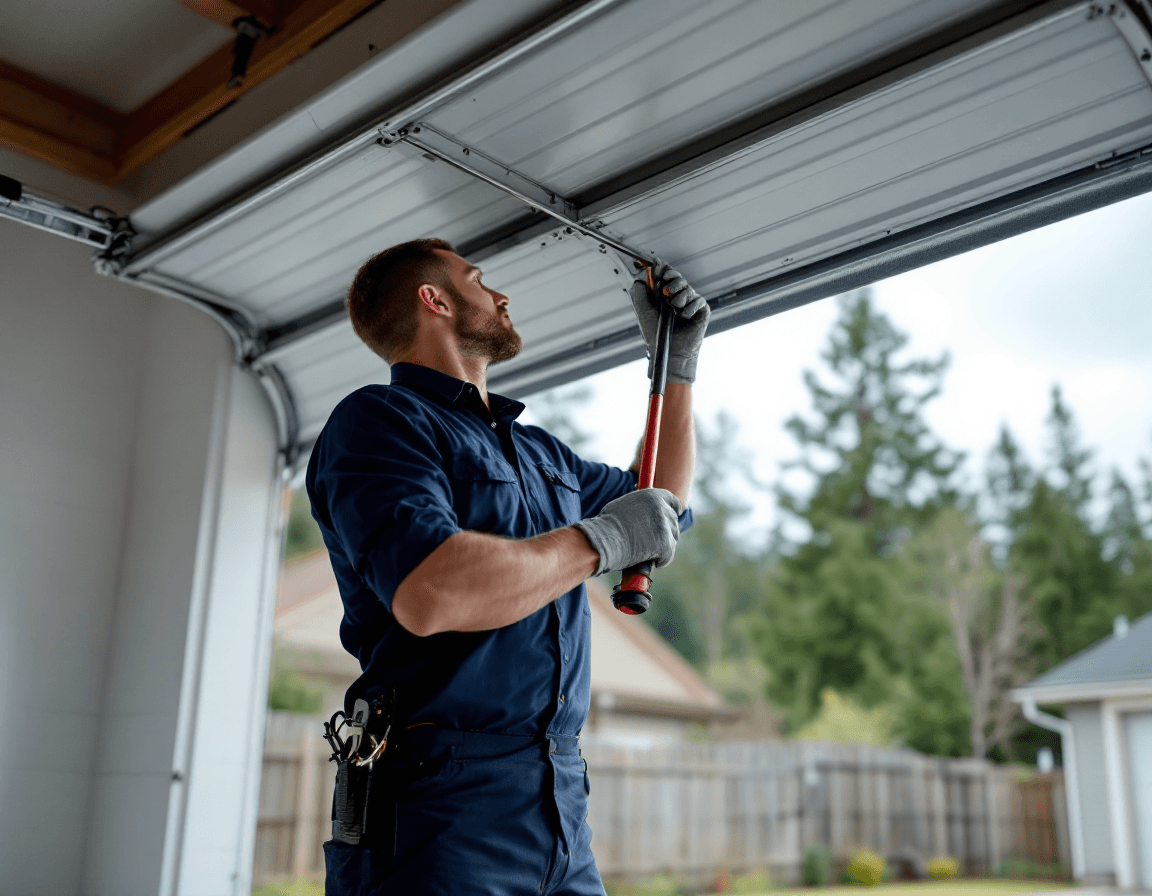
Garage Door Spring Replacement in Redmond, WA is one of the most common repairs we handle for homeowners across the Eastside, and it is also one of the most important to get right. The springs carry most of the weight of your garage door, so when one fails, the door often becomes difficult or impossible to open safely. Redmond's mix of older homes near downtown, newer subdivisions on Education Hill, and townhomes and condos around Overlake means garage doors here vary widely in age, size, and spring setup. This page explains what spring failure looks like, why it happens so often in our wet climate, and what to expect when a licensed technician replaces the springs.
Most Redmond homeowners first notice a spring problem in a moment they will not forget. A door that worked fine the night before may refuse to lift in the morning, or it may let out a sharp bang that sounds like a gunshot in the garage. The cause is almost always the same: a spring has reached the end of its working life and broken under load. Even when the door seems to work afterward, the remaining spring is usually carrying more strain than it was designed for. Acting promptly protects the opener, the cables, the tracks, and the people who walk past the door every day.
Our goal here is to give you a clear, practical picture so you can decide what to do next with confidence. We will walk through the warning signs, the difference between torsion and extension systems, what high-cycle springs offer, how balancing fits into the job, and what a typical price range looks like. We will also cover safety, because spring work is one of the few garage door tasks that should never be attempted as a do-it-yourself project. If you have a door that is stuck, noisy, or behaving strangely right now, you can call us at (888) 799-3819 and we will talk through what you are seeing.
Reading the Warning Signs Before a Spring Snaps Completely
Springs rarely fail without some kind of warning, though the warnings are easy to miss if you are not paying attention. A door that begins to feel heavier over a few weeks is often a spring that has lost tension and is no longer doing its share of the lifting. You may also notice the door rising unevenly, with one side moving faster or sitting higher than the other. Many homeowners in Redmond mistake these early changes for a sticky track or a tired opener, when the real culprit is the spring system.
Visual clues matter too. On a torsion system, the spring is a long coil mounted on a steel shaft above the door opening, and you may see small gaps forming between the coil windings, rust-colored flakes, or a noticeable stretch in the coil length. On an extension system, the springs run along the sides of the track, and a sagging or visibly stretched spring is a red flag. Check the area around the spring for fresh metal dust or small particles on the floor, since these often appear when a coil is beginning to fatigue.
Do not wait for a dramatic failure to call for help. If you notice any of the following, schedule an inspection while the door is still operating:
- The door feels much heavier when lifted by hand, even with the opener disconnected.
- One side of the door rises noticeably faster or lower than the other.
- You see a visible gap or stretched section in a torsion coil.
- The door closes too quickly or drops with a jolt near the floor.
Early inspection is typically far less disruptive than an emergency call after the door has jammed shut with the car inside.
Why Redmond's Wet Winters Are Hard on Garage Door Springs
The Pacific Northwest climate is gentle in many ways, but its long wet season is tough on steel. Redmond gets plenty of drizzle and damp air from October through early spring, and garage interiors often stay humid even when the weather outside seems mild. That moisture settles on exposed metal and encourages surface rust, which weakens the spring wire over time. A spring that looks fine on the outside may have corrosion inside its coil that you cannot see without a close inspection.
Temperature swings add another layer of stress. A cold snap that drops temperatures well below freezing can make steel more brittle, and a spring that has been slowly losing strength may give way on the first cold morning. Redmond homeowners who park in unheated garages near the Sammamish River or in lower-lying neighborhoods sometimes report that their doors begin acting up right after a stretch of cold, wet weather. The spring did not suddenly fail because of one night; it had already been weakened by months of moisture and cycling.
Frequent use compounds the problem. Households with two drivers, teenagers coming and going, or home businesses that open the door several times a day put far more cycles on a spring than a garage used only occasionally. Each open and close cycle loads the spring, and over thousands of cycles the wire fatigues. Local conditions combined with heavy daily use are a big reason why replacement is so common on busy Redmond streets and in shared-use driveways.
Torsion or Extension: Knowing Which Spring Your Door Uses
Before any replacement, a technician needs to identify the spring system, because torsion and extension springs behave very differently and are installed in different ways. Torsion springs mount on a horizontal shaft above the door opening and wind up as the door closes, storing energy that helps lift the door when it opens. They are the more common setup on modern residential doors in Redmond, and they tend to provide smoother, more balanced lifting. Extension springs run parallel to the horizontal tracks on each side and stretch as the door lowers, which is why they are sometimes found on older or lighter doors.
Each type fails in its own way. A broken torsion spring often creates a visible gap in the coil, may cause a loud bang, and can leave the door stuck halfway up or sitting unevenly. Extension springs more often sag, separate from their hardware, or snap near one end, and they may be accompanied by a cable that has come loose from the drum. In both cases, the door should be treated as unsafe until a professional has inspected it, because the stored tension in a spring can be dangerous to anyone working nearby.
Identifying the system also affects cost and timing. Torsion replacements usually involve a matched pair of springs and sometimes new cables, bearings, or drum hardware, while extension replacements may be simpler but still require careful handling. Many of the homes we service in Overlake and Education Hill have torsion systems on builder-grade doors, while older houses near downtown Redmond may still have extension springs or a mixed setup after past repairs. A quick, honest assessment on site is the best way to know exactly what your door needs.
What a Broken Spring Actually Looks and Sounds Like
Homeowners often describe a spring break with the same phrase: "It sounded like a gunshot." The noise is sharp and sudden because the coiled steel releases its stored energy all at once. Some people hear it from inside the house, while others notice the bang only after finding the door hanging crooked or refusing to move. The sound is the clearest sign that a spring has failed, and it is a reason to stop using the door until it has been examined.
After a break, look for a gap in the torsion coil, which may be an inch or more wide, or for a coil that appears loose along the shaft. The door may open a few inches and then stop, or it may not lift at all. In some cases the opener strains or hums while the door barely moves, which can tempt people to keep pushing the button. Doing so can damage the opener, twist the door panels, and pull on the cables, turning a spring repair into a larger job.
If you have heard a bang and are unsure whether the door is still safe, keep everyone clear of the door, avoid trying to lift it manually, and disconnect the opener only if you know how to do so without putting yourself in the path of the door. Call a licensed technician to inspect and replace the spring. Attempting to remove or wind a spring yourself is dangerous, and it is the reason spring work is best left to trained professionals.
When the Door Stalls or Tips Crooked
A door that opens a few inches and then stops is one of the most frustrating symptoms, and it often points to a broken spring combined with other issues. When the spring fails, the door loses the lift force it needs to travel smoothly, and the opener may stall when it reaches the point where the remaining weight is too great. You may hear the motor working hard, see the door shudder, or notice that it reverses automatically. In some cases the door may stop because the safety sensors detect a change in movement and reverse the travel.
A door that closes too fast, drops unevenly, or hangs crooked can also trace back to spring trouble. When one side of a torsion system is weaker, the door rises on an angle, and the cables may begin to bind or slip off the drum. Over time the track alignment can shift, the rollers can wear unevenly, and the panels can flex. Replacing the spring is only part of the fix; the cables, drums, and tracks should be checked for damage at the same visit.
Cables that come loose after a spring break deserve special attention. When the spring releases, the cable can slacken and jump off the drum, which creates a tangled hazard and may cause further damage if the door is operated. A technician will inspect the cable path, reseat it correctly, and replace it if it shows fraying or kinks. Leaving a loose cable in place can lead to a second failure at the worst possible time.
High-Cycle Springs for Busy Redmond Households
Standard springs are rated for a certain number of cycles, and that rating reflects how many open-and-close movements they are designed to handle before wear becomes a concern. For many households that use the garage a few times a day, a standard spring may serve well for years. However, families with several drivers, home offices with frequent deliveries, or driveways shared with neighbors often generate far more cycles than the standard design expects, and that is where high-cycle options come in.
High-cycle springs are made from wire and tempered to handle greater repetitive loading. They are a practical upgrade when a homeowner is replacing a spring that broke early, when the door is heavy due to insulation or decorative windows, or when the household wants a longer expected service interval. We discuss cycle ratings and expected usage during the estimate so you can choose an option that fits how your garage is actually used. The conversation is always about matching the spring to your daily routine, not pushing the most expensive option.
Choosing a high-cycle spring also makes sense in climates like ours, where moisture can speed corrosion. Quality wire with appropriate finishes resists rust better than bargain components, which matters in a garage that stays damp for months. A well-matched spring, installed correctly and balanced to the door's actual weight, will generally perform more consistently than a mismatched replacement. That consistency reduces strain on the opener and helps the door last longer overall.
Balancing the Door After the Swap
Replacing a spring is not the end of the job. Once the new spring is installed, the door must be balanced so that it stays in place when it is raised halfway, lifts smoothly, and closes without slamming. A properly balanced door should be able to hover at about the halfway point with the opener disconnected, though exact behavior depends on the door's design and weight. An unbalanced door places extra stress on the opener, the cables, and the spring, shortening the life of every component.
Precision matters because even small differences in tension between the two sides of a torsion system can cause problems. A technician checks the lift on each side, adjusts the winding as needed, and confirms that the cables are seated correctly on the drums. The door is then tested through several complete cycles to verify smooth travel, correct auto-reverse function, and proper closing force. Skipping this step is one of the most common causes of premature repeat failures.
Balancing also reveals other issues that might otherwise go unnoticed. Worn rollers, bent track sections, a failing bearing, or a loose bracket can all make the door feel uneven even after the spring is new. Addressing these at the same visit protects the investment you made in the replacement and helps the door operate quietly. A thorough tune-up after a spring swap is one of the best ways to extend the life of the entire system.
Typical Pricing for Spring Replacement in Redmond
Pricing for spring work depends on several factors, including whether the door uses torsion or extension springs, the weight and size of the door, the spring rating selected, and whether cables, drums, or bearings also need attention. For most spring replacements, our range runs from $180 to $450. Lower-end jobs often involve a standard single spring on a lighter residential door, while higher-end jobs may involve a matched pair of high-cycle torsion springs plus additional hardware.
Homeowners sometimes ask why one quote differs from another. The answer usually lies in what is included: the quality of the spring wire, whether the work covers balancing and safety checks, and whether the cables and drums are inspected and replaced when needed. A low quote that leaves out balancing or uses a poorly matched spring can cost more in the long run. We would rather explain the details clearly than hand you a number without context.
We will always provide the price before work begins, and we will explain what the price covers. If the inspection reveals additional damage, such as a cracked drum or failing bearing, we will describe it and give you the option to proceed or wait. You should never feel pressured into an upgrade you do not need. Our aim is a repair that is safe, accurate, and fairly priced for the specific door in your garage.
Neighborhood Notes Across Redmond and Nearby Areas
Redmond is not a single kind of neighborhood, and garage door needs can shift from one area to another. Downtown Redmond has a mix of older single-family homes and newer mixed-use buildings, and many of the detached garages there have aging doors that were installed before modern spring systems became common. Those doors often respond well to a careful inspection, and sometimes a conversion or upgrade improves both safety and performance.
Overlake is home to a large number of townhomes, condos, and newer multi-family buildings, where garage doors may be shared, heavily used, or subject to strict community rules about appearance and modification. Our technicians take those details into account when scheduling and planning the work. Education Hill features many single-family homes built in recent decades, where torsion systems are common and households often have multiple vehicles that drive the door several times a day. Marymoor Park and its surrounding streets include a range of homes, from older bungalows to modern builds, each with its own door configuration.
Our service area covers the 98052 and 98053 ZIP codes and extends to surrounding communities across King County and the Eastside. Whether your home is near the park, close to the Overlake employment corridor, or tucked into a quiet neighborhood on Education Hill, the same principles apply: identify the spring system, match the replacement to how the door is used, and balance the door carefully. We bring that consistent approach to every job, regardless of where it is located.
Safety Steps Before a Technician Arrives
Until a licensed professional arrives, a few simple precautions can prevent injury and additional damage. Keep children and pets away from the door, and do not stand under it while it is partially open or hanging. Do not attempt to lift the door by hand, and do not try to wind, unwind, or adjust a spring, since the stored energy can cause severe injury. If the door is stuck, disconnect the opener only if you can do so safely, and avoid forcing the door in either direction.
Taking a few simple steps can also help the technician work more efficiently when they arrive. Note the sound you heard, when the problem started, and whether the door has been behaving differently over the past few weeks. Take a photo of the spring area if you can do so safely from a distance, and make sure the path to the garage door and opener is clear. These details help us diagnose the problem faster and reduce the time you spend without a working door.
- Keep everyone and every pet clear of the door's travel path.
- Do not attempt to lift, wind, or adjust the springs yourself.
- Avoid repeatedly pressing the opener button, which can strain the motor and cables.
- Note any noises, gaps in the coil, or uneven movement for the technician.
- Make sure the garage is accessible and the vehicle is moved if needed.
Why Spring Work Belongs in Licensed Hands
Garage door springs store a large amount of energy, and mishandling them is one of the most dangerous home repairs a person can attempt. Tools slip, coils release unexpectedly, and a single mistake can cause serious injury or damage to the vehicle and property. That is why we recommend a licensed, bonded, and insured technician for every spring and cable job, no matter how simple it looks. Professional training and the right equipment make the difference between a safe repair and an accident.
Our technicians approach each job with a clear checklist. They confirm the spring system type, inspect the cables, drums, bearings, and tracks, select an appropriate replacement, and balance the door before handing it back to you. They also test the auto-reverse feature and safety sensors so that the door operates safely for everyone in the household. Those steps are not optional extras; they are part of what it means to repair a spring properly.
If you are dealing with a broken spring, a loud bang, a door that refuses to lift, or cables that have come loose, do not wait for the problem to get worse. Call Seattle Garage Door Fix at (888) 799-3819 to schedule an inspection and get a clear, honest estimate for your Redmond home. We will explain your options, answer your questions, and get your garage door moving safely again.