
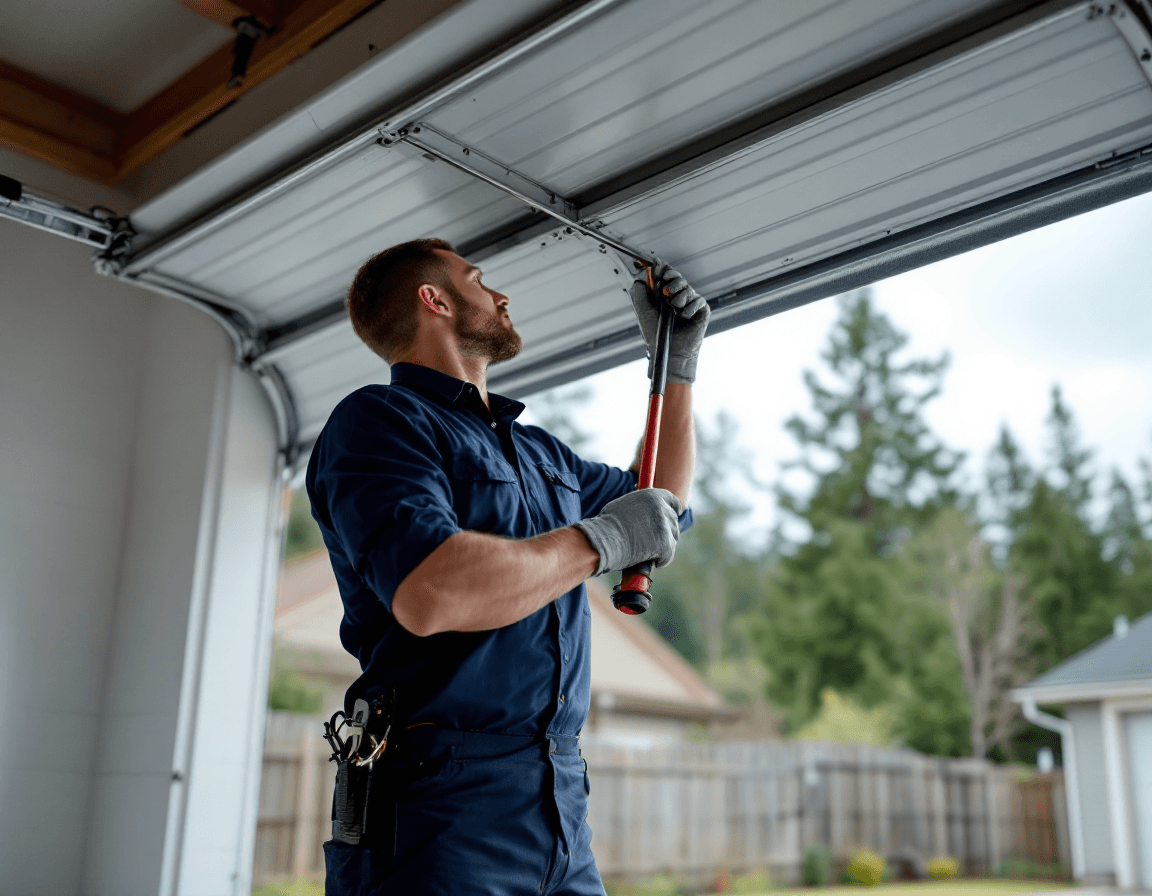
Garage Door Spring Replacement in Kirkland, WA is one of those repairs most homeowners postpone until the decision is made for them, usually with a sharp crack from inside the garage at six in the morning. The springs do the heavy lifting on your door. They carry most of its weight so the opener doesn't have to, and when one fails, the door becomes difficult or impossible to move. Our technicians at Seattle Garage Door Fix work across Kirkland every week, from townhomes near Downtown Kirkland to larger lots in Finn Hill and Holmes Point, and the same pattern shows up again and again: a spring that was already worn finally gives out.
This page explains what a broken spring looks and sounds like, how Kirkland's wet winters and cool summers affect the hardware, and what to expect when you call for service. We cover the difference between torsion and extension systems, why cables and drums often need attention after a break, and why high-cycle springs and precise balancing matter for a door that will see daily use. We also give a realistic picture of cost. Most spring replacements we handle fall in the $180 to $450 range, though the exact figure depends on the door's size, weight, and hardware. Everything here is meant to help you make informed decisions, not to turn you into a do-it-yourself spring technician.
One point needs to be stated plainly before anything else: spring work is dangerous. Torsion springs are under enormous tension even when they look still, and a mistake during removal or winding can injure someone badly. Please leave spring replacement to a licensed, bonded, and insured professional. The sections below will help you recognize the problem early and understand what the repair involves.
How Kirkland's Wet Winters and Cool Summers Wear Down Springs
Kirkland sits on the eastern shore of Lake Washington, and that location brings the mild, damp climate that defines Western Washington. Winters are long and gray, with frequent drizzle and a steady supply of moisture in the air. Even when it isn't raining hard, humidity sits near the surface of the metal for months at a time. Steel springs are coated to resist corrosion, but that coating wears thin over the years, and once surface rust starts, it gradually weakens the coil.
Temperature swings add another layer of stress. A cold snap that drops the garage down into the 20s followed by a warm afternoon causes the metal to contract and expand, which can open tiny fatigue cracks in an already aging spring. Many of the springs we replace in Juanita and Rose Hill fail on the first chilly morning after a long stretch of mild weather, which is a useful reminder that the break happened earlier and simply became noticeable then. Summer is not a free pass either, since the heat can soften lubrication and make the coil more prone to binding when the door cycles.
Garages in older Kirkland neighborhoods can also be less insulated and more exposed to the elements than newer builds. An attached garage that shares a wall with a heated living space stays drier than a detached garage with an uninsulated door. Knowing which situation you're in helps explain why one home needs spring service every decade while another needs it sooner. Either way, the springs are a wear item, and their lifespan depends heavily on the environment they live in.
Hearing the Bang: What a Snapped Spring Sounds Like
A broken torsion spring usually announces itself with a loud, sharp bang that many homeowners describe as a gunshot or a car backfiring. The sound often comes from the garage, and it can be startling enough to make people think something has hit the house. In most cases the noise is the spring coil releasing its stored energy all at once. The bang is over quickly, but the consequences linger because the door is no longer balanced and may not move at all.
After the noise, the door often looks normal from the outside but behaves strangely. You might find it sitting partway open, sagging at one side, or refusing to lift when you press the opener button. Sometimes the opener runs and strains without moving the door far. Other times the door drops slightly when you release the lock, which is a sign that the remaining spring tension can no longer hold the panels in place. Treat any unexpected bang as a reason to stop operating the door until someone has inspected it.
It helps to know that a loud bang is not always a spring. Loose hardware, a rolling door hitting a track, or a bearing giving way can produce similar sounds. A technician can usually tell the difference within minutes by examining the coil, the cables, and the drums. What matters most is that you stop using the door, keep people and pets away from the opening, and avoid trying to lift or inspect the spring yourself. A damaged spring can still hold residual tension, and a quick look at the coil does not reveal how much energy remains.
Reading the Warning Signs Before a Spring Breaks
Springs rarely fail without warning. Most show a gradual decline that is easy to miss if you only use the garage for quick trips in and out. Learning to recognize early signs can save you from a stuck door, a damaged opener, or a more expensive repair later. The following symptoms are the most common ones we see in Kirkland homes before a spring finally gives way:
- The door feels noticeably heavier when lifted by hand, or the opener seems to work harder than it used to
- A visible gap appears in the torsion spring coil, or the coil has developed a rust-colored, flaky surface
- The door opens a few inches and stops, then needs a second press to continue
- The door closes faster than normal or lands with a hard thump
- One side of the door sits lower than the other, or the panels look crooked when closed
- The opener hums or strains even though the door barely moves
Any single item on that list deserves attention, and a combination of them is a strong signal to schedule service soon. Do not wait for the bang. A spring that is partly fatigued can still break under normal use, and the failure often happens during the coldest or wettest part of the year, when the door sees heavy use and the metal is most brittle. Calling early keeps the repair simple and often avoids damage to the opener, cables, or track.
Torsion Versus Extension Springs: Knowing Which You Have
Most garages in Kirkland use one of two spring systems, and identifying yours matters before any repair begins. A torsion system mounts one or more long springs on a steel shaft directly above the door opening. These springs twist to store energy and are typically the source of the loud bang when they break. An extension system uses pairs of springs that run along the horizontal tracks on either side of the door, stretching as the door opens and pulling it back toward a balanced position when it closes.
Torsion systems are common on newer doors and generally handle heavier panels and frequent cycling with more stability. Extension systems are often found on older doors or on lighter residential panels, and they can be installed with safety cables running through the centers of the springs to contain the coil if it breaks. Both systems are dependable when properly installed, but they require different tools and procedures. A technician who understands both can match the replacement to the door's original design and weight rating.
Here is a quick way to tell them apart from the outside of your garage:
- Torsion springs sit on a horizontal bar above the door, usually with a bearing plate and drum on each end
- Extension springs run diagonally or horizontally along the tracks, often with a pulley and cable assembly near the top
- Torsion springs are generally wound, and the winding cones are visible at the center of the bar
- Extension springs are generally stretched, and the lengths of the coils are visible along the track
If you are unsure which type your door uses, take a photo of the top of the door and the tracks and share it when you call. Accurate identification helps us quote the job correctly and bring the right replacement parts.
Cables, Drums, and the Hidden Damage After a Break
When a spring breaks, the cables that connect it to the bottom corners of the door often suffer as well. In a torsion system, the cables wind around drums at each end of the shaft, and when tension suddenly releases, a cable can jump off its drum, fray, or pull loose from its anchor. A cable that has come off the drum will leave the door hanging unevenly, and a frayed cable can snap later under load. Either problem can be dangerous if the door is operated without inspection.
Drums deserve careful inspection too. Many drums are made of cast metal or heavy-gauge steel, and some are designed to be replaced as a set when one shows wear. Cracked drums, stripped set screws, or worn bearing plates can cause the door to bind, tilt, or drop unexpectedly. A spring replacement that ignores the cables and drums will leave the door unstable, which is why a complete inspection is part of a proper service call rather than an optional extra.
Extension systems have their own hardware concerns after a break. The rollers, brackets, and safety cables that run through extension springs may be bent or stressed by a sudden release. Technicians check each component for alignment and wear before reassembling the system. In Kirkland's humid climate, we also look for corrosion on fasteners and track hardware, since rust on those parts can interfere with smooth travel and accelerate the next failure.
High-Cycle Springs and Why They Suit Busy Kirkland Households
Standard springs are rated for a certain number of cycles, meaning complete up-and-down operations of the door. A typical residential spring is designed for somewhere around 10,000 cycles, which works well for households that use the garage a few times a day. Busy families, home offices that double as workshops, and homes with teenagers who come and go constantly may wear through standard springs faster than expected. High-cycle springs are manufactured with heavier wire or upgraded materials to handle more cycles over their service life.
High-cycle options are not a universal upgrade, and they are not always necessary. A single-car garage used mainly for parking and occasional storage may be well served by a standard spring. A busy household in Totem Lake, where the garage is the main entrance and the door opens several times a day, can benefit from the added durability. We discuss cycle expectations with each homeowner and recommend an option that matches actual use rather than selling the most expensive part by default.
Choosing a high-cycle spring also affects the rest of the system. Heavier springs may change the balance point of the door, so the cables, drums, and opener settings should be checked after installation. This is one reason why spring work should always include a balance test. The new springs need to match the door's weight precisely, or the opener will struggle and the door will wear unevenly over time.
Precise Balancing: The Step Most Quick Fixes Skip
A garage door is balanced when it stays in place halfway open with the opener disconnected, and it moves smoothly in both directions without drifting. Balance is more than a convenience. A door that is out of balance places extra load on the opener, the rollers, and the track, and it can cause premature failure of parts that were otherwise in good condition. Many quick fixes skip this step, leaving the door to work well for a few weeks and then begin to drift again.
Precise balancing begins with measuring the door's weight and comparing it with the spring rating. Technicians then adjust the tension so the spring supplies the right amount of lift. For torsion systems, this usually means carefully adding or removing turns on the spring, a procedure that must be done with the proper tools and safety equipment. For extension systems, adjustments involve the length, tension, and attachment points of the springs. In both cases, the goal is the same: the door should hold position at mid-height and move without effort.
After adjustment, the door is tested through several cycles. The technician checks the track alignment, the roller condition, and the way the door seats at the bottom of its travel. Kirkland homes often have driveways that slope or garages built into hillsides, and these conditions can subtly influence how the door behaves. A good balance adjustment accounts for the specific installation, not just a generic setting. This is one of the main reasons we recommend a professional rather than an approximate DIY fix.
What Spring Replacement Typically Costs in Kirkland
Most spring replacements we perform fall in the range of $180 to $450. The final price depends on several factors, including whether the door has torsion or extension springs, the size and weight of the panels, whether the job requires one spring or a pair, and whether cables, drums, or other hardware also need replacement. A high-cycle upgrade adds to the cost, as do repairs to the track, bearings, or opener components discovered during inspection.
It helps to think of the total job in three parts. The first is the spring itself, which is the largest variable and depends on the door's specifications. The second is the labor required to remove the broken part safely, install the new spring, and adjust the tension. The third is any associated hardware that should be replaced at the same time, such as cables, drums, or bearing plates. Replacing these items together usually costs less overall than handling them in separate visits.
We provide a clear estimate before work begins. If the inspection reveals problems beyond the spring, we explain what we found and what it would cost to address it, and you decide what to approve. There is no obligation to proceed with additional work. Kirkland homeowners who ask for a written breakdown tend to find that the estimate matches the final invoice, which is how a trustworthy service relationship should work.
Why Attempting Spring Work Yourself Carries Real Risk
Searching online for spring replacement instructions can make the task look manageable, but the physical hazards are serious. A torsion spring holds a large amount of stored energy, and winding bars can slip, spring out, or strike a person with enough force to cause lasting injury. Even experienced homeowners have been hurt when a cable snapped or a drum released unexpectedly. The risk does not end when the spring is removed, because residual tension may still exist in parts of the system.
Tools matter as well. Proper winding bars, cable clamps, and safety equipment are designed for specific spring sizes, and using the wrong tool can damage the spring or the shaft. Many home garages lack a stable workspace for handling a heavy door section, and a door that falls during repair can crush fingers, hands, or worse. Licensed technicians train for these situations and carry the equipment needed to manage them safely.
Insurance and liability also deserve a moment of thought. If a homeowner is injured while doing their own spring work, the consequences can extend to medical costs and property damage that far exceed the price of a professional repair. Our technicians are licensed, bonded, and insured, which means the work is covered and the responsibility is clearly defined. For homeowners in Kirkland, that peace of mind is often worth more than the time saved by attempting a risky job alone.
Choosing a Technician for Your Juanita, Totem Lake, or Rose Hill Home
When selecting a company for spring replacement, look first for licensing, bonding, and insurance. These credentials protect you if something goes wrong during the job and show that the company takes its obligations seriously. Ask whether the technician will inspect the entire door system, including cables, drums, rollers, and the opener, rather than only replacing the spring. A thorough inspection is a sign of professional practice, not an upsell.
Local familiarity also helps. Juanita homes often have a mix of older and newer garage doors, and the technicians who serve that area are used to working with both. Totem Lake and Rose Hill have many townhome and multi-family garages with shared walls and tight clearances, which can make the installation more demanding. Downtown Kirkland's older buildings sometimes have unusual headroom or track configurations. Experience with these conditions leads to faster, more accurate service.
Finally, ask about the work itself. A good technician will explain which spring type your door uses, why the replacement suits your household, and how the balance will be tested. They will give you a clear estimate, answer questions without pressure, and leave the door operating smoothly. If anything about the process feels rushed or vague, it is reasonable to ask for more detail or to get a second opinion.
Keeping Springs Healthy Between Service Visits
Routine care can extend the life of your springs and reduce the chance of a sudden failure. Once or twice a year, inspect the torsion coil or extension springs for gaps, rust, or flaking, and look at the cables for fraying or kinks. Check that the door moves smoothly and stops where it should. Keep the moving parts lightly lubricated with a silicone or lithium-based product that is suitable for garage doors, and avoid heavy oils that attract dust and grit.
In Kirkland's damp climate, keeping the garage well ventilated helps reduce corrosion. Wipe away moisture from the tracks and hardware after heavy rain, and consider a dehumidifier if the space stays consistently wet. Trim vegetation that touches the door or tracks, and keep the area clear so the door has room to move. These simple habits make a noticeable difference over several winters.
Most importantly, do not ignore changes in how the door behaves. If you notice a new noise, a slower opening, or a door that seems off balance, schedule an inspection before the problem grows. A small adjustment made early is far less expensive than an emergency repair on a cold morning, and it keeps your garage safe and dependable for the seasons ahead.
If your Kirkland garage door has gone quiet in a way that feels wrong, has produced a loud bang, or simply won't lift the way it should, call Seattle Garage Door Fix at (888) 799-3819. Our licensed, bonded, and insured technicians will inspect the springs, cables, drums, and balance, explain what they find in plain language, and give you a clear estimate before any work begins. Whether you live near Downtown Kirkland, in Juanita, Totem Lake, or Rose Hill, we are ready to help you get your door moving safely again.