
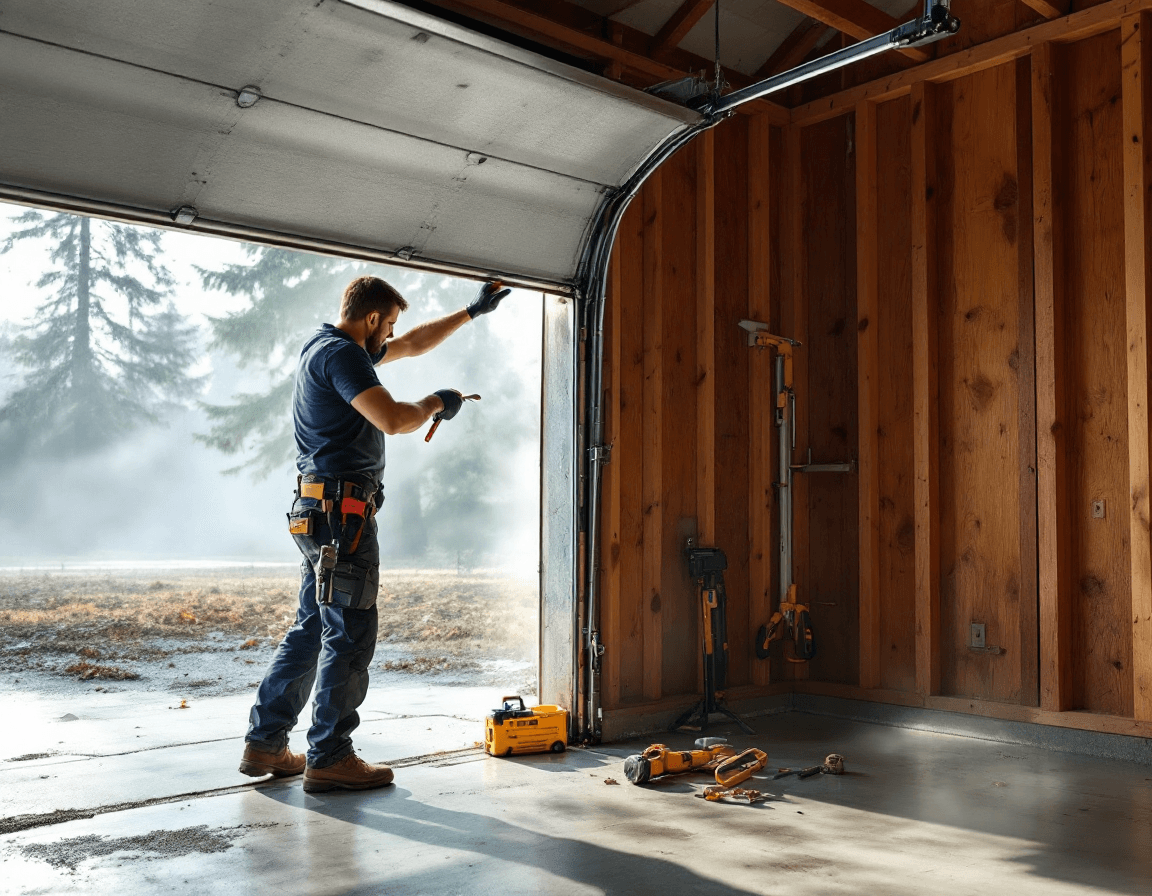
Off-track garage door repair in Mercer Island, WA is one of those problems that rarely waits for a convenient day. One morning the door sits a little crooked on its rails, and by the next time you back out of the driveway, a roller has popped free and the panel hangs at an angle that makes the whole assembly groan. Because the door is still partly attached to the track, many homeowners assume it is only a minor adjustment, but a door that has left its track is under uneven load and can drop or shift without warning. This page explains what usually causes a derailment on the island, how to recognize the early warning signs, and what a licensed technician does to get the door running true again.
Mercer Island homes have their own quirks that make garage doors work harder than they do in flatter neighborhoods. Many houses sit on sloped lots with driveways that pitch toward the garage, older split-level and mid-century layouts with tight headroom, and garages that were never designed around today's heavier insulated steel doors. Add the damp Pacific Northwest air that rolls off Lake Washington and the constant freeze-thaw cycles of a wet winter, and the hardware that keeps a door centered on its track gets stressed in ways that are easy to overlook. Seattle Garage Door Fix sees these conditions regularly across the island, and the repair approach is shaped by them. The information below is meant to help you make calm, informed decisions, whether you are dealing with a door that is simply crooked or one that has jammed completely.
Why Island Driveways and Slopes Push Doors Off the Rails
Driveways on the island often rise or fall at noticeable angles, and that slope changes how a garage door behaves when it travels. When a door is closing downhill toward a garage that sits lower than the street, gravity can pull the bottom edge toward one side if the rollers on that side are sticky or worn. Over months of cycling, that small imbalance can nudge the door against the vertical track until a roller rides up out of the channel. Homeowners often notice this first as a faint scraping sound on one side rather than as an obvious failure.
Older garages around the Town Center area and in the older neighborhoods on the north and east sides of the island can also have framing that is slightly out of square. When the header or the side jambs have settled, the tracks may no longer be perfectly parallel to the door opening, even if they looked fine when they were installed. A door that was properly balanced in a square opening can start to bind once the opening shifts by a fraction of an inch. This is one reason technicians measure the track alignment rather than simply pushing the door back into place.
Sloped lots also raise the chance of the door being struck or bumped by a vehicle, particularly when a car backs out at an angle or a bumper clips the bottom panel. A single impact can bend a track section just enough to affect every cycle afterward. If you have noticed a new dent in the door or a faint kink in the track after a driveway incident, it is worth having the alignment checked even if the door still appears to move.
Reading the Warning Signs Before a Door Derails
Most off-track doors give some warning before they fully leave the track. The earliest sign is usually a change in sound, such as a rhythmic scraping, a grinding that seems to come from one corner, or a clunk at the top of travel. Watch for a door that stops moving smoothly and instead hesitates, jerks, or leans as it rises. Any of these behaviors suggests that one side is traveling differently than the other, which is the core problem of misalignment.
Visual clues matter as much as sounds. Walk outside with the door partly open and look for a visible gap between the top or side edge of the door and the weatherstripping or track face. An uneven gap that is wider on one side is a strong sign that the panels are no longer riding evenly. Also look at the rollers themselves: a roller that is cocked sideways, cracked, or missing its stem has likely been pushed out of its normal path.
Pay attention to what the door does when you run the opener. If the door reverses unexpectedly, the opener may be detecting resistance caused by binding, and repeated reversals can strain the motor and the springs. Continuing to run the door in this condition can turn a simple realignment into a larger repair involving damaged panels or track sections. Stopping the door and calling for service at the first sign of binding is far less expensive than waiting until it sticks halfway up.
What Actually Goes Wrong Inside the Track
A garage door track is a precision guide. Each side of the door has a vertical track, a curved section that turns the door overhead, and a horizontal section that runs along the ceiling in a standard setup. Rollers ride inside these channels, and hinges connect the panels so that the door bends at the curves. When any part of this system is out of alignment, the rollers are forced to press against the track edges, which creates friction, noise, and eventual damage.
The most common mechanical failure is a roller that has worked out of the track or been pushed past the lip of the channel. Rollers with worn nylon tires or stems that have loosened from the hinge can slip out when the door flexes. Once a roller is outside the track, the door panel next to it drops or tilts, and the weight shifts onto the remaining rollers. That added load can bend the track or pull a hinge loose if the door continues to run.
Track problems are often less obvious. A track can be bent slightly outward, creating a narrow spot the rollers must squeeze through. It can also separate at a joint where the bolts have loosened or the mounting brackets have pulled from the wall or ceiling. Each of these conditions can cause a door to bind or derail even when the rollers themselves are in good shape, which is why a complete inspection of the track, brackets, and hinges is standard practice.
Wet Winters, Lake Fog, and the Metal Along the Shore
Mercer Island's climate plays a bigger role in door performance than many homeowners expect. Winters bring long stretches of rain, and the moisture that lingers near the lake can speed up corrosion on steel tracks, bracket bolts, and roller bearings. A track that has developed surface rust may still look usable, but rust increases friction and can cause the rollers to grab as they pass over a rough patch. Over time, that grabbing can pull a roller out of its channel.
Cold snaps add another layer of trouble. When temperatures drop below freezing, lubricants stiffen, rubber weatherstripping contracts, and the door panels themselves can respond unevenly if one side of the garage is more exposed to the cold than the other. A door that moved smoothly in October may bind in January simply because the components have changed slightly with the weather. This is one reason many off-track calls cluster during the coldest and wettest months of the year.
Summer and early fall are not free from risk either. Dry spells followed by sudden windstorms, which can sweep across the island from the water, may push or rattle a door that is already marginal. Many homeowners also notice that a door binds more during the first heavy rain of the season because water has washed grit and debris into the track channels. A seasonal inspection before the rainy months begin can catch these issues early, when the fix is usually simple.
A Homeowner's Safety Checklist Before Anyone Touches the Door
Before you attempt any inspection or movement of a door that has come off its track, safety comes first. A door that is partially derailed can shift unexpectedly, and the springs that counterbalance its weight store a great deal of energy. The safest approach is to keep people and pets away from the door, avoid standing underneath it, and resist any temptation to force it back into place by hand. The following checklist covers what you can and cannot safely do:
- Keep everyone clear of the door's path, including children and pets, and do not stand beneath a door that is out of its track.
- Do not attempt to lift, pull, or push a door that has jumped its track by hand, because a sudden shift can cause serious injury.
- Do not touch, loosen, adjust, or remove torsion springs, spring cones, or lift cables under any circumstances; these components are under high tension and require licensed service.
- If the opener is connected, disengage it only with the manual release cord while the door is fully closed, and then move on to a professional inspection rather than attempting repairs yourself.
- Photograph the track and rollers from a safe distance so the technician can see the condition of the system before arrival, which can help them plan the visit.
- Keep the vehicle out of the garage bay until the door is evaluated, since a door that unexpectedly drops can damage cars or other property.
Anything beyond visual observation belongs to a trained technician. Spring and cable work carries a risk of severe injury even for experienced homeowners, which is why licensed professionals are the only ones who should address it.
Common Causes Behind Vehicle Impacts and Wind Damage
A vehicle strike is one of the most dramatic ways a door can leave its track. A car that backs out too quickly, a delivery vehicle that clips the bottom panel, or a bicycle or lawn equipment that leans into the door can bend a track section or knock a roller loose. Even a glancing blow can deform the track just enough to create a binding point that appears days or weeks later. For this reason, a minor impact should be checked even when the door still appears to operate normally.
Wind is a quieter but serious cause. Strong gusts can push a large single-panel or double-wide door sideways, especially if the garage sits in an exposed location or if the door has lightweight panels that catch the wind. When the door flexes under gusts, rollers can be forced out of their channels, and the track may take a permanent set if the pressure is repeated. Homeowners in open lots near the water sometimes report that the door rattles during storms and then sticks the next morning.
Other forms of impact include stacked storage that leans against the door from inside, heavy items hung on the door's interior, and accumulated debris that wedges between the door bottom and the track. Inspecting the interior of the garage occasionally, not just the exterior, can reveal these pressures before they cause a derailment. Clearing the bottom of the track of leaves, gravel, and sawdust is also a simple habit that reduces the chance of a roller jumping its channel.
How a Technician Realigns a Door and Re-Seats Rollers
A professional realignment begins with a complete inspection rather than an immediate push back into the track. The technician checks whether the springs and cables are intact, looks for damage to the rollers and hinges, and measures the track for level, plumb, and parallel alignment. They also confirm that the door is balanced, since an unbalanced door will put uneven stress on the rollers even after it is seated correctly. This sequence prevents a quick fix from hiding a more serious problem.
Once the system is assessed, the technician carefully lifts the door's weight in a controlled manner and re-seats each roller into its track channel. Worn or cracked rollers are typically replaced rather than reinstalled, because a damaged roller will likely derail again under normal use. Track sections are checked and adjusted with the correct tools, and loose brackets and bolts are tightened to the manufacturer's specifications. The goal is a door that travels straight, stops evenly, and does not bind at any point in its range.
The final stage involves testing the door through several full cycles, both by hand and with the opener if one is installed. The technician watches for any sign that one side is traveling differently, listens for scraping, and checks the balance by disconnecting the opener and confirming that the door stays put when partially raised. If the opener's auto-reverse or force settings were affected by the binding, those are checked as well. A door that passes this full test is far less likely to derail again in the near term.
Bent Track Sections: Straightening Versus Replacing
When a track has been bent by an impact or by long-term stress, the technician must decide whether it can be straightened or whether it needs to be replaced. Light bends that do not crack the metal or pull the track away from its mounting points are often corrected in place with careful adjustment. Straightening is generally appropriate when the deformation is modest, the track is otherwise sound, and the correction will leave the rollers able to travel without grabbing. Working on a track that has been bent in several places, however, may not produce a reliable result.
Replacement becomes the better option when the track has creases, splits at a seam, or shows separation at a joint that cannot be corrected by re-tightening. A track that has been stressed repeatedly may also have metal fatigue that is not visible to the naked eye, and attempting to straighten it can cause it to fail later. Matching replacement sections to the existing door hardware is important, since mismatched tracks can change how the rollers seat and how the door moves. A technician will typically explain which option is appropriate and why before any work begins.
Homeowners sometimes ask whether they can straighten a track themselves with a rubber mallet or a pair of pliers. This is a common instinct, but it can make matters worse. Improper bending can crack the track, misalign the curves, or create a new pinch point that wears the rollers quickly. Track work should be done by a professional who understands how the components relate to the door's balance and travel.
Pricing for Off-Track Work and What Shapes the Final Bill
Most off-track repairs in the Mercer Island service area fall within a range of $125 to $400, depending on the nature of the damage and the time required to restore full operation. A straightforward realignment in which the rollers are re-seated and the track is adjusted without parts replacement typically sits at the lower end. Jobs that involve replacing damaged rollers, straightening or replacing a bent track section, or tightening multiple brackets generally fall higher on the scale. These figures reflect the typical scope of off-track work and are not a guarantee for every situation, since each door has its own condition.
Several factors influence where a specific repair lands within that range. The number of sides affected, whether one or both tracks are involved, the door's size and weight, and the accessibility of the track and brackets all contribute. A door that has been bent by a vehicle may need more time because the technician has to evaluate whether the panels, hinges, and springs were also affected. Doors with insulated panels or custom finishes may require more care during handling, which can also affect the time needed on site.
Before any work begins, a responsible technician should explain what they found, what they recommend, and what the cost will be for the recommended approach. If the inspection reveals additional issues, such as a damaged spring, a frayed cable, or a failing opener, those should be presented separately so you can decide how to proceed. Spring and cable repairs must be handled by a licensed professional, and they carry their own pricing that depends on the components involved.
Preventing the Next Derailment Around the Island
Prevention for off-track doors comes down to a few consistent habits. Keep the tracks clean by wiping the channels with a dry cloth to remove grit, leaves, and sawdust, especially at the start of the rainy season. Lubricate the rollers and hinges with a silicone-based or garage-door-specific lubricant rather than heavy grease, which can attract dirt. Avoid spraying lubricant directly into the track channels in a way that creates a sticky buildup, and do not lubricate the torsion springs, since they require professional maintenance.
Visual checks once a month can catch problems early. Look for a gap that has grown on one side, a roller that appears to be sitting at an angle, a track bolt that looks loose, or rust forming on a track section. Stand inside the garage with the door closed and look for light leaking unevenly around the edges, which can indicate a panel that is starting to shift. Listen for new sounds during operation, since a change in noise often arrives before a visible problem appears.
Annual professional maintenance is a sensible investment, particularly for homes with sloped driveways, older framing, or exposure to strong winds off the lake. A technician can check balance, tighten hardware, test safety reversal, and evaluate the springs and cables before a small issue becomes a derailment. For households that rely on a door every day, a yearly inspection tends to pay for itself by avoiding emergency calls during bad weather.
Scheduling Off-Track Service Across Mercer Island
When an off-track door needs attention, the best first step is to stop using it and call for service. Driving the door back and forth in hopes that it will self-correct usually makes the damage worse. Describe what you have observed, including whether the door is fully off the track, partly off, or simply binding, and whether anyone has been hurt or whether a vehicle was involved. Those details help the technician arrive prepared and decide whether a same-day visit is appropriate.
Service requests from across the island are handled with the same care regardless of which neighborhood the home sits in. Whether your property is near the Town Center, along a quiet residential street, or close to the bridge corridors that connect the island to Seattle and Bellevue, the process is the same: a safe assessment, a clear explanation, and a repair that restores smooth travel. If your garage is in the 98040 area, mention it when you call so the scheduling team can confirm the most efficient route and timing.
Seattle Garage Door Fix is a licensed, bonded, and insured company serving more than 60 cities across the greater Seattle and Western Washington region. Off-track repairs, roller replacement, track straightening, and the inspections that prevent future derailments are all part of our work. If your door has left its track, is binding, or shows any of the warning signs described above, do not wait for it to fail completely. Call (888) 799-3819 today and a technician can help you get your door moving safely and smoothly again.