
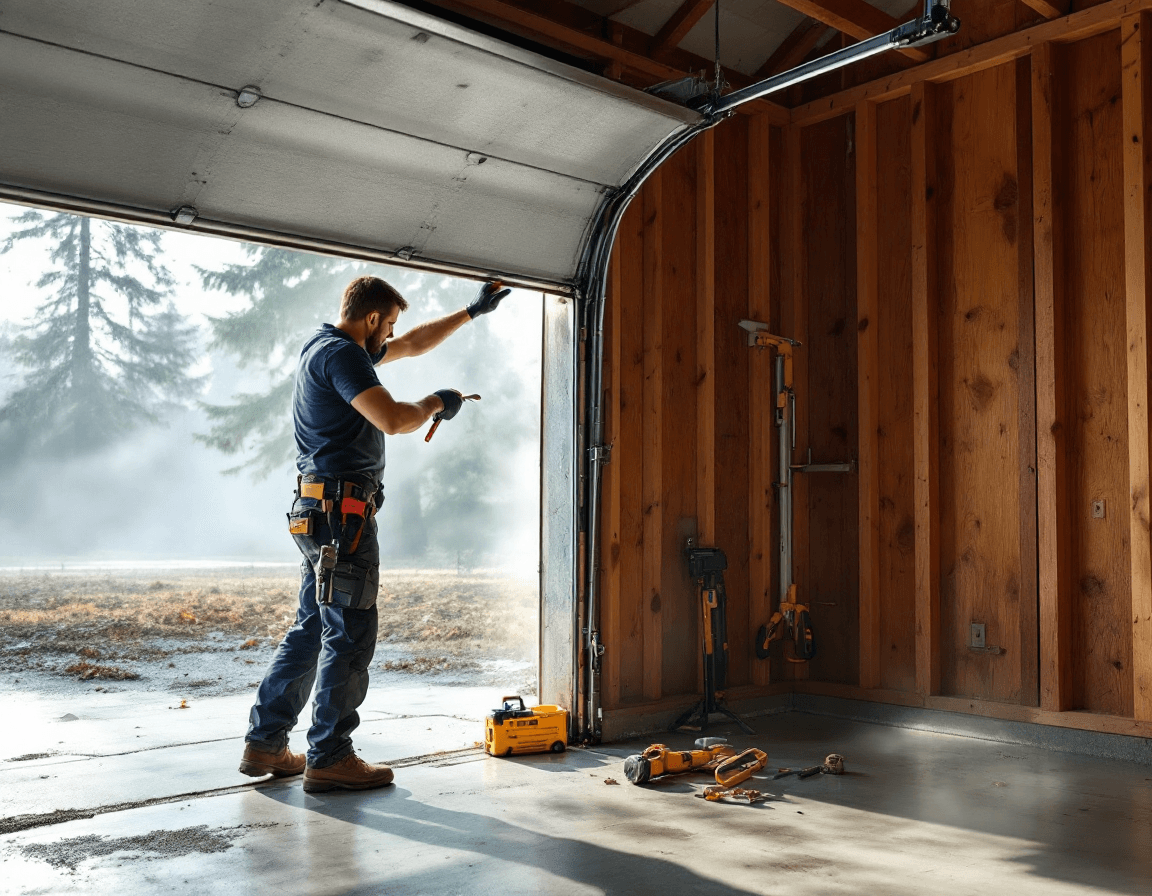
Off-Track Garage Door Repair in Seattle, WA is one of the most common calls our technicians handle, and it rarely comes at a convenient time. A door that has jumped its tracks can leave a household stuck inside or outside, and a door that is only partly off can look fine from the street while quietly stressing its springs, rollers, and opener. Our crews answer these calls across the greater Seattle area, from the older homes near Queen Anne and Fremont to newer builds on the slopes of Magnolia and West Seattle. We are a licensed, bonded, and insured garage door repair company, and we approach every off-track job with the same question: what made the door leave the track, and what will keep it there?
Derailments in this region tend to have a few recurring causes that reflect the local climate and terrain. Long stretches of rain, damp soil, and freeze-thaw cycles in the colder months shift foundations and driveway slabs just enough to change how a door sits in its opening. Salt air drifting in from Puget Sound affects hinges and roller shafts in neighborhoods closer to the water, and moisture trapped in door sections can swell or warp panels over time. When you combine these conditions with daily use, a door that was perfectly aligned after installation can gradually drift until a roller finally pops out.
Whether your door is fully off one track, sitting crooked with a visible gap, or completely jammed, the information below will help you understand what is happening and what a professional repair typically involves. Most off-track repairs in King County fall in the range of $125 to $400, depending on the damage and the parts needed. If you are unsure whether your situation is safe to handle on your own, our phone line at (888) 799-3819 is open for questions, and we are glad to talk through what you are seeing before anyone climbs a ladder.
Why Western Washington Winters Push Doors Out of Line
Seattle's wet season is long, and the moisture it brings does more to garage doors than most homeowners realize. Rain saturates the ground around a garage, and as the soil swells and then drains, the slab and footings can move by small but meaningful amounts. Even a quarter-inch of shift at one corner of the opening can be enough to change the angle at which the track meets the header, and a door that once rolled smoothly may start to hesitate or lean.
Wood framing and older wooden door sections respond to humidity in their own way. A steel door in a damp garage may hold up well, but the bottom panel can absorb moisture from a concrete floor that never fully dries during November through March. When panels swell unevenly, the edges push against the track rollers at odd angles, and that pressure is often what finally forces a roller out of its channel. Many of the older homes in Ballard, Queen Anne, and the Rainier Valley have detached garages with floors that sit low relative to the surrounding grade, which makes this moisture problem especially persistent.
Freezing nights, though less common than in eastern Washington, still matter in higher-elevation neighborhoods and on shaded north-facing driveways. Water that seeps into track seams and freezes overnight can deform thin steel track sections, and the thaw that follows may not return them to their original shape. Over several seasons, these small changes accumulate, and a door that seemed fine in September can be riding crooked by the first hard rain of the following year.
Warning Signs That a Door Is Heading Off Track
Off-track failures almost always announce themselves before the door actually comes loose. Paying attention to these early signals can turn an emergency call into a routine adjustment, and it can prevent the kind of secondary damage that drives repair costs up. The symptoms below are the ones our technicians see most often in homes across King County.
- A grinding, scraping, or squeaking noise that starts at one side of the door and travels along the track as the door moves.
- A visible gap between the top or side weatherseal and the track, especially when the door is closed.
- Rollers that look tilted, flattened, or sitting at an angle inside the track channel.
- A door that rises or lowers unevenly, with one side lagging or jerking ahead of the other.
- Track sections that show dents, kinks, or spots where the metal has separated from its bracket.
- A door that pauses or reverses at a point where it used to move without resistance.
Any one of these signs deserves attention, and several together usually point to an alignment problem that is already underway. It is tempting to wait until the door stops working entirely, but a door that is slightly out of square places extra load on its rollers, hinges, and opener, and those parts wear faster when the misalignment continues. Taking a photo of the gap or the crooked section can help when you describe the problem to a technician, because the angle of the door often reveals more than a verbal description can.
Hillside Driveways and Seattle's Uneven Ground
Seattle is a city of hills, and that topography shapes how garage doors behave. Homes on the slopes of Queen Anne, the bluffs of Magnolia, and the ridgelines of West Seattle often have garages built into or against a grade, with driveways that pitch noticeably toward the street. When the ground beneath a garage is not perfectly level, the door opening can be slightly out of square even on the day it was installed, and a door hung in that opening will want to ride at an angle from the start.
Retaining walls and older concrete aprons add another layer of complexity. A wall that has begun to lean, or an apron that has settled toward one corner, can pull the header and track out of alignment without any obvious visible crack. In these situations, the door may run perfectly for months and then begin to bind after a heavy rainy stretch, which often confuses homeowners who assume the door itself must be at fault. A careful technician will check whether the opening has moved before adjusting the door, since correcting the door alone will only hide the problem temporarily.
Properties near steep grades in Capitol Hill and Interbay sometimes have garage openings that were modified over the decades to accommodate new vehicles or added storage. Those changes can leave tracks mounted to framing that was never designed to carry the load of a heavy door. Before we re-seat rollers or straighten a track in these situations, we look closely at the mounting points, because a track that comes loose from a weak header will derail again no matter how carefully it was realigned.
What a Technician Does During an Off-Track Realignment
A proper off-track repair begins with safety and ends with verification. Before any work starts, the opener is disconnected, the door is secured so it cannot shift unexpectedly, and the technician confirms that the spring system is not under tension that could cause injury. Because doors can be heavy and springs store significant energy, this stage is not something a homeowner should attempt alone, and it is one reason we recommend a licensed professional for any repair that involves the door's lifting components.
Once the door is secured, the technician inspects each roller, track section, bracket, and hinge to find the point where the alignment first failed. This inspection usually reveals whether the problem is a single displaced roller, a track that has been pushed out of its channel, or a broader issue such as a bent section or a misaligned header. The technician then re-seats rollers, tightens or replaces loose brackets, and gently coaxes the track back into its proper path using the correct tools so that the metal is not stressed beyond its limits.
The final stage is testing and fine-tuning. The door is run slowly through its full travel several times, with attention to whether it rises and lowers evenly, whether the weatherseal meets the track along its full length, and whether the opener reverses properly if it encounters resistance. Many off-track jobs also reveal small problems that were not the original cause, such as worn rollers with cracked stems or hinges that have started to elongate their mounting holes. Addressing those items during the same visit prevents a repeat call a few weeks later.
Rollers, Hinges, and the Small Parts That Cause Big Failures
Rollers are the most frequent culprits in off-track incidents, and they tend to fail in predictable ways. Nylon rollers can become brittle with age and crack along the stem, while steel rollers may flatten on one side from years of uneven loading. Once a roller develops a flat spot or loses its ability to spin freely, it can jump out of the track on a bump or when the door is pushed by wind, and the door follows the roller out of its channel.
Hinges play a quieter but equally important role. Each hinge connects one door section to the next and helps keep the panels aligned as they travel around the curve of the track. When a hinge loosens or its rivets elongate, the sections can shift relative to one another, and that shift can push a roller toward the edge of the track. On heavier residential doors common in older Seattle homes, hinge fatigue is often the slow cause that eventually leads to a sudden derailment.
Replacing rollers and hinges is usually straightforward for a trained technician, but the choice of parts matters. Higher-quality sealed steel rollers with ball bearings tend to hold their alignment longer than basic nylon rollers, particularly in damp garages where moisture can swell or stiffen cheaper components. A technician who understands the local climate will often recommend upgrades that reduce the chance of a repeat derailment, and those recommendations should always be based on what your specific door needs rather than a one-size-fits-all package.
Bent Track, Separated Sections, and Vehicle Impacts
Not every off-track problem is caused by wear. A vehicle backing into a door, a delivery truck clipping the frame, or a stray basketball hitting the track at the wrong angle can dent or kink the metal enough to prevent the rollers from riding correctly. Track damage can also happen gradually when a door is repeatedly forced past a jam, and sections that were once straight may develop a subtle bow that only shows up when the door is in motion.
Separated track sections are a particularly serious issue. When the bolts or brackets holding two sections together come loose, the gap between them can catch a roller and pull it sideways, and the door can jam or fall out of its path with little warning. A technician will check each joint, tighten or replace fasteners, and confirm that the track is continuous from the bottom bracket to the top before the door is returned to service. Bent sections are straightened where the metal allows, but badly deformed track is replaced, since a track that has been overstressed rarely holds a stable alignment for long.
If a vehicle has struck your door, it is wise to have the entire assembly checked even if the damage looks minor. Impacts can bend the header, crack a bracket, or stress the spring system in ways that are not visible from the outside. Please do not attempt to pry a damaged door back into shape or pull on the torsion or extension springs while you wait for help. Those components store enough force to cause serious injury, and the safest course is to keep people and vehicles away from the door until a licensed technician arrives.
Typical Costs for Off-Track Repairs in King County
Pricing for off-track work depends on what the technician finds once the door is secured and inspected. Many straightforward realignments, such as re-seating a single roller or tightening a loose track bracket, fall within a range of roughly $125 to $400. Jobs that involve replacing several rollers, repairing bent track sections, or correcting a misaligned header will typically land toward the higher end of that range or require a separate estimate for additional parts.
Several factors influence the final figure for a Seattle-area repair. The door's size and weight affect how much time and care the realignment requires, and insulated or custom doors often use specialized rollers and hinges. The age of the system matters as well, since older track profiles and discontinued hardware can take longer to source. Access also plays a role, because a door on a steep driveway or in a tight detached garage may need extra setup before the technician can work safely.
We recommend asking for a clear explanation of what is included before the work begins. A reputable technician should be able to describe which parts are being replaced, why each one is necessary, and what the repair will and will not address. If a technician suggests a larger repair than you expected, it is reasonable to ask for the reasoning and to request time to consider the options. Transparent communication is one of the clearest signs of a trustworthy garage door company, and it is something we work to provide on every call.
Safety Boundaries Every Homeowner Should Respect
Garage doors are heavier than most homeowners expect, and the springs that counterbalance them are under high tension even when the door appears to be at rest. Torsion springs and extension springs can release their stored energy with enough force to cause serious injury, and the cables that run alongside the tracks can snap under load. For these reasons, any work involving springs, cables, or drum assemblies should be handled by a licensed, trained professional rather than a do-it-yourself project.
Homeowners can take a few safe steps while waiting for a technician. Disconnect the opener by pulling the emergency release cord only when the door is closed, which reduces the risk of the door falling suddenly, and keep hands and fingers away from the tracks and rollers. Do not stand under a door that is partly off its track, and do not attempt to lift a jammed door manually, since sudden movement can cause the panels to drop or twist. If the door is leaning, keep children and pets clear of the area and avoid using the garage as a walkway until the door is secured.
Our technicians follow these boundaries on every job and will explain clearly when a task falls outside what a homeowner should attempt. If you are unsure whether something is safe to try, call us at (888) 799-3819 before touching the door. A short conversation can prevent an injury that would cost far more, in both pain and expense, than the repair itself.
Neighborhood Notes From Ballard to Rainier Valley
Every part of Seattle has its own quirks when it comes to garages, and our crews work across all of them. In Ballard and the Fremont and Green Lake areas, many homes were built on modest lots with detached garages that have seen decades of weather, so track brackets and headers often need reinforcement during an off-track repair. Properties in the 98107 and 98117 areas frequently have older steel doors that respond well to proper lubrication and roller upgrades when realigned.
Queen Anne, Magnolia, and the Interbay area (98199) present their own challenges, with sloped driveways, retaining walls, and varied foundation conditions that affect how doors sit in their openings. Capitol Hill and the central neighborhoods covered by 98122 and 98101 often feature tight garage spaces where access for a technician requires careful planning. In West Seattle, including the 98116 and 98136 areas, salt air and hillside drainage can accelerate hardware wear, which makes routine inspection especially valuable.
Rainier Valley (98118 and 98144) and the north-end communities around Lake City (98125) and Bitter Lake (98133) also see plenty of off-track calls, often tied to older construction and doors that have been moved or repaired multiple times over the years. Wherever you live in the city, from the 98103 corridor to the 98115 and 98105 areas near the University District, our goal is the same: a door that tracks smoothly and safely through every season. We serve dozens of neighboring cities across Western Washington, and our technicians understand how local conditions shape each repair.
Simple Seasonal Habits That Prevent Future Derailments
A little attention throughout the year can dramatically reduce the chance that a door will leave its track. Because Seattle's weather shifts from dry summers to soggy winters, the most useful habits are those that address moisture, wear, and early warning signs before they turn into emergencies. Many of these tasks take only a few minutes and require nothing more than a flashlight and a damp cloth.
- Wipe the tracks clean of debris, leaves, and grit at least twice a year, paying special attention to the bottom bracket area where dirt collects.
- Lubricate the rollers, hinges, and bearings with a silicone-based or lightweight garage door lubricant, avoiding heavy grease that attracts dust.
- Check that the bolts holding the track brackets and hinges are snug, and tighten them gently if you notice any movement.
- Watch the weatherseal along the bottom of the door for gaps or tears, since moisture entering the garage can accelerate hardware damage.
- Run the door slowly through a full cycle once a month and listen for new noises, uneven motion, or hesitation.
- Keep the garage floor free of standing water, and address drainage problems near the door opening before they reach the tracks.
Beyond these routine habits, schedule a professional inspection every year or two, especially if your home is more than a decade old or if the door has been involved in any impact. A technician can spot slow-developing problems, such as an elongating hinge hole or a track that has begun to drift, long before they cause a derailment. Early attention is almost always less disruptive and less costly than waiting for the door to come off its track during a storm or a busy morning.
If your garage door has come off its track, is sitting crooked, or is jammed and refusing to move, please call Seattle Garage Door Fix at (888) 799-3819. Our licensed, bonded, and insured technicians serve homeowners across Seattle and King County, and we will explain what we find, outline the options, and handle the repair safely. Do not wait for the next storm to turn a small misalignment into a bigger problem.