
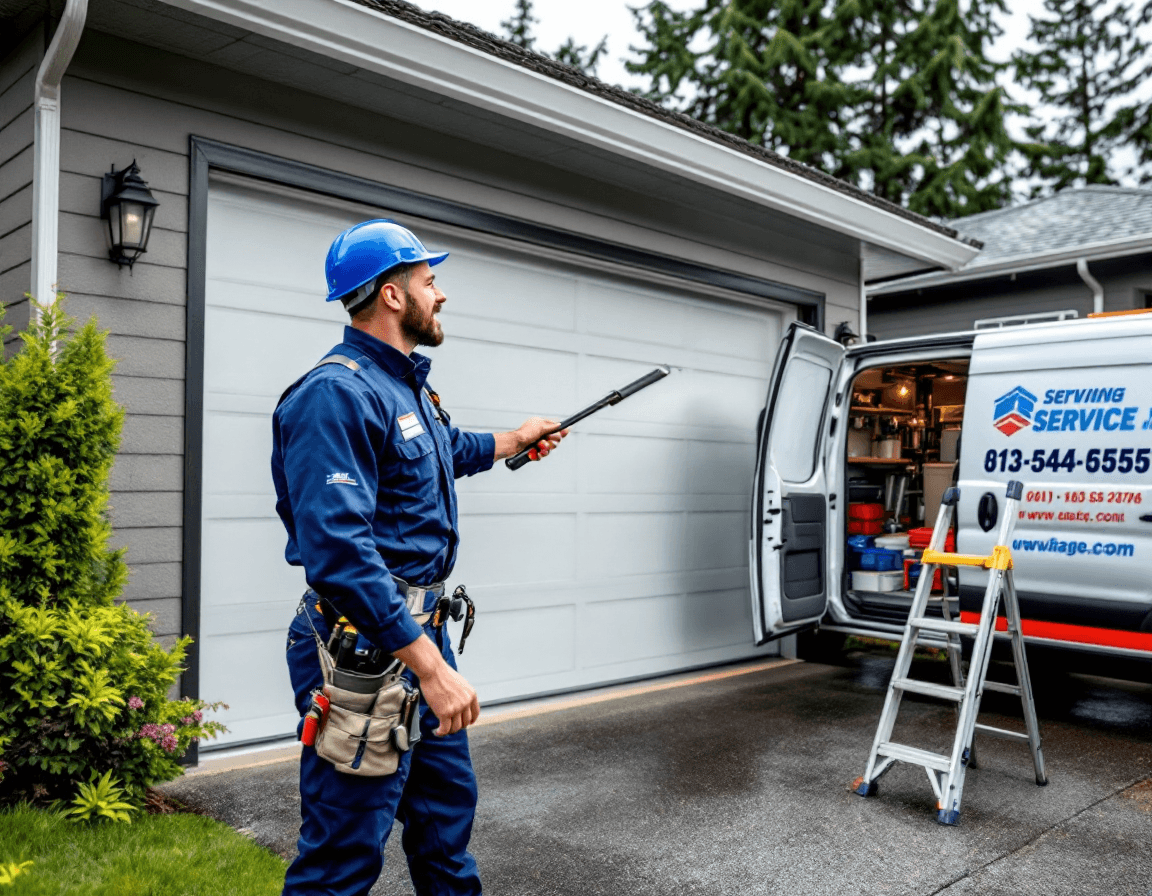
Garage door repair in Seattle, WA is one of those services people tend to put off until the door makes the decision for them, usually on a wet weekday morning when the car is stuck inside or outside. Our technicians see the same pattern across King County: a door that worked fine last month suddenly hesitates, reverses, or refuses to budge at all. Most of these problems start small, with a worn roller, a loose bracket, or a sensor that has drifted out of alignment, and they become expensive only when they are ignored.
This page explains what we typically find when a Seattle homeowner calls about a door that won't open, won't close, or moves unevenly. It covers how the Pacific Northwest climate affects garage door hardware, which warning signs deserve attention right away, and what a typical repair involves. We also explain where safety boundaries sit, because some parts of a garage door system carry enough stored energy to cause serious injury if handled by someone without training.
Whether you live near the water in Magnolia, on the slopes of Queen Anne, or in a older bungalow off Rainier Avenue, the goal is the same: a door that opens and closes quietly, reliably, and safely. If you would rather talk through your symptoms with someone now, call (888) 799-3819 and describe what the door is doing.
Why Seattle's Damp Winters Work Against Your Door Hardware
Seattle's climate is mild by most American standards, but it is persistently damp. Long stretches of drizzle, frequent fog, and a steady rainy season from late fall through spring mean that garage door components rarely get a fully dry day to recover. Moisture finds its way into steel hinges, roller bearings, and track seams, where it encourages surface rust and washes away the lubricant that keeps parts moving freely.
Humidity also causes wood and composite doors to swell and shift slightly, which can change how the panels sit in the tracks. A door that closed cleanly in August may rub at the bottom seal in January simply because the panels have absorbed water and grown a few millimeters. Those small changes are often the first thing a technician checks when a customer says the door "feels different" after a few weeks of wet weather.
Cold snaps, which do happen in Seattle even if they are short, add another layer of stress. Lubricants thicken in low temperatures, and metal contracts, which can make an opener strain harder than normal to lift a door that has been sitting outside. If you notice more sluggish operation on the first cold morning of the season, that is a reasonable time to schedule an inspection before a minor drag becomes a complete failure.
Hills, Older Homes, and the Layout Challenges of Central Seattle
Seattle's topography creates garage configurations you will not find in flat suburbs. Many homes on Queen Anne, Capitol Hill, and parts of Fremont sit on sloped lots, so the driveway apron may meet the garage floor at an angle, or the garage slab may be slightly out of level. When the floor is not level, the door's vertical tracks can be subtly out of plumb, and the door can start to travel crookedly even though nothing looks obviously wrong.
Older houses in neighborhoods like Green Lake, Ballard, and parts of Rainier Valley often have garages built decades before modern door standards. The framing around the opening may have settled unevenly over time, and the header may sag a fraction of an inch. These issues do not usually cause a sudden breakdown, but they put extra load on one side of the door, which wears out one spring or one roller long before the other.
Detached garages, which remain common on Seattle lots, bring their own challenges. Exposure to wind-driven rain, uneven soil movement, and limited sun to dry out wet surfaces all affect how the door and its tracks behave over time. When we visit a detached garage, we often look first at the threshold, the weather seal, and the ground drainage around the slab, because water intrusion there can quietly corrode the bottom bracket and the lowest roller.
Reading the Warning Signs: Reversing, Gaps, and Crooked Travel
A door that reverses before reaching the floor is one of the most common and most useful warning signals a homeowner can see. Most modern openers include a safety reversal system, and if the door touches an obstruction or the photo-eye beam is interrupted, the door should stop and go back up. When the reversal happens in midair with nothing in the path, the cause is usually a misaligned sensor, a dirty lens, or a force setting that has drifted too sensitive.
Visible gaps, sagging sections, and a door that looks slightly lopsided are signs that something structural is working loose. Look for daylight between the top panel and the header, or a bottom panel that bows downward in the middle. Check whether the door sits level when closed, and whether the gap at the left and right sides of the tracks looks the same. A door that leans, sags, or rides higher on one side is often telling you that a cable, spring, or track bracket is no longer sharing the load evenly.
Doors that move unevenly often produce a stutter, a hitch, or a sideways drift as they lift. Some homeowners notice that the door opens fine until it reaches about halfway, then pauses, then jerks upward. That pattern points toward a worn roller, a bent track section, or an imbalance in the spring system. Continuing to run the opener in that condition can strain the motor and the drive gear, which turns a modest repair into a larger one.
Here are signs that call for a professional visit soon rather than later:
- The door reverses in midair with no obstruction in view
- One side of the door is noticeably higher or lower than the other
- You can see daylight between the top section and the header when the door is closed
- The door stops partway through its travel and will not continue without help
- Rollers look flattened, cracked, or have visible shredding on the edges
Noises That Tell You Something Is Wrong
Garage doors are never silent, but they should not sound alarming. A quiet rumble from the opener is normal, and so is a soft rattle as the door moves over its rollers. What deserves attention is a new sound, or a sound that gets louder over a few weeks. Each type of noise tends to point toward a particular category of problem.
Grinding often suggests that a roller bearing has worn down, or that the drive chain or belt has dry metal-on-metal contact. Squealing usually comes from a roller that has run out of lubricant or from a hinge that needs attention. A sharp banging when the door reaches the top or bottom of its travel may indicate a loose track bracket, a stop that has shifted, or a spring that is beginning to fatigue. Each of these sounds is worth investigating before the repair gets more complicated.
Some homeowners try to fix noise with a quick spray of general-purpose lubricant. That approach can make the problem worse, because many common sprays attract dirt and leave residue that grinds more aggressively over time. A technician will typically clean the tracks, check the rollers, and apply the correct lubricant to moving parts. Quieter operation usually follows, along with a clearer picture of what is wearing out and how quickly.
When the Door Stops Halfway or Slams Shut
A door that stops midway, sometimes called a jammed or stuck door, is frustrating because it leaves the car half-exposed to the weather and blocks an entry point. The cause is often a track obstruction, a broken cable, a damaged roller stem, or a spring that has lost tension. Never try to force a stuck door open by hand or pull on a cable, since the tension in those components can release suddenly and cause injury.
A door that slams shut too fast is a different symptom with a different set of causes. When the closing speed or force setting on the opener is wrong, or when the door's balance has shifted, the door can drop quickly onto the floor with a loud impact. This stresses the bottom bracket, the floor seal, and the opener. In some cases it also signals that a spring is weaker than it should be, so the door is no longer being supported through its full travel.
Doors that refuse to close at all sometimes have a simple explanation, such as a safety sensor that is blocked, misaligned, or wired incorrectly. Cobwebs, a stray leaf, or sun glare can interrupt the beam, and the opener will refuse to close until the path is clear. If the sensors look clean and aligned but the door still will not close, the problem may lie in the opener logic or in a mechanical obstruction that a technician needs to inspect in person.
Remotes, Wall Buttons, and the Electronics Behind the Door
When a remote or wall button does nothing, the first thing to check is the simplest one: the battery in the remote and whether the wall control has power. Many Seattle homeowners keep remotes in a car or a jacket pocket, where cold, damp conditions can drain batteries faster than expected. Replacing the battery solves the problem more often than people expect.
If batteries are fine, the next step is to confirm that the opener itself has power and that the logic board has not reset. A tripped breaker, a loose outlet connection, or a power interruption during a storm can leave the opener in a state where it ignores commands until it is reset. Some openers also have a learn button on the motor unit, and pressing it incorrectly can erase programmed remotes. A technician can usually recover the programming without replacing the opener.
Wireless interference is less common in residential neighborhoods but not impossible, particularly in dense apartment-adjacent areas of Capitol Hill and Rainier Valley where many devices share the same frequencies. If a remote works in one part of the house and fails at the garage, a range or interference issue may be involved. Upgrading to a newer rolling-code system or relocating the receiver can resolve the problem and improve reliability for years afterward.
Salt Air, Coastal Moisture, and Wear in Ballard, Magnolia, and West Seattle
Homes in Ballard, Magnolia, and West Seattle sit close enough to Puget Sound that salt-laden moist air plays a real role in how metal hardware ages. Even when there is no visible spray on the door, a light salt film can settle on hinges, springs, and track brackets, where it accelerates corrosion. Galvanized hardware resists this better than bare steel, but no finish lasts forever in an environment that stays wet for months at a time.
Corrosion in coastal-influenced neighborhoods tends to show up first at the bottom bracket, the lower hinges, and the track fasteners closest to the ground. Those areas collect water and debris, and they are the first to develop rust that can seize a roller or weaken a bracket. Technicians often recommend a seasonal wipe-down with a damp cloth and a light coat of a lubricant rated for outdoor metal, which helps slow the process considerably.
Homeowners in these areas should also pay attention to the weather seal along the bottom of the door and the side jamb seals. Salt and moisture can degrade rubber and vinyl faster than in drier climates, and a seal that has cracked or hardened will let water and cold air into the garage. Replacing a worn seal is usually an inexpensive part of a larger tune-up, and it protects both the door hardware and any stored items inside.
What a Typical Repair Visit Covers and What It Costs
Most residential garage door repairs we handle fall in the range of $95 to $450, depending on the parts needed, the complexity of the diagnosis, and whether the work involves a single component or a combination of issues. A simple sensor realignment or a lubrication and adjustment visit sits at the lower end of that range. Replacing a set of rollers, a bottom bracket, or an opener component generally moves the cost upward.
A typical visit begins with a walk-around of the door, the tracks, the springs, the cables, and the opener. The technician will test the balance of the door, check the safety reversal system, inspect the photo-eye sensors, and confirm that the remote and wall controls operate as expected. We explain what we find before any work begins, and we describe which repairs are urgent, which are recommended, and which can wait a season if the homeowner prefers.
Pricing depends on what the door actually needs, not on a fixed bundle that may include services you do not require. In some cases, a few adjustments and a lubrication service may restore smooth operation for a modest fee. In other cases, a worn spring or cable system needs replacement, which is a larger job and should be handled with appropriate tools and training. Honest diagnosis is more valuable than a low headline number, and we aim to give you a clear estimate before we start.
Safety First: Why Springs and Cables Belong with Licensed Professionals
Garage door springs store a substantial amount of mechanical energy, and the cables and drums that work alongside them are under constant tension. When a torsion or extension spring fails, it can release that energy suddenly and with enough force to cause serious injury. For this reason, spring replacement, cable repair, and any work involving tension should be left to a licensed, trained technician who has the right tools and procedures.
Homeowners sometimes attempt these repairs using online videos or hardware store kits, and some of those attempts end in injury or a damaged door. Even experienced DIY enthusiasts can misjudge the winding turns or the tension required, and a spring that appears to be unloaded may still hold enough energy to cause harm. We strongly advise against any attempt to remove, adjust, or replace springs or cables yourself.
There are maintenance tasks that are reasonable for a homeowner to handle. Keeping the tracks clean, wiping down the door panels, checking that the auto-reverse sensors are aligned, and testing the emergency release cord while the door is closed are all safe habits. If the emergency release does not disengage the opener, or if the door feels unusually heavy, stop using it and call a professional. Your safety and the safety of anyone in your household should always come before a quick fix.
Preventive Habits That Extend the Life of a Seattle Garage Door
A few consistent habits can go a long way toward keeping a Seattle garage door running smoothly through wet winters and mild summers. These habits cost very little and often prevent the kinds of breakdowns that interrupt daily routines. Think of them as a seasonal checklist rather than a major project.
- Wipe the tracks and the bottom seal every few months to remove grit, leaves, and road salt residue
- Apply a silicone-based or garage-door-specific lubricant to rollers, hinges, and the opener chain or belt as directed by the manufacturer
- Test the auto-reverse by placing a light object on the floor in the door's path, and confirm the door reverses
- Check that the photo-eye sensors are aligned and free of cobwebs or dust
- Listen for changes in sound and watch for changes in travel, then schedule service when something shifts
Keep an eye on the door from the inside as well as the outside. Look for daylight around the edges, pay attention to how the door behaves on the first cold morning and the first long rainy stretch, and note anything that seems off. Small observations made early make a big difference when a technician arrives, because they help narrow down the cause quickly and accurately.
Where We Work Across Seattle and King County
Our technicians serve homeowners across Seattle and the surrounding King County communities, including neighborhoods from Ballard and Fremont to Capitol Hill, Queen Anne, Magnolia, Green Lake, West Seattle, and Rainier Valley. We cover the Seattle ZIP codes listed below, along with more than 60 cities in the greater Western Washington region. If you are unsure whether your address falls within our service area, call and we will confirm before scheduling.
The Seattle ZIP codes we regularly serve include:
- 98101, 98103, 98105, 98107, 98109 covering downtown, the Eastlake and Westlake corridors, and nearby central neighborhoods
- 98115, 98116, 98117, 98118, 98122 covering Green Lake, Wallingford, West Seattle-adjacent areas, Ballard-side neighborhoods, and parts of Capitol Hill and the Central District
- 98125, 98133, 98136, 98144, 98199 covering north Seattle, Lake City-adjacent areas, Magnolia-side neighborhoods, West Seattle, Mount Baker, and surrounding communities
Our technicians are licensed, bonded, and insured, and they carry the tools and parts needed for most common residential repairs on the first visit. Scheduling is straightforward, and we will tell you what to expect before the appointment. Whether your door is stuck in the middle of a rainy afternoon or making a new sound that worries you, we are ready to help you get it back on track safely.
If your garage door is stuck, sagging, noisy, reversing for no reason, or refusing to respond to its remote, do not wait for it to fail completely. Call Seattle Garage Door Fix at (888) 799-3819 and describe what the door is doing. We will help you understand what is happening, explain your repair options, and get your door moving smoothly again.