
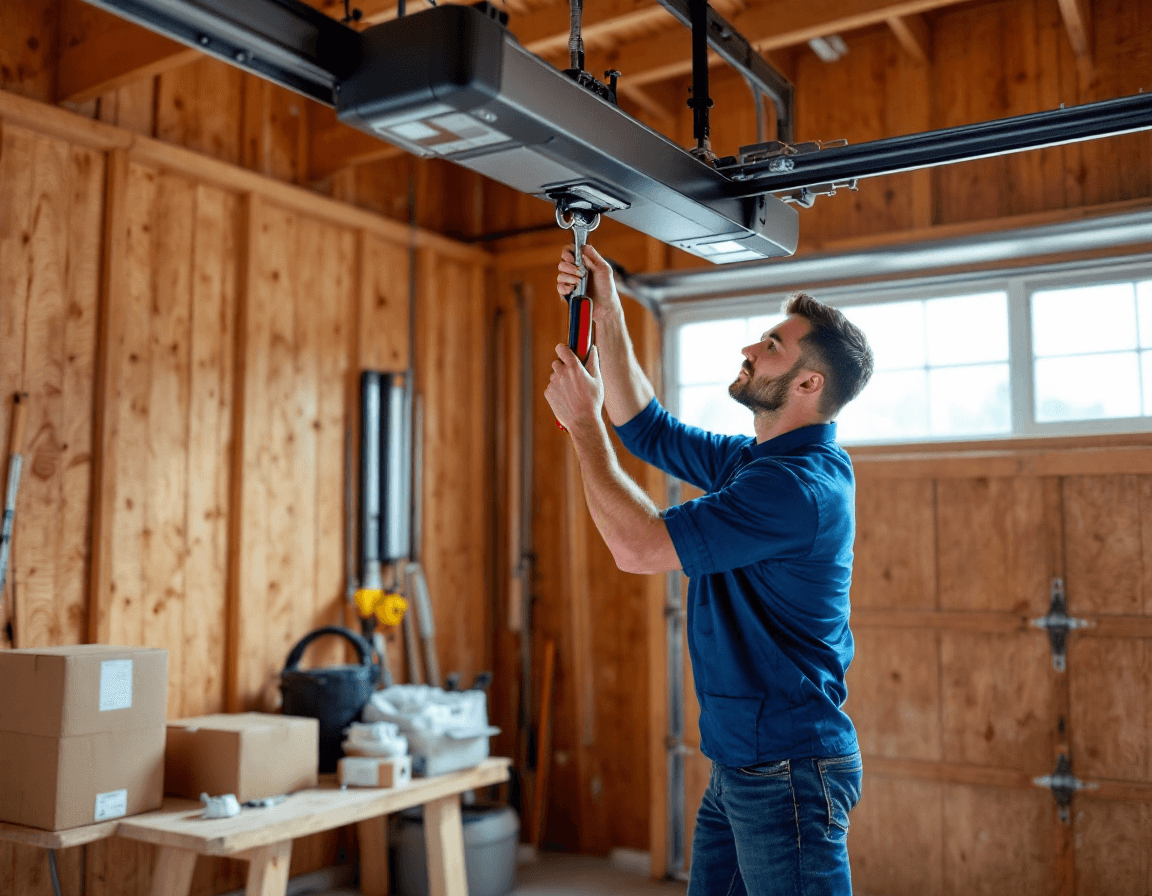
Garage Door Opener Installation & Replacement in Seattle, WA is one of the most useful upgrades a homeowner can make, and it is also one of the most misunderstood. Many households keep the same opener for fifteen years or more, nursing it through rainy winters, loud grinding starts, and remotes that work only when the sky cooperates. If your garage door feels slow, sounds like a cement mixer, or stops responding during a windstorm, the opener is often the culprit rather than the door itself. This page explains how we approach that decision for homes across Seattle and King County.
Seattle garages face a different set of pressures than garages in drier parts of the country. Our winters bring long stretches of damp, drizzly weather, and that moisture finds its way into motor housings, wall-control wiring, and the metal hardware that keeps the door balanced. Homes near the Sound in Magnolia, West Seattle, and parts of Ballard can also contend with salt-laden air that accelerates corrosion on exposed brackets. Whether you live in a Craftsman bungalow in Green Lake or a newer townhouse off Rainier Valley, choosing the right opener is about matching the equipment to your home, your routine, and the weather you actually live with. The sections below walk through the decisions most homeowners face, from drive style to battery backup to what a clean installation should include.
Our goal is to give you enough detail to make a confident choice, whether you call us or compare quotes elsewhere. We never recommend equipment just because it has the highest price tag, and we are glad to talk through a budget-friendly model if it suits your garage. Installed pricing for this work generally falls between $275 and $650, and the spread depends mostly on the opener model and features you select. Keep reading for a plain-language look at what drives that number and what you should expect when a technician arrives.
Why Seattle Weather Shortens the Life of a Garage Opener
Western Washington rain is rarely dramatic, but it is relentless, and that steady dampness works on garage equipment every day of the year. Condensation forms inside a poorly ventilated garage when temperatures swing overnight, and it settles on the rail, the chain or belt, and the electrical contacts of the drive unit. Over several seasons, that moisture can gum up lubricants, promote rust on mounting hardware, and corrode the small connectors that link the wall control to the motor. Homeowners often blame the opener for failing when the real issue is a combination of moisture and neglected maintenance.
Coastal and hillside properties add another layer of wear. Homes in West Seattle, Magnolia, and the bluffs above Puget Sound often sit closer to salt air, and that salt accelerates corrosion on steel brackets, torsion components, and exposed fasteners. Garages built on sloped lots in Queen Anne and parts of Capitol Hill can experience uneven settling, which shifts the door track slightly out of alignment and forces the opener to work harder on every cycle. A motor that must fight a crooked track will run hot, draw more current, and wear its gears faster than one operating on a level, well-aligned system.
Older Seattle homes bring their own quirks. Many detached garages off alleys in Ballard, Wallingford, and the Central District were built decades ago with minimal insulation, low headroom, and wiring that was never designed for modern openers. When we replace an opener in one of these structures, we look at ceiling clearance, the condition of the outlet, and whether the door's springs and cables are in good enough shape to support a new motor. A new opener only performs as well as the system it is attached to, and that is why we inspect the whole setup rather than simply swapping boxes.
Warning Signs Your Current Opener Is Losing the Fight
Some openers give plenty of warning before they quit, while others fail suddenly on a cold November morning. The trick is recognizing the early signals and understanding what they usually mean. Many homeowners put off replacement for months because the door still opens, but a gradual decline often becomes an expensive emergency when the motor finally gives out. Pay attention to changes in sound, speed, and reliability, since these almost always appear before a complete breakdown.
Typical symptoms of an opener nearing the end of its useful life include:
- A loud grinding, clattering, or rattling noise during travel, especially at the start or stop of the cycle
- A door that moves noticeably slower than it used to or pauses partway up or down
- Remote controls or wall buttons that work only intermittently, particularly after rain or during wind
- Motor housings that feel hot to the touch, or a burning smell after repeated cycles
- Lights on the unit that flicker, fail to turn on, or stay on without a clear reason
Some problems are inexpensive to fix and do not justify a full replacement. A worn remote battery, a misaligned safety sensor, or a loose chain can often be corrected in a single visit. The question to ask is whether the opener is still mechanically sound and whether the repair costs will keep stacking up. If you find yourself calling for service every few months, or the unit is more than a decade old with no parts available for it, replacement usually makes better financial sense than another patch.
Belt Drive, Chain Drive, or Wall Mount: Choosing the Right Mechanism
Three primary drive styles dominate the residential market, and each suits different garages. Chain-drive openers use a metal chain running along a steel rail to pull the door. They are typically the most affordable option, deliver plenty of lifting force, and handle heavy or oversized doors well. Their main drawback is noise, since the chain makes a distinctive rattle that can carry through a shared wall into a bedroom or a neighbor's yard, which matters on tightly spaced Seattle lots.
Belt-drive openers replace the chain with a rubber-reinforced belt, which runs quietly and smoothly. If the garage shares a wall with living space, if you work from home in an upstairs office, or if your neighbors sit close enough to notice, a belt drive is usually the better choice. Belts do not require the same frequent lubrication as chains, and they tend to hold up well in damp conditions. Expect the price to sit toward the higher end of our installed range when you select a belt-drive model with additional features.
Wall-mount openers attach to the wall beside the door rather than to the ceiling, which is a practical solution for garages with limited headroom. This layout is common in older Seattle homes, including some Craftsman-era garages in Green Lake and Wallingford, where the ceiling simply does not offer enough clearance for a traditional track-mounted unit. Wall-mount designs free up overhead space, and many models are compatible with smart controls and battery backup. We evaluate your garage's ceiling height, rail length, and door type before recommending one of these three approaches, because the wrong choice can lead to cramped installation or unnecessary strain on the motor.
Rolling-Code Security and Why an Older Remote Is a Weak Point
If your opener predates the widespread adoption of rolling-code technology, it may be operating on a fixed-code system that is easier to compromise. Fixed-code remotes transmit the same signal every time you press the button, which means a determined person with inexpensive equipment could potentially record and replay it. Rolling-code systems change the transmitted signal with every use, making that kind of replay attack far less practical. For a home that already has good locks and lighting, upgrading the opener's security layer is often one of the most cost-effective improvements available.
Modern openers also make it easier to manage access. You can deactivate a remote that belonged to a former tenant or a contractor, add a new code for a family member, and review basic usage patterns through a companion app on many smart models. These features matter in multi-unit buildings and rental properties across Rainier Valley, Beacon Hill, and parts of the Central District, where multiple households may share parking structures or detached garages. A replacement opener lets you tighten control without relying on the honor system.
We do not claim that a new opener makes a garage impenetrable, and no equipment substitutes for locking the house door, keeping valuables out of sight, and closing the door fully after use. Security improves when the hardware is current, the remotes are managed, and the sensors are working correctly. The safety reversing sensors, which stop the door if something passes through the opening, are also part of the security conversation, and we test them on every installation to confirm they respond as designed.
Smart Control, myQ Compatibility, and Life on a Busy Seattle Network
Smart control has become one of the most requested upgrades for Seattle homeowners, especially those who come and go on unpredictable schedules. Many openers now connect to a home Wi-Fi network and work with compatible smartphone apps, including myQ-enabled systems, so you can check whether the door is closed and open or close it from anywhere. Notifications can alert you when the door has been left open, which is especially useful for households that frequently forget after a late commute or an early morning run.
Connectivity in Seattle is not always straightforward. Dense multifamily neighborhoods in Capitol Hill, Fremont, and the U District may have crowded wireless environments, and detached garages can sit beyond the reliable range of a home router. Some installations benefit from a Wi-Fi extender or a mesh node placed near the garage, while others work fine with the existing signal. We test connectivity before we leave the job site and will tell you honestly if the signal is too weak for reliable app control. We also recommend keeping the opener's firmware current, since manufacturers occasionally release updates that improve stability or security.
Smart features add convenience, but they also introduce new settings to manage. Homeowners sometimes forget that an app-connected door is still a physical object that needs attention, so we encourage clear rules about who has access and how alerts are routed. Setting up shared access for a partner or an adult child takes only a few minutes when done during installation, and we are happy to walk through each feature so nothing is a surprise later. If you prefer a simpler system, a standard opener with a well-designed wall control remains a perfectly sound choice.
Battery Backup for Seattle Power Outages
Windstorms and heavy rain occasionally knock out power across parts of King County, and when that happens, a standard opener becomes an expensive decoration. Battery backup systems allow the door to operate for a limited number of cycles during an outage, which can make the difference when you need to pull the car out for a medical trip, a work commitment, or an evacuation. Backup options vary by manufacturer, so the number of operations and the recharge time differ from one model to another.
Battery backup is not a substitute for a manual release, and every homeowner should know how to disconnect the opener and lift the door safely by hand. Manual release cords are standard on nearly all residential openers, and we show you how to use it during installation. Keep in mind that a door that is difficult to lift manually may signal a spring or balance problem, and that is a matter for a licensed technician rather than a do-it-yourself fix. Never attempt to adjust, release, or remove torsion springs or lift cables yourself, since stored spring tension can cause serious injury.
When you consider backup power, think about how often your household relies on the garage as its main entry or exit. Families with young children, people with mobility concerns, and homeowners who park a vehicle they need for work often find the backup feature worth the added cost. Some backup batteries also serve as a useful reminder to check the system periodically, and we recommend testing the battery at least once a year as part of routine care.
What a Professional Installation Visit Includes
A thorough installation is about much more than mounting a motor and plugging it in. Our technicians arrive prepared to inspect the entire door system, including the tracks, rollers, hinges, springs, and cables, because an opener is only as reliable as the door it moves. Once the mounting plan is confirmed, we install the unit, connect the power, program the remotes and wall control, and test the safety reversing sensors until they respond correctly.
A typical visit generally covers the following steps:
- Inspecting the door balance and confirming that the door moves smoothly by hand before the new opener is attached
- Checking the ceiling clearance, rail length, and mounting surface to select the correct drive style
- Verifying the outlet and wiring, and noting whether any electrical work requires a licensed electrician
- Installing the opener, adjusting the travel limits, and setting the force so the door reverses on contact with an obstacle
- Testing the safety sensors, programming the remotes, and walking the homeowner through the manual release and app setup
We also explain what we found and what we did, so you understand the work when we leave. If we discover a worn roller, a frayed cable, or a bent track during the inspection, we will tell you clearly, explain the risk, and provide a fair estimate for the repair. You should never feel pressured into a decision, and our goal is for you to understand your garage better than when we arrived.
Pricing Between $275 and $650: What Shapes the Final Number
Installed prices for opener replacement generally range from $275 to $650, and the difference comes down mostly to the equipment you choose. A basic chain-drive model with a standard wall control will land near the lower end of that range, while a quiet belt-drive unit with Wi-Fi, smart features, and battery backup will sit toward the top. We quote based on the specific model and features you want, so the price is tied to the hardware rather than a vague estimate.
Other factors can nudge the total. A wall-mount installation may require additional mounting hardware and careful alignment, and a garage with an outdated outlet may need a new receptacle placed for the opener. If the existing wiring must be modified, a licensed electrician may be needed, which can add cost and scheduling time. We will tell you about any such requirement before work begins, and we will confirm whether a permit is needed for the work in your jurisdiction so you are not surprised later.
Price should not be the only factor in your decision. A low-cost opener that is loud, unreliable, or incompatible with your security needs can end up costing more over time than a better-matched model. We would rather help you choose the option that fits your home and budget, even if that means a simpler unit that does the job well. Ask us for a written quote that lists the equipment, labor, and any additional items so you can compare options clearly.
Neighborhood Notes Across Seattle and King County
Garage conditions vary across the city, and understanding your neighborhood helps predict what your opener will face. In Ballard and Crown Hill, where many homes sit on older lots with detached garages reached from alleys, we often see low headroom and aging wiring that needs careful attention before a new unit goes in. Queen Anne and Magnolia present different challenges, with steep driveways, sloped lots, and in Magnolia's case, exposure to salt air that favors corrosion-resistant hardware and regular inspection.
Fremont, Wallingford, and Green Lake share a mix of older bungalows and newer infill, and many garages in this area sit close to neighboring homes, which makes quiet operation especially valuable. Capitol Hill and the Central District include a mix of historic structures, rowhouses, and multifamily buildings, where shared parking and access control can influence the choice of remotes and smart features. Rainier Valley and Beacon Hill often feature garages that have seen decades of use, so an inspection of the door's hardware is usually as important as selecting the new opener.
West Seattle, including areas served by ZIPs 98116 and 98136, has its own character, with hillside lots, Puget Sound breezes, and a range of home ages. Northeast neighborhoods such as the areas near ZIPs 98115, 98105, and 98125 include older single-family homes where garage doors may have been replaced decades ago without an updated opener. Wherever you are in King County, the same principle applies: inspect the whole system, choose the drive style that matches your garage, and install equipment that will handle the rain and the seasons you live with.
Safety Boundaries: What We Handle and What Requires a Licensed Pro
Garage door work involves real hazards, and we want every homeowner to understand where the line sits. Opener installation, remote programming, sensor alignment, and battery replacement are tasks our licensed technicians perform routinely, and they are generally safe when done correctly. Spring and cable work is different. Torsion springs store tremendous energy, and when they fail or are adjusted improperly, they can cause severe injury, which is why we always recommend that spring replacement and cable repair be handled by a licensed, trained professional.
If your door is off-balance, if a cable has slipped or frayed, or if the springs look damaged, stop using the door and call for service rather than attempting a repair yourself. Even a seemingly simple task like loosening a set screw or pulling on a spring can release energy unexpectedly. We recommend keeping children and pets clear of the door during any inspection, and never placing your body under a door that is not fully supported. A door that will not stay up on its own is a warning sign that it needs professional attention.
Our installation work includes checking these components so we can tell you when a repair is needed, but the actual spring or cable replacement belongs to a licensed technician with the right tools and training. We will explain what we see, document the concern, and recommend the appropriate next step. That approach protects you, protects your property, and gives you a clear picture of what the garage needs before you commit to any work.
Repair or Replace: Knowing When an Opener Has Reached Its Limit
Deciding whether to repair or replace an opener depends on age, condition, parts availability, and how often the unit has failed. A younger opener with a single failed component, such as a worn logic board or a damaged remote receiver, may be worth repairing if the parts are available and the cost is reasonable. An older unit that requires repeated service, produces persistent noise, or cannot support modern safety and security features is usually a better candidate for replacement.
Ask yourself a few practical questions. How many service calls have you made in the past two years? Does the unit still meet current safety expectations, including reliable sensor response and secure rolling-code operation? Are replacement parts still available for the model? If the answer to these questions points toward decline, replacing the opener often gives you better reliability, quieter operation, and features you will actually use. We are happy to give you a candid assessment and will never recommend replacement when a simple repair will serve you well.
Whether you need a quiet belt drive for a shared wall, a wall-mount system for a low Craftsman garage, or a smart opener that keeps you connected from a ferry terminal, Seattle Garage Door Fix can help you choose and install the right equipment. Our licensed, bonded, and insured technicians will inspect the full system, explain your options in plain language, and provide clear pricing in the $275 to $650 range based on the model you select. To schedule an evaluation or ask a question about opener installation or replacement anywhere in Seattle or King County, call us at (888) 799-3819 today.