
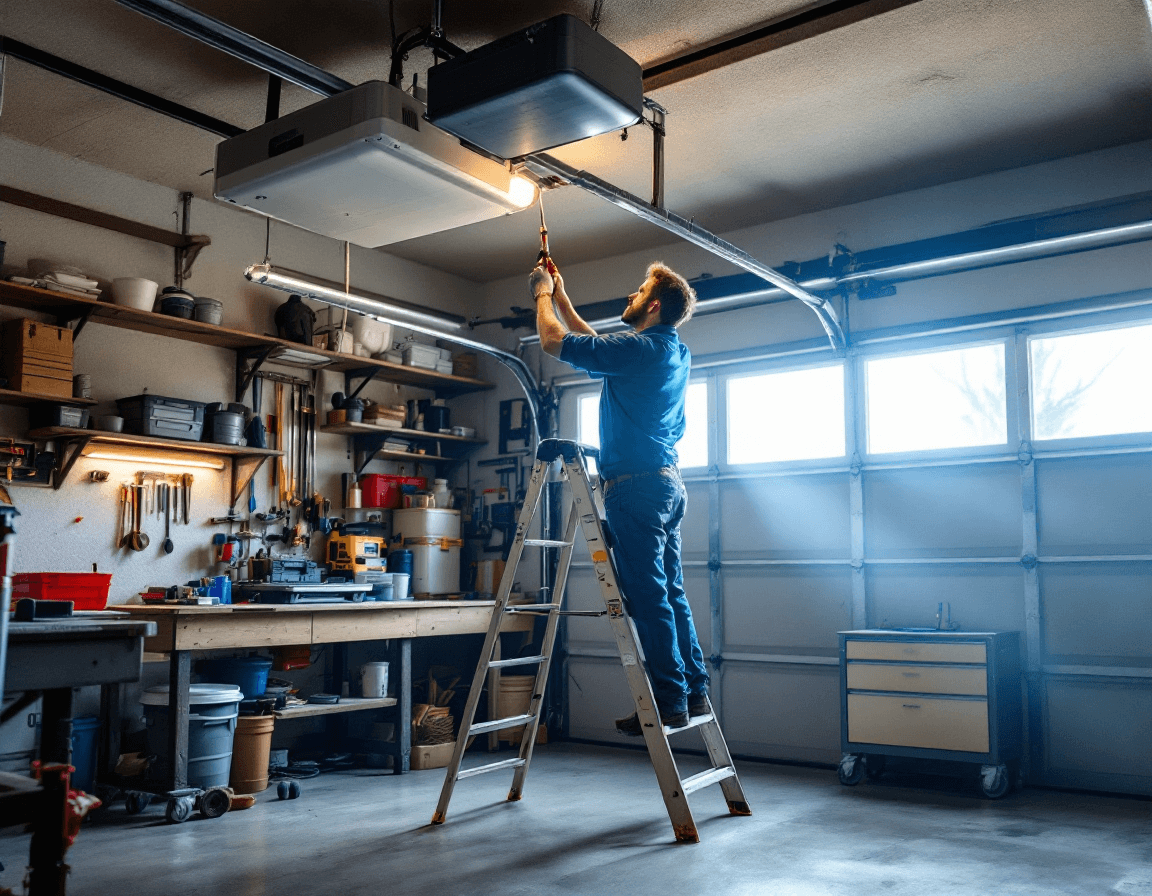
Garage Door Opener Repair in Seattle, WA is one of the most common calls we take, and it's often the result of small problems that build up over years of rain, damp, and daily use. Your opener is the motor, logic board, gear train, and safety system that lifts and lowers a door that can weigh several hundred pounds. When one of those parts starts to fail, the door may still work most of the time, which makes it easy to put off the repair until the day it stops entirely. A knowledgeable technician can usually tell you what's wrong from a few observations and a short test.
This page explains the most frequent opener problems we see across Seattle and King County, what they tend to mean, and what a proper repair involves. We service the major opener brands, including chain-drive, belt-drive, and screw-drive models, and we work on motor, gear, circuit board, and travel-limit issues. Most opener repairs we perform fall in a range of $95 to $375, depending on the part involved and how much diagnostic work the job requires. Every technician is licensed, bonded, and insured, and we follow safe procedures on every visit.
Read through the sections below for symptom-by-symptom guidance. If you hear grinding, see flashing lights, or notice that the door reverses before it fully closes, you can start with the matching section. For anything involving torsion springs, cables, or drums, please step back and call a licensed professional, because those components store enough energy to cause serious injury even when they look harmless.
Why Seattle Openers Wear Out Faster Than the Brochures Suggest
Seattle's climate is mild in the sense that we rarely see extreme heat or deep freezes, but the constant moisture is hard on electronics and metal. Between October and May, many neighborhoods, from Ballard down to Rainier Valley, spend long stretches with humidity near saturation and frequent drizzle that finds its way into garage door tracks and openers through gaps around the rail. Homes near the water in Magnolia, Alki and parts of West Seattle also deal with salt-laden air that accelerates corrosion on exposed hardware and brackets. Over time, that moisture can work its way into circuit boards, safety sensor connections, and wall control wiring.
Many Seattle homes also have detached or semi-detached garages on sloped lots, especially in Queen Anne, Capitol Hill, and parts of Green Lake. Sloped driveways and older garage slabs can settle, which slightly shifts track alignment and puts extra load on the opener over time. A door that's out of square will make the motor work harder on every cycle, and the gear train absorbs that stress. Our technicians often find that what looks like a sudden opener failure is actually the cumulative result of alignment drift, lubrication breakdown, and moisture exposure.
Because of these conditions, we recommend a basic check at least once a year, ideally before the wettest months arrive. That check should include the safety sensors, the travel limits, the drive chain or belt tension, and a look at the logic board for corrosion or heat marks. Catching a worn part early is nearly always cheaper and less disruptive than waiting for the opener to quit on a rainy morning when you need to leave for work.
When the Motor Hums but the Door Refuses to Move
One of the most puzzling symptoms is when you press the button, hear the motor run, and watch the door stay exactly where it is. This usually points to a disconnect somewhere between the motor and the door rather than a dead motor. The most common culprit is a disengaged trolley, where the release cord has been pulled or the carriage has slipped off the rail. Less obviously, the drive chain or belt may have lost tension and is spinning without grabbing the carriage, which produces the familiar hum with no movement.
Mechanical binding can also cause this symptom. If the door is stuck in the track because of a bent section, a damaged roller, or debris lodged in the track, the motor may run until its internal protection kicks in. Before you assume the motor has failed, it's worth checking that the door moves freely by hand when the opener is disconnected. Only do this with the power off and the release handle engaged, and never try to lift a door that feels heavy or uneven, since that can indicate a spring or cable problem that needs professional handling.
A technician will typically verify motor torque, inspect the drive gear and coupling, and test whether the logic board is sending the correct signal to the motor. If the motor is drawing power but not turning the drive shaft, the problem is often in the gearbox or a stripped coupling. Repairing or replacing those parts usually restores normal operation without needing a full opener replacement, which is worth remembering when you're weighing options.
- Confirm the release cord is attached and the carriage is still on the rail
- Check whether the door moves freely by hand with the opener disengaged
- Listen for chain or belt slippage, especially near the carriage
- Note whether the motor hums steadily or clicks and stops, which can signal different faults
Remote and Wall Button Silence: Separating Signal Trouble From Power Trouble
When the door doesn't respond to the remote or the wall button, the first question is whether the problem is the transmitter, the receiver, or the wiring between them. Many homeowners reach for a new remote before checking the simple things. Start by replacing the transmitter battery and confirming the remote is programmed to the opener you're standing next to. If the remote works from the driveway but not from the garage, the issue may be an obstruction, a weakening signal, or interference from nearby devices.
Wall buttons fail in different ways. A cracked or water-damaged button can short out, especially in garages where the wall station sits near a door that rain blows against. Loose or corroded wiring at the button or at the opener terminals is another common problem, and it becomes more likely after the house has settled or the garage has been exposed to repeated damp conditions. A technician will check continuity, look for signs of moisture intrusion, and confirm that the button is sending the correct command to the logic board.
Receiver problems are less visible but just as real. Circuit boards can lose the ability to recognize a remote after a power surge or after moisture has affected the antenna connection. In those cases, reprogramming may help temporarily, but if the symptom returns, the board or antenna may need to be replaced. We always recommend testing each control point separately so we can tell you exactly which component has failed rather than replacing parts on guesswork.
The Grinding Head: Stripped Gears and Worn Drive Components
A grinding, clacking, or whirring sound coming from the opener head is one of the more urgent symptoms, because it often means the gear teeth inside the drive assembly are worn or stripped. In a typical jackshaft or trolley opener, the motor turns a worm gear or spur gear that moves the carriage. When the plastic or metal teeth wear down, they no longer mesh cleanly, and the result is a harsh grinding noise that sometimes gets worse with each cycle. If you ignore it, the stripped teeth can break off and jam the mechanism entirely.
Some openers use nylon gears that wear faster than steel, particularly in homes where the door opens and closes many times a day. Others rely on a lubricated worm gear that dries out over time, especially in Seattle's damp conditions where grease can absorb moisture and lose its consistency. A technician will remove the gear cover, inspect the teeth for chipping or rounding, and check whether the gear is still seated correctly on the motor shaft. In many cases, a gearbox replacement or a motor and gear kit restores quiet, dependable operation.
Grinding can also come from the door itself, so it's important to rule out roller and hinge problems before condemning the opener. Worn rollers, misaligned tracks, and dry bearings can produce noises that sound very similar to gear damage. Our technicians listen to the opener under load and check the door's movement along the full length of the track to isolate the source. That diagnosis saves time and money, because you don't pay for a gear replacement when a roller set is the real problem.
Doors That Reverse Right Away: Travel Limits and Force Settings
When a door starts to close and then immediately reverses, it's usually the opener's safety system doing its job. The most common reasons include misaligned safety sensors, a blocked sensor beam, or a force setting that's too sensitive for the door's current weight and balance. Seattle's heavy rain and the occasional leaf or cobweb can block sensor lenses, and sensors mounted near a wall or on a bracket that flexes slightly can drift out of alignment over time. The sensors should be mounted about six inches off the floor and aligned so the indicator lights are steady.
Travel limits control where the door stops when opening and closing. If those limits have drifted, the opener may think the door has reached the floor when it hasn't, or it may reverse before the door is fully closed. This is common after a door has been adjusted, after a spring has been replaced, or after the opener has been relocated. Adjusting travel limits is a precise task, and setting them incorrectly can create a safety hazard, so we verify the settings with the door at full open and full closed positions and confirm the reversal behavior with an object in the path.
Force settings deserve special attention. An opener that's been set to a very high force to compensate for a sticking door may reverse unexpectedly once the door's balance changes. In contrast, a door that's properly balanced should move with relatively light force from the opener. If you find yourself increasing force settings to get the door to close, that's a strong sign the door needs a professional inspection of its springs, rollers, and track before the opener is adjusted further.
Reading the Blinking Lights on the Opener Head
Many openers include a small light that blinks in a repeating pattern to indicate a fault. A steady light usually means normal operation, but a flashing sequence can point to specific problems such as a safety sensor fault, a motor overload, or a logic board issue. The exact pattern varies by manufacturer, so the best first step is to check the label inside the opener cover or the owner's manual, which lists the codes for that model. Counting the blinks and noting how many pauses occur between sequences will help the technician narrow the diagnosis.
Sensor-related codes are very common in Seattle homes because the sensors are exposed to damp air and dust that gathers on the lenses. If a sensor wire has been pinched or chewed, the opener may read an open circuit and flash continuously. Loose connections at the terminal block are another frequent cause, especially in garages where the opener has been moved or where a door bump has jostled the wiring. Cleaning the lenses and tightening the terminals sometimes clears the code, but a repeating fault usually requires a closer look.
Repeated flashing that doesn't clear after basic checks can indicate a failing logic board or motor. Overheating from a motor that's been working too hard, or moisture that has reached the board, may leave permanent damage that causes intermittent faults. In those situations, we recommend against repeatedly resetting the opener, since the reset may hide the symptom while the underlying damage progresses. A proper diagnostic will identify whether the board, sensors, or motor is responsible.
Loose Chains, Slipping Belts, and Carriage Trouble
Chain- and belt-drive openers depend on proper tension to move the carriage smoothly. A chain that's too loose can skip over the sprocket, producing a clicking sound and inconsistent movement. A belt that has stretched or cracked may slip, and in some cases it can come off the pulleys entirely. Both conditions tend to develop gradually, which is why many homeowners don't notice them until the door begins to stall or the opener makes a new noise. Routine tension checks are an easy way to prevent larger failures.
Adjusting chain or belt tension is a task that a technician can perform safely in most cases, but it requires care. The carriage and rail should be inspected for wear, and the drive should be checked for alignment so the chain or belt runs straight. A chain that has come off the sprocket can sometimes be reinstalled, but if the teeth are damaged or the chain has stretched beyond its adjustment range, replacement is the better option. Belts should be inspected for fraying, glazing, and cracking, which are common in homes exposed to temperature swings and moisture.
Carriage problems are also worth noting. A carriage that's worn or bent can cause the door to bind or the chain to pull unevenly. The release mechanism can also wear out, causing the door to disconnect unexpectedly or preventing the opener from re-engaging. Because the carriage and release system directly affect how the door moves, we inspect them during every chain or belt service, and we explain clearly what needs attention and what can wait.
Intermittent Operation: When the Door Works Sometimes and Not Others
Intermittent problems are among the most frustrating for homeowners, because the door may work perfectly for a week and then fail on a wet Tuesday morning. In Seattle, these symptoms often trace back to moisture, loose connections, or heat-related fatigue in electronic components. A loose wire at the logic board may make contact only when the board flexes slightly, and condensation inside the opener housing can cause temporary short circuits that disappear as the garage warms up.
Weather patterns can make the problem seem random. A door that works fine on a dry afternoon may hesitate on a cold, damp evening, and the same opener may behave differently after a long rain. Our technicians recognize this pattern and typically check connections, seals, and grounding first. They also look for signs of water tracking along the wire runs and check whether the opener is mounted in a way that allows water to collect near the electronics.
Intermittent faults can also come from the door's own movement. If the door sticks at a particular point in its travel, the opener may only encounter that resistance some of the time, which makes the problem appear inconsistent. Lubricating the tracks, checking roller condition, and verifying the door's balance can reveal whether the opener is reacting to a mechanical issue. Solving intermittent problems requires patience and a methodical approach, and it's one of the areas where a trained technician's experience makes the biggest difference.
Brand Coverage, Parts Sourcing, and Keeping Your Opener Running
We service the major opener brands found in Seattle homes, including popular chain-drive, belt-drive, and jackshaft models. Each brand uses its own logic boards, sensor designs, and error codes, so we tailor our diagnostics to the specific unit in your garage. Many brands share similar mechanical layouts, but electronic components often differ enough that a part from one model won't work in another. That's why we ask for the opener's model and serial information before ordering parts, which helps us avoid delays and unnecessary return trips.
Parts availability can affect how quickly a repair is completed. Some common components, such as sensors, remotes, and chain or belt kits, are typically easy to source, while logic boards and gearboxes for older models may take longer. When a part is not immediately available, we explain the options, including whether a temporary solution is safe and how long the wait may be. We don't recommend running an opener with a known safety fault while waiting for parts, and we'll tell you plainly if the door should be kept out of use until the repair is finished.
Keeping an opener in good condition is less about expensive upgrades and more about consistent care. Keep the tracks clean and lightly lubricated with a product recommended for garage doors, check that the safety sensors are clear and aligned, and test the auto-reverse function monthly by placing a board in the door's path. Watch for new noises, slow movement, or changes in how the door stops. Addressing those early signs keeps small issues from turning into full breakdowns.
What a Typical Opener Repair Visit Covers and What It Costs
A repair visit usually begins with a conversation about what you've noticed, when the problem started, and whether it happens every time or only sometimes. The technician then inspects the opener, door, tracks, safety sensors, and wiring, and tests the operation through a full cycle. This diagnostic step is important because it identifies the actual cause rather than just the most visible symptom. We explain what we find before any work begins, and we provide a clear estimate so you know what to expect.
For most opener repairs, pricing ranges from $95 to $375, depending on the parts needed and the complexity of the job. Simple adjustments such as sensor alignment, travel-limit tuning, or tension correction are generally at the lower end of that range, while gearbox, motor, or logic board replacements land higher. The final cost depends on the brand, the part availability, and what the inspection uncovers, so we'll always discuss the scope before proceeding. Our goal is to fix the problem properly without recommending work that isn't needed.
Safety is a central part of every visit. We do not perform spring or cable replacement as part of a standard opener repair, and if the inspection reveals a problem in those areas, we'll tell you clearly and recommend a licensed professional for that portion of the work. Homeowners should never attempt to adjust, remove, or wind torsion springs on their own, since they can release stored energy with enough force to cause serious injury. Keeping that boundary clear protects you, your family, and your home.
Serving Seattle Neighborhoods From Ballard to Rainier Valley
Our technicians serve homes across Seattle and King County, including Ballard, Capitol Hill, West Seattle, Queen Anne, Fremont, Green Lake, Magnolia, and Rainier Valley. Each neighborhood has its own mix of housing styles, garage types, and weather exposure. Ballard and Fremont homes often have older detached garages with aging wiring, while Queen Anne and Magnolia properties may include newer attached garages with more sophisticated openers. West Seattle's coastal exposure and Rainier Valley's dense housing both create distinct access and maintenance considerations that our crews understand well.
We regularly respond to calls in ZIP codes including 98101, 98103, 98105, 98107, 98109, 98115, 98116, 98117, 98118, 98122, 98125, 98133, 98136, 98144, and 98199. Garages in these areas vary widely, from narrow alley-access garages in Capitol Hill and Fremont to wide driveway entries in Green Lake and Magnolia. Knowing the layout, access route, and typical opener setup helps us arrive prepared and complete repairs efficiently. If you're in a neighborhood not listed here, call us anyway, since our coverage extends across many nearby communities in King County.
Whether your opener is humming without moving, flashing a warning pattern, grinding during every cycle, or working only some of the time, a qualified technician can help you find the cause and restore dependable operation. Call (888) 799-3819 to schedule a visit, describe what your opener is doing, and get clear guidance on the next step. Our licensed, bonded, and insured team is ready to help homeowners across Seattle keep their garage doors working safely through every season.