
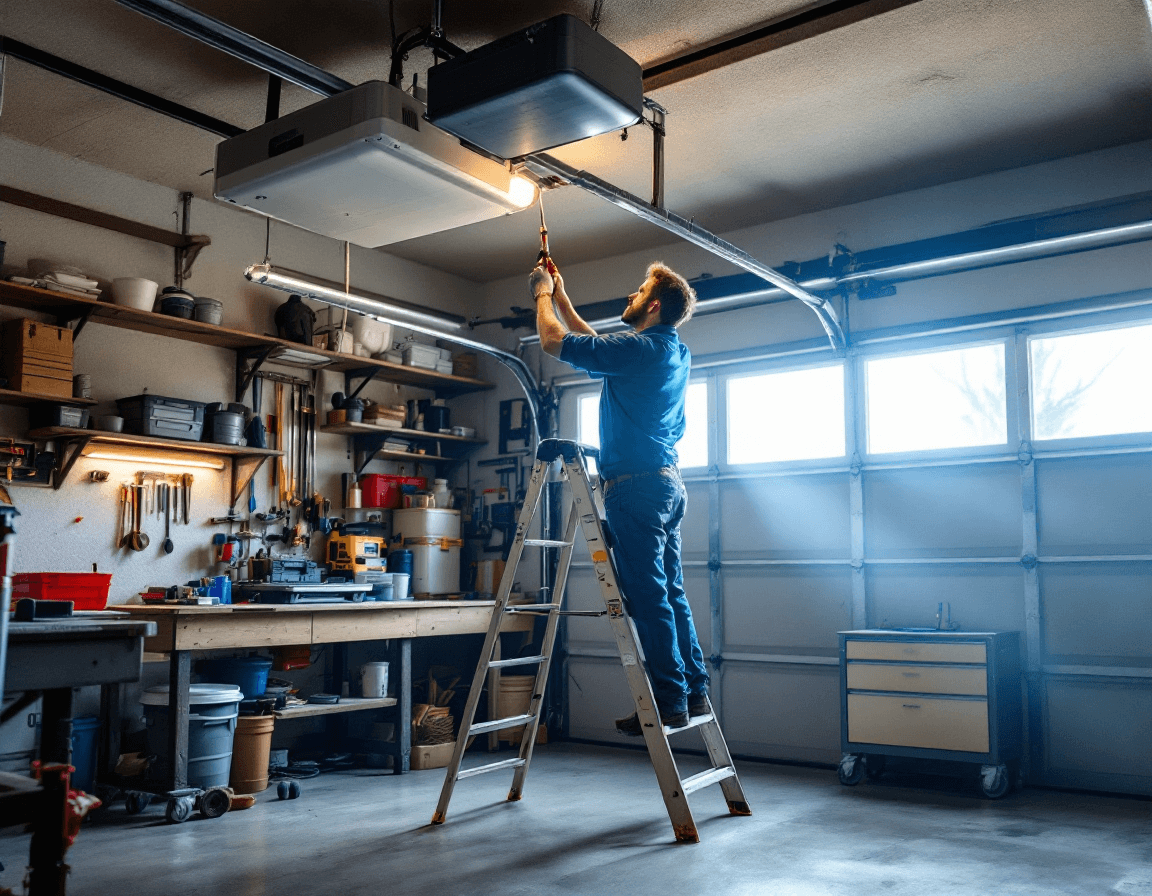
Garage Door Opener Repair in Tukwila, WA is one of the most common calls we take, and it's often a repair that costs less than homeowners expect. A motor that hums without lifting the door, a remote that suddenly stops working, or a ceiling unit that grinds on the way up can all look like major failures. In many cases the cause is a worn gear, a misaligned sensor, a loose connection, or a travel setting that drifted over time. Knowing what your opener is trying to tell you can save a service call or help you describe the problem clearly when you call.
Tukwila homes sit in a practical mix of older single-family houses, mid-century ranch-style properties, and newer townhomes and infill builds, and garages here get used hard. Many double so as workshops, storage rooms, or the main entry for daily traffic in and out of the house. Openers in these garages cycle several times a day, often on a schedule set by school runs, shift work, and weekend errands near Southcenter or along Tukwila International Boulevard. That constant use is why small wear items such as gear teeth, trolley bushings, and limit-switch contacts tend to surface as operating problems over a few years rather than all at once.
This page explains the most frequent opener symptoms we see across Tukwila and nearby neighborhoods, including Allentown and the blocks around Tukwila Village. It covers what usually causes each symptom, what you can safely check yourself, and when the work belongs in a technician's hands. Pricing for most opener repairs falls between $95 and $375, depending on the brand, the part involved, and how much diagnostic time the fault requires. If you're dealing with a door that won't move right now, call (888) 799-3819 and we'll walk through the situation with you.
Reading the Blink Patterns on Your Opener's Light Panel
Most modern openers use the small light lens on the motor head to report status. Many units flash a repeating pattern when they detect a fault, and the number of blinks often points toward a category of problem such as a safety sensor issue, a stuck button, or a motor fault. The exact meaning differs by manufacturer and model, so the owner's manual or the label inside the light cover is the best starting point. Write down the pattern you see, including how many times it repeats and whether the light stays on between flashes, before you start troubleshooting.
Repeating flashes are often the opener's way of saying a circuit has noticed something it doesn't like. A common culprit in Western Washington is a safety sensor that's knocked out of alignment, which can happen after a delivery, a bumped bicycle, or a shifted sensor bracket after a wet winter. Another frequent cause is a wall button that's stuck or shorted, especially in garages where humidity has crept into the wiring box. If the pattern appears only after rain or on cold mornings, moisture in a connection or in the sensor housing is a likely suspect.
If the light pattern continues after you've checked sensor alignment and cleared obvious obstructions, don't keep cycling the door to see if the problem goes away. Repeated attempts can strain the motor and gear train, turning a simple sensor fix into a stripped-gear repair. A technician can read the controller's status more precisely and determine whether the fault sits in the sensors, the wiring, the logic board, or the mechanical drive. Early diagnosis is usually the least expensive path.
When the Motor Hums but the Door Stays Put
A motor that runs with an audible hum but doesn't move the door usually points to a disconnect between the motor and the door, or a problem with the drive mechanism that transfers power to the trolley. The most common cause is a trolley that has come off the rail, a broken release cord that has left the door in a partially disengaged state, or a drive gear that's no longer meshing with the chain or belt. In some cases the door itself has become heavy because of a broken spring, which causes the opener to strain without lifting the panels. That last scenario is important because it involves spring work, and spring work should only be handled by a licensed professional with proper tools.
Tukwila's cold, damp winters can make pulleys, bearings, and track rollers stiffen, which increases the load the motor must overcome. A door that was lifting easily in August may hesitate or stall in January, and the opener may hum harder during that struggle. Lubrication of the track and rollers helps, but it should be done with a lubricant appropriate for garage door hardware and not with heavy grease that collects grit. If the door binds in the track at one spot, the issue may be a bent track section or a roller that has worn flat.
Do not try to force the door open by hand while the motor is energized, and do not attempt to remove or adjust torsion springs yourself. If the door is stuck at a partial height, pull the emergency release cord once to disconnect the trolley and then test the door's balance by lifting it slowly by hand with the opener disconnected. A door that feels extremely heavy, drops quickly, or sags unevenly needs professional inspection before anyone attempts to operate it further.
Remotes, Wall Buttons, and the Radio Problems Nobody Expects
When the door won't respond to a remote or wall button, the fault can sit in the transmitter, the receiver, the wiring, or the keypad itself. Start with the simplest checks: replace the remote battery, confirm the wall button isn't stuck, and make sure the opener has power. Many openers include a learn button on the motor head, and if the system has been reset or a new remote was programmed incorrectly, you may need to relearn the code by following the manufacturer's sequence. A remote that works from the driveway but not from inside the garage can indicate interference, a failing antenna wire, or a receiver that's losing sensitivity.
Pacific Northwest weather adds its own wrinkles. Rain and humidity can corrode battery contacts in older remotes and cause wall-button wiring to develop intermittent faults, particularly where low-voltage runs pass through unsealed junction boxes. Homes near busy commercial corridors may also see radio interference from nearby businesses, cell infrastructure, or other garage door systems, which can make a remote work only at certain times of day. Rolling-code systems are designed to resist this, but a weak transmitter or a receiver with a damaged antenna can still struggle.
A wall button that works intermittently is a sign that the low-voltage wire or the switch contacts need attention. Rather than tapping the button repeatedly to see if the door responds, check whether the button feels loose, whether the cover plate has moisture inside, or whether the wire has been pinched behind the drywall. A technician can test the circuit with a meter and determine whether the switch, the wire, or the receiver board is responsible. Replacing a worn wall button is generally a straightforward repair, while rewiring or board replacement depends on the opener model.
Stripped Gears and That Grinding Noise From the Ceiling
A grinding, clicking, or ratcheting sound from the opener head is one of the most important warnings a homeowner can hear. It often indicates that one or more gear teeth have worn or stripped, which can happen after years of cycles, after a sudden jolt from a door hitting an obstruction, or after the door has been forced by hand while the opener was engaged. Once teeth begin to strip, the gear can slip under load, and the door may stop partway or fail to lift completely. Continuing to run the opener in this condition can cause the damage to spread to the drive shaft and motor coupling.
Many openers use a nylon or composite drive gear that is designed to wear before the steel components do. This is a deliberate design choice because it protects the motor, but it also means the gear eventually needs replacement. The repair typically involves removing the gear cover, extracting the worn gear, inspecting the worm shaft and drive assembly, and installing a matched replacement part. Using a gear that doesn't match the opener's specification can lead to noise, misalignment, and early failure, so brand-specific parts matter.
If you hear grinding and the door is still moving, power down the opener if it's safe to do so and avoid further cycles until a technician can inspect it. Unplugging the unit, or switching off the breaker that feeds it, prevents accidental operation while you wait for service. Keep children and pets away from the door track while the opener is out of service. A stripped gear repair is usually among the more affordable opener repairs when caught early, and it often prevents a larger motor or shaft problem from developing.
Doors That Close Partway or Bounce Back Up
A door that closes most of the way and then reverses immediately is typically responding to the auto-reverse system, and the most common trigger is a safety sensor problem. The sensors mounted near the floor on each side of the door send an invisible beam across the opening, and if that beam is interrupted or misaligned, the opener assumes something is in the way and reverses. Check that both sensor lenses are clean, that the indicator lights on each sensor are steady, and that the brackets haven't been bumped out of position. Spider webs, dust, road grime tracked in from the driveway, and morning condensation can all interfere with the beam.
A door that reverses at a specific point, such as near the bottom or after it has been closed for a few seconds, can indicate a force setting that's too sensitive or a travel limit that needs adjustment. Many openers measure resistance as the door closes, and a slightly uneven floor, a warped panel, or a bottom seal that has stiffened in the cold can trigger the reversal. Tukwila's temperature swings, especially when morning fog gives way to freezing overnight conditions, can also cause the bottom weather seal to contract and catch on the threshold. Clearing ice and debris from the door's path often resolves this type of problem.
Adjusting force and travel limits requires care. Incorrect settings can allow the door to close with too much force or fail to stop at the correct position, both of which create safety hazards. Some openers provide simple adjustment dials or menu functions that owners can use, while others require a technician's diagnostic tools. If you have any doubt about the settings, leave them alone and schedule a visit so the balance, limits, and safety reversal can be tested together.
Chains, Belts, and Loose Drive Components
A loose chain or belt can make the opener rattle, cause the door to jerk, or stop the drive entirely if the component has slipped off its sprocket or pulley. Chain-drive openers are common in Tukwila because they are widely used and affordable, and their chains can stretch over time as the door cycles. Belt-drive openers are quieter and popular with homeowners who use the garage as living space, but belts can loosen or wear as well. A visible sag in the chain or belt, a clicking sound at the start of travel, or a chain that has jumped off the sprocket are all reasons to stop using the opener until it has been inspected.
Tensioning a chain or belt is a task that some capable homeowners attempt, but it should be approached with caution. Incorrect tension can damage the drive gear, the sprocket, the trolley, or the motor, and an overtightened chain can put unnecessary stress on the entire system. Before adjusting anything, disconnect power to the opener and confirm the door is disengaged from the trolley. A technician will check for worn sprockets, a damaged trolley carriage, or a misaligned rail, which are often the real reasons a chain keeps loosening.
Loose drive components are also a safety concern when the door is in motion. A chain that comes off mid-cycle can allow the door to fall unevenly or the trolley to strike the rail. If you notice a chain hanging, a belt that is visibly slack, or an unusual vibration when the door starts, keep people out of the garage and call a professional. Quick attention can prevent a minor drive problem from becoming a damaged door or a damaged opener.
Intermittent Operation Caused by Moisture and Temperature Swings
Intermittent operation is among the most frustrating symptoms because it may work perfectly for days and then fail without warning. In the Pacific Northwest, moisture is the usual suspect. Condensation can form inside the opener housing on cold mornings, wiring connectors can develop a thin film of corrosion, and sensor wires that run along the floor can pick up dampness from wet tires and foot traffic. Each of these factors can create a poor electrical connection that works sometimes and not others. A door that operates reliably in summer but not during the wettest months of the year is a strong sign that moisture plays a role.
Temperature swings can also affect the electronics and the mechanical parts. Circuit boards and capacitors may behave differently when cold, and lubricants can thicken enough to change the load on the motor. Garages in Tukwila that have minimal insulation or ventilation can see larger temperature swings, and the opener may respond with inconsistent force or timing. Checking whether the problem appears at the same time of day, after rain, or after a cold snap can help a technician narrow down the cause quickly.
Improving the environment can help. Sealing gaps around the garage door, keeping the floor clear of standing water, and making sure the sensor wires are secured away from the track can all reduce moisture exposure. Replacing corroded connectors and resealing wall-button boxes is often a simple fix. If the problem persists after these steps, a diagnostic visit can determine whether a failing board, a worn capacitor, or a weak power supply is responsible.
Travel Limits, Force Settings, and Why Adjustments Need a Careful Hand
Travel limits tell the opener where the door should stop when it's fully open and fully closed. Force settings tell the opener how much resistance to tolerate before reversing. Both are adjusted during installation, and both can drift over time as springs fatigue, tracks shift, or the door's weight changes after hardware replacement. When limits are set too short, the door may stop before it reaches the floor or the top of the opening. When limits are set too long, the door may slam into the stops or put extra strain on the drive.
Each opener brand has its own method for setting limits, and the steps are not interchangeable. Some use dials or sliders, some use push-button programming, and some use digital menus that display codes. A homeowner who follows the wrong procedure can accidentally erase settings or create a dangerous configuration. If your door stops at the wrong height or reverses unexpectedly after you've changed a setting, return the controls to their prior position and call for service.
Force testing is an important safety step that should be completed after any opener repair, spring adjustment, or travel-limit change. A technician will check that the door reverses when it meets an obstruction, typically a test object placed in the path, and that the auto-reverse system responds within the required distance. This test protects children, pets, and vehicles, and it should never be skipped. If the door fails to reverse properly, the opener should not be used until the problem is corrected.
What a Tukwila Technician Checks on a Typical Service Visit
A thorough opener service visit follows a logical sequence, and understanding it can help you know what to expect. The technician starts by reviewing the symptoms you describe, checking the light pattern, and testing whether the opener responds to the wall button and remote. The door is then inspected by hand for balance, smoothness, and track alignment. Finally, the drive system, safety sensors, limits, and force settings are checked and corrected as needed.
- Confirm power supply, breaker condition, and outlet function at the opener
- Inspect the light pattern, wall button wiring, and remote programming
- Test sensor alignment, lens cleanliness, and sensor indicator lights
- Check the drive gear, chain or belt tension, trolley, and rail condition
- Verify travel limits, force settings, and auto-reverse performance
- Look for moisture, corrosion, or loose connections in the opener housing and wiring
Many visits uncover more than one issue, especially in older garages where wear has accumulated across several components. A technician will explain what needs immediate repair, what can wait, and what preventive maintenance will keep the system running reliably. Ask for a clear explanation of each recommendation so you can make informed decisions about the work.
Pricing, Brands, and What Affects a $95–$375 Repair
Opener repair pricing generally falls between $95 and $375 for most common repairs, though the final figure depends on several factors. The opener brand and model influence the cost of parts, since some manufacturers use proprietary boards, gears, and remotes. The nature of the fault matters as well: a sensor realignment or wall-button replacement is usually at the lower end of the range, while a gear replacement, logic-board repair, or motor-related work tends to fall higher. Access to the opener and the age of the system can also affect how long the repair takes.
We work on most major opener brands, and our technicians can troubleshoot motor, gear, circuit board, and travel-limit issues across common models. Some older openers are no longer supported by current parts channels, and in those cases a replacement unit may be a more practical choice than repeated repairs. A good technician will tell you honestly when a repair is worth the investment and when it isn't, based on the condition of the rest of the system.
Pricing ranges are estimates for typical opener repairs and do not replace an on-site diagnosis. The most accurate way to determine cost is to describe your symptoms, share the opener brand if you know it, and let a technician confirm the fault. Ask for a written estimate before work begins so you understand the scope and cost of the repair.
Safe Checks You Can Do Before Calling a Technician
Some opener issues can be checked safely by homeowners before a service call. Confirm the opener is plugged in and that the breaker hasn't tripped. Replace the batteries in your remotes and test them from close range. Clear any debris from the sensor lenses, and check that the sensor brackets are still aligned so the two beams face each other. These simple steps resolve a surprising number of calls and cost nothing but a few minutes.
- Check the opener's power cord, outlet, and breaker
- Replace remote batteries and test each transmitter
- Clean both safety sensor lenses and confirm both indicator lights are steady
- Look for visible debris on the track and rollers
- Note the light blink pattern and any sounds before the door moves
Stop immediately if the door is heavy, sagging, or unbalanced, if a spring looks broken or gapped, or if cables appear frayed. Those conditions involve tension and stored energy, and they require a licensed professional. Spring and cable work is not a homeowner task, no matter how familiar the rest of the system feels. Once the simple checks are complete and the problem remains, call (888) 799-3819 and a technician can take it from there.
If your Tukwila garage door opener is grinding, reversing, flashing, or refusing to respond, the sooner it's inspected, the more likely a small repair will stay small. Call (888) 799-3819 to schedule an opener repair visit, describe what you're seeing, and get a clear plan for getting your garage door working safely again.