
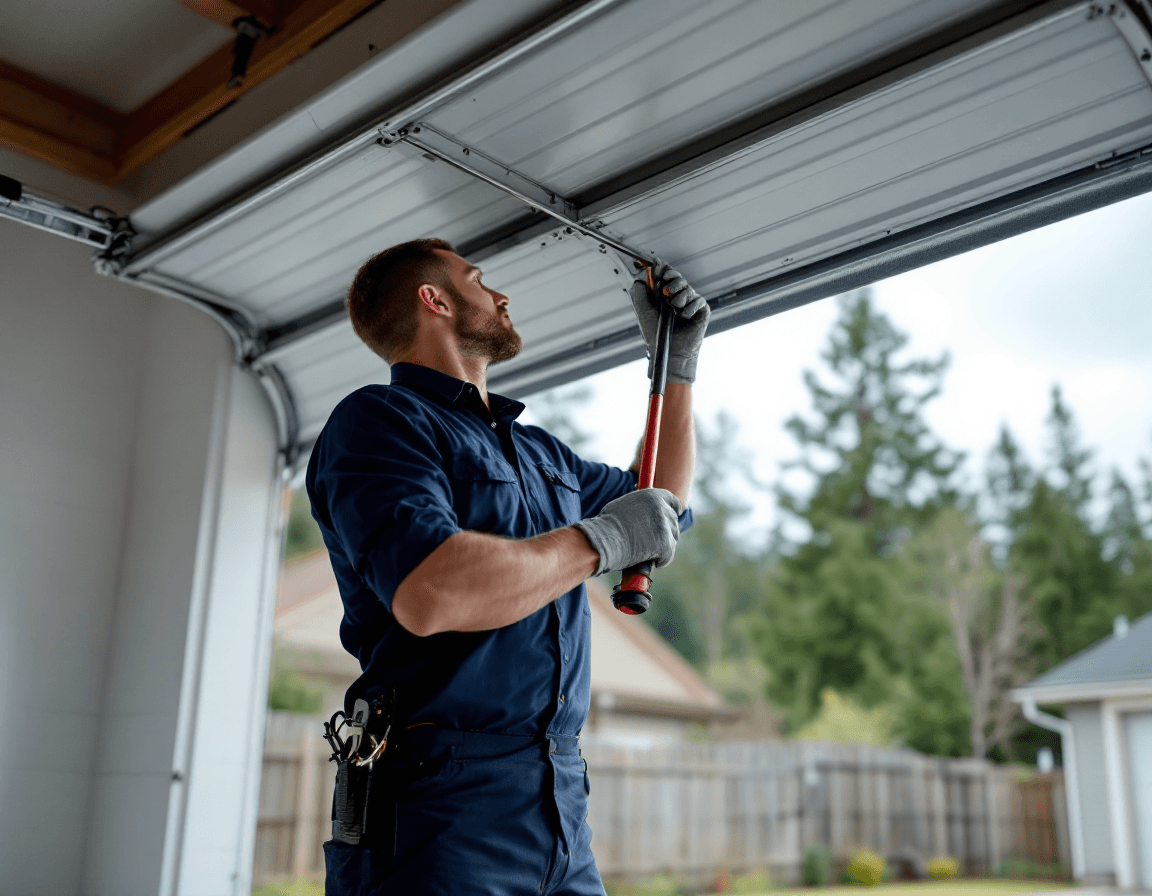
Garage door spring replacement in Tukwila, WA is one of the most common and most urgent repairs we handle for homeowners across the Duwamish Valley and the surrounding neighborhoods. The springs carry most of the weight of a typical residential door, so when one fails, the door often stops working altogether. Many Tukwila households find out about a broken spring the hard way, with a sharp bang from the garage in the early morning or a door that suddenly refuses to rise. Knowing what a failing spring looks like and what a proper replacement involves can save you time, money, and a lot of worry.
Tukwila sits in a part of King County where garages tend to hold far more than cars. Many homes near Southcenter and in the older Allentown area have single-car or tandem garages that double as workshops, storage rooms, and overflow space for bikes, tools, and holiday décor. Doors in these homes often get opened several times a day, and the springs quietly absorb that repeated stress. Whether your door is a 1970s-era sectional or a newer insulated model installed more recently, the spring system is the part most likely to need attention first. This page explains what to watch for, how the two main spring types differ, and what a responsible repair looks like.
Our crews are licensed, bonded, and insured, and we serve Tukwila and neighboring communities across ZIP codes 98168, 98178, and 98188. Spring work is not a task for a weekend DIY project, because the stored energy in a torsion or extension spring can cause serious injury. If you are dealing with a broken spring right now, the safest first step is to keep people and pets away from the door and call a professional. You can reach our dispatch team at (888) 799-3819 for guidance on scheduling and what to expect when we arrive.
Why a Snapped Spring Sounds Like a Gunshot in Tukwila Garages
Homeowners often describe the moment a spring breaks as a loud crack or a bang that echoes through the house. In a typical Tukwila garage, which tends to be attached to a bedroom or kitchen wall, that sound can be startling enough to wake everyone up. The noise happens because the spring releases the tension it has been holding, and the metal recoils sharply inside its housing or along the track. Many people assume something has hit the door from outside, but the cause is almost always internal.
After the bang, you may notice that the door no longer lifts smoothly or does not lift at all. Sometimes the door drops abruptly a few inches when the spring lets go, which can damage the bottom seal or bend a section. If the door is still closed, do not attempt to force it open or disconnect the opener in an effort to muscle it up. A door that has lost spring tension can slam down unexpectedly or lift unevenly once you release a component, creating a pinch or crush hazard.
It helps to take a quick look without touching the spring. Note whether the door is level, whether any cables appear slack or hanging loose, and whether the broken piece of spring is visible near the header or the center bracket. Photographing what you see can help our technician prepare the right replacement before arriving, which often shortens the visit. Keep the opener unplugged or disengaged until a technician confirms it is safe to operate the door.
Reading the Warning Signs Before a Spring Lets Go
Springs rarely fail without warning, and in our experience the signs often appear weeks or months before the actual break. One of the most useful clues is a door that feels noticeably heavier than it did a season ago. Homeowners sometimes describe a door that used to rise easily but now seems to fight back, especially when lifted by hand during a power outage. That extra effort usually means the spring is losing its tension and the opener is compensating.
Another common warning is an opener that strains, hums, or whines without the door moving much. The motor is trying to lift a load it cannot manage, and the result is wear on gears, trolley arms, and the opener itself. If your door opens a few inches and then stops, or if it begins to close crooked or too quickly, the balance between the springs and the door weight may be off. These symptoms can point to a weakening spring even when the spring has not yet broken.
Visual inspection can also reveal trouble. On torsion systems, look for a visible gap in the coil, a spring that appears stretched or separated, or rust that flakes off in reddish patches. On extension systems, check for stretched coils or a spring that no longer looks uniform along its length. Any of these signs means the spring should be evaluated soon, because a broken spring is frequently the next step after visible deterioration.
Torsion Versus Extension: Which Spring Is Holding Your Door Up
Most garage doors in the Tukwila area use one of two spring systems, and understanding the difference helps you talk clearly with a technician. Torsion springs mount on a steel shaft above the door opening and wind up to store energy as the door closes. They are generally found on newer sectional doors and are often preferred for their smoother operation and longer lifespan when properly maintained. A broken torsion spring usually shows a visible gap in the coil and can leave the door sitting heavily in its track.
Extension springs run parallel to the horizontal track along each side of the door and stretch as the door lowers. They are common on older homes and on many lighter doors, and they typically come with safety cables that run through the spring's center. When an extension spring breaks, the door may drop or sag at one side, and the cable can whip if it is not secured correctly. The safety cable is designed to limit that movement, which is why any repair should include inspection of cables, pulleys, and anchor points.
Some doors have both systems or have been retrofitted over the years, which is common in older Tukwila garages that have been updated piecemeal. A proper assessment identifies every spring component, measures the door's weight and dimensions, and confirms the correct replacement specifications before any work begins. Replacing the wrong type or the wrong tension can create imbalance, premature wear, and new safety problems. This is one reason we recommend a licensed technician rather than guessing from a parts listing.
How Western Washington Rain and Cold Wear Down Steel Coils
The Pacific Northwest climate has a real effect on garage door hardware, and the springs are no exception. Seattle-area winters bring long stretches of rain, damp air, and condensation, and garages are not always climate controlled. Moisture can settle on steel surfaces, and over time it encourages surface rust that weakens the metal and makes winding and unwinding less consistent. Homes near the Duwamish River and the lower-lying flats around Tukwila can feel this dampness more acutely in the cooler months.
Temperature swings add another layer of stress. Cold mornings can make steel stiffer and more brittle, and a spring that has been slowly fatiguing may be more likely to fail during a sudden cold snap. Summer heat in an attached garage can also cause expansion and contraction cycles, especially if the door sits in direct sun on a south or west wall. These repeated changes gradually reduce the spring's ability to hold tension, which is why many springs in this region reach the end of their working life sooner than the manufacturer's rated cycles might suggest.
Lubrication and protective coatings matter too. Springs that are coated and periodically lubricated tend to resist corrosion better, and a technician can recommend appropriate products for your specific system. Avoid using heavy grease or random household oils, which can collect dirt and attract grit. Ask your technician how to keep the springs and drum assemblies protected during wet months, because a little attention to moisture can extend the life of a replacement considerably.
What Happens During a Professional Spring Swap, Step by Step
A professional spring replacement follows a predictable sequence designed to keep the door secure at every stage. The technician begins by disconnecting the opener and confirming the door is safely supported, often with locking pliers or clamps on the track to hold the door in place. Every spring and cable component is then inspected, including drums, pulleys, bearings, hinges, and tracks, because worn parts found during a spring job are much easier to address in the same visit.
Next comes the careful removal of the broken spring and the installation of the new one. On torsion systems, this involves using winding bars in a controlled way and securing the spring so tension cannot release unexpectedly. On extension systems, the technician checks the safety cables, replaces any frayed or stretched cable, and confirms the spring is matched correctly for the door's weight. Work at this stage is delicate, and it is exactly why we keep it in the hands of trained, licensed professionals rather than encouraging homeowners to attempt it.
Here is a typical sequence a homeowner can expect during a visit:
- Initial safety check, including confirming the door is secured and the opener is disengaged
- Inspection of springs, cables, drums, pulleys, bearings, and track alignment
- Careful removal of the failed spring with controlled tension release
- Installation of the matched replacement spring and any required hardware
- Balancing adjustments and a full operational test of the door through several cycles
- Cleanup, a walkthrough of the work, and guidance on maintenance going forward
Balancing the Door After the New Spring Goes In
Installing a new spring is only part of the job. The door must also be balanced, meaning the spring tension matches the door's actual weight so it can rise and stop without the opener doing all the work. A well-balanced door should stay in place when lifted partway and manually released, and it should move smoothly from closed to fully open. If the door drifts up or down on its own, or if one side rises faster than the other, the tension or cable setup needs refinement.
Balancing in Tukwila homes sometimes reveals issues beyond the spring itself. Older doors can carry more weight than they did when new because of added insulation, heavier hardware, or accumulated grime, and a new spring may need to be sized specifically for that load. Warped sections, bent tracks, and worn rollers can also throw off balance even when the spring is perfect. A thorough technician checks these factors rather than simply swapping in a part and leaving.
Balance also affects the life of your opener. When the door is properly balanced, the motor draws less current, runs more quietly, and experiences less strain. This is one reason we encourage homeowners to schedule a balance check whenever a spring is replaced, especially if the door has been noisy or slow for a while. A brief test after installation can prevent many small problems from becoming future service calls.
High-Cycle Springs for Busy Households and Heavy Use
Not every household uses its garage door the same way. A family with teenagers who come and go at all hours, a home-based business that receives frequent deliveries, or a household that runs a workshop may cycle the door far more often than average. For these situations, high-cycle springs are worth discussing. These springs are engineered with materials and winding characteristics intended to handle a greater number of open and close cycles before fatigue sets in.
High-cycle options are not automatically necessary for every door. Our technicians evaluate how the door is used, its weight, its size, and the existing hardware before recommending a specific spring. In some cases a standard spring with proper balancing will serve well for years. In other cases, particularly with heavier doors or frequent daily use, a high-cycle option can provide a longer working life and more consistent performance through Western Washington's damp seasons.
Some households also ask about upgrading when the door is replaced entirely or when a spring fails for the second time within a short period. Repeated failures usually point to a balance problem, a worn drum, or a mismatch in spring specification rather than simple bad luck. A technician can identify these patterns and suggest the most sensible path, whether that means a high-cycle replacement, corrected balance, or both.
Realistic Pricing for Tukwila Homeowners
Homeowners often want a clear sense of cost before scheduling. For most garage door spring replacements, our pricing falls between $180 and $450, depending on the type of spring, the size and weight of the door, and whether additional parts such as cables, drums, or bearings are needed. Torsion repairs and extension repairs can differ in complexity, and high-cycle options will generally cost more than standard springs. Your final quote depends on an on-site evaluation rather than a phone estimate alone.
Several factors influence where a job lands within that range. A single-car door with one standard spring is often at the lower end, while a larger or heavier double door with a torsion system and additional hardware may fall higher. If the drum, bearing, or cable also needs replacement, the total may increase, but those components are often worth addressing while the door is already open and the springs are being serviced. Ask your technician to explain each line item so you understand what is being replaced and why.
Be cautious of any offer that seems dramatically lower than typical market pricing without explanation. Spring work involves high-tension components, and shortcuts can lead to dangerous failures or repeated visits. A transparent quote that describes the spring specifications, the balancing process, and any included warranty details will serve you better over the long run than the lowest number on a flyer. We are happy to walk through pricing questions when you call (888) 799-3819.
Cables, Drums, and Why They Often Come Loose Together
When a spring breaks, the cables frequently suffer too. On torsion systems, the lift cables are wound around drums attached to the shaft, and the sudden release of tension can cause a cable to slip off its drum or become tangled. On extension systems, the safety cable running through the spring can fray, stretch, or detach when the spring fails. Homeowners often notice a door that sits crooked after a break because one cable has loosened while the other has held.
Cable problems are a serious safety issue. A cable under uneven tension can pull a door out of its track or cause it to drop unexpectedly. Drums that are cracked, worn, or slipping can also contribute to imbalance, which is why a technician inspects them as part of every spring visit. Replacing a cable or drum that shows wear is far safer than reinstalling a questionable part, even if it appears to function at first glance.
If you notice a loose cable or a drum that seems out of position, do not try to reattach it yourself. Even a simple-looking cable can carry tension that is hard to predict, and an incorrect repair can injure you or damage the door further. A licensed technician can assess the cable, the drum, and the spring together and recommend a complete solution. Bundling these repairs into one visit usually costs less overall and gives you more confidence in the result.
Keeping the Replacement Spring Working Through Seattle-Area Seasons
Once a new spring is installed, a bit of ongoing attention can help it last. Visual checks every few months are a good habit, especially before and after the wettest parts of the year. Look for new rust, unusual gaps in coils, cables that appear loose, and any change in how the door opens or closes. Catching a small issue early often prevents a larger failure later.
Lubrication should be handled carefully. Use a lubricant recommended for garage door springs and apply it according to the product instructions, usually to coils and moving hardware rather than to tracks or rollers. Wipe away excess to avoid attracting dust, and avoid spraying lubricant into the opener's mechanism unless the manufacturer specifies it. A technician can show you the right approach for your specific door during a service visit.
Keep the area around the door clear of stored items that could interfere with movement or create hazards. In many Tukwila garages, shelves and boxes are placed close to the track, and objects that touch the door while it moves can cause misalignment. Also consider the door's exposure to rain at the bottom seal, since water intrusion can encourage rust on hardware nearby. A few small habits can make a noticeable difference in how your system performs through the damp months.
Choosing a Technician Who Knows Local Homes
Choosing the right technician matters as much as choosing the right spring. Look for a company that is licensed, bonded, and insured, and that is willing to explain its work in plain language. A reputable technician should be comfortable discussing the difference between torsion and extension systems, describing the balancing process, and recommending options such as high-cycle springs only when they truly fit your needs. Be wary of anyone who pressures you into unnecessary upgrades or refuses to show you the damaged parts.
Local experience also helps. Technicians who regularly work in Tukwila and nearby communities become familiar with common door types, typical installation layouts, and the way Western Washington weather affects hardware over time. That familiarity often leads to faster diagnosis, more accurate parts selection, and fewer surprises during the job. It can also mean a better understanding of how older garages near Allentown and Southcenter-area homes are built and how their doors typically respond to daily use.
When you are ready to schedule, have your door's make and model if you know it, a description of the symptoms you have noticed, and a few photos if possible. Let the team know whether the opener has been running or whether the door has been stuck in one position. The more information you share, the more efficiently we can prepare. To book a spring replacement or ask questions before your visit, call Seattle Garage Door Fix at (888) 799-3819, and our team will help you get your Tukwila garage door moving safely again.