
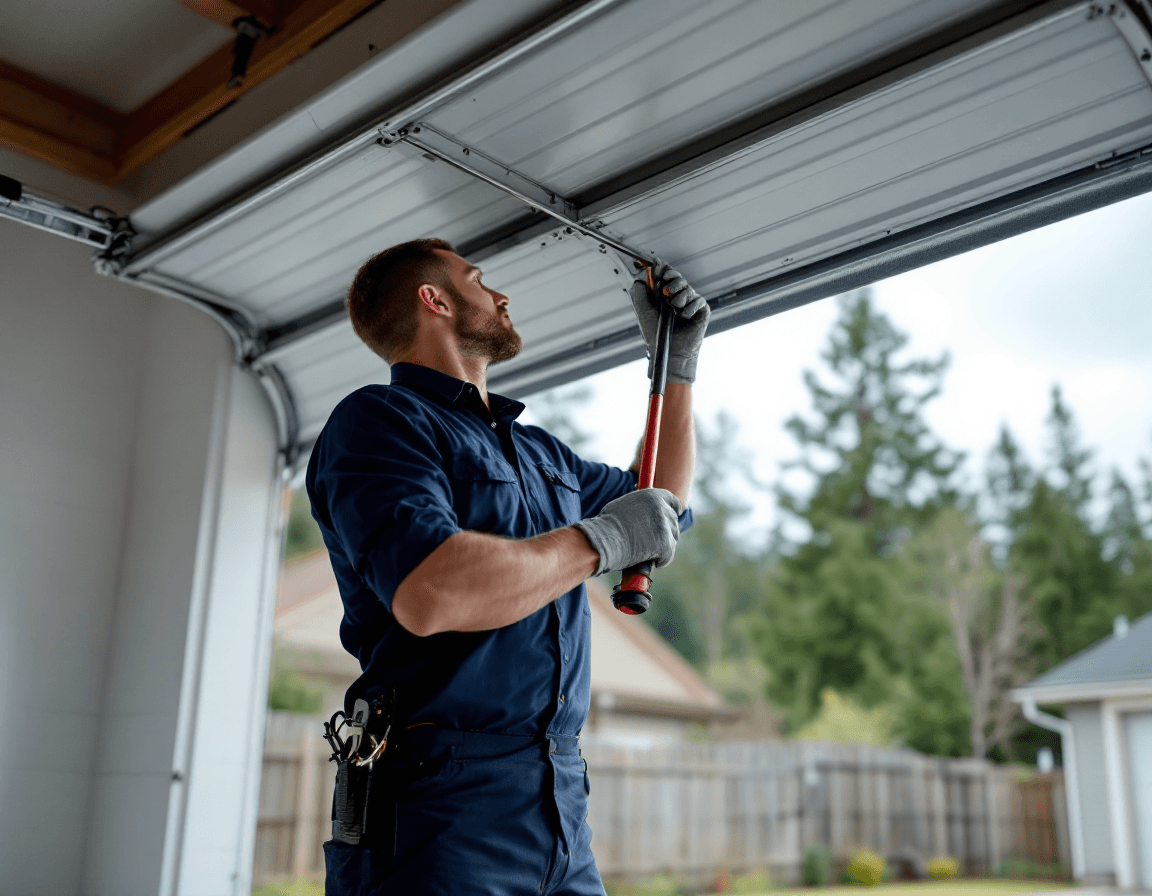
Garage Door Spring Replacement in SeaTac, WA is one of the most frequent repairs we handle, and it is also one of the most hazardous to attempt on your own. When a garage door drops suddenly, refuses to lift, or lets out a crack that echoes down the street, the spring is almost always the cause. Homes around Angle Lake, McMicken Heights, and Bow Lake see this pattern often, partly because of the mix of older houses and newer builds that carry heavier insulated doors. Those heavier doors put steady load on the springs every time they cycle.
Western Washington's damp, mild winters and cool, wet shoulder seasons work slowly on steel, encouraging surface rust and metal fatigue that may not be visible until a spring gives way. Early-morning and late-evening temperature swings also make the metal expand and contract, which speeds up wear over thousands of cycles. Many SeaTac garages double as workshops or storage rooms, so the door may open several times a day without anyone thinking much about it. This page explains how to recognize a failing spring, how torsion and extension systems differ, what influences the price, and what a careful technician does during a replacement visit. Seattle Garage Door Fix is licensed, bonded, and insured, and we treat every spring job as a controlled, methodical process rather than a quick guess.
Our goal is to help you make a clear decision before the situation becomes urgent. Knowing the warning signs lets you call for service while the door is still operable, which is often safer and less expensive than dealing with a door that has come off its track or a cable that has whipped loose. You will also find practical guidance on what to avoid, because most of the injuries we hear about start with someone trying to fix a spring with household tools. Read through the sections below, and call us at any point if your door is behaving differently than it did last month.
What a Snapped Spring Sounds Like in a SeaTac Garage
A broken spring usually announces itself with a single loud bang that many homeowners describe as a gunshot or a heavy metal object dropped on concrete. The sound often comes from inside the garage, sometimes from the wall where the torsion tube is mounted, and it can be startling enough to make you check whether something has fallen or someone has come in through a window. In attached garages around the Bow Lake and Angle Lake areas, the sound can carry into kitchens and bedrooms, which is why several customers assume a car accident or a break-in before they realize it is the door. After the bang, the door often sits low, leans, or refuses to move at all.
Not every bang is a spring, so it helps to look for supporting evidence before you assume the worst. Check the bottom bracket and the center of the torsion shaft above the door for a gap in the coils, a loose cone at the end of the shaft, or a spring that appears stretched. For extension springs, look along the horizontal tracks for a coil that has sprung loose or a pulley that has shifted. Remember that the spring itself is under very high tension, so the goal of this inspection is observation only. Do not touch the winding cone, do not loosen any bolt, and do not attempt to move the door by hand once you suspect a break.
If the bang was followed by a door that is sagging, uneven, or hanging from one side, keep people and pets away from the door and avoid parking underneath it. A door that has lost its spring balance can drop unexpectedly when the opener is engaged, and the opener alone is not designed to lift the full weight of a door. Turn off power to the opener at the breaker if you can do so safely, and use the manual release only when the door is closed. Those simple precautions give the technician a safer and more predictable starting point when they arrive.
Torsion Versus Extension Springs: Knowing What You Have
Most garage doors in the Seattle area use one of two spring systems, and the difference matters for both safety and cost. Torsion springs are mounted on a steel shaft above the door opening, and they wind and unwind to counterbalance the door's weight. Extension springs run parallel to the horizontal tracks on each side and stretch as the door moves. Torsion systems are generally considered more balanced and longer lasting, while extension systems are common on older or lighter doors and tend to be found in older SeaTac homes that were built before torsion became the standard choice in many new installations.
To identify your system, look above the closed door. A long steel tube with one or two cones on each end, with coiled spring wound around it, indicates a torsion setup. If you see two springs running lengthwise along the horizontal tracks, usually with a safety cable threaded through the center of each spring, you have extension springs. Some doors have a mix of both, particularly after a previous partial repair, and that situation deserves a professional look because the two systems behave differently when one part fails.
Identifying the system is also important when you call for service. Torsion repairs usually require specialized winding bars, a measured setup, and careful attention to the cone and drum hardware, while extension repairs focus on the safety cables, the pulleys, and the tension in each spring pair. If you tell the dispatcher which system you have and describe what you saw or heard, the technician can arrive with the right parts and the right plan. That reduces the number of return visits and keeps the job moving efficiently.
Why Western Washington Weather Wears Springs Down
Springs are designed to last for a rated number of cycles, but that number assumes conditions that are not always met in the Pacific Northwest. The region's persistent moisture, especially during long gray stretches from late fall into spring, can cause surface corrosion on exposed steel. Once rust begins to pit the wire, the coil loses its uniform strength, and the spring can fail at the weakest point. Garages with poor ventilation, uninsulated walls, or slab floors that stay cold and damp can trap condensation, making the problem worse.
Temperature changes add another layer of stress. Steel contracts in cold weather and expands in warm weather, and the change can be noticeable in a house where the garage is not heated. A spring that has been working through the winter may feel stiff on a chilly morning and then loosen as the afternoon warms, which is a hint that the metal is near the end of its service life. Homeowners sometimes mistake that stiffness for a minor opener problem, when the real issue is spring fatigue.
Usage patterns in SeaTac also matter. Households with teenagers who come and go on different schedules, or with multiple vehicles that use the garage daily, may cycle the door far more often than the original builder expected. Some of our customers in newer neighborhoods near the airport have heavier insulated doors that they chose for quieter operation and better energy performance, and that added weight shortens spring life if the balance is not checked periodically. A technician who understands these local habits can recommend a practical replacement interval and point out risks before they become emergencies.
Early Warning Signs Your Spring Is Failing
Springs rarely fail without warning, even though a sudden snap can feel that way. Paying attention to small changes in how the door moves gives you a window to schedule service before the door is stranded. Many of the earliest signs are subtle, such as a slight hitch at the start of travel or a door that feels heavier on one side than the other. Catching those hints early keeps the repair predictable and often less expensive.
Watch for these common indicators:
- A loud bang or pop from the garage, followed by a door that sits low or refuses to lift.
- A visible gap between coils on a torsion spring, or a spring that looks stretched or loose on an extension system.
- A door that opens a few inches and then stops, or one that seems to pull against the opener.
- An opener that strains, hums, or clicks while the door barely moves, which often means the springs are no longer carrying their share of the weight.
- Cables that have come loose from the drum, appear frayed, or are hanging slack after a spring break.
- A door that closes too fast, drops rapidly near the bottom, or closes crooked and rubs against the frame.
Any one of these signs deserves attention, and several together usually mean the spring is close to failure or has already broken. Do not wait for the door to stop completely, because a strained opener can burn out its motor or gears, which turns a spring job into a larger repair. When you notice more than one symptom, arrange a service visit within a few days and avoid using the door until a technician has checked it.
Why a Door That Stops Halfway Points to Balance
A door that opens a few inches and then stalls is one of the most frustrating symptoms, and it is sometimes misdiagnosed as a broken opener. In reality, the opener is doing its job by trying to lift the door, but the springs are not supplying enough counterbalance to make the lift smooth. Once the spring tension drops, the opener must work much harder, and it may stop when the force exceeds its safety limits. Balance problems often trace back to a spring that has lost tension or to an uneven pair of springs that are carrying different loads.
Door balance is measured by how the door behaves when it is disconnected from the opener and moved by hand. A properly balanced door should stay roughly in place when lifted to about halfway and released, without drifting up or sinking down. If the door drops, rises rapidly, or stays put only in certain positions, the springs are likely mismatched or worn. Balance checks are a standard part of a responsible spring replacement, because a new spring installed on an unbalanced door will continue to cause strain and premature wear.
Balancing also influences how the door closes. A door that closes too fast or slams at the bottom often has too little spring tension, while a door that struggles to close may have too much. Adjusting tension is precise work that depends on door weight, track geometry, and the condition of the rollers and hinges. That is why we recommend against trial-and-error adjustments on the winding cones or the opener's force settings, since those changes can shift tension in ways that are difficult to reverse.
High-Cycle Springs and What Upgrading Actually Buys You
Many replacement springs are rated for a standard cycle count, often in the range that suits a typical residential door used a few times per day. High-cycle springs are engineered to last longer under heavier use, and they are a sensible option for busy households in SeaTac that open the garage several times daily or that run heavier insulated doors. The higher rating comes from changes in wire composition, coil design, and finishing that help the spring resist fatigue and corrosion over a longer service life.
An upgrade is not always necessary, and a good technician will explain the tradeoffs rather than pushing the most expensive option. For a lightly used single-car door, a standard spring may serve well when installed correctly and balanced to the door's actual weight. For a double-wide door, a door with glass panels, or a garage that sees frequent use from a work-from-home schedule or a home-based business, a high-cycle spring may reduce the frequency of future repairs. The most important factor is correct sizing, because an undersized spring will fail early regardless of its rating.
When high-cycle springs are installed, they should be paired with a balance check and, where appropriate, a review of the cables, drums, and bearings. Upgrading only the springs while leaving worn hardware in place can shift stress onto other components, which may fail sooner than expected. We treat the spring as one part of a system, and we explain each option in plain language so you can decide what makes sense for your home and budget.
Cables, Drums, and the Damage a Broken Spring Leaves Behind
A broken spring is rarely the only problem. When a torsion spring snaps, the energy it stored releases suddenly, and that force can shock the drum, bend the shaft, or pull the lift cables loose from their anchor points. Cables that come off the drum may fray or kink, and a drum that has spun unexpectedly can crack or slip on the shaft. These hidden injuries are why a visit that begins with a spring should always include a close look at the entire lift system.
Extension spring failures can also stress the safety cables that run through the springs. If a spring breaks and the safety cable remains intact, it may hold the spring piece in place and reduce the risk of a whipping coil, but the cable itself can be overstressed or fouled. Pulleys and brackets along the track can be bent or cracked when the door drops suddenly, and misaligned hardware causes uneven travel. A technician should check each of these parts and replace any that show wear, rather than assuming the rest of the system is fine.
Cable safety matters because a cable under tension can cause serious injury if it releases. Never attempt to reattach a cable while the spring is still under tension, and never stand in the path of a cable when someone else is working on the door. A cable that has come off its drum should be treated as a hazard until a licensed professional confirms that the lift system is secure and properly tensioned.
What a Careful Spring Replacement Visit Involves
A professional spring replacement follows a sequence designed to control the stored energy in the spring and to restore balance safely. The process begins with a visual inspection of the door, the track, the drum, and the opener, followed by a check of the door's weight and size. Those details guide the choice of replacement spring and help the technician estimate whether additional parts will be needed. Clear communication at this stage keeps you informed about what is being done and why.
During the repair, the technician will secure the door, release the tension on the failed spring using proper winding equipment, and remove the damaged hardware. The replacement spring is installed with careful attention to cone alignment, coil orientation, and fastening, and then the tension is restored in a controlled manner. Once the spring is set, the door is tested manually and with the opener to confirm that it lifts, lowers, and reverses correctly. Final adjustments to the balance, cable tension, and safety reversal are made before the job is considered complete.
Here is a general outline of what a typical visit includes:
- A complete inspection of the spring, cables, drums, pulleys, rollers, and opener.
- A manual balance test to determine whether the door is carrying its own weight.
- Securing the door and releasing tension on the damaged spring with proper winding tools.
- Installing the replacement spring, with correct sizing and cone alignment.
- Restoring tension in a controlled sequence and verifying the balance.
- Testing the opener, safety reversal, and the door's travel from top to bottom.
If a visit reveals additional issues, a good technician will explain them and provide options. Some repairs, such as replacing a worn drum or a bent track section, may be necessary for the door to operate safely. You should always feel comfortable asking questions about any recommended part before work continues.
Understanding the $180–$450 Price Range
For most garage door spring replacements, our typical price falls between $180 and $450. That range reflects the variety of door sizes, spring types, and conditions we encounter across SeaTac and surrounding areas. A single-car door with a standard torsion spring may land near the lower end of the range, while a double-wide door, a heavier insulated door, or a repair that includes high-cycle springs and additional hardware may fall toward the upper end. The final quote depends on what is found during the visit, and we explain the specifics before any work begins.
Several factors influence the cost. The door's weight and dimensions determine the spring size and tension needed, and the spring type matters because torsion and extension systems require different tools and labor. If cables, drums, bearings, or pulleys are worn or damaged, those parts add to the total. Access can also play a role, particularly in garages with limited clearance, unusual track layouts, or previous modifications. Because the range is broad, we recommend asking for a clear breakdown so you can see which items are included and which are optional.
Some homeowners compare spring repair costs to the price of a new door, and that comparison is worth making. Replacing a spring is usually far less expensive than replacing a complete door, and it restores the function of a door that may otherwise be in good condition. The right choice depends on the door's age, condition, and insulation, and we can help you weigh those factors honestly. Our goal is to make sure the work matches your needs without unnecessary add-ons.
Staying Safe While You Wait for a Technician
When a spring breaks, the minutes before a technician arrives are important, and the most useful thing you can do is avoid the door's hazard zone. Keep children, pets, and visitors out of the garage, and do not stand under a door that is sagging or hanging unevenly. Avoid using the opener to force the door, since that can strain the remaining hardware and create a sudden drop. If the door is partially open, leave it alone rather than trying to close it by hand.
Do not attempt to replace a spring yourself, even if you have watched a video or own a set of winding bars. Torsion springs store a large amount of energy, and a slip of the winding bar can cause serious injury. Extension springs can also release suddenly, and cables under tension can strike with enough force to cause lasting harm. Spring and cable work should always be handled by a licensed, insured professional with the proper equipment and training, and that rule applies whether the door is in SeaTac, Bow Lake, or anywhere else in King County.
If you need to use the family vehicle or access the garage before we arrive, use the side door or a pedestrian entrance when possible. Let your household know that the door is out of service so that no one attempts to operate it. Taking these simple steps keeps everyone safer and gives the technician a clear, undisturbed setup when they arrive.
Garage door springs fail when they are most stressed, and a prompt, careful repair protects both your home and your household. If your door in SeaTac, McMicken Heights, Angle Lake, Bow Lake, or nearby ZIP codes 98188 or 98198 has shown any of the warning signs described above, do not wait for it to become a larger problem. Call Seattle Garage Door Fix at (888) 799-3819 to schedule a licensed, bonded, and insured technician who can inspect the spring, explain your options, and restore safe, balanced operation.