
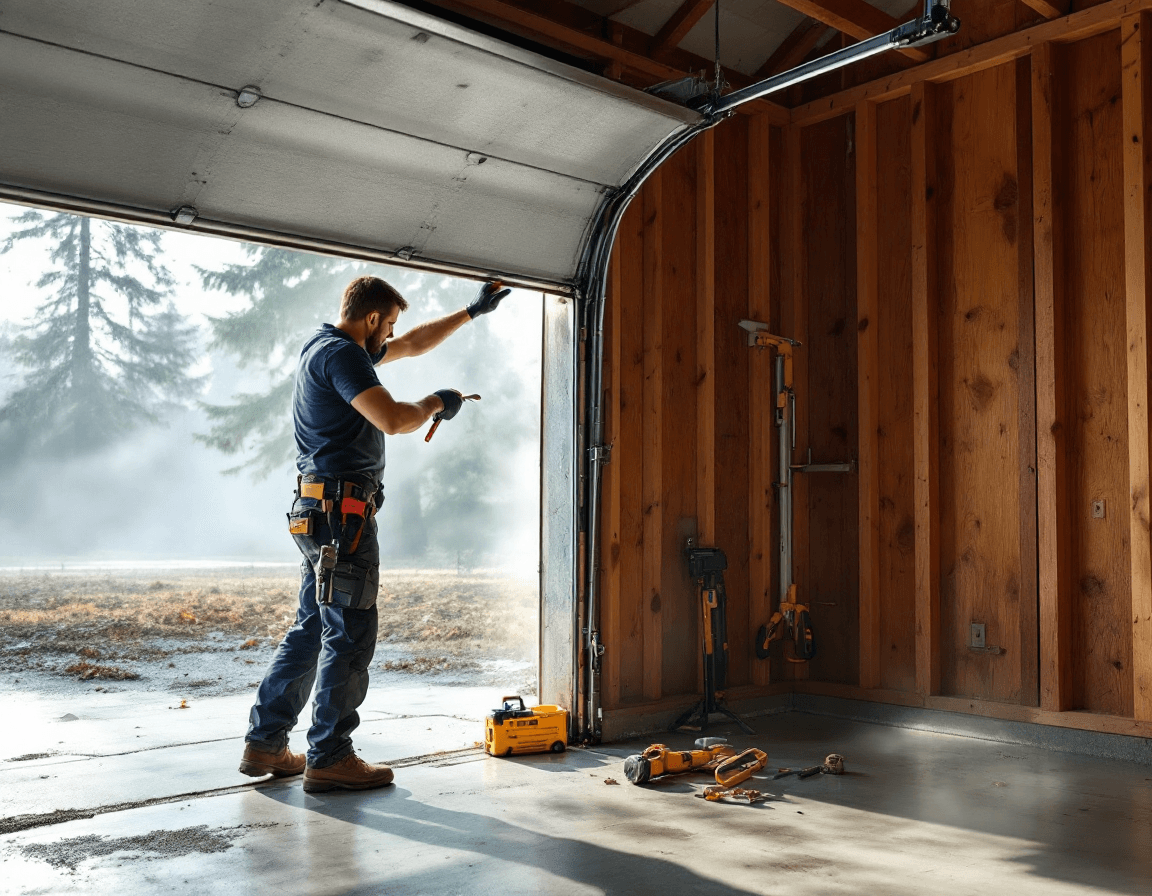
Off-track garage door repair in SeaTac, WA is one of the more common calls we handle, and it usually begins with a sound: a sharp bang, a grinding rattle, or a door that stops halfway up and refuses to move. When a door leaves its track, the panels may look fine from the driveway, but the door is no longer riding the path it was built to follow. Running the opener in that condition can bend hardware that was only slightly out of position and turn a modest adjustment into a much larger job. Acting early usually keeps the repair simple.
SeaTac sits in a part of King County where garage doors take a steady beating from weather and traffic. Homes near the airport corridor deal with constant road vibration, while the lower ground around Angle Lake and Bow Lake tends to hold moisture through long gray stretches of the year. Doors in these pockets often show rust on track joints and hinge hardware sooner than doors in drier areas, and that corrosion can make a track section less forgiving when a roller catches. This page explains why derailments happen here, how to recognize one early, what a typical repair involves, and where the safety limits are for homeowners.
Our pricing for most off-track repairs falls between $125 and $400, depending on what has moved and how much damage the track has taken. A roller that simply popped out and needs to be reseated is at the low end of that range. A bent section, a separated joint, or a door that was struck by a vehicle will sit higher because more parts must be measured, straightened, or replaced. Every job starts with an inspection so the homeowner understands the actual cause before any work begins. Spring and cable work always goes to a licensed professional, and we will explain that clearly if it comes up during a visit.
Why Doors Keep Leaving Their Tracks in This Part of King County
Most derailments are not random. They tend to follow a handful of causes that show up again and again in neighborhoods with the same mix of housing and weather. In SeaTac, the combination of wet winters, windy stretches off the Sound, and older garage door installations creates a steady supply of misaligned doors. Homes built several decades ago often still carry original track brackets, worn rollers, and fasteners that have loosened through years of vibration.
Wind plays a bigger role here than many homeowners expect. A light panel with a tall profile can catch a gust in an open driveway, pushing the bottom edge sideways just enough to pull a roller out of its channel. Doors that are opened and closed while the wind is pushing against them are especially prone to this, because the track is being asked to handle a force it was never designed to resist during operation. Keeping the door fully closed during storms and checking the wall brackets afterward is a simple habit that prevents many of these events.
Moisture is the quieter culprit. Standing water in the tracks, a thin film of road grime, and rust that forms on the inside of a steel channel all increase friction and can cause rollers to hang up on one side. When one roller binds while the other rolls freely, the door starts to skew, and the skew grows with every cycle until a roller pops free entirely. Because this process is gradual, many homeowners only notice the problem when the door finally stops, which is often the moment a small adjustment has already become a larger repair.
Recognizing an Off-Track Door Before It Stops Working
The most useful thing a homeowner can do is learn the early warning signs. A door that has slipped partly off its track almost always announces itself before it fails completely. Listen for scraping, a repeated clicking as the door travels, or a grinding sound near one of the bottom corners. Look along the edges of the door while it moves, because a door that is coming out of alignment will often appear to lean or hover slightly higher on one side than the other.
Several symptoms should prompt a call sooner rather than later. These are the most common signs we hear described when a homeowner first reaches out:
- A visible gap between the top or side seal of the door and the track
- One or more rollers sitting outside the channel, sometimes visible from the outside of the door
- The door looking crooked, leaning, or sitting lower on one side
- The door binding partway through its travel and then moving freely after being nudged
- The door jammed in place and refusing to move in either direction
- A bent, dented, or separated section of track, often with a noticeable kink or a joint that no longer lines up
Any of these signs points to a track or roller problem that will likely get worse under continued use. The safest first step is to stop operating the door electrically and keep people and vehicles clear of the opening until a technician has looked at it. Taking a photo of the track and the gap before anyone touches it can also help the technician understand what changed.
What Happens Inside the Door and Opener When It Derails
It helps to understand the mechanics, because a derailed door is not just a stuck door. A typical residential garage door runs on two vertical tracks, a horizontal track that carries the door overhead, and a set of rollers attached to the door panels. The rollers ride inside the track channels and guide the door through its curve from vertical to horizontal. When the track is straight and the rollers are seated, the door moves smoothly. When either one is out of position, the door has to fight its own geometry.
The opener adds a complication. Its motor and trolley pull the door with considerable force, and that force does not know the door is misaligned. If the door is trying to climb while a roller is wedged against the track edge, the strain goes into the track brackets, the roller stems, and sometimes the door panel hinges. This is why continuing to run the opener after a derailment often causes secondary damage. The opener should be disconnected from the door using the emergency release cord, which should only be pulled when the door is closed, so the door can be checked by hand.
Springs deserve special attention. Torsion springs and extension springs are under very high tension, and a derailed door can change how they load. A technician will inspect the springs during an off-track visit even when the immediate problem is only a roller. If a spring shows signs of fatigue, cracking, or gapping between coils, that work requires a licensed professional with the right tools, and it should not be attempted by a homeowner under any circumstances.
Re-Seating Rollers Without Forcing the Door
For many SeaTac homeowners, the most common repair is simply re-seating one or more rollers that have popped out of the track. This sounds straightforward, and when the track is undamaged it often is. The technician first confirms that the door is closed and secured, then examines the roller, its stem, and the track channel for scuffing, bending, or debris. A roller that has been pulled sideways may have a worn bearing or a stem that has flattened slightly, and those parts may need to be replaced rather than reinserted.
Once the roller is in good condition, it is guided back into the channel by hand, usually with the door supported at a safe height. The technician checks that the roller rolls freely and sits centered in the track before moving on. Lubrication is applied to the roller bearings and the track surface where appropriate, using a product suited to garage door hardware rather than a heavy grease that attracts grit. This step matters in our wet climate because a dry, gritty track will wear rollers faster than one that is properly maintained.
Re-seating rollers is not something a homeowner should try to force. Prying at a roller with a screwdriver or hammer can bend the track, crack the roller housing, or push the door panel out of square. If a roller will not go back into the channel with gentle guidance, that is a sign the track itself may be deformed. Stopping at that point and calling for an inspection protects both the door and the people working near it.
Straightening Bent and Dented Track Sections
Track damage is the more serious version of an off-track problem, and it is common enough in SeaTac that we address it on many service calls. Steel track is strong, but it can bend when a roller is driven hard into a kinked section, when a door is forced past an obstruction, or when a vehicle clips the lower part of the track. A bend may be slight enough to see only as a faint wave along the channel, or it may be obvious as a visible dent or a joint that has pulled apart.
Straightening a track involves loosening the mounting brackets, aligning the section with a level and reference line, and gently correcting the bend before resecuring the hardware. Minor bends can often be corrected in place, while more severe deformation may call for replacing the affected section. A track that has been bent and straightened repeatedly will weaken at the bend point, so the technician will judge whether a repair will hold or whether a replacement is the more reliable choice. Replacement track sections are matched to the door's size and track profile, which is why an accurate measurement matters.
Separated sections are a warning sign that the track has been under unusual load. When two track pieces pull apart at a joint, the door may drop unevenly, and the roller may catch on the gap. These joints need to be reconnected with the correct fasteners and checked for level along their entire length. Attempting to bridge a separated joint with improvised brackets or tape creates an unpredictable path for the rollers and should be avoided.
When a Car Hits the Door: Damage Beyond the Panel
A vehicle strike is one of the more dramatic causes of an off-track door, and it is not unusual in tight driveways or on properties where a car backs out without fully checking the opening. Many homeowners focus on the dented panel and assume the door is otherwise fine, but the force of an impact travels through the frame and into the tracks. A door that looks only lightly damaged can still have a shifted track, a bent header bracket, or a torsion spring that has taken a sudden load.
After a collision, the first step is to make sure no one is in the path of the door and to avoid operating it. The door should be checked by hand only if it is closed and safe to touch, and the opener should be disconnected. A technician will inspect the track, the brackets bolted to the wall and ceiling, the hinges, the rollers, and the springs. The goal is to find damage that is not visible from the driveway before the door is returned to regular use.
Insurance documentation can also play a role here. Homeowners who plan to file a claim should photograph the damage from several angles before any repairs are made, and they should keep a copy of the invoice. A written description of the repair, including which parts were straightened, replaced, or reseated, helps when a claim requires detail about the work performed.
Local Conditions Around McMicken Heights, Angle Lake, and Bow Lake
SeaTac is not a single uniform neighborhood, and the conditions we see vary from one part of the city to another. Properties in and around McMicken Heights often sit on slopes or uneven lots, which can affect how a driveway drains and how the garage floor sits relative to the door opening. A sloped approach can push water toward the bottom of the door, and an uneven floor can change the angle at which the door enters the track. Both conditions can leave the door slightly out of square even when the hardware is in good condition.
Homes closer to Angle Lake and Bow Lake tend to sit in areas where the ground stays damp for long periods. Humidity in these pockets accelerates corrosion on exposed steel track, especially at the lower sections near the floor where splashed water and road salt residue collect. Homeowners in these areas often benefit from wiping the track and rollers during seasonal checks and from keeping the garage floor clear of standing puddles near the door. Small habits like these reduce the friction that leads to binding.
Many SeaTac homes also sit close to busy roads and within the noise and vibration footprint of nearby traffic and airport activity. That vibration loosens fasteners over time, particularly the bolts that hold the track to the wall and the brackets that hold the header. A quick check of these fasteners during routine maintenance can catch a loosening bracket before it lets a section drift out of line. Our technicians pay close attention to these mounting points on every off-track visit, because a door that is misaligned at the wall is likely to be misaligned at the rollers as well.
What a Typical Off-Track Visit Includes and What Affects the Cost
Most homeowners want to know what they are paying for before a technician arrives, so it is worth outlining what a standard off-track visit usually covers. The bulk of the time goes into diagnosis, because a door can look similar from the outside while having very different causes underneath. The technician confirms the door is safely secured, examines the rollers and track, checks the brackets and fasteners, and inspects the springs and cables before recommending a repair.
Our off-track repairs generally fall between $125 and $400. Several factors move a job toward the lower or higher end of that range:
- How many rollers are out of position and whether any of them need replacement
- Whether the track is simply out of alignment or actually bent, dented, or separated
- How many track sections are involved and how accessible they are
- Whether the door was struck by a vehicle, which may reveal additional hidden damage
- Whether the opener, brackets, or hinges were affected by the derailment
- Whether spring or cable work is required, which is handled by a licensed professional and priced separately
We provide an explanation of the findings before any work begins, so the homeowner understands what is needed and why. If additional work is recommended, it is presented clearly, and the homeowner decides how to proceed. This approach keeps the focus on the door's actual condition rather than on an assumed scope.
Safety Lines a Homeowner Should Never Cross
Garage doors are heavy, and the forces stored in their springs and cables are substantial. For that reason, every off-track situation has a clear line between what a homeowner can safely check and what must be left to a licensed technician. Staying on the right side of that line protects both the household and the people who may later work on the door.
Homeowners can safely do a few things. They can keep children, pets, and vehicles away from the door, look at the track and rollers from a safe distance without touching the springs, and disconnect the opener using the emergency release cord when the door is closed. They can also take photographs of the damage and note when the problem began, which helps the technician diagnose it faster. Beyond those steps, the work belongs to a professional.
The following should always be handled by a licensed technician rather than attempted at home:
- Adjusting, winding, or replacing torsion springs or extension springs
- Removing or replacing cables, drums, or the end bearings that carry spring tension
- Prying, hammering, or forcing rollers or track sections back into position
- Working on a door that is partly raised, partly fallen, or hanging by one side
- Any repair that requires standing under an unsupported door
Our technicians follow these limits on every call, and they will explain clearly when a repair needs a licensed specialist. This is not about upselling. Spring tension can cause serious injury in seconds, and an unsafe shortcut is never worth the risk.
Preventing the Next Derailment with Simple Seasonal Checks
Once a door has been returned to alignment, the best way to avoid another derailment is a short seasonal check. These checks take only a few minutes, and they catch the common problems before they grow. The Pacific Northwest rhythm of wet winters and drier summers gives homeowners natural points in the year to look at the door, and tying the routine to those seasons makes it easier to remember.
In the fall, before the rainy months settle in, look along both vertical tracks for debris, rust spots, and any gap between the track and the wall. Make sure the wall brackets are tight and that the track is straight when viewed from the side. Wipe the track channels clean and apply a light coat of appropriate lubricant to the rollers and hinges. In the spring, after the wettest weeks have passed, repeat the visual check and listen for new noises while the door operates slowly, paying attention to any hesitation at the start or end of travel.
Between seasons, a homeowner can watch for changes that signal trouble. If the door begins to hesitate, if one side seems to rise faster than the other, or if a new rattle appears near the top of the track, schedule an inspection rather than waiting for the door to stop. Keeping the area around the door clear of stored items also helps, since objects pressed against the bottom panel can push the door out of its channel during operation.
Choosing a Licensed Technician for Track and Spring Work
When a door has come off its track, the quality of the repair depends heavily on who performs it. Track alignment, roller replacement, and spring work all require specific tools, accurate measurements, and an understanding of how the components interact under load. A licensed, bonded, and insured technician brings that training to the job, and that protection matters for the homeowner as much as for the company.
Homeowners should look for a company that explains the diagnosis clearly and that does not pressure them into work they do not need. A reputable technician will describe what they found, show the damaged parts when possible, and separate urgent repairs from recommended upgrades. Asking about licensing, insurance, and how spring and cable work is handled is a reasonable part of choosing who to call. Clear answers to those questions tell you a great deal before the work begins.
Our team serves SeaTac and the surrounding communities across King County, including the McMicken Heights, Angle Lake, and Bow Lake areas. We approach every off-track door as a safety issue first and a cost question second, and we will tell you plainly what the door needs and what it does not. If your door has slipped off its track, has a bent section, or was struck by a vehicle, call (888) 799-3819 and a technician can schedule a visit. Please do not run the opener or force the door until someone has had a look, because a quick inspection today often prevents a much larger repair next week.