
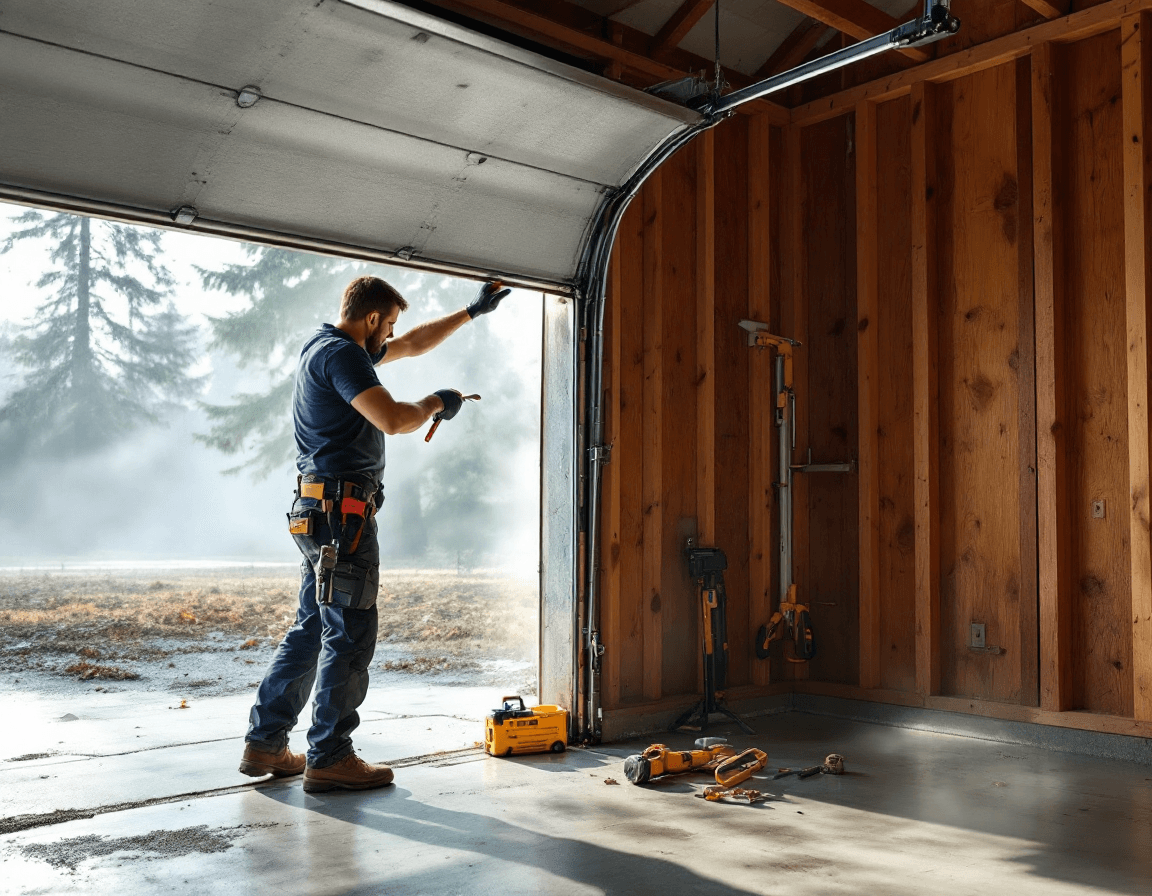
Off-Track Garage Door Repair in Tukwila, WA is one of those calls that tends to arrive at the worst possible moment, usually when you are backing out for an early shift or trying to pull in after a long day near Southcenter. A door that has slipped out of its tracks can look dramatic, but the damage is often limited to a few rollers, a bent track section, or a panel that has shifted just enough to bind. Our technicians see this problem across Tukwila's mix of older single-family homes, newer townhome clusters, and multi-car garages scattered through the neighborhoods around Tukwila Village. This page explains what is actually happening when a door comes off track, what you can safely check yourself, and when it is time to bring in a licensed crew. Knowing where those boundaries sit can keep a modest repair from turning into an expensive replacement.
Tukwila sits in the low ground where the Green River and Duwamish valleys meet, and that geography shapes how garage doors behave over time. Western Washington winters bring long stretches of rain, damp air that settles on the flats, and temperature swings that can move from mild afternoons to near-freezing nights within a few hours. Steel tracks gather surface rust along their seams, wooden door sections absorb moisture and swell, and metal hardware expands and contracts with every change. Over several seasons that constant movement loosens brackets and nudges rollers toward the edge of their channels. Many of the off-track calls we answer in the cooler months are really the end result of a slow drift that finally crossed a tipping point.
Whether your home is near Allentown or on one of the quieter blocks off Interurban Avenue, the path to a lasting fix begins with the same question: why did the door leave the track? A quick push back into position might get the door moving again, but it rarely addresses the cause. A roller that popped out because its stem wore thin needs a different solution than a track that was knocked out of plumb by a backing vehicle. The sections below walk through the most common scenarios we encounter in Tukwila and nearby communities, so you can describe what you are seeing accurately when you call us at (888) 799-3819.
Why Doors in the Green River Valley Drift Off Track
Moisture is the quiet culprit behind many off-track problems in this part of King County. When humidity stays high through November and February, wood panels pick up water, and the resulting swell can change the width of a section just enough to alter how it rides between the track walls. Steel components do not swell the same way, so the mismatch between wood and metal creates friction and uneven pressure at the rollers. Over time, one side of the door may start to lag behind the other, and the roller on the lagging side begins to press against the track lip instead of rolling cleanly through the channel. Eventually it jumps.
Temperature swings add a second layer of stress. A door that closes smoothly on a mild afternoon may bind on a frosty morning because the metal has contracted and the tracks have shifted slightly in their brackets. Homeowners often notice this as a door that seems fine on the way down but sticks a few inches from the top. We have also seen cases where a garage was built with a slightly out-of-level header or a concrete slab that settled unevenly after years of rain, and the track never sat perfectly true from the start. None of these conditions mean the door is beyond saving, but they do mean the underlying alignment should be checked rather than assumed.
Salt and road grime are another factor for homes close to busier streets. Winter treatments and spray from wet pavement can leave residue on the lower sections of the tracks and on the rollers themselves. Grit that collects in the channel acts like sandpaper, wearing down roller surfaces and building up enough resistance to pull a door sideways. Keeping the bottom of the track clear is one of the simplest preventive steps, and it is one we discuss with every customer who asks how to avoid a repeat call.
Reading the Damage Before You Touch the Door
Before anyone attempts to lift or nudge a door that has come off track, it helps to look carefully at what is going on. Start by observing the door from a safe distance, noting whether it is sitting flat across the opening, leaning to one side, or hanging with one edge lower than the other. Check whether the top roller on each side is still inside the track or has popped free. Look for daylight between the top section and the header, and note any gaps between the door edge and the vertical track. These observations will help a technician understand whether you are dealing with a single roller problem, a full track misalignment, or a damaged panel.
Pay close attention to the track itself. A track that has been bumped is often visibly out of line, with a bend that shows up as a kink or a wave when you sight along the rail. Look for separated sections where a bolt has loosened or a joint has pulled apart, because even a small gap can catch a roller and send it off the edge. Compare the vertical tracks on both sides of the opening; if one is set farther out than the other, the door will try to ride at an angle no matter how carefully you reposition it. Taking a few photos from several angles is a helpful habit, since they give you a record to share with a technician and make it easier to tell whether damage has changed over a day or two.
It is also worth noting any sounds. A grinding or scraping noise as the door moves usually points to a roller or track contact problem, while a sharp bang can indicate that a section dropped or a roller struck the track lip at speed. A groaning or popping sound from the top corners can suggest that cable or spring tension is uneven, which is a reason to stop operating the door entirely. Write down what you heard and when it happened, because those details are useful when a technician asks how the failure unfolded.
Immediate Safety Steps for a Door That Has Left Its Track
The first priority is keeping people and vehicles clear of the opening. A door that is partly off its track can shift without warning, and the weight of a sixteen-foot panel is more than enough to cause serious injury. Keep children and pets indoors and away from the garage, and avoid parking under or directly in front of the door until it has been secured. If the door is blocking a vehicle, move the car only if you can do so safely from outside the opening and without disturbing the door.
Do not run the opener to try to force the door back onto its track. Electric openers pull with significant force, and running one against a derailed door can bend the rail further, strip a roller, or damage the opener's own drive system. Likewise, pulling the emergency release cord on a door that is hanging off track is risky, because the door can drop suddenly once it is disconnected from the carriage. If the door is still partly on the track and you are unsure, the safest choice is to leave it alone and call a technician. Many of the expensive repairs we see began with an attempt to fix the door by pushing or pulling it while it was already compromised.
- Keep everyone and every vehicle at least a few feet clear of the door's path.
- Do not operate the opener or pull the emergency release while the door is off track.
- Do not climb onto a ladder or stand under the door to try to lift it back into position.
- Do not touch springs, cable drums, or the torsion shaft under any circumstances.
- Photograph the damage, note the time it happened, and call a licensed technician.
Rollers That Pop Out and Why They Keep Doing It
Rollers are the small wheels that carry the door along the track, and they are responsible for more off-track events than almost any other component. Older doors often use steel rollers with a bearing or a worn stem, while many newer doors use nylon or sealed rollers that run more quietly. Whichever type you have, the roller stem is the part most likely to fail. When the stem bends or the bearing seizes, the roller stops turning smoothly, and the door begins to ride on its edge. Once that happens, the roller can pop out of the track on the next firm push.
A roller that pops out once may simply have been knocked free by debris or an uneven track. A roller that pops out repeatedly is trying to tell you something more specific. Sometimes the wheel is worn to an oval shape, sometimes the track near the roller has a slight inward bend, and sometimes the bracket that holds the track has loosened enough to change the geometry. Replacing the roller alone may help temporarily, but the underlying wear or misalignment will keep causing trouble until it is corrected. A technician will usually check the track at the roller's position, inspect the stem, and confirm that the hinge and bracket are secure before recommending a fix.
Lubrication matters, but it must be the right kind. Petroleum-based grease and oil can attract grit and gum up over time, so most garage door professionals recommend a silicone-based lubricant on rollers and hinges. Spray sparingly, wipe away the excess, and avoid lubricating the track itself, since that can create a slick surface that encourages slippage. Good lubrication will not fix a bent stem, but it can slow the wear that leads to pop-outs in the first place.
Bent, Dented, and Separated Track Sections
Track damage is one of the most visible causes of off-track failures, and it is also one that homeowners often underestimate. Garage tracks are made from relatively thin steel, and a modest impact can bend a section enough to throw the whole door out of alignment. Typical causes include a backing vehicle that clips the vertical rail, a ladder or bicycle that gets pushed against the track during a move, or a section that was never fully tightened during installation. Even a small dent can create a pinch point where a roller catches and then jumps.
Separated track sections are a different problem. Most tracks are assembled from several pieces joined by bolts and brackets, and those joints can loosen with repeated vibration or after a strong gust pushes the door. When a joint separates, the roller crosses a gap and drops, which can damage the roller and the track edge at the same time. Technicians typically check every joint for alignment, measure the gap between sections, and examine the mounting brackets for stripped holes or cracked welds. In many cases the track can be straightened and re-secured, but a severely kinked or cracked section may need to be replaced to restore smooth operation.
Straightening track is delicate work. Bending a rail by hand without the right tools can introduce new kinks, and a track that looks straight to the eye may still be out of plane by enough to cause binding. Our technicians use levels, measuring tools, and careful adjustment to bring the track back into line, then recheck the door's travel through the full range of motion. The goal is not simply to get the door moving again, but to make sure the track is plumb, level, and parallel so the door can run the way it was designed to run.
When a Vehicle Strikes the Door or the Track
A car or truck that backs into a garage door is one of the most common sources of sudden off-track damage, and the aftermath can be deceptively complicated. The visible dent may be on the panel, but the force of the impact often travels into the tracks, the brackets, and sometimes the spring system. A door that seemed fine right after the collision may begin to bind or pop off track a few days later as the metal settles. This delayed pattern is why we recommend inspecting the door after any vehicle contact, even if the damage looks minor.
If a vehicle has struck the door, avoid operating it until a technician has checked the hardware. Look at the top corners and the springs for obvious bends or gaps, and note whether the door sits level when closed. Keep in mind that the springs and cables are under very high tension, and an impact can shift or damage them in ways that are not visible from the outside. Any sign of stress near the torsion shaft, cable drum, or spring coils should be treated as a reason to stop and call a licensed professional rather than attempt a repair yourself.
Insurance and documentation can also come into play after a collision. Taking clear photos of the damage, the vehicle involved, and the surrounding area can help when you speak with your insurer. Our team can provide a written description of the repairs performed, which many homeowners find useful for their records. Whether the impact came from a careless delivery driver in a crowded lot or a routine backing mistake in your own driveway, the best next step is the same: get the door inspected before it is pushed beyond its limits.
Crooked Doors, Uneven Gaps, and Binding That Still Runs
Not every alignment problem results in a full off-track event. Many homeowners notice a door that runs but looks uneven, with a wider gap on one side, a top section that sits slightly askew, or a hitch that makes the door pause during its travel. These symptoms often start small and grow over time, and they are easiest to correct when they are caught early. A door that binds once in a while is usually telling you that a roller, a hinge, or a track bracket is beginning to shift.
Uneven gaps deserve particular attention because they can indicate a problem with cable tension or spring balance rather than just the track. When the cables are not winding evenly on the drum, one side of the door lifts faster than the other, and the panels can begin to rack or twist. This stress eventually shows up as a roller that jumps or a track that pulls away from the header. Because the springs and cables are under extreme force, adjusting them is strictly a job for trained technicians with the right equipment and experience.
Binding can also come from hinges and panel connections. A hinge that has pulled loose from a panel edge can change the angle of the section and push a roller against the track lip. Technicians typically check every hinge, tighten or replace fasteners, and confirm that the panels are seated correctly before adjusting the track itself. A quick tune-up at this stage often prevents a more serious off-track event later, which is why we encourage homeowners to call when a door seems slightly off rather than waiting for it to stop altogether.
What Shapes the Cost of an Off-Track Repair
Pricing for off-track repairs depends on what has actually failed and how much labor the fix requires. For most off-track repairs in the Tukwila area, the range falls between $125 and $400, which typically covers realigning the door, re-seating rollers, and making minor track adjustments. Simpler calls, such as a single roller that popped out of an otherwise sound track, tend to land at the lower end of that range. Jobs that involve several rollers, a bent track section, or multiple loosened brackets usually sit higher, because they require more time and parts.
Several factors influence the final quote. The number of rollers that need replacement, whether a track section must be straightened or replaced, and how many brackets and fasteners need attention all affect labor. Door size and weight also matter, since larger, heavier panels take more care to handle safely. If the inspection reveals that the springs or cables are involved, the scope of work changes, and a technician will explain the options before proceeding. We believe homeowners should understand what they are paying for, so the technician will walk through the findings before any work begins.
- Rollers replaced: a single roller is quicker than a full set of rollers.
- Track work: minor realignment costs less than straightening or replacing a section.
- Brackets and hardware: loose or stripped fasteners add time to the repair.
- Spring or cable involvement: these items require specialized handling and may change the scope.
- Access and site conditions: tight garages or difficult layouts can affect labor time.
Why Spring and Cable Work Belongs in Licensed Hands
Garage door springs and cables are among the most dangerous components in a home, and this is why any off-track call that touches them should go to a licensed professional. Torsion springs and extension springs store enormous amounts of energy, and a spring that releases unexpectedly can cause serious injury. Cables that come off their drums can snap under tension or whip violently when the door moves. Even experienced homeowners who feel confident with tools can misjudge the force involved, and a single mistake can cost far more than the original repair.
Off-track events sometimes damage these parts without any obvious sign. A cable may slip off its drum, a spring may lose tension, or a bracket may shift and place uneven load on the shaft. Attempting to adjust or replace these components without the correct winding bars, safety clamps, and training is one of the most common ways a simple repair becomes a hazardous one. Our technicians are licensed, bonded, and insured, and they approach every spring and cable job with the caution it demands. If we find that these parts need attention, we will explain exactly what is required and why.
The right approach is simple: if a spring or cable is involved, step away and call. Do not attempt to wind a spring, loosen a set screw, or detach a cable from its drum. Even a door that appears to be working normally after being pushed back onto its track should be inspected if there is any question about its hardware. A short inspection now is far safer than a rushed repair later.
Seasonal Habits That Keep Tracks Aligned Through Wet Winters
Preventive care is the most effective way to avoid repeated off-track calls, and Western Washington's wet seasons make a few simple habits especially valuable. Because moisture and temperature swings are a constant factor, a quick check every few months can catch loosening hardware before it causes a problem. Most homeowners can handle these tasks safely, provided they stay away from the springs, cables, and any part under tension.
- Check that the tracks are securely fastened to the wall and header, and tighten any loose bolts with the door closed.
- Look for debris, gravel, or grit in the bottom of the track, and clear it with a dry cloth or soft brush.
- Apply a silicone-based lubricant to the rollers and hinges, wiping away any excess.
- Inspect the weatherstripping along the bottom of the door and the sides for c