
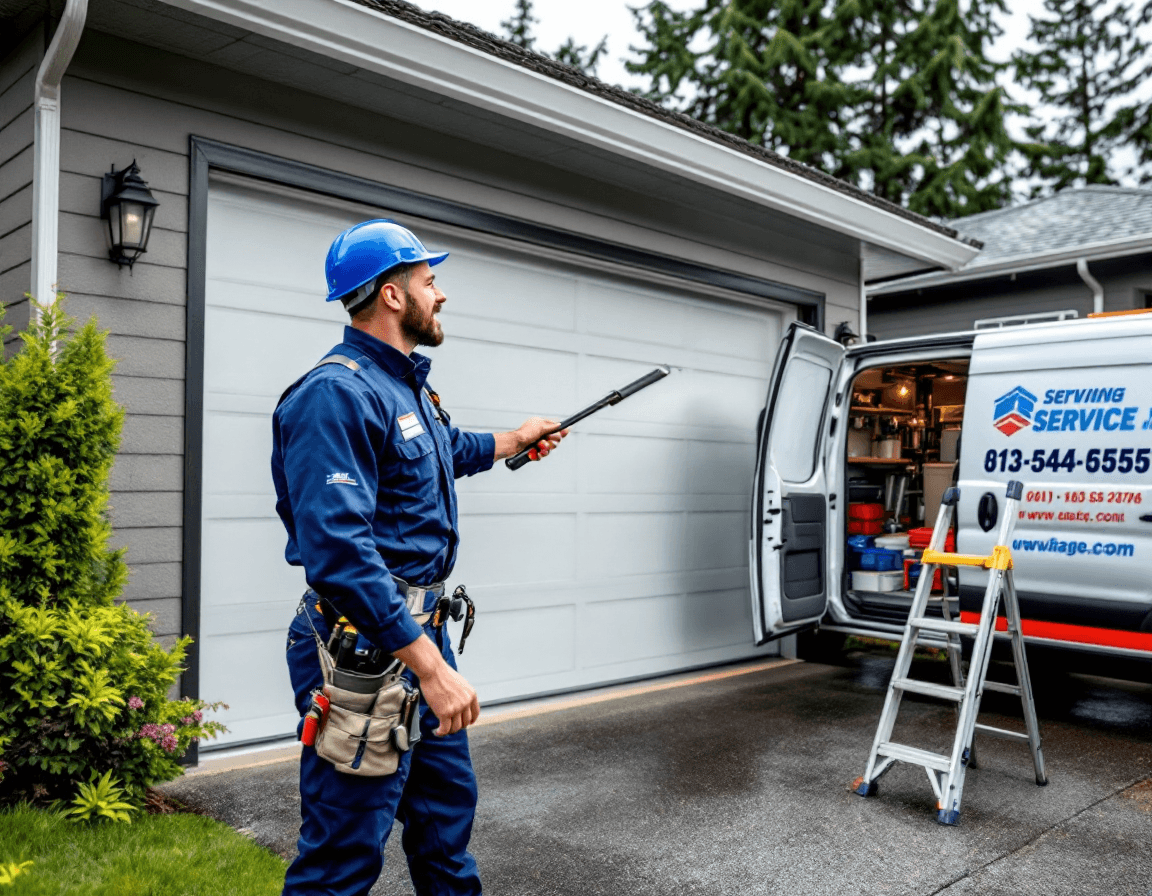
Garage Door Repair in Tukwila, WA is one of the most common calls we take from homeowners in the south end of King County, and for good reason. A garage door is the heaviest moving part of most homes, and when it stops cooperating, it affects everything from getting the car out for work to keeping the house secure overnight. Tukwila sits in a busy, low-lying corridor between Seattle and the airport, with Southcenter on one side and the Green River and Duwamish valley nearby, so the doors here see plenty of moisture, traffic, and daily cycling. This page explains what typically goes wrong, what the warning signs look like, and when it makes sense to call for help.
Whether your door won't open at all, rises unevenly, or makes a noise you've never heard before, most residential repairs in our service area fall in a range of $95 to $450, depending on the parts involved and how much labor the fix requires. Many of the problems described below can be diagnosed in a few minutes, and some have simple explanations that a homeowner can rule out before scheduling a visit. Other problems, especially anything involving tension springs or cables, need a licensed technician with the right tools. Read on to learn which is which, and call us at (888) 799-3819 if you'd rather have a professional look at the door today.
Why Tukwila Garage Doors Face a Different Set of Challenges
Our weather here is mild by national standards, but it is persistently damp. Long stretches of gray, drizzly months keep humidity high in attached garages, and the cool-warm cycles of late fall and early spring cause metal to expand and contract at the hinges, rollers, and track joints. Over time, that moisture encourages surface rust on steel track sections and corrosion on the hardware that holds panels together. Even a garage that feels dry inside can carry enough dampness to slowly stiffen rollers and dull lubrication.
Many homes in Tukwila and the surrounding neighborhoods were built in phases over several decades, which means you'll see a mix of door styles, track configurations, and opener models on the same block. Older sectional doors may have thinner gauge steel, worn rollers, and openers that no longer match the safety standards common today. Newer installations may use nylon rollers and sealed bearings that run quieter but still wear down when the door is forced or left unbalanced. Knowing the age and type of your door helps a technician narrow down the likely cause quickly.
Traffic and vibration also matter in this part of the county. Homes close to the major freight and commuter routes, along with the constant flow of vehicles around the Southcenter area, can experience more vibration through the framing and slab than a quiet cul-de-sac would. That vibration loosens bolts, shifts track brackets, and gradually pulls mounting hardware out of alignment. A door that worked perfectly two years ago may now show small misalignments that grow into noticeable problems if they go unaddressed.
When Your Door Reverses Before It Reaches the Floor
A door that starts down, then bounces back up a few inches before hitting the ground is doing exactly what it was designed to do. Modern openers include safety reversal systems that stop and reverse the door when they detect an obstruction, and that feature protects children, pets, and vehicles. The trouble is that a misreading sensor or a poorly positioned safety eye can trigger a reversal even when nothing is in the path. Before assuming the opener is faulty, it helps to look at the simple causes first.
The most common culprit is the photo-eye sensors mounted on either side of the door near the floor. These two small units send an invisible beam across the opening, and if the beam is interrupted, the door will refuse to close or will reverse on the way down. Dust, spider webs, a bent bracket from a stray bicycle or recycling bin, and direct sunlight through a side window can all confuse the sensors. Our technicians often find that the lenses simply need cleaning and the brackets need to be squared up so the two units face each other directly.
- Check that both sensor lenses are clean and free of dust, cobwebs, or road grime.
- Confirm that the sensor lights match: a steady light on each unit usually means a good connection, while a blinking light often signals misalignment or wiring trouble.
- Look for the sensor wires being pinched, chewed, or pulled loose at the staples along the wall.
- Make sure nothing is sitting in the door's path, including a tall trash can, a stray tool, or a child's toy.
- Test the auto-reverse force setting only if you understand the adjustment; an overly sensitive setting can reverse the door on minor resistance caused by an uneven floor.
If sensors are clean and aligned but the door still reverses, the issue may be in the opener's control board or the force settings, and that is worth a professional diagnosis. A door that reverses partway through its travel, rather than at the floor, can also indicate that the springs are losing balance or that the track has shifted, which increases the load on the opener.
Grinding, Squealing, and Banging: Decoding the Noises
Garage doors talk to you before they fail, and most homeowners learn to recognize the difference between normal operating sounds and a warning. A gentle whir from the opener is expected. A high-pitched squeal usually means dry or dirty rollers and hinges. A deep grinding noise that comes and goes can point to worn gears inside the opener or to a roller that has seized in its track. Sharp banging, especially at the top or bottom of travel, often means the door is hitting a stop, a loose bracket, or a track section that has moved out of place.
Squealing is the easiest noise to address. Rollers, hinges, and the springs themselves should be lubricated with a silicone-based or lithium-based garage door lubricant, not a heavy grease or household oil that attracts dust and gums up over time. Wipe the track clean before applying lubricant, and apply it sparingly to moving parts rather than soaking the track. Some squealing comes from the rollers themselves, which may be worn flat or cracked, and those are usually a simple replacement.
Grinding and banging deserve more caution. If you hear grinding from the opener while the door is moving, the drive gear or trolley may be worn, and continued use can strip the gear entirely, leaving the door stuck. Banging that repeats at the same point in the travel usually means something is catching, bending, or rattling against the track. Turn off power to the opener and disconnect the emergency release only if you know how to do it safely, then have a technician check the hardware. Ignoring these sounds rarely makes the repair cheaper.
Uneven Travel and Crooked Panels: Track and Alignment Problems
When one side of the door rises faster than the other, or the panels look tilted when the door is halfway open, the problem is almost always in the track system or the cable and spring balance. Garage door tracks are precision-formed steel channels, and even a small bend or a bolt that has backed out can throw the whole door off square. The rollers ride inside these channels, and if one roller binds, the door will pull unevenly to the side that's struggling.
Start by looking at the tracks from inside the garage. Check that the vertical and horizontal sections are straight, that the mounting brackets are tight against the wall and ceiling, and that the bolts holding the track sections together have not loosened. Measure the gap between the top of the door and the header on each side, and compare them. A noticeably larger gap on one side is a sign that the track or bracket on that side has shifted. Tightening a loose bolt is a reasonable task for a handy homeowner, but bending track back into shape is not, since a poorly corrected track can cause the door to jump off entirely.
Crooked doors also show up after cold snaps and wet winters, when framing and wall anchors move slightly. The brackets that hold the tracks to the wall may have pulled loose from drywall or siding, especially where the anchors were set into soft material. In those cases the fix involves reinforcing the mounting point with proper anchors or blocking, which a technician can usually do in a single visit. Ignoring a track that has gone out of square puts strain on rollers, hinges, and the opener, and it can lead to a sudden failure when you least expect it.
Stuck Halfway and Jammed: What Blocked Doors Usually Mean
A door that stops partway up or down is one of the more stressful situations a homeowner faces, especially when the car is inside and the schedule is already tight. The first step is to make sure nothing is physically obstructing the door. Check the floor and the tracks for tools, debris, a fallen bag, or a bike handlebar that might have slid into the path. Then look at the opener's status light and listen for a click or a hum when you press the wall button. Those clues often tell you whether the problem is electrical or mechanical.
A door that stops after a few seconds and then hums without moving is often dealing with a binding roller, a broken cable, or a spring that has lost tension. Some openers will stop automatically when they detect too much resistance, which is a protective feature rather than a fault. A door that shudders, pulls to one side, and then halts usually has a track or roller problem. If you can see that one side of the door has dropped or the cable is slack, do not try to force the door open or closed.
Manual operation can be useful for diagnosis, but it comes with real risks. Pulling the emergency release cord disconnects the door from the opener, which lets you lift it by hand, but a heavy door with a failed spring can drop suddenly. Keep your hands clear of the tracks and springs, and never stand under the door while it is unsupported. Call a licensed technician for any door that is stuck in an odd position, has visibly damaged cables, or refuses to move at all after basic checks.
Dead Remotes and Silent Wall Buttons: Troubleshooting Before You Call
When the remote and the wall button both do nothing, many homeowners assume the opener has died. In reality, the cause is frequently something much simpler. Remote batteries are the first suspect, and a fresh battery costs very little compared with a service call. Make sure the remote is programmed to the correct opener, since some households have multiple openers or a shared-access system that can drift out of sync after a power outage.
Next, check the power. The opener's plug should be firmly seated in its outlet, and the outlet should have power. If the opener is wired directly into the house circuit, look at the breaker panel for a tripped breaker. A flickering light on the opener's motor housing or a single beep when you press the button can indicate a low voltage problem or a blown fuse inside the unit. Those faults usually need a technician to confirm before replacing parts.
Wall buttons can fail for their own reasons. Wiring to the wall control may be cut, pinched, or corroded, especially where it runs through an exterior wall and sits in damp conditions. The button itself can wear out after years of use. Keypads and wireless wall controls may lose their connection if the battery is low or if a nearby device is interfering with the signal. If you have checked the batteries, the breaker, and the plug, and the door still won't respond, a technician can test the full control circuit and the opener's receiver.
- Replace remote batteries first, then test the remote while standing close to the opener.
- Confirm the opener's power cord is seated and that the outlet or breaker is live.
- Press the wall button firmly and check for a light or click at the opener.
- Look for a lock or vacation mode setting on keypads, which can disable remote and wall control.
- Reset the opener only after reading the manufacturer's instructions, since some resets erase programmed remotes.
Doors That Slam Shut or Sag: Speed, Balance, and Structural Wear
A door that drops quickly and hits the floor with a bang is more than an annoyance. Garage doors are designed to descend at a controlled speed, and when that speed increases, the door puts stress on the bottom seal, the weatherstripping, the floor, and the opener. Rapid descent often signals that the springs are no longer balanced, which forces the opener to work against the door's weight in unpredictable ways. It can also be a sign that the opener's close-speed or force settings have been changed.
Sagging is the opposite problem, and it is just as important to address. A door that sits lower in the middle, or that has one panel visibly drooping, may have a broken or worn section, failed hinges, or a spring that has lost tension. Gaps along the sides or top, daylight visible at the edges, and a door that no longer seals against the floor all reduce insulation and invite water, pests, and cold air into the garage. In a wet climate, that extra moisture can ripen into mildew on stored items and corrosion on tools.
Some of these symptoms can be checked by a homeowner. Look for cracked or flattened bottom seals, torn weatherstripping, and loose panel hardware. Check that the hinges between panels are not cracked and that the rollers are seated fully in the track. Beyond those items, the most reliable diagnosis comes from a technician who can test spring tension and inspect the cable drums, since the balance of the entire door depends on those components working together.
Springs and Cables: Why These Repairs Belong to a Licensed Technician
Torsion springs and extension springs carry the weight of the door, and they store an enormous amount of energy. Adjusting, winding, or replacing them without the right equipment can cause serious injury, and the risk is the same whether the spring looks worn or perfectly intact. Cables that have frayed, slipped off the drum, or snapped also require careful handling, because the tension released during a failure can be dangerous. For these reasons, we recommend that every spring and cable repair be handled by a licensed, insured professional.
A spring that has broken often produces a loud bang and leaves the door hanging unevenly or refusing to lift. A cable that has come off its drum typically causes one side of the door to drop while the other remains higher. Both situations can seem tempting to fix quickly, but winding or unwinding a torsion spring requires specialized bars and a clear understanding of the spring's tension rating. Making a mistake can send the bar or spring flying, and that is why professionals take the work seriously.
If you have a broken spring or a cable problem, keep the door closed if possible, avoid using the opener until it has been inspected, and keep children and pets away from the area. A technician can usually replace springs and cables in a single visit, and they can check the other components at the same time so that the repair doesn't leave a weak link behind. Balanced doors run more quietly, last longer, and put less strain on the opener.
What a Typical Repair Visit Looks Like and What It Costs
Most residential repairs in our service area fall between $95 and $450, depending on what is wrong and which parts are needed. A simple sensor alignment, lubrication, or roller replacement sits at the lower end of that range. Larger jobs, such as replacing a spring pair, swapping a damaged panel, or repairing an opener's drive system, will land higher. Every technician should explain the diagnosis and the estimated cost before doing any work, and you should feel comfortable asking questions before approving a repair.
A typical visit begins with a walkthrough of the door's operation. The technician will test the door both manually and with the opener, check the balance, inspect the rollers, hinges, tracks, and cables, and confirm that the safety reversal system works correctly. They will also look at the wall control, the opener's power source, and any signs of moisture or corrosion. Once the cause is clear, they will explain the options, including whether the repair is safe to complete the same day or whether parts need to be ordered.
It helps to have a few details ready when you call. Know the door's approximate age, the brand of the opener if you can find the label on the motor housing, and a short description of the symptom, such as when the noise happens or whether the door moves in one direction only. Photos of the tracks or the door's position can speed up diagnosis, especially for uneven or crooked doors. Clear information lets the technician arrive prepared and reduces the number of return trips.
Neighborhoods We Serve Around Southcenter, Tukwila Village, and Allentown
We regularly serve homeowners across Tukwila, including the areas near Southcenter, the Tukwila Village district, and the Allentown neighborhood. Our service covers ZIP codes 98168, 98178, and 98188, along with the surrounding communities in the greater Seattle and King County area. Homes in these parts of the county range from older single-family houses with attached garages to newer townhomes and duplex-style units, and each type presents its own mix of door and opener issues.
Doors on attached garages in townhome complexes often share walls or structural framing with neighboring units, which can transmit vibration and noise. Single-family homes in older neighborhoods may have doors that have been replaced once or twice, leaving a mismatch between the door, the tracks, and the opener. Homes near busy commercial corridors may notice more dust and road grime on the sensors and tracks, which is a good reason to schedule periodic cleaning. Our technicians are familiar with these local patterns and can adapt their approach to the specific door in front of them.
If you live in a nearby community and aren't sure whether we cover your address, call us and describe your location. We are happy to confirm service availability and discuss timing before you commit to an appointment. Because we serve a wide area, calls for same-day or next-available appointments may depend on the day and the type of repair, so the sooner you reach out, the more options you will likely have.
Keeping Your Door Running Through the Wet Months
Preventive care goes a long way in a climate like ours. A few simple habits can extend the life of your door, reduce the chance of an unexpected breakdown, and keep the garage dry and comfortable. Start with a seasonal check, ideally in early fall before the rainy months settle in and again in late winter after the coldest stretch passes. Look at the tracks, rollers, hinges, weatherstripping, and sensors, and note anything that seems loose, dirty, or out of place.
Lubrication should happen at least once a year, and more often if the garage sees heavy use or if the door is exposed to splashing rain. Use a silicone or lithium-based product on the rollers, hinge joints, and springs, and wipe away excess so it doesn't collect grit. Keep the tracks free of dirt and leaves, and make sure the bottom seal is not cracked or flattened, since a poor seal lets water and cold air seep in. Test the auto-reverse feature every few months by placing a flat object in the door's path and confirming that the door stops and reverses.
Finally, schedule professional inspections for the parts that most homeowners shouldn't touch. A technician can check spring balance, cable condition, opener gearing, and the mounting hardware in one visit, and they can catch small problems before they become expensive ones. If you notice any of the symptoms described above, don't wait for the door to fail completely. Early attention usually means simpler and more affordable repairs.
Garage door problems rarely fix themselves, and the sooner a noise, a crooked panel, or a sensor fault is checked, the less likely it is to turn into a bigger repair. If your Tukwila door is stuck, noisy, reversing, or out of alignment, call Seattle Garage Door Fix at (888) 799-3819 to schedule a visit with a licensed technician who can diagnose the problem and explain your options clearly.