
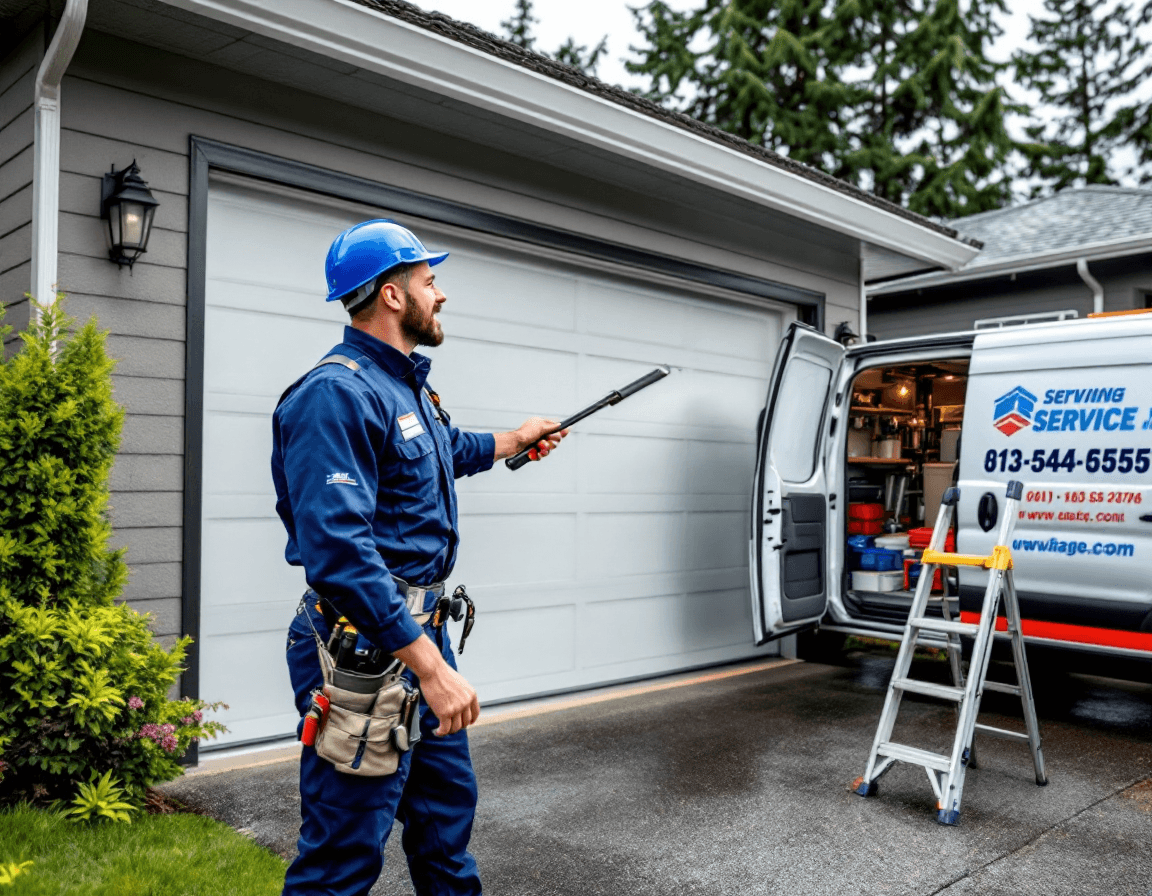
Garage Door Repair in Renton, WA is a common need for homeowners across the city, from the newer subdivisions near The Landing to older streets in the Highlands and Talbot Hill. A door that won't open, closes halfway, or lurches up and down is more than an annoyance, because it can leave your car exposed and your household stuck on the wrong side of the door. Our technicians handle these problems every week, and most residential repairs fall somewhere between $95 and $450 depending on what has failed and which parts are needed. This page explains what tends to go wrong with garage doors in Renton, what you can check safely yourself, and when it is time to call a licensed professional.
Renton sits in the Green River valley at the south end of Lake Washington, and that location shapes how garage doors age. Winters bring long stretches of drizzle and fog, and the humidity rarely drops far enough to let metal parts dry out completely between storms. Over time that moisture works into hinges, rollers, and the steel tracks that guide the door, and it can leave surface rust that slowly binds moving parts. Our service calls cover the full range of residential doors in the area, including attached garages in ZIP codes 98055, 98056, 98057, 98058, and 98059, so we see the effects of this climate on a wide variety of hardware.
Why Renton Garages Take a Beating From Damp Winters
The Pacific Northwest climate is hard on garage doors in a way that is easy to underestimate. A door that operated smoothly through a dry summer can start grinding after a wet November, because cold, damp metal contracts and the lubricant on rollers and hinge pins thins or washes away. Many Renton homes also have garages on sloped lots or in older sections where the concrete slab gets damp from below, and that moisture can migrate into the bottom panel and the weatherstripping. These conditions do not usually cause a sudden failure, but they set up the gradual wear that eventually produces the symptoms homeowners notice.
Wind is another factor, especially on exposed lots and during the windier months when gusts come off the surrounding hills. A large, lightweight door acts like a sail when it is partly open, and the pressure can push the panels out of alignment inside the tracks. We often see doors that were never properly balanced or whose tracks were bent by a bump from a vehicle, and the wind simply reveals the weakness. Keeping the door fully closed during storms and checking that the lock engages cleanly can reduce strain, though it will not fix a structural issue.
Seasonal changes also affect the opener. The motor and logic board are designed to work within a certain range of resistance, and a door that has become stiff from cold or swollen from moisture may draw more current than the opener expects. The result is sometimes a door that stops halfway or reverses without any obvious obstruction. Understanding how local weather feeds into these problems helps explain why a repair that seems minor in July can turn into a more involved job by winter.
Reading the Door's Behavior: What a Misbehaving Door Is Telling You
Every symptom a garage door shows is a clue, and learning to read those clues can save you time and money. A door that stops, reverses, or moves unevenly is usually reporting a change in resistance, alignment, or safety input. Paying attention to when the problem happens, such as only in the morning, only after rain, or only when the door is near the floor, narrows down the likely cause before a technician ever arrives. Keep notes on the pattern if you can, because a precise description helps us bring the right parts on the first visit.
Our technicians commonly hear about the following conditions from Renton homeowners:
- The door opens partway, pauses, and then drops back down without any clear reason
- The door reverses just before it reaches the floor when you try to close it
- The opener runs but the door does not lift, which often points to a disconnected or failed drive connection
- Grinding, squealing, or banging occurs during movement, especially at the top or bottom of travel
- One side of the door lags behind the other, leaving the panels visibly crooked
- The door slams shut faster than it should, sometimes with a jolting stop at the bottom
Each of these can have several causes, so a repair should start with an inspection rather than a guess. Sometimes the fix is a simple adjustment of the travel limits or a cleaning of the track, and other times it involves replacing a worn roller, a damaged hinge, or a failing spring. The more clearly you can describe what you observed, the faster the diagnosis tends to go.
Photo Eyes, Safety Reversals, and the Sensor Problems Nobody Expects
Modern garage door openers are equipped with safety sensors, often called photo eyes, mounted near the bottom of each track. These sensors send an invisible beam across the opening, and if the beam is interrupted while the door is closing, the opener is designed to reverse and go back up. This is an important protection, especially in homes with children or pets, but it is also a frequent source of frustration when the door keeps reversing for no visible reason. In Renton, we often find that the sensors have been knocked out of alignment, have a loose wire, or have collected dust, cobwebs, or road grime that interferes with the beam.
Sunlight can cause problems too. A low western sun in the late afternoon or early evening can shine directly into a sensor and confuse it, making the door reverse even when nothing is blocking it. Some homeowners respond by covering the sensors or bypassing them, and we strongly discourage that practice because it removes a safety feature that exists for good reason. A proper repair realigns the sensors, checks the wiring, and confirms that the lenses are clean and aimed correctly.
Sensor issues can also mimic mechanical problems. A door that reverses a few inches above the floor may look like it has a spring or cable fault, when the actual cause is a dirty lens or a small wiring fault at the bracket. A technician should test the sensors and the opener's force settings before assuming the door hardware is at fault. This distinction matters because sensor repairs are often much less expensive than replacing springs or a motor.
Remote and Keypad Failures: Quick Checks Before You Call
When the remote or wall button does nothing, the cause is often simpler than it appears. Batteries in handheld remotes drain gradually, and a weak signal can look like a dead opener. Wall-mounted keypads can also suffer from corroded contacts or a loose connection at the wall, especially in garages that see temperature swings and humidity. Before scheduling a service visit, it is worth running through a few basic checks, because they take only a few minutes and can sometimes restore function immediately.
Start by replacing the batteries in the remote and testing it from a few different spots, including near the opener and from the driveway. Check that the opener's power light is on and that the outlet supplying it is working, since a tripped breaker or a loose plug can make the whole system appear dead. If the wall button is unresponsive, look for a damaged wire or a button that sticks, and make sure the panel has not been painted over or covered. Clearing any obstruction in the path of the remote's signal, such as a metal shelf or a bundle of stored items, can also help.
If these steps do not solve the problem, the issue may be in the receiver, the antenna wire, or the logic board. Opener electronics are generally inexpensive to replace compared with a full opener, but they should be matched to the correct model. Our technicians can identify the make and model quickly and bring the right components so the repair is completed in one visit.
Uneven Movement and Crooked Panels: Cables, Drums, and Track Alignment
A door that moves unevenly or looks crooked usually points to a problem with the lift system, the tracks, or the balance between the two sides. Most residential doors use steel cables that wind around drums at the top of the door, working with the springs to lift the weight evenly. If a cable frays, slips off its drum, or stretches, one side can rise faster than the other, and the panels will look out of square. Track misalignment can cause a similar effect, since a bent or loose track pulls the rollers out of their proper path.
Visible gaps, sagging sections, and a door that appears to be pulling away from the frame are also signs that something has shifted. In many Renton homes, the lower panel sags slightly over time because of repeated stress and the damp conditions described earlier, and a sagging panel can rub against the track or drag on the floor. Tightening brackets, replacing worn rollers, and re-seating the track are common corrections, and they often restore smooth movement without major expense. Never attempt to adjust cable tension or drum position yourself, because those components are under substantial force.
Because the cable system is under such stress, a technician should inspect it whenever a door is crooked or unbalanced. Our team checks the drums, cables, and springs together, since a problem in one part often affects the others. Catching a frayed cable early can prevent a sudden drop that could damage the door, the opener, or the vehicle parked beneath it.
Springs Are Not a Homeowner Project: Why Licensed Techs Handle the Tension
Torsion springs and extension springs store enough energy to lift a heavy door, and when they are under tension they can cause serious injury if released improperly. Torsion springs mount on a bar above the door opening and are wound with specialized tools, while extension springs run along the horizontal tracks on each side. Both types can break, and a broken spring often causes the door to stop suddenly, feel very heavy, or refuse to open. Because the energy involved is so high, spring replacement and tension adjustment should always be performed by a licensed, insured professional with the right equipment.
We recommend that homeowners never attempt to wind, unwind, or remove a spring, even if they have watched videos or have general mechanical experience. The most common injuries from garage door work happen when a spring is released unexpectedly or when a homeowner is standing in the wrong position during a repair. If you see a gap in the spring, a visibly stretched coil, or a door that suddenly feels impossible to lift by hand, disconnect the opener and keep everyone clear of the door until a technician arrives. Shutting off power to the opener and using the manual release handle are safe first steps, but they do not make spring work safe for a homeowner.
Our technicians are licensed, bonded, and insured, and they treat spring and cable work as the highest-risk part of any repair. We will explain what we found, what it will cost, and how the work will be done before anything is touched. If the spring needs replacing, we will match the correct size and cycle rating for your door, which is important for both safety and longevity.
Doors That Slam Shut or Drop Too Fast
A door that slams closed or drops too quickly is more than noisy. It can damage the bottom seal, crack panels, loosen fasteners, and place stress on the opener and the tracks. In many cases the cause is a weak or disconnected counterbalance, meaning the springs or cables are no longer supplying enough lift to control the door's descent. Another possibility is a problem with the opener's force or speed settings, which may have been changed during a previous adjustment or may have drifted over time.
Worn rollers and damaged track sections can also make a door drop unevenly, because the rollers no longer roll smoothly and the door catches or jolts as it moves. Homeowners sometimes notice a banging sound at the bottom of the travel, which is often the bottom seal or the door itself meeting the floor with more force than designed. Replacing worn components and adjusting the close limit typically resolves the problem, though the underlying counterbalance must be verified first. A door that drops quickly should not be left in service while the cause is unknown.
When we inspect a fast-closing door, we check the springs, cables, rollers, hinges, and opener settings in sequence. This approach prevents a situation where a new part is installed while the real problem remains. It also helps us give you a clear explanation of what caused the issue, so you can watch for the same symptoms in the future.
Stuck Halfway: Jams, Off-Track Panels, and What to Leave Alone
A door that stops partway up or down and refuses to move is one of the most stressful situations a homeowner can face. Often the cause is an obstruction in the track, a bent section, or a panel that has popped out of its channel. In other cases, the opener's safety system has detected something it reads as an obstacle, even if nothing visible is blocking the door. Before doing anything, make sure no one is near the door, no vehicles or bicycles are in the path, and the opener has been disconnected from power if you intend to operate the door manually.
Pulling the emergency release cord and lifting the door by hand may seem like a quick fix, but it can be dangerous if the door is off its tracks or if a spring has failed. A door that has come partly off its track can shift unpredictably when lifted, and a damaged cable can snap. If a panel has clearly left its track, the safest course is to keep the door closed and call for service rather than trying to force it back. Gently removing loose debris from the track with a dry cloth is generally safe, but any bending or hammering on the track should be left to a professional.
Our technicians arrive prepared to secure the door, inspect the track and rollers, and reset the panel safely. We check for any damage that may have occurred during the jam, because a stuck door often indicates a deeper problem that will recur if not corrected. Once the door is operating smoothly, we review the opener's limit settings so the door stops at the right positions without straining the motor.
Neighborhood Notes: Service Across The Landing, Highlands, Fairwood, and Talbot Hill
Renton has a wide mix of home styles, and garage door issues often reflect the age and construction of the neighborhood. Homes near The Landing include a range of newer and mid-age construction, and many have attached garages with smaller turning radii and tighter clearances that can make track and bracket alignment more sensitive. In the Highlands, many homes sit on hillside lots where the driveway slope can put additional stress on the door's lift system and on the opener's travel. Fairwood features a mix of single-family homes that have seen decades of weather exposure, which can mean older hardware that is ready for a full inspection. Talbot Hill's housing varies block by block, and homes there often need careful attention to the door's balance because of the sloped terrain and the wind exposure common to elevated areas.
Our service area includes these neighborhoods and the surrounding parts of Renton across ZIP codes 98055, 98056, 98057, 98058, and 98059. We schedule visits throughout the week and try to give homeowners a clear arrival window so they can plan around work or school. Because weather in this region can change quickly, we also recommend keeping your garage door's manual release accessible and knowing where the opener's power switch is located. Those small preparations make it easier for a technician to diagnose the problem efficiently.
Whatever part of Renton you live in, the core principles of good garage door care are the same: keep moving parts lubricated, keep tracks clear, and never ignore a new noise or movement. A door that has started behaving differently is usually giving early warning, and a short inspection now can prevent a larger repair later.
What a Renton Repair Visit Involves and What It Costs
A typical repair visit begins with a conversation about the symptoms you have observed and a walkthrough of the door, opener, tracks, springs, cables, and sensors. The technician then performs a safety check, tests the balance of the door, and confirms that the opener's force and limit settings are correct. Once the cause is identified, we explain the options, which may include a simple adjustment, a part replacement, or a more involved repair. You are never obligated to approve work you do not understand, and we will walk through the reasoning before proceeding.
Pricing for most residential repairs falls between $95 and $450, depending on the part involved, the complexity of the diagnosis, and whether the job can be completed on the same visit. Simple adjustments and sensor realignments usually sit at the lower end of that range, while spring replacements, cable work, and opener component replacements tend to fall higher. Because every door is different, the final price depends on the specific hardware in your garage and what the inspection reveals. We aim to give a clear estimate before any work begins so there are no surprises.
Some repairs are best handled in stages, especially when a door shows signs of multiple wear points. For example, a worn roller may be accompanied by a frayed cable or a damaged track section, and addressing only the most obvious symptom can leave the door vulnerable. A good technician will point out related issues and help you decide which ones to address now and which can wait. This approach keeps the door safe and reliable over the long term while respecting your budget.
Renton homeowners deal with damp winters, windy stretches, and the everyday wear of busy households, so a garage door that works properly is worth protecting. If your door won't open or close, reverses before reaching the floor, makes grinding or banging noises, moves unevenly, sticks halfway, responds to neither the remote nor the wall button, slams shut, or shows visible gaps or sagging, please do not wait for it to fail completely. Call Seattle Garage Door Fix at (888) 799-3819 to schedule a licensed, insured technician for your Renton home today.