
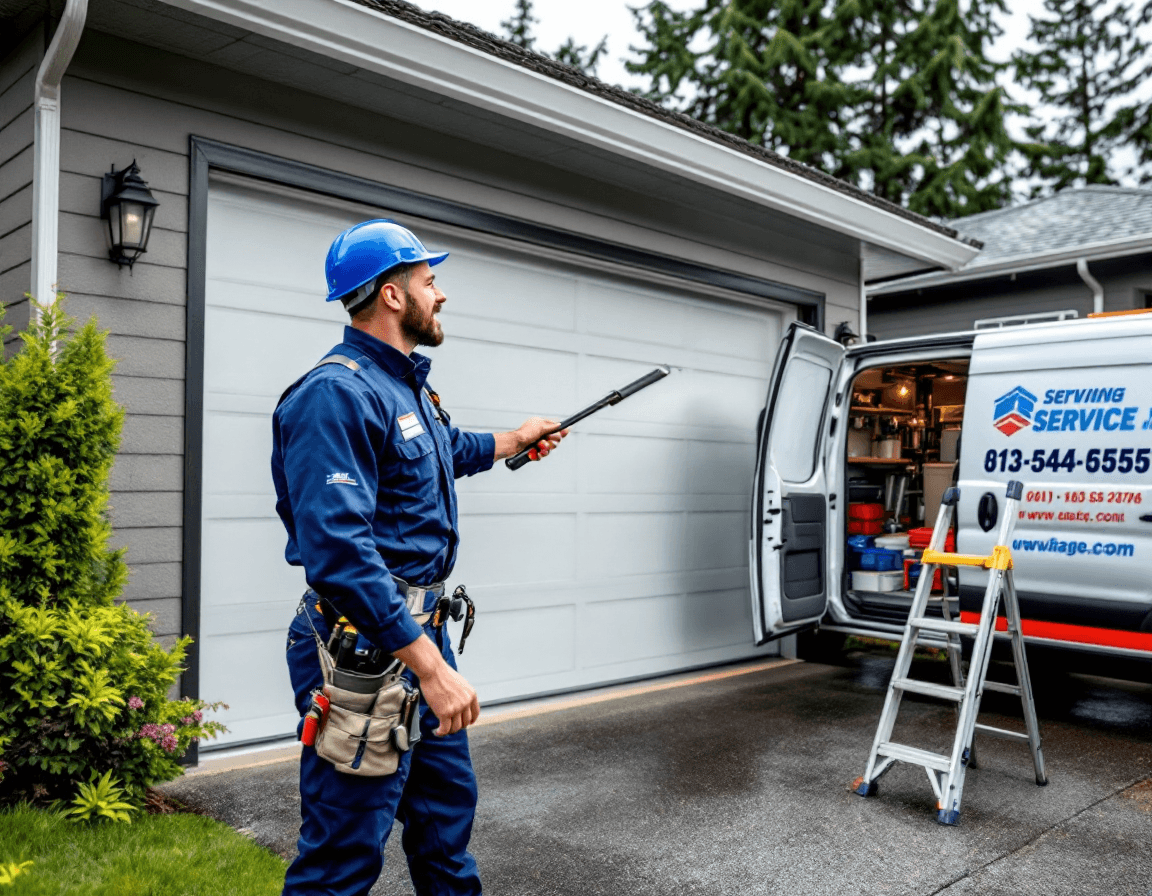
Garage door repair in Newcastle, WA is rarely something homeowners can put off for long, because a door that won't open or close usually blocks the only vehicle route in and out of the house. The city sits on the western slopes of Cougar Mountain in King County, and the combination of hillside lots, mature evergreens, and wet winters means garage doors here work harder than their manufacturers might suggest. The complaints we hear most often are a door that stops halfway, a remote that suddenly goes dead, or a door that bangs at the top of its travel. Most of these problems have clear causes and manageable fixes if they are caught early.
This guide is written for homeowners in the 98056 and 98059 ZIP codes and nearby neighborhoods who want to understand what is happening before a technician arrives. We will walk through the symptoms we see most, explain what typically causes them, and describe what a repair visit usually involves. Most residential repairs in our service area fall between $95 and $450, depending on the part needed and how much labor the job requires. Spring and cable work, however, must be handled by a licensed professional, and we will explain why in the sections below.
Whether your door is an older raised-panel model in a home built decades ago or a newer insulated unit in a recent build, the underlying principles are the same. Balance, alignment, and smooth travel keep a door safe and quiet. When one of those three slips, the door usually tells you through noise, reversal, or uneven movement. The sections that follow give you a practical tour of what to look for and when to pick up the phone.
How Newcastle's Wet Winters Wear Down Garage Doors
Western Washington winters bring long stretches of drizzle, steady humidity, and the occasional hard freeze, and all of that moisture finds its way into garage door hardware. Steel hinges and rollers develop surface rust along their edges, and the rust creates resistance that the opener has to fight every time the door moves. Wood doors, which remain popular on older Newcastle homes, can swell after a few weeks of rain and then shrink again in drier months, which changes how the panels sit within the frame. Even the bottom weatherstrip can stiffen or crack when it is repeatedly exposed to cold and wet cycles.
Hillside properties add another layer of challenge. Soil on sloped lots can shift slightly after heavy rain, and a foundation that settles even a fraction of an inch can throw off the door track's alignment over time. Homes near wooded areas also collect fir needles, leaves, and grit in the track channels, particularly along the lower portion where the door meets the floor. That debris can cause rollers to skip or bind, especially when the door is closing under its own weight.
Because humidity is a constant in this part of King County, we recommend checking your door's hardware at least twice a year rather than waiting for a failure. Look for flaking rust, wobbly brackets, and rollers that have started to flatten or crack. Addressing these early is usually inexpensive, and it often prevents a minor issue from turning into a jammed door on a rainy weekday morning.
When the Door Stops Halfway and Refuses to Budge
A door that stalls partway up or down is one of the most unsettling problems a homeowner can face, and it is often the result of a mechanical bind rather than a dead opener. The most frequent culprits are a track that has shifted out of its proper position, a roller that has seized inside its bearing, or a panel that has pulled loose from its hinge. Sometimes a stiff spring or worn cable adds to the resistance, but the safest assumption is that a stuck door needs to be inspected before anyone attempts to force it. Pushing or pulling a jammed door can bend tracks, strain the opener, and create a sudden release of tension that injures people nearby.
Many openers include a force-sensing system that stops the motor when it detects too much resistance. If the door halts and the motor hums or clicks without moving, the opener is responding to a real obstruction or misalignment. Check first that nothing is blocking the path, such as a bicycle, a storage bin, or a child's toy near the tracks. If the path is clear and the door still refuses to move, disconnect the opener by pulling the emergency release cord and move the door by hand only to confirm it is free. Do not attempt to lift or force a door that feels heavy or unbalanced, because an unbalanced door can drop without warning.
Once the emergency release has been used, the door should be left closed and the opener disengaged until a technician arrives. A licensed repair professional will check the track alignment, roller condition, and spring tension before restoring power to the opener. In many Newcastle cases, the fix turns out to be a realigned track, replaced rollers, and a lubrication service, which keeps the total repair well within our typical pricing range.
Reversing Before the Floor: What the Safety Sensors Are Telling You
If your door starts to close and then reverses before reaching the floor, the safety sensors are doing exactly what they were designed to do. Most residential openers use a pair of photo-eyes mounted near the bottom of the tracks, typically about six inches above the floor, that send an invisible beam across the doorway. When the beam is interrupted, the door stops and reverses. A reversing door can therefore mean something is breaking the beam, but it can also mean the sensors have drifted out of alignment or the wiring has been damaged.
Begin by looking at the two sensor units and confirming that they face each other directly. Check that both indicator lights are steady rather than blinking, because a blinking light is typically the opener's way of reporting an alignment or wiring fault. Wipe the lenses with a soft, dry cloth, since dust, cobwebs, and rain spatter can all interfere with the beam. Pay attention to direct sunlight through a garage window at certain times of day, which can sometimes confuse the receiver. If the sensors look aligned and clean but the door still reverses, the wire running between them may be nicked or pinched, a problem that frequently appears where a garage door has been opened and closed for years.
Here is a short checklist to work through before calling for help:
- Make sure the sensor lenses are clean and free of dust, spider webs, or moisture.
- Confirm both sensors are mounted at the same height and pointed directly at each other.
- Check that the indicator lights are steady and not flashing.
- Look for loose or damaged wiring between the sensors and the opener.
- Clear any object that could be breaking the beam, including low storage or pet items.
If none of those steps resolves the problem, the issue may involve the opener's logic board or the force settings, and a technician should evaluate it. Do not disable the sensors to get the door working, because they protect children and pets from being trapped beneath a closing door.
Grinding, Squealing, and Banging at the Top of the Track
Noise is often the first sign that a garage door is wearing out, and each sound tends to point toward a specific cause. A high-pitched squeal usually comes from dry hinges or rollers that need lubrication. A grinding noise often means worn or metal-on-metal rollers, or debris trapped inside the track. A sharp bang when the door reaches the top of its travel typically indicates that the rollers are slamming into the end of the track or that the door is hitting its stops too hard because the tension is off.
Lubrication helps, but it must be done correctly. Apply a lithium-based or silicone lubricant to the hinges, roller bearings, and the springs' moving parts, and wipe away any excess so dirt does not stick to it. Avoid spraying heavy oil onto the tracks themselves, since it can collect grit and create a sticky film that slows the door down. If the rollers are nylon and have cracked or flattened, lubrication will only mask the problem, and replacing them is the more durable fix. Many Newcastle homeowners find that upgrading to sealed steel or high-quality nylon rollers reduces noise noticeably.
Banging can also signal that the door is out of balance or that the spring system is no longer doing its share of the lifting. A door that drops quickly, shudders, or slams at the top of its path needs inspection, and this is precisely the kind of situation that must be handled by a licensed technician. Spring tension is serious business, and an improperly adjusted or failing spring can release stored energy with real force.
Crooked Movement and a Door That Has Left Its Tracks
A door that moves unevenly, looks crooked, or sits at an angle when closed is usually suffering from one of three problems: a track that is out of level or plumb, a roller that has popped out of the channel, or a cable that has become slack or frayed on one side. The result is often visible as a gap along one edge of the door, a panel that rubs against the frame, or a door that lifts higher on one side than the other. Left alone, these conditions place extra strain on the opener, the remaining rollers, and the lifting hardware, so they should not be ignored.
Doors that have actually left their tracks require immediate attention. Do not attempt to push the door back into the channel by yourself, and do not run the opener while the door is off track, because the panels can bind, bend, or drop. Secure the door, disengage the opener, and call a professional. Repairs of this type often involve straightening or replacing track sections, reseating rollers, and checking the cable drums and lift cables for damage. Those cables and drums operate under significant tension, and the repair is not a do-it-yourself project.
Gaps, sagging panels, and misalignment often develop gradually, which makes them easy to miss. Stand inside the garage with the door closed and look for daylight around the perimeter, particularly at the top corners and along the bottom seal. Check whether the door sits level when closed and whether the panels line up evenly as the door rises. Noticing these changes early can make the difference between a simple track adjustment and a more involved repair.
Remotes, Wall Buttons, and the Silent Opener
When the remote or wall button does nothing, the first step is to determine whether the problem lies with the transmitter, the receiver, or the power supply. A remote that works on one button but not another may simply need a fresh battery, which is an inexpensive fix that many homeowners overlook. A wall button that stops responding while the remote still works can point to a failed switch, a broken wire, or a damaged control panel. If nothing at all responds, the opener itself may not be receiving power.
Start with the simplest checks. Replace the remote battery and confirm it is seated correctly, then try the wall button and the remote from a few different spots in the driveway. Look at the opener's motor unit and confirm that the light is on and the outlet is supplying power. Some openers are plugged into a switched outlet that can be turned off accidentally, so it is worth checking the outlet's wall switch if one is present. Next, inspect the antenna wire hanging from the motor unit, because a loose or damaged antenna can dramatically reduce range.
Certain problems are common enough to mention specifically. Moisture can work its way into wall button wiring during wet months, especially on exterior-facing walls, so inspect the cover plate and look for corrosion. After a power outage or a lightning storm, a remote may need to be reprogrammed, and the opener's learn button is typically located on the motor unit. For a wall control that has stopped responding, a technician can test the circuit and replace the switch or wiring if needed. Keep in mind that opener electronics are sensitive to power surges, so a surge protector is a worthwhile addition for many Newcastle homes that experience occasional outages.
Slamming Shut and Sagging Panels: Hardware That Has Worn Out
A door that slams shut too quickly is telling you that its closing force or its controls need attention. Many openers have adjustable close-speed or force settings, and an incorrect adjustment can make the door drop faster than intended. Worn rollers or hinges can also allow the door to fall unevenly, which creates a sudden thud at the bottom of its travel. In a home with children or pets, a door that slams without warning is more than an annoyance, and it deserves prompt service.
Sagging panels and visible gaps often trace back to worn hinges, loose brackets, or springs that have lost their ability to counterbalance the door. A panel that bows outward or droops at its center may be exhibiting fatigue in the hinge or the panel itself. Gaps at the bottom of the door may come from a deteriorated seal, a worn threshold, or an uneven floor, and gaps on the sides or top can indicate that the track has moved. Taking note of where the gap appears can help a technician diagnose the problem faster during a service visit.
Weatherstripping deserves particular mention in the Pacific Northwest. Rain driven by winter wind can find its way under a worn seal, and that moisture can encourage mildew and rust on the lower panels. Replacing a bottom seal is typically a straightforward repair, and it keeps water, leaves, and cold air out of the garage. Pairing a new seal with a balance and lubrication check often restores the door's smooth operation and extends its service life.
Spring and Cable Work Belongs in Licensed Hands
Garage door springs and lift cables are among the most dangerous components in any home, and this is the one area where we will never recommend a do-it-yourself approach. Torsion springs store enormous amounts of energy, and the tension they carry can cause serious injury if a spring is adjusted, released, or removed incorrectly. Extension springs and lift cables can snap under load and whip through the air with enough force to cause harm. For these reasons, any spring replacement, cable replacement, or tension adjustment should be performed only by a licensed, bonded, and insured professional who has the proper tools and training.
Homeowners sometimes assume a broken spring is a minor issue because the door still opens by hand. In reality, a broken spring usually means the door is far heavier than the opener was designed to lift, and attempting to operate it in that condition can damage the opener and create a dangerous drop. If you see a gap in a torsion spring, a frayed or slack cable, or a door that feels abnormally heavy, leave the door closed, disengage the opener, and schedule service. Keep children and pets clear of the area until the repair is complete.
Licensed technicians handle spring and cable work with specialized equipment and a methodical process. They will verify the door's weight, confirm the correct spring size and cycle rating, and make sure every adjustment is secured before the door returns to service. This approach protects the family, the vehicle, and the door itself, and it is far more reliable than an improvised fix.
What a Newcastle Repair Visit Typically Covers
A typical service call begins with a conversation about what the door is doing, when the problem started, and whether it has changed over time. Those details help the technician narrow down the cause quickly. The technician will then inspect the tracks, rollers, hinges, springs, cables, sensors, opener, and wiring, looking for wear, misalignment, and damage. Many issues can be resolved during the first visit, while others may require ordering a specific part and returning once it arrives.
Pricing for most residential repairs in our service area falls between $95 and $450. The exact cost depends on the part, the labor involved, and whether the repair requires specialized hardware such as a new spring system. Smaller jobs, like sensor realignment, roller replacement, or a remote programming fix, usually land near the lower end of that range. Larger jobs, such as track rebuilds or opener replacements, will typically cost more, and a technician should explain the scope before any work begins.
Before the technician leaves, you should receive a clear explanation of what was repaired, what was tested, and what maintenance is recommended for the future. Ask questions if anything is unclear, and request a note about any parts that may need attention soon. A good service visit leaves the door operating smoothly, the homeowner informed, and the safety features verified.
Keeping Your Door Running Smoothly Between Service Calls
Routine care goes a long way toward preventing the problems described above. In Newcastle's damp climate, a few simple habits can make a noticeable difference. Wipe down the tracks and the bottom seal after heavy storms, clear fallen leaves and fir needles from the threshold, and keep the area around the sensors free of dust and cobwebs. Test the auto-reverse feature periodically by placing a flat object, such as a piece of wood, on the floor in the door's path and confirming the door reverses when it contacts the object.
Schedule a light lubrication of the hinges and rollers at least twice a year, typically before the rainy season begins and again in late spring. Inspect the weatherstrip for cracks or flattening, and replace it when it no longer makes firm contact with the floor. Keep an eye on the remote batteries and replace them before they fail, since a dead battery at the wrong moment can leave you stuck outside in the rain. A quick visual check of the springs, cables, and track alignment every few months can help you spot changes early, though any actual adjustment should be left to a licensed technician.
If your door begins making new sounds, moving unevenly, or reversing unexpectedly, do not wait for the problem to become severe. Early attention almost always costs less and keeps the door safer for everyone who uses the garage. Newcastle's seasons are predictable, and a well-maintained door will handle them with far fewer surprises.
Need help with a stuck, noisy, or misbehaving garage door in Newcastle or the surrounding 98056 and 98059 areas? Call Seattle Garage Door Fix today at (888) 799-3819. Our licensed, bonded, and insured technicians will diagnose the problem, explain your options clearly, and get your door moving safely again.