
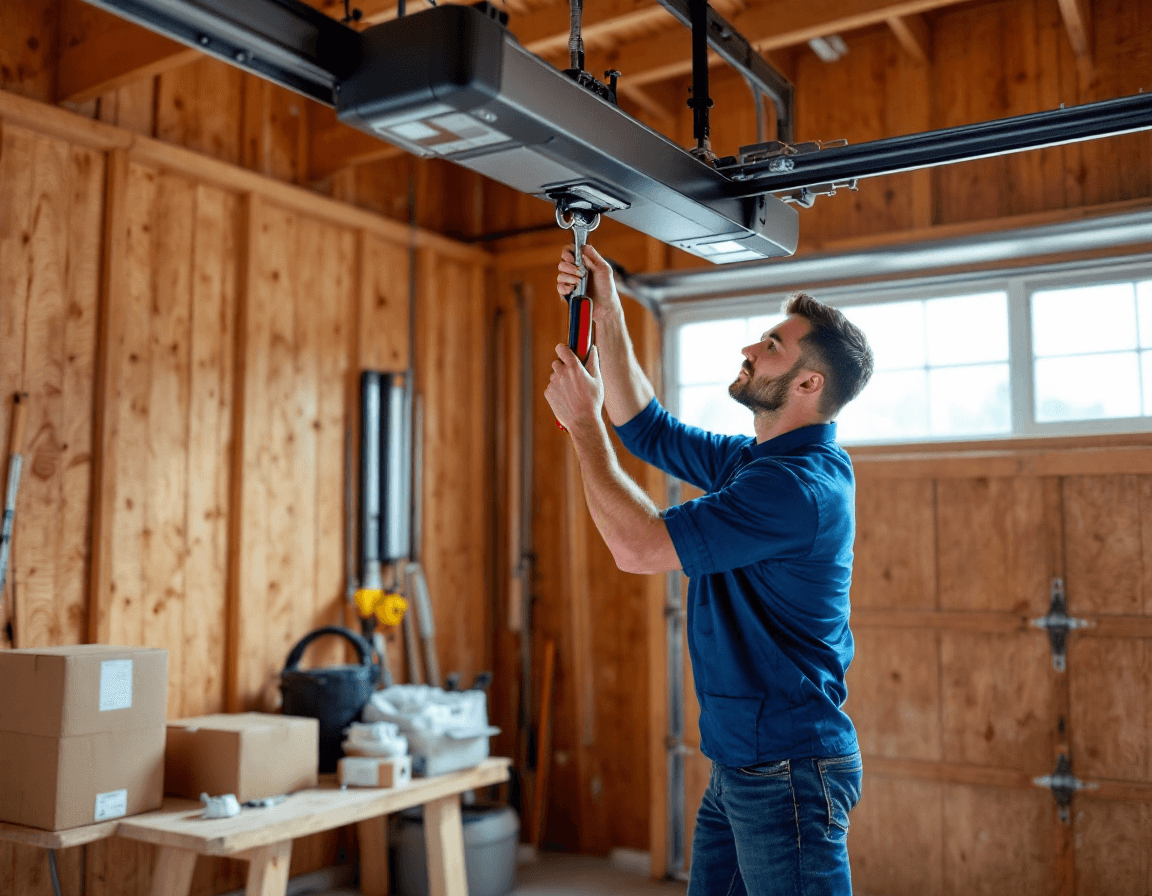
Garage Door Opener Installation & Replacement in Newcastle, WA is one of the most practical upgrades a homeowner on the Eastside can make, and it often delivers more daily benefit than people expect. The opener is the motor that moves a heavy door thousands of times over its life, so when it starts to lag, grind, or stop responding, the whole household feels it. Newcastle sits on the hillside terrain between Lake Washington and the Cougar Mountain foothills, and many homes here have garages that were built with the original opener of a previous decade still doing the work.
This page explains how our technicians evaluate an aging opener, how we compare belt-drive, chain-drive, and wall-mount models, and what changes when you move to a unit with modern rolling-code security and smart controls. We also cover battery backup, realistic installed pricing in the $275 to $650 range, and the points where a homeowner should stop and call a licensed professional. Our goal is to help you make a clear decision rather than pushing a particular model.
If you are reading this because the door took a long time to close last Tuesday or your remote stopped working during a rainstorm, you are in the right place. Call (888) 799-3819 and we can talk through your symptoms before anyone commits to a replacement.
Why Newcastle Garages Put Openers Under Unusual Strain
Newcastle's housing stock includes a mix of older split-levels, mid-century ramblers, and newer homes on sloped lots where the garage sits close to the street and the driveway pitches noticeably. Those conditions matter for an opener. A garage on a grade often means the door is working against a longer, steeper approach, and the motor may run hotter during the morning commute when several cars come and go in quick succession. Over years, that repeated load wears gear reduction components and drives the force settings further from where the manufacturer intended.
The Pacific Northwest climate adds its own pressure. Winters bring long stretches of damp air, cold mornings, and the occasional hard freeze that stiffens lubricant and makes the door track less forgiving. Summer is gentler, but the swings from wet spring to dry August can warp weatherstripping and shift how the door meets the floor. An opener that worked fine in a dry garage may start reversing unexpectedly after a wet week because the door is binding slightly against the seal.
Newcastle also has a strong tradition of tree-lined lots and wooded edges, close to areas like China Creek and the open greens around the Newcastle Golf Club. Homes in those pockets often collect leaf debris, fine dust, and moisture in the garage that finds its way into opener housings and sensor wiring. None of this means every local opener fails early, but it does mean that a unit with an unsealed control board or corroded safety sensor connection tends to surprise its owner sooner than a comparable unit on a flat, sunny street would.
Reading the Signs That Your Opener Is Failing
Most people do not replace an opener because it died in one dramatic moment. Instead, they notice a pattern of small irritations that quietly add up. The door may stop halfway, the motor may hum without lifting the panels, or the light may flicker on and off at unexpected times. Our technicians often hear that the problem started as a single odd behavior that the owner learned to work around, such as pressing the button twice or walking up to the door to nudge it.
Recognizing these early signals helps you decide whether a repair is likely to hold or whether the unit is nearing the end of its useful life. A loud, rattling, or grinding opener usually points to worn drive parts, loose hardware, or a motor that is compensating for an unbalanced door. A slow, labored opening may indicate tired motor components or a door that has become harder to lift as springs and rollers age. Intermittent behavior, where the opener works one day and refuses the next, often suggests a control board, a failing wall button, or a radio receiver that is picking up interference.
- The motor runs but the door barely moves, or moves only after several attempts
- The door reverses for no clear reason, especially in damp weather
- The remote works only when standing close to the garage or inside the car
- The light or lock modules flicker, go dark, or stop responding entirely
- The opener is noticeably louder than it was even a year ago
- The unit has no battery backup, so a power outage leaves the family stuck inside or outside
Any of these symptoms deserves attention, but several together usually mean the opener has crossed from repairable to replaceable. We are happy to diagnose the issue on site, and if the cost of parts approaches the cost of a new installed unit, we will say so plainly.
Choosing Between Belt-Drive, Chain-Drive, and Wall-Mount Designs
The three main opener styles behave differently, and the right one depends on how your garage is laid out and how you use it. A chain-drive opener uses a metal chain running along a rail. It is typically the most affordable and is durable, but it operates with more audible noise because metal chain links engage the sprocket with a rhythmic clatter. Chain-drive units are a sensible choice for detached garages, workshops, or any space where the family is not sleeping directly above or beside the door.
Belt-drive openers use a reinforced rubber belt in place of the chain. The result is noticeably quieter, smoother operation, which makes it the common recommendation for attached garages in Newcastle where a bedroom or family room sits over the bay. The belt does not stretch as much as people fear when it is properly tensioned, and it is less prone to the metal-on-metal vibration that transmits through framing. Belt-drive units usually cost somewhat more than chain-drive, though the gap is often smaller than homeowners assume.
Wall-mount openers attach to the side wall rather than to the ceiling. They are the best answer when the ceiling is low, when the garage has a finished space overhead that you do not want to disturb, or when the existing rail geometry would require awkward bracketing. Wall-mount designs keep the motor out of the way and can improve headroom, though they require a solid, properly framed wall, and we verify that before drilling anything. In older homes with plaster or thin sheathing, we often add reinforcement so the bracket does not work loose over time.
Rolling-Code Security and What Older Openers Leave Exposed
Many openers installed before the late 1990s used fixed-code remotes, meaning the signal from the handheld transmitter was the same every time. A determined person with simple scanning equipment could capture that code and reuse it to open the door. Modern rolling-code systems change the transmitted signal with every press, so a captured code is useless for the next attempt. For a homeowner who wants a basic layer of protection, this is one of the most meaningful reasons to upgrade an older unit.
Rolling-code security also improves day-to-day reliability in a subtle way. Newer receivers are designed to reject interference more effectively than older ones, which matters in a neighborhood where many households run Wi-Fi routers, garage keypads, and other wireless devices close together. Upgrading the opener and remote as a set typically means the system is tuned to work with its own components, rather than a mix of old and new parts that may not communicate reliably.
Security is not only about the remote. A complete installation should also include a properly adjusted safety reversal system, with photo-eye sensors aligned and wired correctly, and a manual release that operates smoothly. We check both during every replacement. Keypads should be mounted in a location where they are not exposed to the weather, and any exterior wiring should be protected from moisture and rodents, which are a real concern in wooded parts of King County.
Smart Controls, myQ, and Wi-Fi Setup Done Right
Smart garage openers allow you to see the door status from a phone, receive alerts when it opens or closes, and grant access to a family member or service visitor without handing over a physical remote. Many current models support myQ-style apps and connect through a home Wi-Fi network. For households where someone regularly forgets whether the door was closed, or where a teenager returns home at unpredictable hours, the convenience is real and often worth the modest premium.
Setting up a smart opener works best when the installation technician also checks the Wi-Fi signal at the garage location. A bridge or hub may be needed if the router is on the far side of the house, and some older homes with thick framing or stucco walls can weaken the connection. We test the signal before leaving the job so the app will stay connected after the first rainy week, when a marginal link is most likely to drop.
Smart features should never override the safety basics. Make sure any app access is protected with a strong account password and two-factor authentication where the platform supports it. Limit shared access to people who truly need it, and review the list of authorized users if your household changes. If you move or sell the home, remove previous owners from the account and reset the connection so the new occupants start with a clean system.
Battery Backup and Staying Mobile During Outages
Power outages on the Eastside are not common enough to ignore, and they often arrive with winter storms that bring wind, saturated soil, and falling branches. When the power goes out, a standard opener becomes a heavy door you can only lift manually, which is difficult with an unbalanced or stiff door and can be risky for anyone who is not careful. A battery backup unit keeps the opener functional for a limited number of cycles, allowing you to open or close the door during the outage without needing to force it.
Battery backup is available as an add-on or as a feature of many new openers. The exact number of cycles depends on the battery, the age of the door, and how the motor is loaded, so we will explain realistic expectations for your specific model rather than quoting a fixed number. The battery also serves as a convenient safety reserve during a temporary failure, though it is not a substitute for regular maintenance or for a working manual release.
Keep the manual release accessible and test it once or twice a year. Make sure everyone in the household knows where the release cord is and how to use it safely, and that the door should be closed and fully disengaged only when the garage is clear of vehicles and people. If the door is heavy or the springs appear to be the problem, call a licensed professional rather than attempting to adjust tension yourself.
Pricing From $275 to $650 and What Shapes the Quote
Our installed pricing for opener replacement generally falls between $275 and $650, depending on the model selected and the conditions of your garage. The lower end typically covers a straightforward chain-drive or entry-level belt-drive unit replacing an existing opener in a similar location. Higher quotes reflect features such as wall-mount hardware, smart connectivity, battery backup, or added reinforcement for an older wall or ceiling that needs bracing before the new unit goes in.
Several other factors influence the final number. The condition of the door hardware matters, because a worn track or bent bracket may need correction before the new opener can run smoothly. Wiring upgrades, such as a new wall control or a relocated outlet, add time and materials. Access can matter as well, particularly in tight garages filled with stored items or in homes where the opener must be installed on a high ceiling. We give you a written estimate before work begins so there are no surprises on the day we arrive.
Our pricing is meant to be transparent. We are happy to explain the difference between two models so you understand what you are paying for, and we will not recommend a premium unit if a more modest option will serve your household well. If a repair on your existing opener is actually the better value, we will tell you that as well.
What Happens on Installation Day in Your Garage
A typical replacement begins with a careful inspection of the door, tracks, springs, and existing opener. Our technician checks that the door is balanced and moves freely by hand, since an opener cannot compensate for a door that is binding or heavily out of balance. We also confirm the header and ceiling structure can support the new unit and that mounting points are solid. If anything looks questionable, we explain what we found and what it would take to correct it.
Once the site is ready, the old opener is removed, and the new unit is mounted according to the manufacturer's specifications. The rail is assembled and tensioned, the door arm is connected, and the limit settings are programmed so the door stops at the correct open and closed positions. We then install and align the photo-eye sensors near the floor, connect the wall control, and program the remotes or smart features you selected. Each safety reversal function is tested with an object placed in the door path before we consider the job complete.
Before we leave, we walk through the operation with you. We show you how to use the manual release, how to replace remote batteries, and how to recognize early signs of trouble. We also give you a clear explanation of any maintenance you should schedule, such as periodic lubrication of rollers and hinges. Our goal is for you to feel confident with the system, not dependent on a technician to explain every button.
Moisture, Debris, and Winter Damp in Newcastle Garages
Because Newcastle receives substantial rainfall, many garages carry more humidity than homeowners realize. That moisture can settle on metal components, corrode electrical contacts, and gradually reduce the reliability of a safety sensor or wall control. When we install a new opener, we pay attention to where the control wiring runs and whether the sensor brackets are protected from splash and drip, particularly on garages with an exterior-facing entry or a driveway that slopes toward the door.
Debris is the other ongoing concern. Leaves, fine tree dust, and sawdust from a nearby workshop can accumulate inside the opener housing and along the rail. A quick seasonal check with a dry cloth and a light touch of the manufacturer-recommended lubricant can prevent a surprising amount of wear. Avoid spraying heavy oil into the motor housing or onto the belt or chain, because that can attract grit and create new problems.
Winter brings its own routine. In cold snaps, the door may move more slowly as lubricants thicken and weatherstripping stiffens. This is normal to a degree, but a door that suddenly struggles or reverses should be checked. Our technicians can adjust the force settings for seasonal conditions where appropriate, though significant changes in tension or balance should always be handled by a professional.
Deciding Between Replacement and Repair
The decision to replace an opener rather than repair it usually comes down to three questions. First, how old is the unit, and is it still supported with available parts? Second, what does the repair cost compared with the installed price of a new model? Third, does the existing opener lack features you now need, such as rolling-code security, smart control, or battery backup? When two or three of those answers point toward replacement, the economics usually favor a new unit.
Repair can still be the right call in some situations. A failed wall button, a worn remote, or a damaged safety sensor is often inexpensive to fix on a fairly recent opener that otherwise runs well. The same is true when the motor is healthy but the control board has a single failed component, provided the part is available and the rest of the system is in good condition. We will give you an honest comparison, and if the repair is the better path, we will say so.
Be cautious about repeated repairs on an aging unit. Each service call adds up, and an opener that needs frequent attention is often signaling broader wear in the motor, gears, or electronics. Replacing it on your schedule, rather than during a cold, rainy morning when the family needs to leave for work, usually produces a better result and less stress.
Safety Boundaries: What Should Stay With a Licensed Professional
Garage door openers are powerful machines, and the doors they move are heavy and under significant spring tension. Homeowners can safely perform some simple tasks, such as replacing remote batteries, cleaning sensor lenses, testing the manual release, and wiping down the rail. Those actions reduce the need for a service call and help you notice problems early.
Other work should always be handled by a licensed, bonded, and insured professional. That includes any adjustment, removal, or replacement of torsion or extension springs, cable work, drum or bearing repair, and any task that requires disconnecting heavy door panels or working from an unstable ladder under a loaded door. Spring tension can release with enough force to cause serious injury, and cable failures can drop a door without warning. These are not areas where good intentions substitute for training and proper tools.
Opener installation itself is a professional job for good reasons. Correct mounting, precise limit setting, sensor alignment, and safety reversal testing all affect whether the door operates safely for every person who uses it. If you are unsure whether a task falls within safe DIY territory, stop and call us at (888) 799-3819. We would much rather answer a question before you start than help you clean up after an accident.
If you are ready to modernize your garage, whether you need a quieter belt-drive unit, rolling-code security, smart Wi-Fi control, or battery backup for the next power outage, our Newcastle team can help. Call (888) 799-3819 to schedule an inspection and receive a written estimate in the $275 to $650 installed range, with the model options explained clearly before any work begins.