
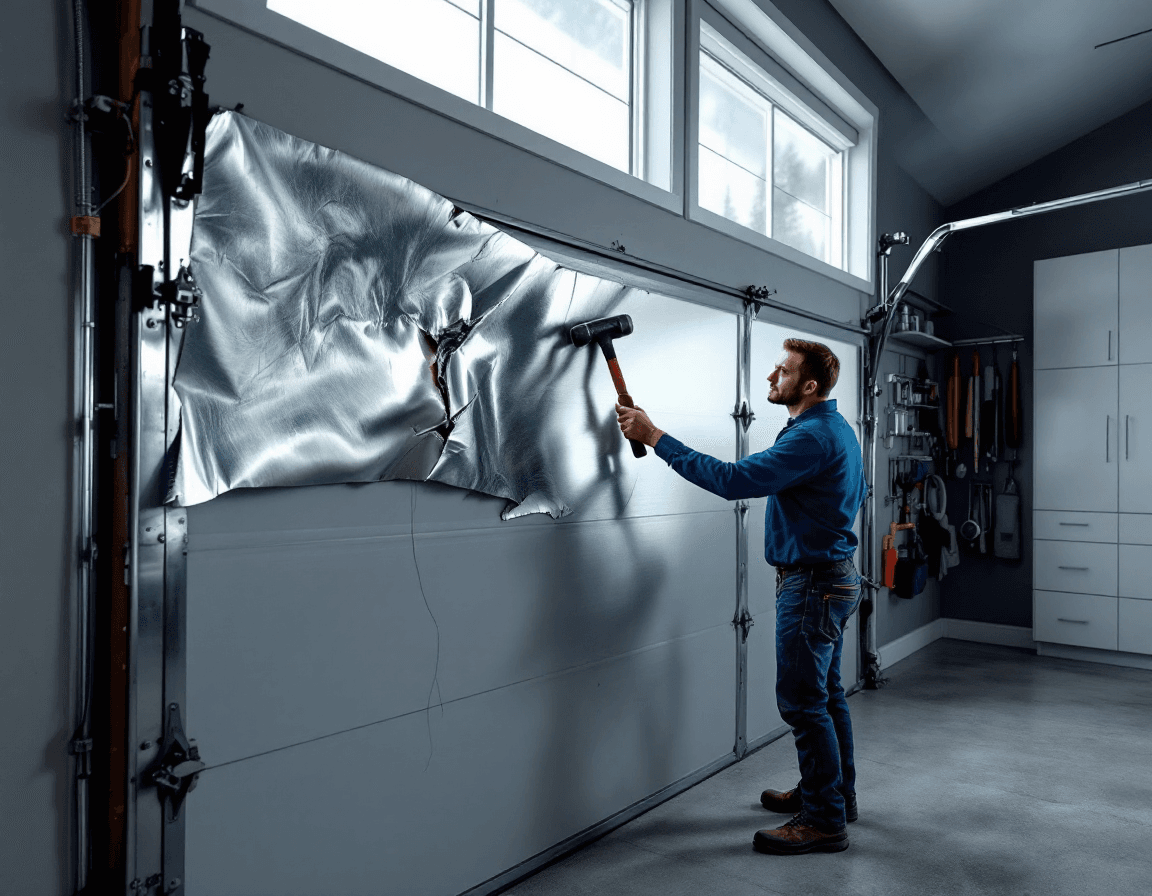
Garage door panel replacement in Newcastle, WA is one of the most common jobs we see on Newcastle driveways, and it is often less urgent than homeowners fear. A single dented or cracked section can make an otherwise working door look tired, and it can also let moisture, drafts, and pests into the garage. Replacing the damaged section, rather than the whole door, is frequently the most sensible fix when the rest of the door is sound.
Newcastle sits on the hillside edge of the Eastside, with neighborhoods that wind around Cougar Mountain and lots that often slope toward the street. Many garages here face steep or narrow driveways, and it is easy to clip a corner when backing out in the dark or on a rainy morning. Pair that with the wet, mild winters typical of King County and the damp shade under mature evergreens, and panels tend to show their wear in predictable places. This guide walks through what damage looks like, when a single panel is the right call, what the work involves, and where the limits of a DIY attempt lie.
If you are reading this because a panel is visibly bent, cracked, or streaked with rust, you are in the right place. We have organized the page around the questions homeowners in Newcastle and nearby ZIP codes 98056 and 98059 typically ask us, from spotting hidden damage to choosing a matching replacement. Pricing is given as a general range so you can plan, and every job begins with an on-site look before anyone commits to a repair.
How the Pacific Northwest Weather Wears Down Garage Panels
Panels in our region rarely fail from a single event. Steel and aluminum sections spend months in cool, damp air, and the constant moisture works its way into scratches, chips in the paint, and the seams where panels join. Even on a door that looks spotless from the street, the inside face of a panel can hold condensation for days after a foggy stretch. Over several winters, that trapped moisture is what turns a small chip into a spreading patch of corrosion.
Shade is another factor that homeowners in Newcastle often underestimate. Many properties here have tall conifers and broadleaf trees that keep driveways cool and damp, which slows drying and encourages moss and algae on the lower part of the door. Those growths hold water against the panel surface and can accelerate rust along the bottom edge. A door that receives direct afternoon sun may fade unevenly, while a shaded door may look fine on top and quietly deteriorate underneath.
Temperature swings, while modest by Midwest standards, still matter. Panels expand slightly during warmer afternoons and contract overnight, and over years that movement can open small gaps around the edges of a panel or loosen the fasteners that hold it in the track assembly. None of this makes a door unsafe on its own, but it does mean that a panel that looked solid last year may start to flex or rattle now. Noticing those changes early makes replacement simpler and less expensive.
Reading the Damage: What Dents, Cracks, and Rust Really Mean
Not every mark on a garage door needs a new panel, and not every small dent is harmless. The first step is determining what kind of damage you are dealing with. A shallow dent with intact paint and no sharp creases may be purely cosmetic, while a dent that has cracked the finish or folded the metal along a crease usually needs attention. Cracks in the insulated layer of a steel panel can also let moisture in, which is why we always look inside the panel as well as at the exterior face.
Rust deserves a closer look than most people give it. Surface oxidation on the outer skin can often be cleaned and treated, but rust that has pushed through from the inside, softened the edges, or formed a bubbling blister usually means the section has lost structural integrity. Aluminum panels behave differently, typically showing oxidation as chalky white residue rather than the red-brown flaking of steel, so the appearance of the damage tells a technician a lot about what material they are working with.
Here are the signs we recommend Newcastle homeowners check before calling for service:
- A dent that has creased the metal, broken the paint, or left a sharp fold line
- Hairline cracks running through a panel or along a seam, especially near the hinges
- Red-brown rust bleeding through paint, or rust on the inside face of the panel
- Soft or spongy spots when you press gently on the lower section
- Gaps that have opened between adjacent panels, letting light or drafts through when the door is closed
- Sections that have separated from their hinges or rail brackets after an impact
If you see any of these, it is worth having a technician assess whether a single section can be swapped or whether the damage extends into the surrounding structure. Taking a few clear photos from several angles also helps, because it gives the service team a starting point before they arrive.
Bottom Sections and the Water Line Problem
The bottom panel takes more abuse than any other part of the door. It sits closest to the driveway, catches splashed water and road grit, and is the section most likely to be struck by a bumper, a bike, or a wheelbarrow. In a region where driveways stay damp for much of the year, the lowest panel also soaks up moisture from the concrete, which is why bottom sections are such common replacement candidates.
Water damage at the bottom often shows up as a band of discoloration or blistered paint that runs along the lower edge. Sometimes the bottom rubber seal has torn or compressed unevenly, allowing water to pool against the panel and seep upward. Fixing the seal alone may stop future damage, but if the panel has already swelled, cracked, or lost its shape, replacing that section is the only way to restore a tight, weather-resistant fit.
Bottom sections also tend to be the easiest to match and swap, since they are often the same profile as the panels above. That said, a bottom panel on some models is slightly different in thickness or hardware placement, so the replacement should be confirmed against the door's model and original specifications before the order is placed. Taking a photo of the manufacturer label, which is often on the back of a panel or inside the top section, can save a return trip.
Backing Accidents on Tight Newcastle Driveways
A single panel damaged by a backing accident is one of the most straightforward repairs we handle, but it also deserves careful attention. Many Newcastle driveways are narrow, sloped, or bordered by landscaping, and a quick reverse with a trash bin or a bicycle nearby can leave a neat dent in one section. Because the impact is localized, the rest of the door often remains perfectly functional, which makes a targeted panel replacement a practical choice.
After an impact, check the adjacent hardware before assuming the panel is the only problem. A hard hit can bend a track section, loosen a roller, or stress a hinge that connects the damaged panel to its neighbors. We recommend a visual inspection of the tracks and rollers and a check that the door still moves evenly and closes flush. If the panel has pulled away from its hinge or the door binds on one side, the service should include those components rather than just the panel itself.
Insurance and documentation are worth mentioning here. If the damage came from an accident involving a vehicle, keep photos of the dent, the surrounding area, and the vehicle or object involved. Those records can help with any claim you choose to file. Whatever you decide, avoid driving the door through repeated open-and-close cycles until it has been inspected, because a bent section can jam or drop unexpectedly.
Matching a Panel That Has Faded or Changed Over Time
Matching a replacement panel is often the trickiest part of the job, especially on doors that are several years old. Garage door finishes fade under UV exposure, and a section that has spent a decade facing the street may look noticeably different from one that has been shaded by a cedar. Even when the color code is the same, weathering can make a brand-new panel look like an odd piece in the middle of the door.
There are a few practical ways to approach this. Some homeowners accept a slight difference and rely on the door's overall look to hide it, while others choose to refinish the surrounding panels so the whole door reads as one. A third option is to replace the entire door when the model has been discontinued or the color has changed substantially. We will always talk through these options with you on-site and show you what each would look like, rather than pushing one approach.
To improve your chances of a good match, collect the model number, serial plate information, and any original paint code you can find. Bring a clear photo of the full door in daylight, along with a close-up of the damaged section. If the door has a decorative window, a textured finish, or a woodgrain pattern, mention that too, because those details affect how a replacement panel will blend in. Keep in mind that a panel from the same model year may still differ slightly if the door was manufactured in batches.
Repair or Replace: A Practical Decision Framework
Deciding between repairing a panel and replacing it depends on how far the damage reaches and how the section fits into the door's structure. A surface scratch or a shallow dent that has not compromised the paint or the internal insulation can often be left alone or treated cosmetically. Once cracks run through the metal or the panel is no longer flat, replacement usually makes more sense than trying to patch it.
Cost and longevity both matter. Replacing one section is generally far less expensive than replacing an entire door, which is why it is so often the preferred option when the rest of the door is sound. However, if the surrounding panels are also rusted, the springs are worn, or the door is an older model with limited parts availability, spending heavily on a single section may not be the best use of money. In those cases we will compare the cost of panel replacement against a broader upgrade.
Use the following checklist to think through the decision before your appointment:
- Replace the panel if the metal is cracked, creased, or perforated by rust
- Replace the panel if it no longer sits flush with its neighbors or leaks air and water
- Consider a cosmetic repair if the damage is limited to scuffs or a shallow dent with intact paint
- Consider a full door replacement if matching is impossible, the model is obsolete, or several sections are failing at once
- Have the springs and cables inspected by a licensed professional whenever the door is being serviced, regardless of which option you choose
What a Typical Panel Replacement Involves
A panel swap is a methodical job that begins with securing the door and taking the weight off the mechanism. A licensed technician will first confirm the door is safe to work on, check the spring tension status, and make sure the door will not move unexpectedly during the work. From there, they remove the fasteners and hinges connecting the damaged section to its neighbors, slide or lift the panel free, and fit the replacement into the same track position.
Once the new section is in place, the technician reconnects the hinges, tightens the hardware to the manufacturer's specifications, and checks that the door travels evenly in its tracks. They will test the balance, look for any binding, and confirm that the bottom seal meets the new section. If the bottom panel was replaced, the weatherstripping and threshold alignment are checked as well, since a slight mismatch can leave a visible gap.
Most panel jobs are completed in a single visit once the replacement section is on hand. Timing can vary depending on the door design and whether the panel must be ordered, so ask your technician for an estimate of the lead time before scheduling. We recommend clearing the area around the garage, moving vehicles, and removing any stored items from the bottom of the door so the team has room to work safely.
What Panel Replacement Costs in Newcastle
For most homeowners, panel replacement in Newcastle falls in the range of $250 to $800 per section, depending on the door. That figure reflects the variation in panel size, material, insulation, and finish, as well as the complexity of the hardware involved. A standard steel section on a common residential door will usually cost less than a custom-profile or insulated panel with decorative glass, while an aluminum section may fall elsewhere in the range depending on design.
Several factors push the cost within that range. Panels that must be specially ordered to match an older finish, or that require additional hardware or track adjustments, tend to be at the higher end. Conversely, a bottom section on a widely produced model with an available replacement is often more affordable. Repairing a section that is only dented, with no cracks or rust, may also cost less than full replacement, though the specific repair will always be confirmed after an inspection.
Because every door is different, the best way to get an accurate number is a site visit. A technician can measure the section, check the model, inspect the surrounding hardware, and give you a clear quote before any work begins. We believe in transparent pricing and will explain what is included, so you know what to expect before the first panel is removed.
When the Door Still Works but a Panel Is Damaged
One of the more frustrating situations for homeowners is a garage door that opens and closes perfectly while a panel looks clearly damaged. The door's mechanics may be in good shape, which can lead people to assume the problem is purely cosmetic. In reality, a damaged panel can still affect the door in subtle ways, such as allowing drafts, letting water in, or placing uneven stress on hinges and rollers over time.
If the door is working well, you have some flexibility in scheduling. You do not need to rush, but you should avoid leaving a cracked or separated section unattended for long periods, especially during the wet months when water and cold can worsen the damage. Keep the door closed and avoid using it in high winds if a section has come loose, and arrange an inspection soon so the panel can be addressed before it causes additional problems.
It is also worth checking whether the damage has spread to nearby components. A dented panel may have pressed into a roller or pinched a weatherseal, and those issues can quietly worsen. A thorough inspection will look at the entire door, not just the damaged section, so the replacement is done right the first time and the rest of the door continues to operate smoothly.
Safety Limits: Why Springs and Cables Belong to Licensed Professionals
Panel replacement sits comfortably within what many homeowners can understand, but it is not a free-for-all. Garage doors are heavy, and the springs and cables that counterbalance them store a great deal of energy. Attempting to remove or adjust spring tension, or loosening cable components, can cause serious injury even when the door appears to be simple to handle. This is why we always recommend a licensed professional for any spring or cable work, and why our technicians treat those components with extra caution during panel jobs.
Even when only a panel is being swapped, the door's balance can shift when sections are removed or hardware is loosened. A competent technician will support the door properly, check the balance after the replacement, and make adjustments only within the scope of their training and the manufacturer's specifications. Homeowners should never attempt to manipulate torsion springs, lift cables, or drum assemblies themselves, and should keep children and pets well clear of the door during any service.
If you are unsure whether a task is safe to attempt, the right answer is to call a professional. We are licensed, bonded, and insured, and we would rather help you plan a safe repair than see someone get hurt trying to save a few dollars. A short phone call can clarify what is involved and whether an on-site visit is the best next step.
Serving Newcastle and Nearby Neighborhoods
Our technicians regularly work in Newcastle and the surrounding communities, including homes in ZIP codes 98056 and 98059. Many of the properties we visit are on sloped lots, near wooded greenbelts, or within a short drive of local landmarks such as the Newcastle Golf Club and the natural areas along China Creek. Those settings bring familiar challenges, from moisture-driven corrosion to driveway traffic, and our team is accustomed to working with the specific conditions that Eastside homes face.
We aim to keep scheduling simple and to explain each step clearly. When you contact us, we will ask a few questions about the door, the damage, and your access, then arrange a visit that fits your day. If a panel is needed, we will confirm availability and timing before the appointment so you are not left waiting without information. Our goal is a clean repair, a clear estimate, and a door that looks and works the way it should.
If you have a dented, cracked, rusted, or water-damaged panel in Newcastle, the next step is a conversation. Call (888) 799-3819 to describe what you are seeing, share a few photos if you have them, and schedule an inspection. A licensed technician can confirm whether a single section will restore your door or whether a broader solution makes more sense, and you will leave with a clear plan rather than guesswork.