
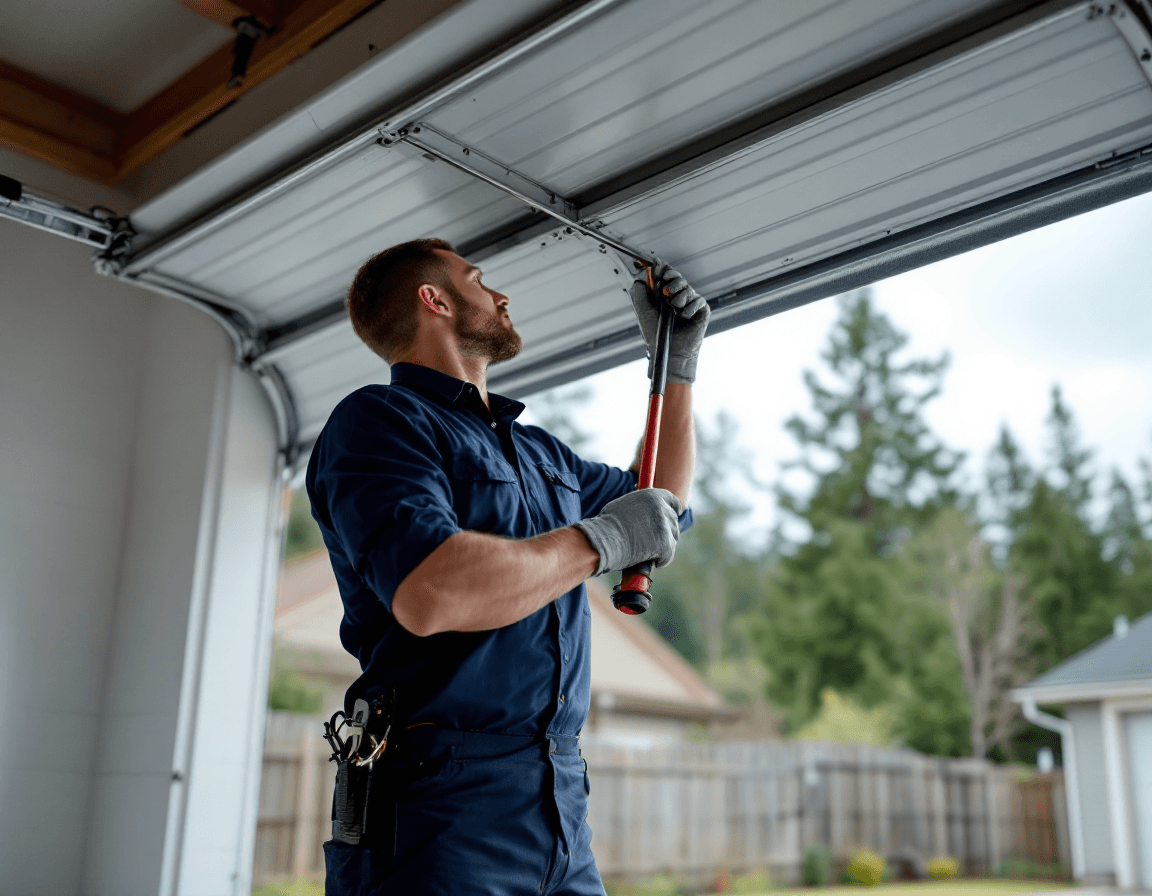
Garage Door Spring Replacement in Renton, WA is a repair that many homeowners put off until the day the door refuses to budge. Renton sits along the Cedar River and the south end of Lake Washington, where wet winters and humid springs work steadily against metal components. Because the springs carry most of a garage door's weight, a single failed spring can turn an ordinary morning into a stuck car and a door that hangs halfway open.
This page explains how spring failures happen, what the warning signs look like, and what a proper replacement should include. We work across Renton and the surrounding King County communities, and the same patterns show up again and again, whether the home sits on a flat lot near the commercial corridor or on a hillside driveway. Our goal here is to help you understand the repair well enough to ask good questions, recognize a sound quote, and know when a situation has moved beyond a do-it-yourself project.
Spring work carries real risk, and that is the reason we always recommend a licensed, bonded, and insured technician for any replacement. The tension in a torsion or extension spring is significant, and a spring that releases unexpectedly can cause serious injury. If you take one thing from this page, let it be this: the spring is not a part to improvise with. The sections below walk through the details so you can make an informed decision.
Why Renton Garage Doors Tend to Lose Their Springs Sooner
Renton's climate is mild by many national standards, but it is persistently damp, and that dampness is hard on steel. Rain and fog settle into garage door hardware through the long gray months, and the galvanized coating on a spring can thin over time, especially where water collects in the winter. Once surface rust forms on the coil, it creates tiny stress points that weaken the wire from the inside out. Many of the springs we inspect in Renton show this pattern, even when the door itself looks clean and well maintained.
Temperature swings add another layer of wear. A cold snap that drops the garage to near freezing followed by a warm afternoon forces the metal to contract and expand, and the spring's steel responds to that repeated movement. Doors in unheated garages feel this more than doors in attached garages that share a wall with a warmer house, although both are affected. The combination of moisture and temperature change is why a spring that has been quietly fine for years can suddenly fail during a November cold spell.
Usage matters as well. A household with two commuters, teenagers coming and going, and a garage that doubles as the main entrance will cycle the door many more times than a retired couple who drive out once a day. Each open and close is one full cycle of stress on the springs. Homes with home businesses, frequent deliveries, or a door that is opened by an automatic timer throughout the day accumulate cycles faster than most people realize.
Reading the Warning Signs Before a Spring Lets Go
Springs rarely fail without warning, although the warning is often subtle. Many homeowners notice that the door seems a little harder to lift in the morning, or that the opener sounds slightly more strained than it used to. Paying attention to these small changes can save you from a sudden breakdown and may prevent additional damage to the opener or the door panels. The following symptoms are the ones our technicians hear about most often from Renton homeowners:
- A loud bang from the garage, similar to a gunshot or a heavy metal object dropping, which usually signals a spring snapping
- A door that will not lift at all, or one that feels extremely heavy when lifted by hand
- A visible gap in the torsion spring coil, where the wire has separated and the coils no longer line up
- A door that opens a few inches and then stops, which often means the remaining springs cannot carry the load alone
- An opener that strains, hums, or runs but the door barely moves
- Cables that have come loose or slack after a spring break, sometimes hanging off the drum
- A door that closes too quickly, drops with a jolt, or closes crooked and off-level
Any one of these signs deserves attention, and several together almost always point to a spring problem. A visible gap in a torsion spring is particularly important because it means the spring has already broken, even if the door still moves. Continuing to operate a door with a broken spring places extra load on the opener, the cables, and the drums, which can turn a straightforward spring replacement into a larger repair. If a loud bang came from the garage and the door now sits partly open, keep people and pets away from the door and avoid trying to force it.
Pay attention to the timing of these symptoms as well. A door that only sticks on cold mornings may have a spring that is losing tension in the cold, while a door that becomes uneven after a long rainy stretch may have corrosion affecting one side more than the other. Writing down when you notice the problem helps a technician narrow down the cause quickly.
Torsion or Extension: Choosing the Right Spring System for Your Home
Most residential garage doors use one of two spring systems, and identifying which one you have is the first step in understanding your repair. A torsion spring system mounts on a steel shaft above the door opening, usually directly over the top of the door. These springs wind and unwind to counterbalance the door's weight, and they tend to be smoother and quieter than the alternative. Torsion systems are common on newer doors and on many heavier insulated panel doors found in Renton's residential neighborhoods.
Extension springs run along the horizontal tracks on either side of the door, and they stretch as the door opens. They are often found on older homes and on lighter single-layer doors, and they include safety cables running through the center of each spring to contain it if it breaks. Extension systems are generally less expensive to repair in parts, but they can be more hazardous to handle because of the stored energy in the stretched coils. Homes in older Renton neighborhoods sometimes still have extension springs, while many newer builds and replacement installations use torsion.
Replacing one spring type with the other is not a simple swap and is rarely recommended as a cost-cutting move. The hardware, drum configuration, and cable routing differ significantly between systems, and mixing parts can create an unsafe door. A qualified technician will confirm the existing system, match the new springs to the door's weight and size, and make sure the replacement keeps the door operating as it was designed. If you are unsure which system you have, a technician can identify it quickly during an inspection.
The Typical Replacement Process, Step by Step
A professional spring replacement follows a predictable sequence, and understanding it helps you judge whether the work is being done properly. The technician begins by inspecting the entire door system, not just the broken spring. That includes checking the cables, drums, bearings, center bracket, track alignment, roller condition, and the opener's ability to handle the door after the repair. Skipping this inspection is a common shortcut, and it is one reason some quick repairs fail again within months.
Next, the technician secures the door and relieves the tension in the spring system using specialized tools. This stage requires training and the correct equipment, because the energy stored in a torsion or extension spring is substantial. Once the tension is safely released, the damaged spring is removed and the replacement spring is installed with the correct winding and fitting. Cables are checked for fraying and seated properly on the drums, and worn hardware is replaced where needed.
The final stage is testing and adjustment. The technician operates the door through several full cycles, confirming that it lifts smoothly, stays put when partially open, and closes without bouncing or drifting. Safety reversal features are tested as well, including the auto-reverse function on the opener and the photo-eye sensors near the floor. A proper job ends with a door that moves evenly, stops where it should, and feels stable when you operate it by hand.
High-Cycle Springs for Households That Use the Door Constantly
Standard springs are designed for typical residential use, but many Renton households exceed that pattern. Busy families, multi-vehicle homes, and garages used as a primary entry point can benefit from high-cycle springs. These springs are manufactured from wire and processed in ways intended to tolerate more open and close cycles before fatigue sets in. They are a sensible upgrade when the existing door is opened many times each day.
High-cycle options are worth discussing whenever a spring is being replaced, because the labor involved is largely the same regardless of spring rating. The incremental cost of upgraded springs is often modest compared with the cost of repeating the entire job a few years later. That said, a high-cycle spring is not a substitute for proper balancing and maintenance. A well-balanced door with ordinary springs will generally outlast a poorly balanced door with premium springs.
Ask your technician to explain the cycle rating of the springs being quoted and how that rating relates to your household's actual use. A reputable company will be transparent about the options and will not push an upgrade you do not need. If your door sees light use, a standard spring may be the right choice, and a clear explanation of why will help you feel confident in that decision.
Door Balancing: The Step Most Quotes Overlook
Balancing is the adjustment that determines how the door's weight is distributed across the springs, and it is one of the most important parts of a replacement. When a door is balanced correctly, it should stay in place when raised manually to about halfway, neither rising on its own nor dropping. An unbalanced door places uneven stress on the opener, the cables, and one side of the spring system, which shortens the life of every component involved. Balancing is sometimes skipped in quick repairs, yet it directly affects how long the new springs will last.
Balancing becomes especially important when a door has been repaired more than once, when it has been fitted with heavier panels or new hardware, or when one side has been sagging for some time. After a spring replacement, a technician should check the door's level and tension and adjust the springs to restore even lift. A door that closes crooked, rises unevenly, or sits off-track after a repair usually needs more balancing work or a closer look at the cables and drums.
Balancing is a precise process, and small changes can make a noticeable difference. Overwinding or underwinding a spring can produce a door that is either dangerously fast on the way down or sluggish on the way up. This is one more reason the work belongs with someone experienced who understands the mechanics of the specific door being repaired.
What Influences the Price of a Spring Replacement
For most spring replacements, our pricing falls between $180 and $450. Where a particular job lands within that range depends on several factors, and it helps to know what they are before you call for service. The type of spring system, the size and weight of the door, the condition of the surrounding hardware, and whether additional parts are needed all play a role. A simple single-spring replacement on a standard door will generally sit near the lower end, while a larger door or a job requiring multiple springs and related parts will move toward the upper end.
Several specific items commonly affect the final figure:
- The number of springs being replaced, since many doors use two torsion springs and a single broken spring often means the other is near the end of its life as well
- The door's size and weight, including insulated panels and windows that add load to the system
- The spring type, torsion or extension, and whether cables, drums, or bearings need attention
- Any hardware that is worn or corroded and should be replaced during the same visit
- Balancing and adjustment time, along with final testing of the opener and safety sensors
We believe a quote should explain what is included, so you can compare it fairly against other estimates. Be cautious of offers that seem dramatically lower than the typical range, as they often leave out inspection, balancing, or hardware that will be needed later. A clear written breakdown is a sign of a company that wants you to understand the work.
Renton Neighborhood Notes: The Landing, Highlands, Fairwood, and Talbot Hill
Renton is a city of distinct areas, and the garages we service reflect that variety. Homes near The Landing, the retail and commercial hub that draws shoppers toward the Cedar River and the I-405 corridor, include a mix of older and newer properties with a range of door styles. Residents in that part of town often value quick turnaround because a stuck garage door can disrupt a busy weekday schedule. Our technicians plan for efficient scheduling in these areas so that a same-day assessment is possible when the situation allows.
The Highlands area and the neighborhoods above downtown Renton include many hillside driveways and sloped lots. Garage doors on sloped properties can experience uneven loading, especially when the driveway pitch affects how the door sits relative to the floor. Those homes benefit from careful balancing and attention to track alignment, because a slight tilt in the installation can magnify stress on one spring. Technicians working in these neighborhoods pay close attention to how the door behaves across its full range of motion.
Fairwood, in the southeast part of Renton, features a substantial number of residential properties with attached garages, many of which see daily use from working families. Talbot Hill, with its established homes and hillside streets, includes older construction where extension springs and earlier door hardware are still common. In both areas, the repair approach depends on the specific door, and a thoughtful inspection tends to reveal wear that a quick look might miss. We serve these neighborhoods along with the wider Renton area across ZIP codes 98055, 98056, 98057, 98058, and 98059, and we tailor each visit to the door in front of us.
Why Spring Work Should Stay With Licensed Professionals
Spring replacement is among the most hazardous repairs a homeowner can attempt. The stored energy in a torsion or extension spring can release with force sufficient to cause serious injury, and the wrong tool or a missed step can turn a repair into an emergency. Many homeowners are tempted to save money by handling the job themselves, often after watching a video or reading a generic guide. The risk is rarely worth the savings, and the consequences of a mistake can be permanent.
That is why we recommend a licensed, bonded, and insured technician for any spring or cable work. Licensing and insurance matter because they protect you if something goes wrong during the job, and training matters because the mechanics of tension, winding, and balancing are specialized. A qualified technician carries the right equipment, follows established safety procedures, and knows how to recognize when a door has additional problems that need to be addressed before the springs go back on.
If you are ever unsure whether a repair is within your comfort level, the answer for spring work is to call a professional. Do not attempt to unwind a spring, remove a spring, or adjust cable tension on your own. Keep children and pets clear of the door area, disconnect the opener if instructed, and leave the hardware to the person trained to handle it.
Protecting Your New Springs Through Renton's Seasons
Once a spring is replaced, a few simple habits can extend its life considerably. Because moisture is the main enemy of garage door hardware in this region, keeping the door and its components dry and protected helps slow corrosion. Wiping down the track and springs during dry weather and checking for standing water near the door can prevent the rust that weakens steel over time. Attention to these small details is one of the most effective ways to protect a repair investment.
Lubrication is another important part of ongoing care. The door's rollers, hinges, bearings, and the springs themselves benefit from periodic lubrication with products recommended for garage door use. Avoid heavy grease that attracts dirt, and never spray lubricant directly into the opener's mechanism without checking the manufacturer's guidance. Your technician can recommend the right products for your specific door and climate.
Finally, schedule periodic inspections. A professional check every year or two can catch loose hardware, fraying cables, or early balance problems before they cause a breakdown. Inspections also give you a chance to ask questions about how your door is performing and what to watch for in the coming seasons. Many Renton homeowners find that a little attention each year prevents the kind of early-morning emergency that started this conversation.
If your garage door is stuck, makes a loud bang, or shows any of the warning signs described above, do not wait for the situation to worsen. Call Seattle Garage Door Fix at (888) 799-3819 to schedule a licensed, bonded, and insured technician who can inspect your door, explain your options, and restore safe, balanced operation for your Renton home.