
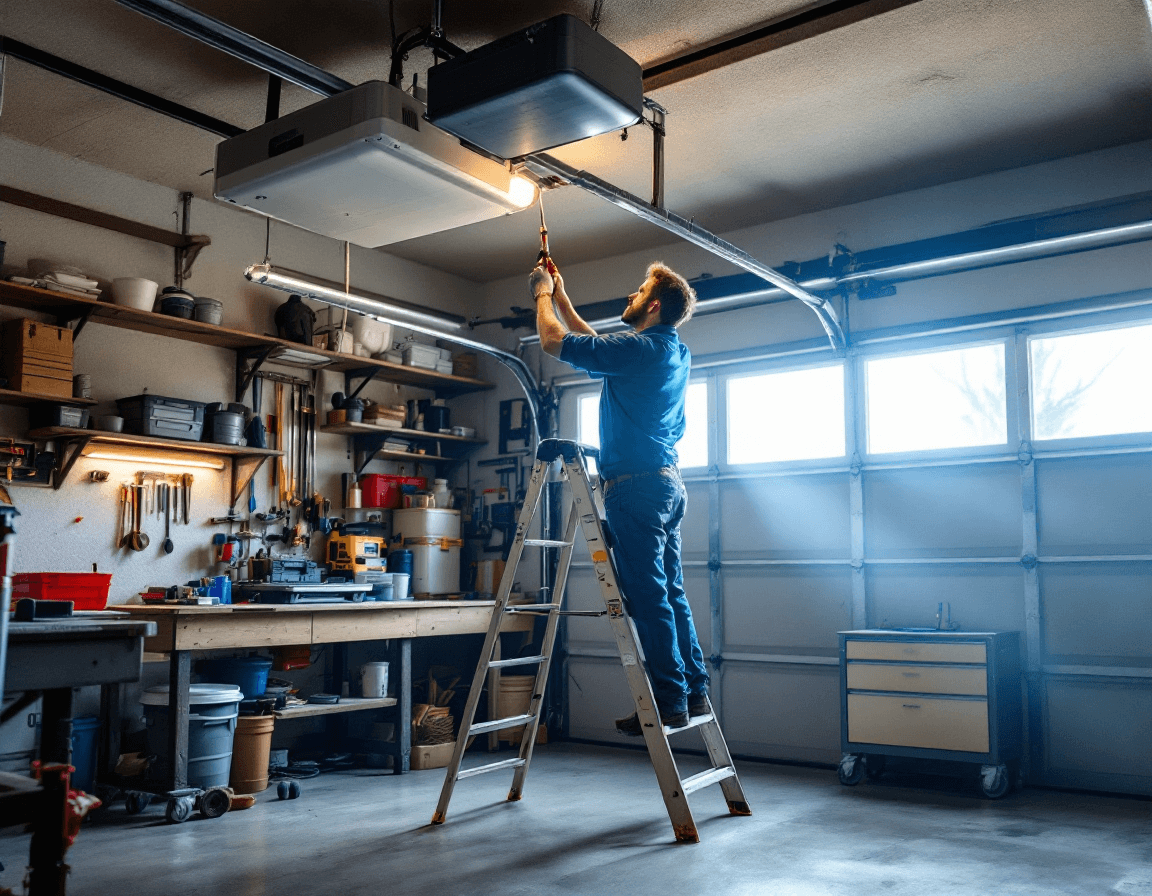
Garage Door Opener Repair in Renton, WA is a common need for homeowners across King County, and it is often more manageable than it first appears. When an opener stops working, the cause is usually one of a handful of components: the motor, the gear assembly, the logic board, the safety sensors, the travel limits, or the drive chain or belt. Seattle Garage Door Fix diagnoses and repairs openers for Renton homes from the Highlands to Fairwood, and our technicians work on the major opener brands you are likely to find in local garages. Most opener repairs in our service area fall between $95 and $375, depending on the part involved and how much diagnostic time the problem requires.
Renton sits in a part of the Puget Sound region where moisture, mild winters, and sudden cold snaps all take a toll on mechanical and electronic parts. Many of the homes we see were built during decades when attached two-car garages were standard, and their openers have been running through years of damp springs and gray autumns. That combination makes it worth understanding what your opener is telling you before you call anyone. This page walks through the most common symptoms we hear about from Renton homeowners, explains what typically causes each one, and describes where the line falls between a reasonable homeowner check and work that belongs to a licensed professional.
Why Renton's Damp Climate Shows Up Inside Your Garage Door Opener
The Pacific Northwest rarely produces the bone-dry conditions that many other parts of the country take for granted. Renton's wet season can keep garages humid for months, and that moisture finds its way into wiring connectors, circuit boards, and the small sensors that tell your opener where the door is. Condensation forms when warm indoor air meets a cold concrete slab, and it can leave a film on the photo-eye lenses at the bottom of the door tracks. Over time, that film can interrupt the safety beam and make the door behave as if something is in its path.
Temperature swings add another layer. A cold morning can stiffen lubricant in the gear assembly and make the motor work harder to lift the door, while a warm afternoon can ease it back to normal. Homeowners sometimes notice that their opener seems sluggish only on certain days, which is a classic sign of a component that is near the edge of its tolerance. Renton's older garage doors, many of them with steel springs and heavier panels, add to the load the opener must overcome, so small weaknesses become noticeable sooner.
Because of this, we often treat a damp garage as a clue rather than a coincidence. Before replacing a part, our technicians look at moisture levels, check the condition of door seals, and inspect whether the opener is mounted in a spot that collects drips from the rafters or the door itself. Addressing the environment is sometimes the difference between a repair that lasts and one that needs to be repeated after the next rainy stretch.
Recognizing When the Motor Runs but the Door Refuses to Budge
One of the most frustrating symptoms is a motor that clearly runs, sometimes with a steady hum, while the door stays firmly in place or only shudders. Homeowners often assume the motor has died, but the motor is only one link in a chain that includes the drive system, the trolley, the springs, and the door itself. The first question a technician asks is whether the problem is in the opener or in the door's mechanical balance. A door that has become heavy or binding can overwhelm even a healthy motor.
In our experience, several causes account for most of these calls. A disconnected or slipping drive chain or belt prevents the trolley from moving the door even though the motor turns freely. A worn gear inside the opener head can spin without transferring force. A failed capacitor or weak power supply can leave the motor under-powered. Sometimes the door has been manually locked, perhaps by an emergency release that was pulled and never reset, and the motor is simply pushing against a fixed point.
Before you call, it is reasonable to disconnect the opener from the door using the emergency release cord, lift the door by hand, and check whether it moves smoothly from top to bottom. If it is stiff or uneven, stop there and call a professional, because the springs and cables store significant energy and should not be adjusted by homeowners. Our technicians can test the motor, the power supply, and the drive components in sequence, which usually reveals the failing part without guesswork.
- Motor hums or clicks but the door does not lift or lower
- Door moves a few inches and then stops or reverses
- Trolley arm moves without carrying the door
- Emergency release was pulled and the door has not been reconnected
- Opener smells of hot electronics or the motor housing feels unusually warm
When the Remote and Wall Button Stop Talking to the Opener
A remote that suddenly stops working is often blamed on the battery, and sometimes that is exactly the cause. Still, when neither the handheld remote nor the wall-mounted control responds, the issue usually lies within the opener's receiver, the logic board, or the wiring between the wall console and the head unit. Renton homes built with long wire runs to a wall console can develop loose connections at the terminal block, and vibration over years can work them loose. Moisture can also corrode contacts, especially in garages where the wall console sits near a damp corner.
Radio interference is another factor in dense neighborhoods. Remote signals travel through the air, and a new device, a changed antenna, or a neighboring system can disrupt the frequency your opener expects. Some homeowners notice that the remote works only when they stand in one spot in the driveway, which points toward signal strength rather than a failed transmitter. Reprogramming the remote to the receiver is a straightforward step, but it only helps when the receiver itself is still functioning.
When we troubleshoot this symptom, we start with the simplest checks: battery condition, wall console wiring, and whether the opener's learn button responds. If those pass, we move to the logic board and receiver, which may need a repair or replacement depending on the opener brand and age. Keeping your remotes and keypad codes organized, and noting which device controls which door if you have more than one, helps us reach the answer faster during a visit.
Stripped Gears and the Grinding Sound From the Opener Head
A grinding, clicking, or metallic scraping noise from the opener head is one of the sounds we most want homeowners to take seriously. Many openers use a gear arrangement that converts motor speed into the controlled force needed to lift a heavy door. Over years of cycles, teeth on the gear can wear down, chip, or strip, and the grinding is the sound of the damaged surface failing to mesh cleanly. Continuing to run an opener with stripped gears can cause the drive to slip unpredictably, and in some cases it can leave the door stranded partway open.
Wear is not always the only cause. A lack of lubrication, debris that has worked its way into the housing, or a door that was forced against an obstruction can all accelerate gear damage. Renton's humidity can also contribute to corrosion on exposed metal parts. Because the gear assembly carries real load, we recommend stopping use of the opener once grinding begins and having it inspected promptly, rather than waiting to see whether the noise fades. A few dollars of delay can turn a gear replacement into a larger repair.
A licensed technician will open the head unit, examine the gear train, and determine whether the damage is limited to a single gear or extends to the drive mechanism. This is also the moment to check whether the door balance is correct, since an unbalanced door forces the gears to do extra work. Our repairs for opener gears generally fall within our standard price range, and the technician can explain the options clearly before any parts are ordered.
Doors That Close Partway or Reverse the Moment They Touch the Floor
When a door reverses immediately after starting to close, or stops a few inches above the floor, the opener is usually responding to a safety system or a travel-limit setting. Modern openers are designed to reverse when they detect an obstruction, and that protective behavior is important. The challenge is that the same protection can trigger when nothing is actually in the way. Misaligned photo-eye sensors, a loose sensor wire, or a bent bracket can convince the opener that the beam has been broken, and the door reverses as a precaution.
Travel limits and force settings present a different puzzle. These settings tell the opener how far to travel when opening and closing, and how much resistance to tolerate before reversing. Over time, a door that has settled, a cable that has stretched, or a track that has shifted can throw those settings off. Some Renton homeowners notice the problem only after a seasonal change, when the door's weight shifts slightly because of humidity in the panels or hardware.
Start by clearing the sensor lenses, checking that both sensors point directly at each other, and confirming that the wiring is intact. If the door still reverses, the travel limits or force settings likely need adjustment, and that adjustment should be done by someone familiar with your specific opener model. Safety features are not optional; they protect people and pets, so adjusting them to stop the reversal without checking the underlying cause is not a fix we recommend.
Decoding the Blinking Light Pattern on Your Opener
Many openers communicate problems through lights on the head unit or the wall console. A light that blinks in a repeating pattern is often the opener's way of signaling a specific fault, and the number of blinks, the pause between them, or the color of the light can point to different categories of trouble. Because brands use different systems, the most useful first step is to consult your owner's manual or the label inside the opener cover. Writing down the pattern exactly, including how many times it repeats, makes the call far more productive.
Some blink patterns indicate a safety sensor problem, such as misalignment, a blocked lens, or a broken wire. Others point to a logic board issue or a communication fault between the wall console and the head. Power-related faults can also produce flashing, especially when the opener is connected to an outlet that is loose or shares a circuit with other high-draw equipment in the garage. Cold mornings and damp conditions can sometimes trigger intermittent flashes that disappear once the opener warms up.
- Repeating flash that stops when the door is clear: check sensor alignment and lens cleanliness
- Continuous fast blinking on the wall console: look for a stuck button or a wiring short
- Blinks that appear only during travel: inspect track, rollers, and travel-limit settings
- Light flashes with no door movement: confirm power supply and the logic board
- Pattern changes after rain or cold weather: suspect moisture in connectors or sensors
Loose Chains and Belts That Have Slipped Off the Track
A chain-drive or belt-drive opener relies on a continuous loop that pulls the trolley along the rail. When that loop develops slack, it can jump the sprocket or pulley, and the opener may run without moving the door. Chain drives are common in many Renton garages because they are durable and affordable, and they sometimes stretch over time. Belt drives are quieter and popular in homes where noise matters, but they also need proper tension to function correctly.
Slack can be easy to miss until the opener starts making a clacking or thumping noise. Homeowners sometimes see the chain sagging low over the rail or notice that the trolley no longer lines up with the door arm. Humidity can make lubrication break down faster, adding to friction and wear. If the chain has come completely off the sprocket, it is important not to force the door by hand, since sudden movement can damage the trolley and rail.
Tightening or replacing a chain or belt is one of the more routine opener repairs, and our technicians handle it as part of the standard price range. The tension should be set carefully, because too tight a drive strains the motor and too loose a drive allows the chain to jump. This is also a good time to inspect the rail mounting, the trolley, and the door arm, since a single loose point can be the reason the drive system wore out early.
Intermittent Operation: The Problem That Comes and Goes
Intermittent operation is one of the hardest symptoms to diagnose, because the opener works perfectly for days and then fails without warning. Renton homeowners sometimes describe the problem as the opener having a mind of its own, responding on some attempts and ignoring the next. In most cases, the root cause is an electrical connection, a sensor, or a component that is sensitive to temperature or moisture. A loose terminal, a cracked solder joint on a circuit board, or a sensor wire that flexes when the door moves can all produce this pattern.
The Pacific Northwest climate makes this symptom more common in some seasons. A garage that is humid in November may behave differently in July, and a cold snap can stiffen parts enough to change how the opener responds. Power fluctuations, especially when other appliances start in the same circuit, can also trigger brief resets. Because the failure is not constant, it can be tempting to ignore it, but intermittent faults often become permanent failures over time.
A good diagnostic visit involves watching the opener through several cycles, checking connections, and testing the power supply under load. Our technicians look for patterns: does the problem happen only when the door is cold, only after rain, or only at a particular point in travel? Identifying the pattern usually leads to the faulty part. Once it is repaired, we recommend monitoring the opener for a few weeks and noting any new behavior so we can follow up if needed.
What a Renton Opener Repair Visit Usually Includes
Every repair starts with a conversation about what you have noticed, and a good technician will ask about the opener's age, the brand and model if you know it, and any recent changes to the door or the garage. Then comes a careful inspection of the motor, the drive system, the logic board, the wall console, the safety sensors, and the door hardware. Because many symptoms overlap, a methodical approach is more effective than replacing parts based on a guess. Our standard opener repairs generally fall between $95 and $375, and the final figure depends on which components need attention.
The lower end of that range often covers simpler jobs such as sensor realignment, wiring corrections, remote reprogramming, or a chain adjustment. The higher end typically reflects more involved work like a gear replacement, a logic board repair, or a motor replacement. Our technicians explain the findings before work begins, and you have the chance to ask questions and decide how you want to proceed. There is no need to commit to a complete overhaul when a targeted repair will resolve the issue.
Renton homeowners often ask whether it is worth repairing an older opener rather than replacing it. The answer depends on the condition of the motor, the availability of parts for your model, and how the rest of the door system is performing. A technician can usually tell you within a single visit whether a repair makes sense or whether replacement would serve you better. That honest assessment is part of the service, and we aim to give you the information you need to make a sound decision.
Brand Coverage and Compatibility for Common Openers
Garage door openers come from many manufacturers, and each brand uses its own logic boards, remote systems, safety sensors, and programming methods. Our technicians work on the major opener brands commonly found in Renton homes, and we can address motor, gear, circuit board, and travel-limit issues across those lines. Knowing your brand and model number helps us prepare, especially when a specific part or programming sequence is needed. The model number is usually printed on a label on the motor housing or near the light cover.
Compatibility matters most when replacing parts. A logic board or motor from one manufacturer may not function correctly in another brand's opener, and mismatched components can create new problems. We recommend choosing parts that match the original specifications or work with your opener system, and we can advise on the best option for your situation. For openers that have been modified or installed by a previous owner, a careful inspection of the wiring and sensors is especially important.
If you are not sure what brand you have, take a photo of the opener head and the wall console and keep it handy when you call. It also helps to note whether the opener uses a chain, belt, or screw drive, because the drive type affects the repair approach. This information allows us to plan the visit more accurately and reduces the chance that a second trip will be needed.
Safety Boundaries: What Homeowners Should Leave to Licensed Technicians
Some garage door work is safe for homeowners to handle, such as cleaning sensor lenses, replacing remote batteries, or checking whether a door is obstructed. Other work carries serious risk and should be left to licensed, bonded, and insured professionals. Torsion springs and extension springs store enormous amounts of energy, and a spring that releases unexpectedly can cause severe injury. Cable repairs are equally hazardous, since a frayed or tensioned cable can snap and whip across the garage. Seattle Garage Door Fix always recommends a licensed professional for spring and cable work, and we encourage homeowners to resist the temptation to adjust these components on their own.
The same caution applies to the door's balance system. Even if an opener seems to be the culprit, the door itself may be stressing the drive, and correcting that requires careful handling. Our technicians work with the springs, cables, rollers, and hinges as a complete system, so the opener is repaired within the context of the whole door. That approach protects both the equipment and the people who use the garage every day.
If you are unsure whether a task is within your comfort zone, the safest answer is to call us. A brief phone conversation can help you decide whether a problem is a simple homeowner check or a job for a technician, and it avoids unnecessary risk. Keeping the emergency release accessible, teaching household members how it works, and keeping children and pets clear of the door during operation are small steps that make a real difference.
Garage Door Opener Repair in Renton, WA calls for a careful, methodical approach that respects the local climate and the realities of homes across King County. Whether your opener hums without moving the door, stops responding to the remote, or flashes a pattern you cannot decode, a prompt inspection can prevent a minor fault from becoming a major failure. To schedule a visit with a licensed Seattle Garage Door Fix technician serving Renton and nearby neighborhoods like the Highlands, Fairwood, Talbot Hill, and The Landing, call (888) 799-3819 today.