
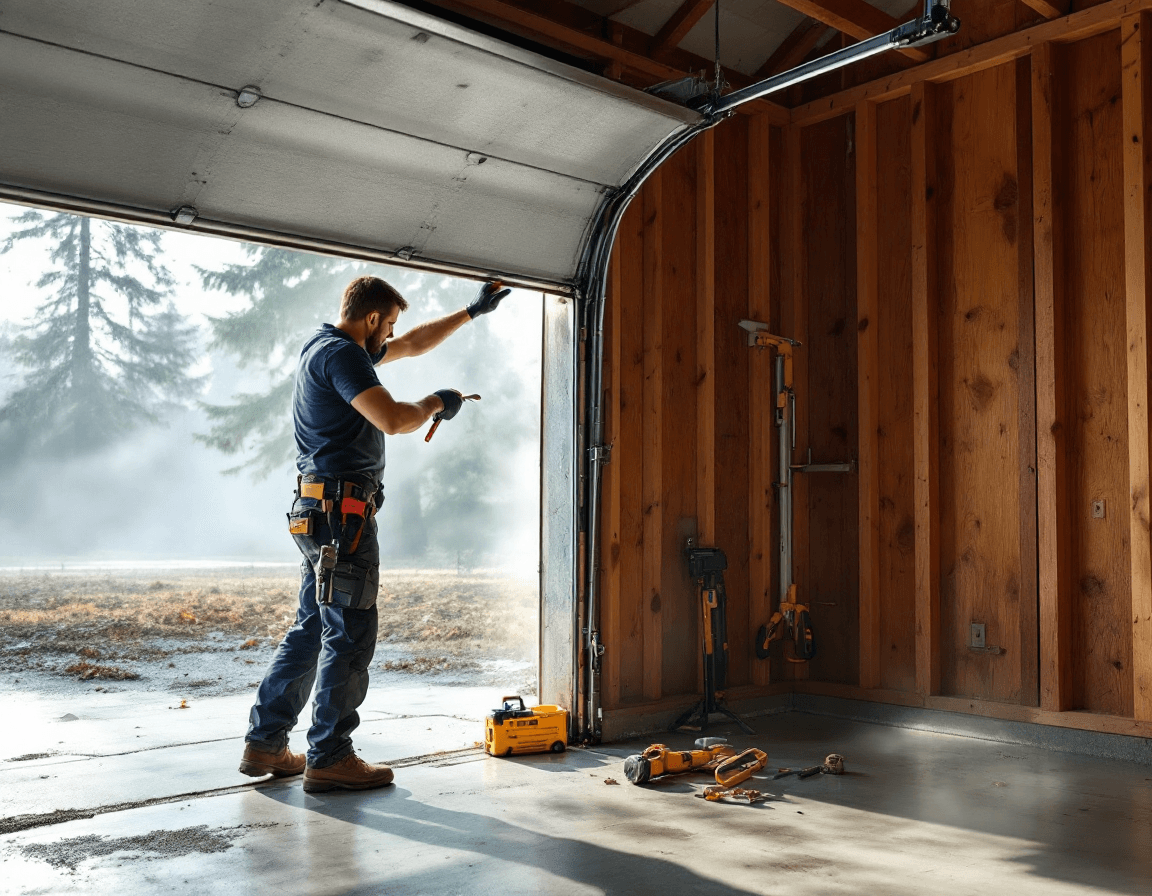
Off-track garage door repair in Renton, WA is one of the most common calls we take from homeowners, and it often starts with a sudden jolt, a grinding noise, or a door that suddenly sits crooked in its opening. Many Renton households find the problem the first time they try to pull into the garage after a long workday. The door may be hanging at an angle, pulling away from one side of the frame, or refusing to move in either direction. Our technicians handle these calls throughout the city and the surrounding King County neighborhoods, and the good news is that most off-track situations are fixable without replacing the entire door.
This page explains what usually goes wrong when a door leaves its track, which warning signs tend to show up first, and what a realignment visit typically involves. It also covers the safety precautions every homeowner should follow while waiting for a technician, and why certain repairs must be left to licensed professionals. We have written it with Renton's weather, housing stock, and driving conditions in mind, since those local factors shape how garage doors wear out here. Our goal is to help you make a clear decision about your next step rather than leaving you guessing.
If your door is off the track right now, the most important thing you can do is keep people and pets away from the opening. A door that has partly derailed can shift, drop, or bind without warning, especially if someone tries to force it. The sections below will walk you through what to look for, what to avoid, and how to decide whether a same-day service call makes sense for your household.
Why Renton Garage Doors Keep Slipping Off Their Tracks
Renton sits in a valley where rain is a regular companion from fall through spring, and that moisture finds its way into nearly everything with moving parts. Steel track sections develop surface rust at the seams and mounting brackets, and the lag bolts that hold the track to the wall or ceiling can loosen as wood framing swells and shrinks through wet and dry cycles. When the track shifts even a fraction of an inch, the rollers at the edges of each door section begin to ride at a slightly different angle than they were designed for. Over time, that small misalignment becomes enough to push a roller out of its channel.
Temperature swings add another layer of stress. A cold snap that drops the garage down into the low thirties can make old lubricant thick and sticky, which slows the rollers and makes the door more likely to hesitate or lurch. The reverse also happens: a warm afternoon following a cold night can cause metal to expand just enough to change how tightly the track fits. Many homes in the Highlands and Fairwood areas have attached garages that share walls with living space, so the interior framing can move differently than a detached structure would, which affects how the track is anchored.
Vehicle contact is a separate but very common cause. Renton driveways are often tight, and backing a car, truck, or delivery van into a half-open door can bend a track section or pop the top roller completely out of its channel. Even a light tap can distort a track enough that the door starts to ride unevenly on the next cycle. Because the damage may not look dramatic from the outside, many homeowners assume the door is fine until it stops working properly a few days later.
Recognizing the Early Warnings Before a Full Derailment
Most doors do not come off the track all at once. They usually send signals for days or weeks beforehand, and learning to recognize those signals can save you from a jammed door on a busy weekday morning. The most common early sign is a faint scraping or squealing noise as the door rises or lowers, particularly on one side. You may also notice that the door seems to lean slightly when it is halfway open, or that the gap between the top weatherstripping and the header looks uneven.
Watch the rollers as well. If you see a roller sitting slightly outside the track channel, or if the nylon or steel wheels appear to be wobbling on their stems, the alignment is already compromised. Some homeowners notice that the automatic opener seems to strain or reverse unexpectedly, which often happens when the door is binding against the track before it fully leaves. A door that closes fine on one day and sticks the next is usually giving you an early warning.
Pay attention to the physical gap as well. A visible space between the door panels and the side jamb, or a bottom seal that no longer meets the floor evenly, can point to a track that has shifted out of plane. These symptoms are easy to dismiss during a busy week, but they usually get worse rather than better. Catching them early often means a simpler and less expensive realignment rather than a more involved repair after a complete derailment.
- Scraping, popping, or squealing on one side of the door during travel
- A door that looks tilted or sits lower on one end than the other
- Rollers that visibly ride outside the track or wobble on their stems
- Uneven gaps along the sides, top, or bottom of the door
- The opener reversing or stopping partway through its cycle
What Actually Happens Inside the Track When a Door Comes Off
A residential garage door rides on two parallel vertical tracks, one on each side of the opening, plus a horizontal section that runs back toward the ceiling. Each door section has rollers on both edges that travel inside the tracks as the door opens and closes. The tracks are shaped to guide the rollers along a precise path, transitioning from vertical to horizontal with a curve that supports the weight of the door as it moves. When everything is aligned, the door glides smoothly and the weight is distributed evenly.
Derailment happens when one or more rollers escape the channel, usually at the curve or where the vertical and horizontal sections meet. Once a roller is outside the track, the door loses the guidance it needs and begins to wedge against the frame or the track itself. The weight shifts onto the remaining rollers, which can bend the track further and pull the door out of square. This is why a door that comes off on one side often looks crooked and why trying to force it can make the problem much worse.
Understanding this mechanism helps explain why we recommend against trying to shove a derailed door back into position. Applying uneven pressure can bend track sections, twist panels, or damage the spring system. It can also cause the door to drop suddenly if the balance changes. A careful technician works to restore the rollers to their channels in a controlled way, checking the track geometry before and after the adjustment.
Rollers, Hinges, and the Small Parts That Fail First
When a door comes off the track, the rollers are often the first components to get attention, and for good reason. Most residential doors use either nylon rollers with steel ball bearings or fully sealed steel rollers. Nylon rollers are quieter but can crack or flatten over time, especially in areas with frequent temperature changes. Steel rollers hold up longer but can seize if the bearings are dry or contaminated with grit and moisture.
Hinges and roller brackets also play a major role in keeping the door aligned. A hinge that has pulled loose from a panel can allow the section to tilt, which in turn pushes the roller at an angle that makes it jump the track. Bent roller stems are another frequent problem, particularly on doors that have been struck by a vehicle or repeatedly forced through a tight track. Sometimes a single damaged roller is enough to start a chain reaction.
Our technicians typically inspect the full set of rollers, hinges, and brackets during an off-track visit, not just the one that is visibly out of place. Replacing a worn roller or tightening a loose hinge bracket can often prevent the same problem from repeating within a few months. In many cases the parts cost is modest, while the labor to restore alignment accounts for most of the service call.
When Track Sections Are Bent, Dented, or Separated
A door that has been hit by a car, a moving dolly, or a sliding cabinet can leave the track permanently deformed. Dents in the vertical sections are easy to spot, but a subtle bend in the horizontal section near the ceiling can be harder to notice until the door begins to bind. Separated track sections, where a joint has pulled apart or a bolt has sheared, create a gap that the rollers can catch in and tear loose. Both situations require more than a quick nudge to fix.
Track repair usually involves carefully removing tension from the door, loosening the track from its mounting points, and gently straightening or replacing the damaged section. Some sections can be reshaped with the right tools and careful measurement, while others are too distorted to restore reliably and need to be replaced. Replacing a full track section is typically straightforward for a trained technician, but it must be done with the door properly supported so the springs and cables are not put under unexpected stress.
Keep in mind that bent track can also indicate that the door itself was damaged by the impact. A technician should check the top section, the bottom seal, and the hinges for signs of a more serious strike. If you notice cracked panels, bowed sections, or a door that no longer closes square even after the track is straightened, an inspection will help determine whether a panel replacement is worth considering.
How a Professional Realignment Visit Usually Unfolds
When you call us about an off-track door, the technician will typically ask a few questions about the symptoms, how the door was last operating, and whether anything hit it recently. That information helps us prepare the right tools and decide whether the job is likely to be a simple reseat or a more involved track repair. We aim to arrive ready to assess the problem rather than to guess from a phone description alone.
On site, the technician will first confirm the door's condition without forcing it. They will check whether the spring system is intact, whether the cables are seated on the drums, and whether the opener is disengaged so it does not move the door during the work. Once the situation is clear, they will carefully guide the rollers back into their channels, inspect the track for bends, and make adjustments to restore proper spacing. Finally, they will test the door through several full cycles to confirm that it runs smoothly and stays aligned.
Before the visit ends, a good technician will explain what was found, what was adjusted, and what, if anything, should be monitored. This is also the moment to discuss whether other parts show wear that could lead to another derailment. Clear communication matters, because a homeowner who understands the cause of the problem is better positioned to prevent it from happening again.
- Initial symptom review and a short safety check before any movement
- Confirmation that the springs and cables are intact and properly seated
- Careful reseating of rollers into their channels
- Inspection and straightening of track sections as needed
- Full-cycle testing to verify smooth, level travel
Safety Steps to Take Until the Technician Arrives
Safety should come first whenever a garage door is off its track. Never stand under a partly derailed door, and keep children, pets, and vehicles clear of the opening. Do not attempt to lift the door by hand, pry the rollers back into place with a screwdriver or pry bar, or tap the track with a hammer. Any of these actions can cause a sudden drop, bend the track further, or injure you when the door shifts.
If the opener is still connected and the door is closed, you may disengage the emergency release cord so the door is no longer attached to the opener while you wait. Pulling the release while the door is open or partly open can allow it to fall quickly. Only use the release when you are sure the door is fully closed and no one is near the opening. If you are not certain whether the door is closed, leave the opener alone and call for help.
Be especially cautious with the springs and cables. These components store a large amount of energy, and a broken spring or slipped cable can cause serious injury. Torsion springs, which are mounted above the door, and extension springs, which run alongside the track, should never be adjusted, unwound, or replaced by a homeowner. Spring and cable work must be handled by a licensed, insured professional with the proper equipment, and that rule applies even when the derailment seems minor.
Understanding the Typical Pricing for Off-Track Repairs
Most off-track repairs we perform fall in the range of $125 to $400, depending on what is actually wrong. A straightforward reseat of one or two rollers on a door with healthy track and intact springs usually lands near the lower end of that range. Jobs that involve straightening a bent track section, replacing several rollers, or correcting hinge damage tend to fall toward the middle or upper end. The final cost depends on the specific parts and time required rather than a single fixed rate.
Several factors influence where a job lands. The number of rollers that need attention, the condition of the track, the door's weight and size, and whether the door was struck by a vehicle all affect the time and materials involved. Doors with heavier insulated panels or longer sections may take more care to manage safely. Access also matters, since a tight or awkward garage layout can extend the time needed to work around the opener or overhead storage.
It is important to be clear about what falls outside this typical range. If an off-track problem reveals a broken spring, a frayed or snapped cable, or damage that requires replacing multiple panels, the scope of the job changes. Those repairs must be handled by a licensed professional and may be priced separately after an inspection. We will always explain what we found and what it means before proceeding with additional work, so you can decide how to move forward.
Neighborhood Notes for The Landing, Highlands, Fairwood, and Talbot Hill
Renton is a city of distinct neighborhoods, and the homes in each area can present slightly different garage door challenges. Near The Landing, the mix of newer construction and older residential blocks means we see a range of track designs and opener types. Homes closer to the lake and river corridors tend to experience more persistent damp conditions, which makes track fasteners and roller bearings more vulnerable to corrosion over time.
In the Highlands, many houses sit on sloped lots with driveways that pitch toward the street. That incline can put extra stress on doors when they are opened and closed, and it can make a small track misalignment show up as a noticeable lean. Technicians working in these neighborhoods often pay close attention to how the door sits relative to the floor and to the wall anchors, since slope and soil movement can gradually shift the mounting points.
Fairwood and Talbot Hill include a mix of single-family homes, some with detached garages and others with attached two-car bays. Driveways in these areas often see frequent use from family vehicles, delivery trucks, and landscaping equipment, which raises the chance of accidental contact with the door. Our crews serving these areas regularly see track damage tied to tight turns into garage bays, so checking for bent sections is a standard part of the visit. Whichever neighborhood you call home, the principles are the same, but a local perspective helps us anticipate what you are likely to see.
Preventing the Next Derailment in a Damp Northwest Climate
Prevention is far easier than emergency repair, and a few simple habits can extend the life of your door's tracks and rollers. Visually inspect the track and rollers every few months, looking for loose bolts, bent sections, debris, or signs of rust. Keeping the track clean and free of leaves, grit, and tracked-in mud helps the rollers move freely. A gentle wipe with a damp cloth followed by a light lubricant on the rollers and hinges, applied as a manufacturer-approved product, can make a noticeable difference.
Weather-related maintenance matters here too. After a stretch of heavy rain, check the bottom weatherstripping and the area where the track meets the wall for signs of water intrusion, since moisture that reaches the anchors can loosen fasteners over time. In colder months, be patient when first operating the door in the morning, and listen for any new sounds that might indicate a roller is starting to shift. Small changes caught early are much easier to correct than a full derailment.
Finally, consider a professional tune-up every couple of years, especially if your door is heavily used or if you have noticed any of the warning signs described above. A technician can check the alignment, balance, and hardware in one visit and recommend targeted fixes before a problem escalates. This kind of proactive service is particularly useful for households that rely on the garage as their primary entrance.
Serving Renton and Nearby King County ZIP Codes
Our crews provide off-track garage door repair across Renton and the surrounding King County communities, including the areas covered by ZIP codes 98055, 98056, 98057, 98058, and 98059. Whether your home is near a commercial corridor, tucked into a quieter residential street, or sitting on a hillside lot, we aim to respond with the same care and attention to safety. Our technicians are licensed, bonded, and insured, and we follow those standards on every call, including the spring and cable work that must always be done by professionals.
If your door has come off the track, is binding, or shows any of the damage described on this page, we are ready to help. Describe what you are seeing when you call, and we will give you practical guidance on what to avoid while we schedule the visit. Typical off-track repairs range from $125 to $400, and we will explain the scope before any work begins. We would rather give you a clear picture of the problem than leave you wondering what the next step should be.
Call Seattle Garage Door Fix at (888) 799-3819 for off-track garage door repair in Renton, WA. Our team will help you get your door moving safely and smoothly again, and we will walk you through what to expect from the visit. Don't wait for a minor misalignment to become a jammed door on a busy morning. Reach out today and let a licensed professional get your garage back in working order.