
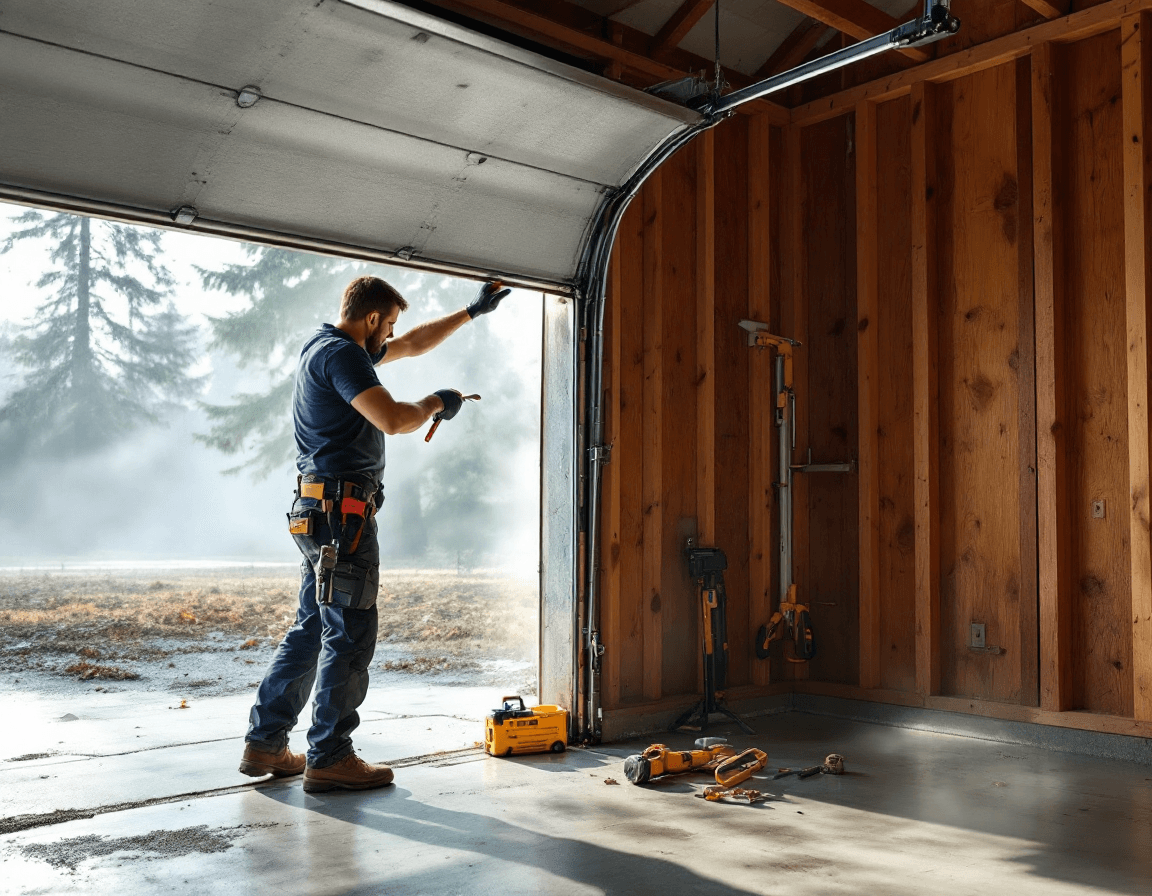
Off-track garage door repair in Maple Valley, WA is one of the calls our technicians handle most often, and it usually comes with a clear sense of urgency. A door that has slipped out of its tracks can leave a family stuck inside or outside the garage, and it can make the whole opening unsafe. Maple Valley homes range from older ranch-style houses near the town center to newer builds on the slopes above the Cedar River, and each one puts a different kind of stress on a door system. This page explains why off-track problems happen in our area, how to recognize them early, and what a realignment visit actually involves.
Our crews work across the surrounding communities, from the busy intersections near Four Corners to the quieter residential streets that wind toward Lake Wilderness. We see the same core problems repeatedly: rollers that pop free, tracks that have been bent by a bumped vehicle, and doors that bind after a wet winter. The good news is that many off-track situations can be corrected in a single visit when they're caught before the door has been forced, pried, or driven on. The sooner you call, the more likely the repair stays simple and affordable.
If your door is off its tracks right now, the most important thing is to keep everyone clear of the opening and avoid trying to muscle it back into place. For a deeper look at what to check and when to call, read on. You'll find details on the symptoms we see most, what goes on inside a track during a repair, how pricing typically works for this kind of job, and which safety habits matter most. Spring and cable work, which often accompanies a derailment, always belongs with a licensed professional, and we'll explain why in the sections below.
Why Maple Valley Doors Tend to Leave Their Tracks
The Pacific Northwest climate has a direct effect on garage doors, and Maple Valley sits squarely in the weather patterns that make wood, steel, and metal components shift over time. Long stretches of rain soak into wood frames and door panels, causing them to swell and add weight. Once the cold snaps arrive, that same material contracts, and the door may sit slightly differently in its tracks than it did in August. Over several seasons, these repeated changes loosen fasteners and wear the nylon or steel rollers that guide each panel.
Local ground conditions add another layer. Many properties in the area have soils that hold water, and slow foundation movement can nudge a slab or header just enough to throw a track out of plumb. Homes on gentle slopes or with driveways that pitch toward the garage can also see the door hang unevenly, because one side of the opening settles faster than the other. A track that was level when the house was built may not stay that way twenty years later.
Finally, Maple Valley is a commuter and errand town, which means vehicles spend a lot of time in driveways, tight turns, and garage approaches. Backing out in the dark or bumping a door while loading groceries is more common than most people admit. A small impact at the bottom corner can bend a track section enough to pull a roller out of line, and the damage may not be obvious until the door begins to bind. Understanding these local pressures helps explain why off-track problems show up in the first place.
Recognizing the Early Warning Signs Before a Door Fully Derails
Most homeowners don't wake up to a fully derailed door. Instead, the problem builds gradually, with small changes that are easy to dismiss. Paying attention to these early signals can save you from a more expensive repair and from the risk of forcing a damaged door to keep moving. Here are the symptoms our technicians hear about most often:
- The door has come off one or both tracks entirely, leaving a gap or a sagging panel.
- One or more rollers have popped out of the track and sit awkwardly against the rail.
- The door looks crooked when closed, with one side noticeably lower or angled.
- A visible gap has opened between the door edge and the track or the weatherstripping.
- The door is jammed and won't move in either direction, even after the opener is disengaged.
- Track sections look bent, dented, or separated at the joints.
- The door shows damage after a vehicle strike, even if the impact seemed minor.
If you notice any of these signs, avoid operating the door with the opener until someone has inspected it. Running the motor against a binding door can strip gears, crack brackets, or put strain on the opener's drive system. A door that moves unevenly also places extra load on its springs and cables, which is one reason spring-related work should never be handled as a do-it-yourself task. Taking a photo of the problem area can help when you call, since it gives us a clearer picture before we arrive.
What Happens Inside the Track When a Roller Pops Out
To understand an off-track repair, it helps to picture what the rollers and tracks are doing during normal operation. Each door section rides on rollers that fit inside a vertical track on each side and a horizontal track overhead. When the door opens or closes, the rollers travel along a curved transition from vertical to horizontal, and this curve is where most derailments begin. If a roller is worn, cracked, or sitting on a bent track, it can jump the lip of the rail and drop out of the channel.
Once a roller is out, the door section is no longer supported evenly, which puts pressure on the adjacent rollers and hinges. Pulling the door in the wrong direction can compound the problem by twisting the panels against the stile or pushing a bent track further out of shape. Technicians typically start by checking whether the rollers themselves are damaged, whether the stem has worn through, and whether the track fasteners have backed out of the wall or header. Then the track is carefully brought back to its correct alignment and the rollers are reseated.
A proper realignment also involves checking the bottom bracket, the hinges, and the struts that connect the door sections. These parts share the load, and if one has failed, the others will often follow. Replacing a single worn roller with a higher-quality nylon or sealed steel version can reduce friction and noise, though the choice depends on the door's weight and the track condition. Our goal is to restore smooth travel, not just to get the door back on the rail for one more cycle.
Damaged Track Sections After a Vehicle Strike or Backing Accident
Vehicle impacts are one of the more disruptive causes of off-track damage, and they're common enough that many of our Maple Valley calls begin with a sheepish explanation about a bumper, a side mirror, or a delivery van that clipped the door frame. Even a light tap can distort a track section, especially at the lower corners where the vertical rail is attached to the jamb. The damage may show up immediately as a visible bend, or it may appear days later when the door starts to lean.
Repairing a struck track starts with determining how far the damage extends. A slight dent can often be straightened and re-secured, while a section that has split at a joint or cracked at a bracket usually needs to be replaced. Technicians check the track's vertical and horizontal alignment with a level and a straightedge, paying attention to both the rail and the mounting points in the frame. If the jamb itself was bent or the header has shifted, we'll note that, because forcing a new track into a distorted opening will only create another problem.
Insurance claims sometimes come into play after a vehicle strike, so it's worth documenting the incident. Take photos of the door, the track, and the surrounding frame before anyone starts working on it. Note the date, what happened, and any visible debris or paint transfer from the vehicle. This information can help with your records, though coverage decisions are made by your insurer and not by the repair crew.
How Our Technicians Approach a Realignment Visit
A typical off-track visit follows a consistent sequence, though every door has its own quirks. The technician begins by asking how the problem started, whether the door was operated after the first sign of trouble, and whether anyone has tried to fix it. This background matters because a door that was forced open may have stressed components that look fine at first glance. Next comes a visual inspection of both tracks, the rollers, the hinges, and the bottom seal, followed by a check of the opener's connection and travel limits.
Once the cause is clear, the technician secures the door against unexpected movement, which is a critical safety step whenever a panel is partly out of its track. Rollers are reseated, track bolts are tightened or replaced, and any bent sections are straightened or swapped. The door is then operated slowly by hand, and then by the opener if the system is safe to run, to confirm that it travels evenly without binding. We'll also check that the auto-reverse safety feature responds correctly, since a misaligned door can affect sensor function.
Before leaving, the technician reviews what was done and what to watch for in the coming weeks. If a part is worn beyond repair, the technician explains the options and the expected cost, so you can make a decision without pressure. Many realignment visits are finished in one appointment, but if the track or frame requires more extensive work, the scope and timing will be discussed up front.
Typical Costs for Off-Track Work in the Maple Valley Area
Pricing for off-track repairs depends on how the door was damaged, how many rollers or track sections are involved, and whether the opening needs additional hardware. For most off-track repairs, homeowners in our service area can expect a range of $125 to $400. Simple jobs, such as reseating a single roller that popped out and tightening loose track fasteners, usually fall near the lower end of that range. More involved work, including straightening a bent track, replacing several rollers, or addressing a separated joint, moves toward the upper end.
Several factors influence the final figure. The door's size and weight matter, since heavier doors require more careful handling and sometimes additional support during repair. The condition of the track is another factor, because a bent section that can be straightened costs less than one that must be replaced. Access also plays a role, particularly when the track is mounted high or the opening has limited clearance. We'll give you a clear explanation of the work and the price before we begin any repair that goes beyond the initial assessment.
It's important to know that certain related items fall outside this range. Spring replacement, cable repair, and opener repairs are separate services with their own pricing, and they require specialized training and tools. If a technician finds that a spring or cable has been damaged during the derailment, we'll explain what is needed and recommend a licensed professional for that portion of the work. Keeping those services separate helps you understand exactly what you're paying for.
Safety Rules Every Maple Valley Homeowner Should Follow
Garage doors are heavy, and a door that is partly off its track can shift without warning. Following a few simple rules can prevent injuries while you wait for a technician. The most important is to keep children, pets, and anyone not directly involved well away from the door and its track. Never stand underneath a door that is hanging unevenly, and never try to lift or push it to free a stuck roller.
Here are safety habits we recommend until help arrives:
- Disconnect the opener by pulling the emergency release cord, then keep the door closed if possible.
- Do not attempt to adjust, unwind, or remove any spring, cable, or drum, even if the door looks easy to fix.
- Keep vehicles out of the garage while the door is compromised, and park elsewhere if the opening is unstable.
- Avoid using the opener to force a binding door, since that can damage the motor and the track further.
- Take photos of the door and track so the technician can see the condition before anything is moved.
Spring-related work deserves particular emphasis. Torsion springs and extension springs store a large amount of energy, and releasing that energy unexpectedly can cause serious injury. If a derailment has involved a broken spring or a cable that has come loose from its drum, the area should be treated as hazardous. A licensed professional with the right tools and training should handle that repair from start to finish.
Rollers, Hinges, and Why One Fix Rarely Stands Alone
One of the most useful things a homeowner can understand about off-track problems is that the derailment is often a symptom of wear that has been building for a while. A worn roller that stays in the track most of the time may suddenly jump when the door is opened in cold weather, when the lubricant has thickened and the wheel doesn't turn freely. Similarly, a hinge that has worked loose can allow a door section to tilt enough that the roller rides against the edge of the track rather than the center.
For this reason, a thorough realignment usually includes a look at the components around the failure point. Technicians check the other rollers on the same side, the hinges connecting the affected section, and the bottom bracket that anchors the door to the cable or spring assembly. If the rollers are worn or the nylon has become brittle, replacing them as a set can prevent the next derailment, which is often less convenient than the first. Stronger steel or sealed rollers may suit heavier doors or homes that see frequent use.
Lubrication also plays a role, though it's easy to overdo. A light, garage-door-specific lubricant applied to the hinges, rollers, and track rail can smooth travel, but dust and grit can gum up a track if too much is applied. Wiping the track clean before lubricating helps prevent that buildup. We're happy to show homeowners what to look for and how to maintain these parts between service visits.
Seasonal Timing: Scheduling Repairs Around Rain, Freezes, and Settling Ground
Timing a repair can make a practical difference in Maple Valley. During the rainy months, doors are more likely to bind because of swollen panels and damp weatherstripping, and many homeowners call us after a stretch of wet weather reveals a problem that had been hiding. Cold snaps have the opposite effect, stiffening lubricants and making the rollers less forgiving. If your door started acting strangely during a freeze, the cold may have exposed a weakness that was already there.
Ground movement is another seasonal consideration. Soils in parts of King County expand and contract with moisture changes, and a track mounted to a slightly shifting header or jamb may need periodic checking. After a particularly heavy rain or a long freeze-thaw period, it's worth taking a quick look at whether the door sits level and whether the gap at the top and sides looks even. Catching a small shift early can prevent a bigger misalignment later.
When possible, schedule non-emergency realignments during drier, milder days, since it's easier to work safely and to test the door thoroughly. Emergency situations, such as a door stuck partly open or a door blocking a driveway, should be addressed as soon as possible regardless of the weather. Calling early gives the technician more time to assess the issue and plan the repair without rushing.
Choosing a Licensed Team for Track and Spring-Related Work
Off-track repairs sit at an intersection of simple mechanical work and higher-risk tasks. A straightforward roller reseat is something a trained technician can complete in minutes, but the same visit may reveal a damaged spring, a frayed cable, or a bent shaft that requires specialized handling. Choosing a company that is licensed, bonded, and insured gives you a clear point of accountability if something goes wrong, and it signals that the crew has the training to work safely around tension and weight.
When you're comparing options, ask direct questions about how the company handles spring and cable work, whether it provides a written estimate before starting, and how it documents what was done. A reputable team will explain what they found, what they fixed, and what remains. They'll also be honest about when a problem is outside the scope of an off-track repair and needs a different specialist.
Seattle Garage Door Fix serves Maple Valley and more than sixty surrounding communities across Western Washington. Our technicians are licensed, bonded, and insured, and we recommend a licensed professional for all spring and cable work because the safety stakes are high. Whether your door has popped a roller, bent a track after a bumped car, or simply started to bind after a wet week, we're ready to take a careful look and explain your options clearly. To schedule an off-track inspection or ask a question about your door, call (888) 799-3819 today.