
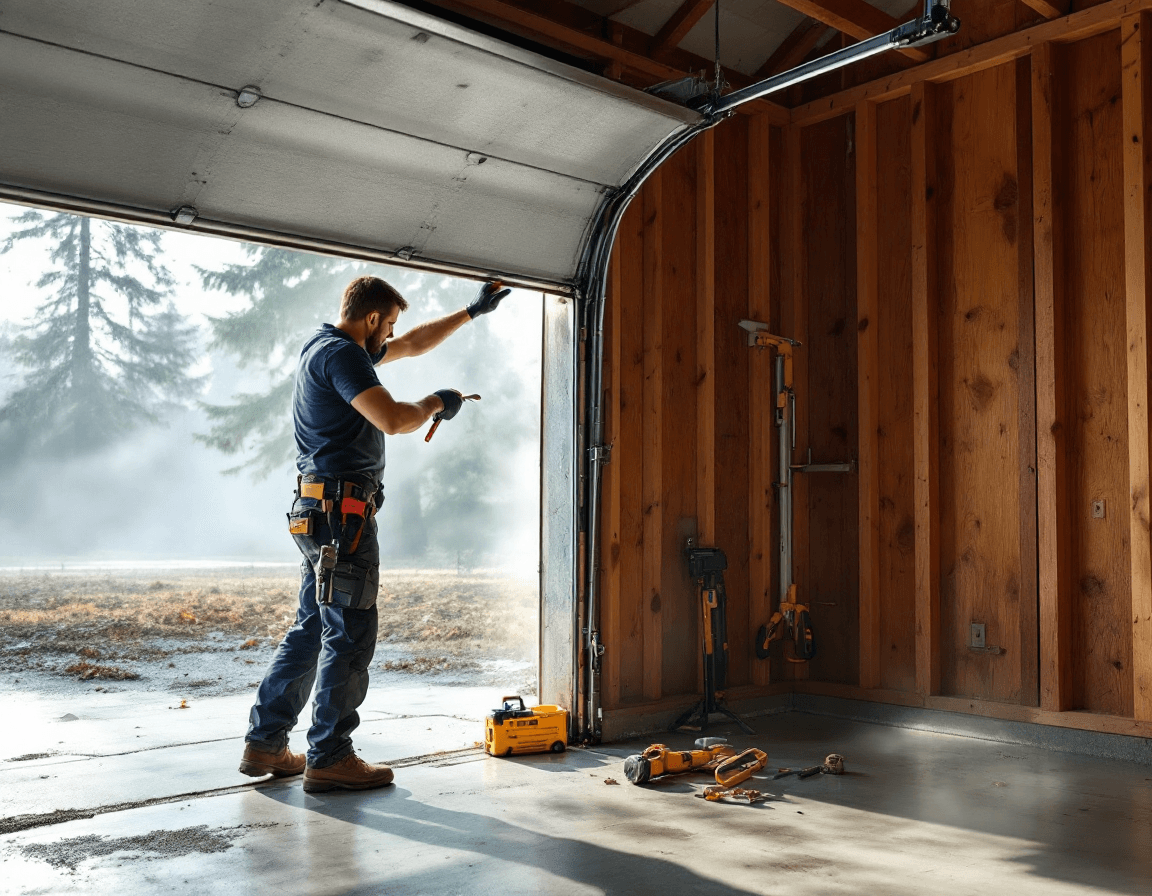
Off-track garage door repair in Covington, WA is one of the more common calls we receive from homeowners in the 98042 area, and it is rarely a mystery once someone looks at the door closely. A door that has slipped out of its track, lost a roller, or started leaning to one side is trying to tell you something about the rollers, the tracks, the hinges, or the springs. Catching the problem early often means a simpler repair and a lower bill. This page explains what typically goes wrong, how to recognize the warning signs, and what a professional realignment usually involves.
Covington sits in the southeast corner of King County, and many homes here were built in the last few decades in subdivisions with attached two-car garages. Those garages see daily use from commuters, school drop-offs, and weekend trips to the hardware store, and every open and close cycle puts stress on the rollers and track alignment. Add the wet, mild winters typical of Western Washington, and a door that once ran quietly can start to bind, shudder, or pop a roller without warning. This guide is written to help you understand that process so you can make a confident decision about what to do next.
Whether your door came off the track after a windy storm, after a child swung on the handle, or after a slow drift that nobody noticed, the principles are the same. The track must be straight, the rollers must sit properly in it, and the door panels must hang level and move freely. When any one of those conditions fails, the door can derail or jam. The sections below walk through each piece so you know what to look for and when to pick up the phone.
Why Doors in Covington Tend to Drift Off Track
Garage doors in Covington live in a damp environment for much of the year, and that moisture works its way into every moving part. Steel tracks can develop surface rust at the bolt holes and along the lower edges, and once rust builds up, rollers can catch on the rough spots. Wooden doors, which are still common on older homes around the Covington Town Center area and in older pockets of unincorporated King County, swell and shrink with humidity, which changes the panel width and can rub against the side tracks. Even modern insulated steel doors can shift a few millimeters over time as the mounting hardware settles.
Daily use is the other major factor. Each cycle the door travels up, rolls back over the top, and returns, so the rollers absorb repeated lateral loads. If the track brackets have loosened, or the header bracket has shifted because of a nearby vehicle bump or a wall that has settled, the door begins to wander sideways. Over weeks or months, a small wander becomes a derailment. Many homeowners notice the problem only when the door finally stops halfway up.
Wind is worth mentioning too. Gusts off the Soos Creek and Jenkins Creek corridors can push on a large, lightweight door, especially a single-panel door or a long two-car door with a lot of surface area. A door that is already slightly out of square has less margin before a strong gust nudges a roller free. That is why technicians often find an off-track door was already leaning before the day it finally came off.
Reading the Warning Signs Before the Door Fails Completely
Most off-track problems announce themselves gradually. The first thing many homeowners notice is a faint scraping or squealing noise as the door rises, which usually means a roller is rubbing the track edge or a bracket is out of position. Another common sign is a visible gap between the top section of the door and the header, or between the door edge and the vertical track on one side. If one side of the door sits lower than the other when closed, the door is likely crooked, and the rollers on the low side are carrying more load than they should.
Pay attention to how the door behaves at specific points in its travel. If it runs smoothly for most of its path but hitches or stutters near the top, the problem often sits where the track curves from vertical to horizontal. Binding in that transition zone can point to a roller that has started to ride up, a track section that has moved out of alignment, or a worn roller stem. Doors that bind only in cold mornings or only after heavy rain frequently have moisture or corrosion problems in the track.
Here are the signs we most often tell homeowners to watch for:
- A visible gap between the door panels and the track on one side but not the other
- Rollers that look flattened, cracked, or pushed partway out of the track channel
- A door that stops, reverses, or jerks at the same point every time it opens
- A door that sits noticeably lower on one side when fully closed
- Loud popping, grinding, or clanking during normal operation
If you notice any of these, avoid repeatedly forcing the opener to finish its cycle. Pushing a binding door with the motor can bend track sections, strip gears, or put strain on the opener motor, which turns a modest realignment into a larger repair.
What Happens When a Roller Pops Out of the Track
A roller is a small wheel, usually nylon, steel, or sealed ball-bearing, that rides inside the vertical or horizontal track and carries the weight of the door. Each roller sits on a stem attached to a hinge at the junction between two door panels. When a roller pops out of the channel, that corner of the door loses its guidance, and the panel can swing away from the track or drop sideways.
Popped rollers often result from a worn or cracked roller tire, a stem that has bent or snapped, or a hinge that has loosened and allowed the panel to shift. Nylon rollers tend to crack in cold weather and flatten after years of use, while steel rollers can seize or lose their grip on the track. Once a roller is out, the panel usually stays put for a moment before it starts to lean, which is why many homeowners find the door sitting at an odd angle in the morning.
A technician will typically check every roller, not just the one that popped. Replacing a single worn roller on a door that is otherwise in good condition is common, but if several are cracked or the stems show wear, replacing the full set can prevent the same problem from returning in a few months. Rollers are inexpensive compared to the labor involved in realigning a door, so addressing the whole set is often the more economical choice.
Bent, Dented, and Separated Track Sections
Track is made from galvanized steel formed into a precise channel, and even a small bend can throw off the whole door. Track sections are typically connected at joints with bolts and a slight overlap, and when one section is struck, the joint can separate or the section can flex out of plane. A bent track forces rollers to climb or wobble through the affected stretch, and that can knock other rollers loose.
Vehicle impact is one of the most common causes of serious track damage. A car that backs in a little too far, a delivery truck that clips the driveway edge, or a bicycle or tool cart that gets pushed into the lower track can all leave a dent or kink. Even a minor dent can cause a roller to catch every time it passes that point, which produces the rhythmic bump or grind many homeowners describe.
Straightening track is delicate work. A technician needs to check the track with a level and straightedge, loosen the mounting brackets, carefully tap or reshape the affected section, and then re-secure everything so the rollers run true. If the damage is severe, cracked, or heavily rusted, replacing the section is safer than attempting to straighten it. Forcing a badly damaged track back into shape can cause it to fail again under load.
Safety First: Why You Should Not Attempt the Repair Yourself
A derailed garage door is heavy, awkward, and potentially dangerous, and the springs that help lift it carry enormous tension. Torsion springs and extension springs store energy that can cause serious injury if they are released incorrectly. Even when the door has simply come off its track and the springs are intact, lifting or pushing the panels by hand can cause a sudden drop or shift that pinches hands or fingers.
The safest immediate step is to disconnect the opener by pulling the emergency release cord, which allows the door to be operated manually. Do not stand under the door while it is moving, and keep children and pets well clear of the opening. Do not attempt to adjust, unwind, or remove springs, cables, or drums yourself, because those components are under high tension and require specialized tools and training.
Spring and cable work should always be handled by a licensed professional. Cables can fray or come off their drums when a door derails, and a technician needs to inspect the drum, cable routing, and spring tension before the door is returned to service. If you see a cable hanging loose, a spring with visible gaps between coils, or a door that seems to drop suddenly when you release it, stop and call for service right away.
How a Professional Realigns an Off-Track Door
A typical realignment begins with a full inspection of the door, tracks, rollers, hinges, springs, cables, and opener connection. The technician will confirm that the door is level, that the tracks are plumb and parallel, and that the cables are seated correctly on the drums. Once the diagnosis is clear, the work usually follows a predictable sequence, although the exact steps depend on what failed.
The process generally runs in this order:
- Securing the door so it cannot move unexpectedly during the repair
- Checking the springs, cables, and drums for damage before any lifting or guiding begins
- Lifting or guiding the panel back into the track channel and reseating each roller
- Straightening or re-securing any bent track sections and tightening brackets to the correct torque
- Testing the door through several full cycles and adjusting the opener's force and travel limits if needed
After the mechanical work is complete, the technician will usually observe the door through multiple open and close cycles and listen for noises that suggest a remaining rub point. A properly aligned door should move smoothly without hesitation and should close with its bottom weather seal making even contact across the threshold. If the door still lifts unevenly, the tech will re-check the level and the brackets before leaving.
Typical Costs for Off-Track Repairs in Covington
Most off-track repairs in the Covington area fall between $125 and $400, depending on what is involved. A straightforward reseat of a single popped roller on a door with no track damage usually sits at the lower end of that range. Jobs that require straightening a bent track section, replacing several rollers, or adjusting multiple brackets generally land higher in the range.
Several factors influence where a specific job falls. The door's size and weight matter, because a heavy two-car insulated door takes more time and more careful handling than a lightweight single door. The type of track and roller system matters too, since standard steel rollers are often less expensive to replace than sealed or specialty roller assemblies. Access to the work area and the condition of the hardware, including whether bolts are rusted in place, can also affect the final quote.
Those figures are general ranges for off-track work and are not a guarantee for every situation. Spring replacement, cable replacement, opener repairs, and full panel replacement are separate services with their own pricing, and a technician should explain those costs before any work begins. Before approving a repair, ask for a clear written breakdown of what is included.
Wet Winters, Mossy Driveways, and Track Corrosion
Western Washington winters bring long stretches of rain, and garages that are not perfectly sealed can collect moisture along the floor and the lower tracks. Standing water, muddy tire tracks, and leaf debris can push grit into the track channel and onto the rollers. Over time, that grit acts like sandpaper, wearing down roller tires and roughening the track surface until the door starts to catch.
Corrosion is the other winter concern. Galvanized track resists rust well, but scratches, dents, and mounting bolts exposed to constant dampness can develop surface rust that slowly spreads. A rusty bolt that has seized can prevent a technician from adjusting a bracket properly, and a rough patch on the track can grab a roller every time it passes. Keeping the lower track clear of debris and wiping away any early rust can extend the life of the system considerably.
Homeowners near wooded lots or along the creek corridors often notice more moss, needles, and organic matter collecting near the bottom of the door. Clearing that debris after storms, and checking that the garage floor drains properly, reduces the chance that moisture will reach the mechanical parts. A damp garage is not just uncomfortable; it is hard on the entire door system.
Covington Homes, Two-Car Doors, and Driveway Impacts
Many Covington homes feature wide, two-car garage doors with long horizontal track runs and substantial panel weight. These doors put more load on the tracks and the header bracket than a single-car door does, and they tend to show alignment problems sooner if the mounting is not perfectly solid. A header bracket that flexes even slightly can allow the door to drift, and that drift often shows up as one side running lower than the other.
Driveway conditions also play a role. Tight turning areas, narrow shared approaches, and parked vehicles near the door can all increase the risk of a bump. Homeowners sometimes do not realize that a slight contact with a side track or the bottom corner of the door has already bent something, until the door starts to misbehave weeks later. If a vehicle has touched the door or its tracks, have the system inspected even if the door still appears to work.
Garage layout matters as well. Some homes have ceiling-mounted openers that add weight to the header, while others have limited headroom that forces the horizontal track to run at a tighter angle. Technicians account for these details when they realign the system, because the correct fix depends on how the door was installed in the first place.
Simple Habits That Keep Your Door on Its Track
Preventive care is inexpensive and can catch small problems before they become derailments. Once or twice a year, close the garage door and look along both vertical tracks for gaps, bends, or loose bolts. Watch the door as it moves, and listen for new sounds that were not there before. Those few minutes of attention often reveal a problem while it is still easy to fix.
Keeping the track clean helps as well. Wipe the inside of the track with a dry cloth to remove grit, and avoid heavy greasy lubricants that attract dirt. Silicone-based or manufacturer-recommended lubricants applied to the rollers and hinges, rather than to the track surface itself, can reduce friction without collecting debris. Check that weather seals and bottom brackets are firmly attached so the door does not shift when wind pushes against it.
Parking and driveway habits matter too. Keep vehicles a safe distance from the door, and teach everyone in the household to stop the door before it hits a bicycle or cart. Finally, have the entire system inspected periodically by a licensed technician who can check springs, cables, bearings, and opener force settings. Routine professional attention costs far less than an emergency call after a derailment.
When an Off-Track Repair Signals a Bigger Problem
Sometimes a derailed door is only the most visible symptom of a larger issue. Worn torsion springs, frayed lift cables, failing bearings, and out-of-balance doors can all cause a door to pull unevenly and jump its track. A technician who realigns a door without checking those components may leave the underlying cause in place, and the door will likely come off again.
Certain signs suggest that a more extensive repair is needed. If the door is consistently heavy to lift by hand, if one cable looks slack while the other is taut, or if the springs show visible gaps or rust, the system may be near the end of its service life. A door that repeatedly derails despite several realignments usually has a structural or mechanical issue that requires a full inspection and possibly replacement of major components.
When that happens, the decision is about safety and long-term value rather than a single repair. A licensed technician can explain which parts are worn, what they cost to replace, and whether repairing or replacing the entire door makes more sense. Good technicians will give you the facts and let you decide without pressure.
If your garage door has come off its track, is jammed, or looks crooked, the safest next step is to stop using the opener and call a licensed technician who can inspect the full system. Seattle Garage Door Fix serves Covington and communities across Western Washington, and our team can typically tell you what is happening and what it will take to get your door running smoothly again. Call (888) 799-3819 to schedule an off-track repair in Covington, and let a professional handle the springs, cables, and tracks while you keep your hands clear.