
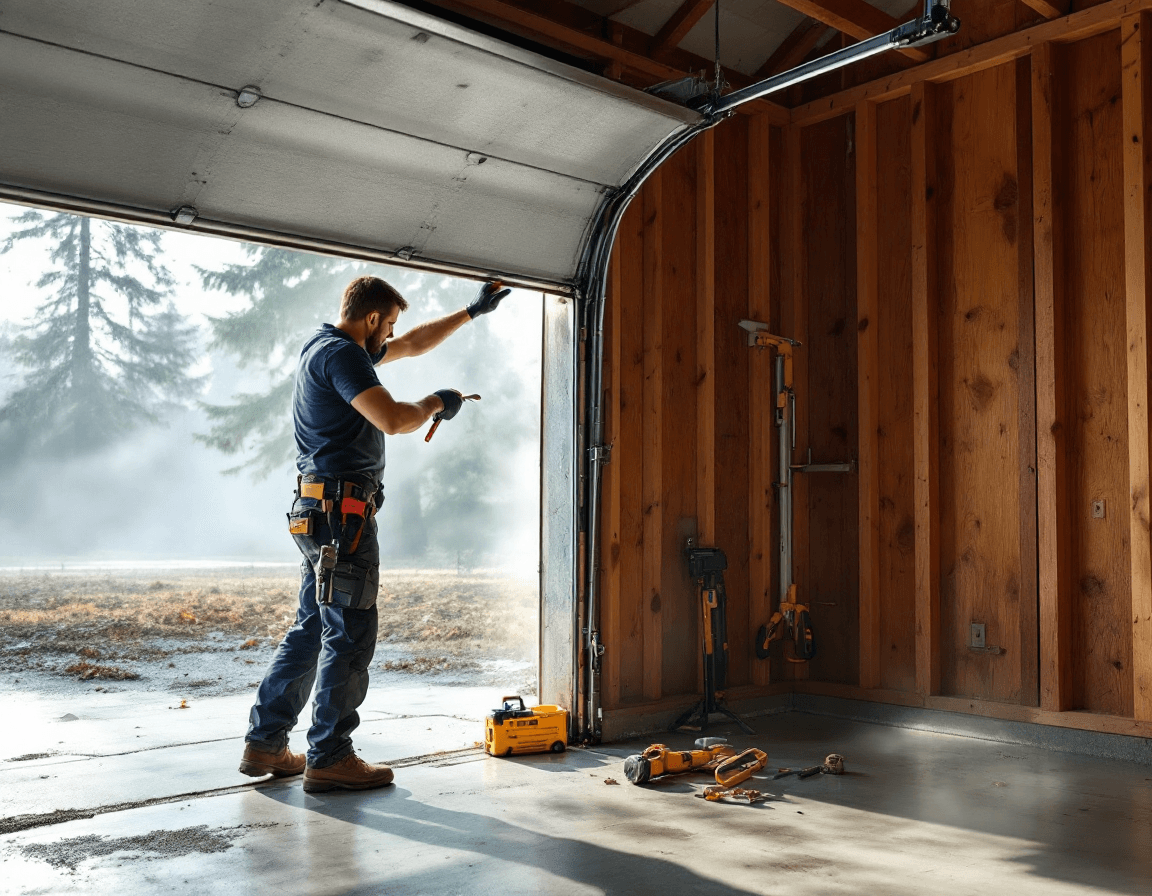
Off-track garage door repair in Black Diamond, WA usually starts with a sound that is hard to ignore: a sharp bang, a grinding scrape, or a door that suddenly sits a few inches out of line. Homes in this corner of southeast King County see plenty of this, especially where long driveways, older garage openings, and wet winters all put extra strain on the rails. A door that has jumped its track is not just inconvenient. It can bind, bend hardware, and become unsafe to operate if someone keeps forcing it.
This page explains what goes wrong when a door leaves its track, what you can safely check on your own, and when you should stop and call a professional. We also cover what a typical realignment involves, how roller and track damage differs, and what most off-track repairs cost. Our technicians work throughout Black Diamond and the surrounding Maple Valley and Enumclaw Plateau communities, and the advice below reflects the kinds of conditions we see on local properties.
If your door is crooked right now, the most important step is to leave it alone. Keep people and pets clear of the opening, avoid pulling the door by hand, and call (888) 799-3819 for help. The sections below will help you understand what the technician is looking at and why certain fixes are quick while others take more time.
Why Doors Jump Their Tracks in Black Diamond
A garage door is essentially a set of heavy panels riding on steel rollers inside two vertical tracks, with a horizontal section that carries the door overhead. The rollers are small but they carry a surprising amount of load, and they only stay in the track when every component is aligned. When a roller is pushed out, the panel it supports can tilt, rub against the track lip, and eventually slip free entirely.
In Black Diamond, several local factors make alignment problems more likely. Many homes were built on sloped lots, which means driveways and garage floors are not always perfectly level, and that tilt can subtly shift how the door travels over the years. Older neighborhoods near the historic downtown sometimes have garages with framing that has settled slightly, so the tracks may no longer sit exactly plumb against the opening. Newer developments are built to tighter tolerances, but even new installations can drift once the house settles through a few wet seasons.
Most derailments are not caused by one dramatic event. A roller wears down, a bracket loosens, a lift cable stretches unevenly, and then a single hard open or close sends the door out of its path. Understanding this helps you see why a technician often inspects the whole system rather than just snapping the door back into place. The track is only as reliable as the hardware that supports it.
Warning Signs That Your Door Is Heading Off Track
Doors rarely leap off their tracks without warning. In the days or weeks before a full derailment, you can usually notice small changes in how the door moves, and catching them early often means a simpler and less expensive repair. Pay attention to the way the door sounds as well as how it looks.
Common early symptoms include a door that seems to lean slightly when it is halfway open, a new squeal or grinding noise at one side, or a visible gap between the top panel and the header. Some homeowners notice that one end of the door closes a little sooner than the other, which suggests one roller is no longer tracking smoothly. Others see the weatherstripping pulling away at a corner, which is often the first visible sign that the door is shifting out of square.
- A gap wider than a finger between the door edge and the vertical track on one side
- Rollers visibly sitting outside the track channel, or stems bent at an angle
- Popping or banging when the door starts or stops
- A door that stops partway, then reverses or refuses to move in either direction
- Track sections with dents, kinks, or bolts that have backed out of their brackets
If you spot any of these, avoid repeated attempts to run the opener. Each forced cycle can stress the brackets and bend the track further, turning a simple realignment into a larger job. A quick inspection now is much cheaper than replacing a damaged section later.
What Actually Happens Inside the Track When a Roller Pops Out
Each roller in a standard steel garage door track is a small wheel mounted on a stem that attaches to a hinge between door panels. The wheel rides inside a channel formed by the track, which is usually made from galvanized steel and bolted to the wall and ceiling of the garage. When the roller is properly seated, its edge stays in the channel through the full travel of the door, and the weight of the panel is shared evenly among the rollers.
When a roller pops out, the panel it supports drops toward the side where it lost its grip and begins to rub against the track lip. That friction creates heat, shaves metal from both the roller and the track, and can pull the stem out of its hinge. The door may appear to be moving normally at first, but it is now riding on a damaged point that will only get worse with each cycle. This is why a roller that seems to be sitting slightly off usually deserves attention right away.
Reseating a roller sounds simple, but the technician must first relieve tension in the system before handling the hardware. The springs and cables on a garage door store enormous energy, and that is why homeowners should never try to pry rollers back into the track while the door is under load. A licensed technician will assess whether the roller, stem, or hinge bracket also needs replacement, since a worn roller that has popped out once is likely to do it again.
Wet Winters, Mossy Rails, and the Hillside Driveway Effect
The Pacific Northwest climate has a direct effect on garage doors, and Black Diamond's combination of heavy winter rain, damp mornings, and cool shaded driveways creates a persistent challenge. Moisture finds its way into the bottom of the track, collects grit and leaf debris, and promotes surface rust on exposed steel. Over time, rust makes the track rougher and less precise, and the rollers begin to catch on the corrosion instead of gliding smoothly.
Hillside driveways add another layer. When a garage floor slopes even slightly toward the door, water can pool at the threshold and run under the bottom seal, where it accumulates against the lower track bracket. Repeated freezing and thawing during the colder months can then loosen the mounting bolts, allowing the track to shift a few millimeters out of plumb. That small movement is enough to let a roller ride against the edge and eventually pop free.
Technicians serving the area often recommend a simple seasonal habit: wipe the tracks with a dry cloth after heavy rain, remove visible debris, and check that the bottom weatherstripping still seals the gap. Avoid spraying penetrating oil into the track, since it attracts dust and grit that turn into a grinding paste. A light silicone-based lubricant on the rollers and hinges is usually the better choice, and it should be applied sparingly so it does not drip onto the floor or the track surface.
When a Vehicle or Tree Strikes the Door
Many off-track calls in Black Diamond follow a minor collision. A delivery van backing too quickly, a tow hitch clipping the bottom panel, or a branch dropping during a windstorm can knock a door out of its tracks in seconds. Sometimes the damage is obvious, such as a crumpled panel or a bent section of track. Other times the door appears to be fine, but the impact has shifted a bracket, cracked a roller, or disturbed the spring tension in a way that will show up days later.
A vehicle strike should always be treated as a potential structural and safety issue, not just a cosmetic one. Even if the door seems to close, the force of the impact can distort the horizontal track, crack the end brackets, or damage the torsion shaft and springs. Those components are under high tension, and a compromised spring can fail suddenly when someone opens the door. For this reason, a technician should inspect the entire assembly after any collision, even when the visible dent is small.
Keep records of the incident, including photos of the door and track, the time it happened, and any information about the vehicle involved if it was another driver's property. That documentation can be helpful for homeowners' insurance claims. We recommend contacting your insurer before authorizing major work when the damage stems from a third party, and asking your technician to note the findings clearly on the invoice.
Why You Should Not Force the Door Back Into Place
It is tempting to grab the bottom bar, lift the door, and try to push a roller back into its channel. Please do not do this. The door may look light, but it is counterbalanced by heavy springs that can hold thousands of foot-pounds of stored energy in a standard residential system. A door that is off track is also unstable, and it can drop, twist, or swing unexpectedly when pressure is applied at the wrong point.
Safety considerations for an off-track door are straightforward and worth following closely. Keep the following in mind until a licensed professional arrives:
- Do not stand under or beside a door that is hanging crooked or jammed in the opening
- Disconnect the opener by pulling the emergency release cord only if the door is closed, and never while it is partly raised
- Do not attempt to adjust, unwind, or remove springs, cables, or the torsion shaft
- Keep children, pets, and vehicles away from the garage entry until the door is secured
- Do not use a ladder to reach the upper track or spring hardware yourself
Spring and cable work carries real risk of serious injury, and it should only be done by a trained, licensed technician who has the correct tools and experience. If there is any doubt about whether the door is safe, treat it as unsafe and call for service. A short delay in getting help is far better than an injury that could have been prevented.
How a Technician Realigns the Door and Reseats the Rollers
When a service technician arrives, the first task is to secure the door and determine why it left the track. They will typically inspect the springs, cables, drums, and opener connection before touching the rollers, because the cause of the derailment often lies in a component that is out of balance or worn. Once the system is safe, the technician can lift the door carefully, guide the rollers back into the channel, and verify that each one travels smoothly from the bottom position to the top.
Realignment involves more than returning the rollers to their tracks. The technician will check that the vertical tracks are plumb, that the horizontal tracks are level and parallel, and that the hinge brackets are tight. Worn rollers may be replaced with sealed nylon or steel ball-bearing versions, which run quieter and handle the local moisture better than older designs. Bent stems, cracked hinges, and loose mounting bolts are corrected at the same visit so the repair does not have to be repeated after a few weeks.
Finally, the technician will test the door through several full cycles, both with the opener and by hand where safe, to confirm that it moves evenly and stops at the correct positions. They should also check the auto-reverse safety feature, since a misaligned door can affect sensor function and force settings. A good service visit ends with a clear explanation of what was adjusted, what was replaced, and what you can watch for in the coming weeks.
Straightening Bent Track Without Replacing the Whole System
Not every track that has been hit or distorted needs to be discarded. Many residential tracks are made from relatively thin galvanized steel, and a moderate bend can often be carefully straightened and re-secured. The technician will examine the track for kinks, creases, and separations at joints, since a crease that has cracked the metal cannot be restored to full strength. Sections that are only slightly out of plane may be corrected with hand tools, while severely deformed pieces are usually replaced.
The condition of the mounting brackets matters just as much as the track itself. Bent brackets can hold a straight track in the wrong position, so they are checked and reset or swapped as needed. Where the track has pulled away from the wall because of an impact or long-term loosening, the technician will install proper fasteners in solid framing rather than relying on drywall anchors that may have worked loose. In older Black Diamond garages, this sometimes means discovering that the original fasteners were driven into a single thin stud, and correcting that improves the entire system.
Replacing a track section is typically faster and more reliable than attempting a complicated repair on a severely damaged piece. Your technician should explain the difference between a simple straightening and a full section replacement, and they should provide an honest recommendation based on the metal's condition. Asking for a clear explanation of what is being repaired and why is always reasonable.
What an Off-Track Repair Usually Costs Locally
Most off-track repairs in the Black Diamond area fall within a range of $125 to $400. The final figure depends on how far the door has traveled out of position, how many rollers and brackets need attention, and whether any track sections must be straightened or replaced. A simple reseat with no hardware damage will sit at the lower end, while a door with bent track, cracked brackets, and several worn rollers will land higher in the range.
Several factors commonly influence the total. Vehicle damage may require additional inspection of the springs and shaft, which adds time. Doors with heavier insulated panels or older steel construction may need more careful handling. Access can also matter: a garage with limited working room or a door that has been jammed for an extended period may take longer to free safely. Your technician should explain these variables before starting work.
Spring replacement and cable repair are separate services and are priced according to the specific components required. Because those repairs involve high tension and significant safety risk, they should always be performed by a licensed professional. If a technician recommends spring or cable work during an off-track visit, ask for a written explanation of the parts involved and the reason they are needed. A transparent estimate helps you make informed decisions about your home.
Keeping the Tracks True Through Lake Sawyer Weather
A well-aligned door depends on regular attention, especially in a region where rain, moss, and temperature swings are part of normal life. Homeowners living near Lake Sawyer and the wooded areas around Black Diamond often notice that spring brings more debris and humidity, while fall leaves and winter moisture add grit to the lower track. A little routine care can prevent many of the conditions that lead to derailments.
Plan a simple check at the start of each season. Look at the vertical tracks for gaps or bowing, confirm the horizontal section is still level, and watch the door through one complete cycle to see whether it moves quietly and evenly. Clean out the track channel with a soft brush and a damp cloth, and make sure the bottom seal is not cracked or hardened. Tighten visible bolts gently, without overtightening, since stripped threads can cause new problems.
When something seems off, do not wait for the next storm to make the decision for you. An early adjustment is almost always quicker and less costly than a derailment during a busy week. If you live in or around Ten Trails, along the Lake Sawyer shoreline, or anywhere else in Black Diamond and the nearby 98010 area, our team can inspect the door, explain what we find, and recommend a practical plan for keeping it running smoothly through every season.
If your garage door has jumped its track, is binding, or shows a visible gap or bent rail, please keep the door closed, stay clear of the opening, and call Seattle Garage Door Fix at (888) 799-3819. Our licensed, bonded, and insured technicians can safely realign the door, reseat rollers, straighten or replace damaged track, and explain every step before work begins.