
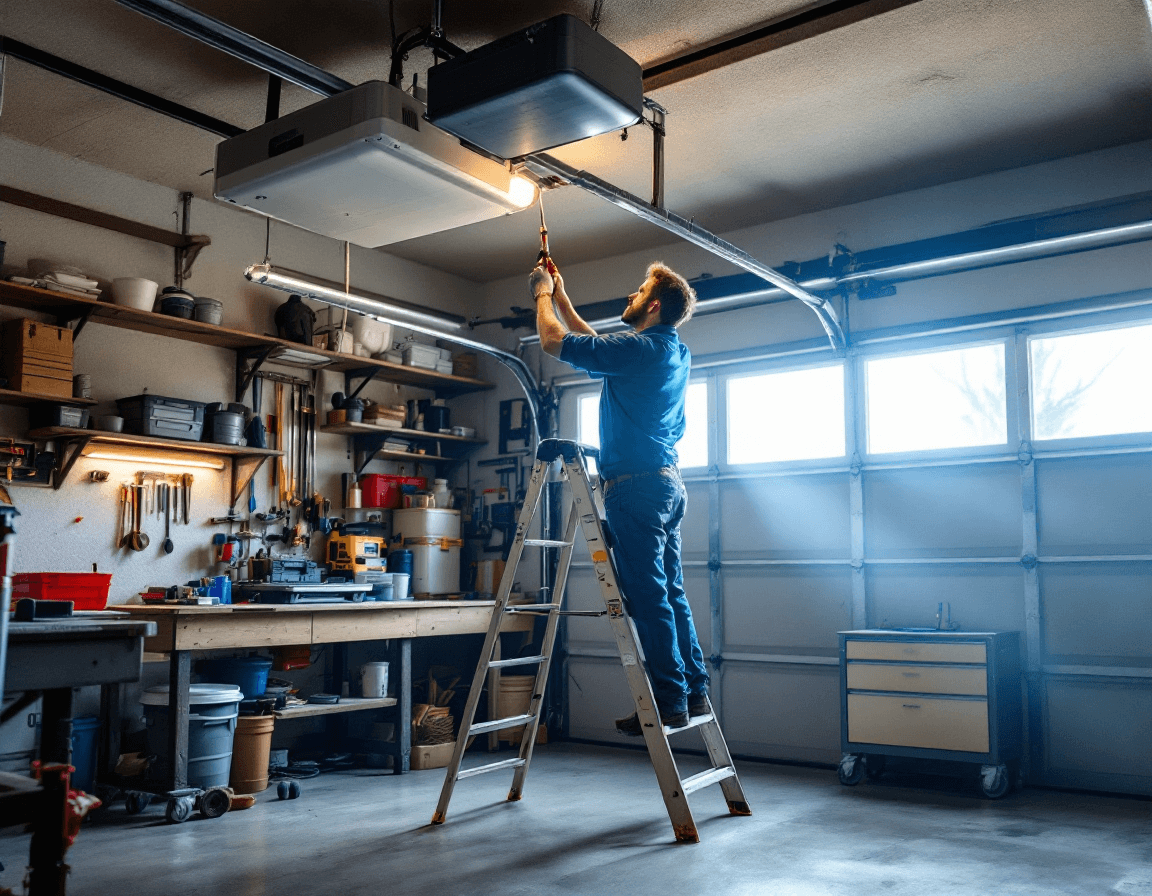
Garage door opener repair in Black Diamond, WA is one of those services people rarely think about until the morning the car is stuck inside or the door refuses to close before the kids leave for school. Black Diamond sits at the southeastern edge of King County, where the Cascade foothills begin to rise and the landscape shifts from suburban streets to tree-lined ridges and open water. Homes here range from older properties near the historic town core to newer houses in developments such as Ten Trails, and that mix means we see everything from decades-old belt drives to recent smart openers with Wi-Fi modules. Our technicians work on every major opener brand, and we approach each call by identifying the actual fault instead of guessing.
Most opener problems in this area fall into a handful of categories: a motor that runs without moving the door, a remote or wall button that stops responding, a grinding noise from the ceiling-mounted head, a door that reverses before it reaches the floor, a blinking light pattern, a chain or belt that has slipped, or an opener that works one day and not the next. Each of these has a different cause, and the fix ranges from a battery swap or a quick adjustment to replacing a logic board or drive gear. For most opener repairs we handle, pricing falls in the $95 to $375 range, depending on the part involved and how much diagnosis the job requires. A clear diagnosis before any parts are ordered is the best way to avoid paying for repairs you do not need.
This page explains how our technicians think through opener problems in Black Diamond, what the common symptoms usually mean, how the Pacific Northwest climate affects the equipment, and what to expect when you call. We also cover the safety boundaries that matter most, because spring and cable work belongs in the hands of a licensed professional. If you are dealing with a misbehaving opener right now, the information below should help you narrow down the problem before we arrive.
Reading the Blinking Lights Before You Touch Anything
Many openers have a small status light on the motor housing, and when something goes wrong it often blinks in a repeating pattern. Manufacturers use these patterns to signal specific faults, such as a safety sensor problem, an obstructed door, a travel-limit setting that has been lost, or an internal board error. The number of blinks, the speed, and whether the light stays on or cycles all carry meaning. Before you assume the worst, count the pattern carefully and write it down, because that single detail can save a technician significant time on the first visit.
The owner's manual or the label inside the opener cover usually includes a diagnostic chart that matches blink patterns to faults. Keep in mind that a steady flash after a power outage can simply mean the opener is relearning its limits, while a rapid repeating blink often points to a sensor or wiring issue. Photo eyes are a frequent culprit, especially in garages where dust, cobwebs, or a shifted bracket block the beam. A pattern that appears only when the door is closing typically points toward the sensors or the force settings, while a pattern that appears at all times may indicate a board fault.
If the pattern does not match anything in the manual, do not keep pressing the wall button repeatedly. Repeated cycling can stress the drive components and make an intermittent problem worse. Instead, power the opener off at the breaker or unplug it, wait about thirty seconds, and restore power to see whether the pattern repeats. Note whether the problem followed a storm, a power flicker, or a period of heavy rain, since moisture and voltage swings are both common in our region.
When the Motor Hums but the Door Stays Put
One of the most puzzling symptoms is an opener that clearly runs, sometimes with a steady hum or a short motor pulse, while the door sits motionless. This usually means the connection between the motor and the door has failed rather than the motor itself. The most common cause is a disconnected trolley, where the release mechanism has been pulled or the carriage has slipped off the rail. In a neighborhood where many garages see frequent use, a child or a previous owner may have pulled the emergency release cord, leaving the door disconnected from the drive.
Other causes include a broken or stripped drive chain, a sheared belt, or a failed drive gear inside the head unit. A chain that has snapped will allow the motor to turn freely with nothing to pull on, so the sound seems normal while the door remains still. Sometimes a worn or damaged coupling between the motor shaft and the drive gear produces the same silence. A technician will check whether the trolley still moves freely by hand, inspect the rail for obstructions, and confirm whether the release handle has been left in the disengaged position.
Because this symptom can also hint at a deeper mechanical failure, it is worth avoiding repeated attempts to force the door open. Pulling hard on a door that is still partly attached to a damaged drive can bend the track or damage the door panels. If the door is still stuck in the closed position, leave the release alone until a technician confirms the trolley and drive are safe to re-engage.
Remotes, Keypads, and Wall Buttons That Go Silent
A remote that stops responding is often the least expensive problem to fix, yet it still generates a lot of frustration. Before calling for service, replace the battery in the remote and check whether the wall button works. If the wall button responds but the remote does not, the problem likely lies in the remote's battery, its synchronization with the opener, or the opener's receiver. Many modern openers require rolling-code remotes to be relearned after a power loss, and the process varies by brand, so the manual is worth checking.
If neither the remote nor the wall button works, the issue may involve the wall control wiring, a blown fuse on the opener board, or a failed logic board. Wall switches in older Black Diamond homes sometimes suffer from corroded low-voltage connections, especially where wiring runs through unheated garages that experience damp winter air. Keypads can also fail after prolonged exposure to moisture or temperature swings, and their seals sometimes degrade on exterior-mounted units.
Radio interference is another consideration in our area. Nearby devices operating on the same frequency, from garage door sensors on neighboring properties to certain wireless security systems, can occasionally block remote signals. A technician can test the receiver's sensitivity and determine whether an antenna wire has been damaged, kinked, or pulled loose during past service. If the signal is weak only in certain parts of the driveway, the antenna placement or the remote's range may be the real issue.
The Grinding Head: Stripped Gears and Worn Drive Parts
A grinding or clicking noise from the opener head is one of the more alarming symptoms, and it is usually a sign that something inside the gear assembly has worn down. Most jackshaft and chain-drive openers use a reduction gear, often made of nylon or a similar material, that meshes with a worm gear on the motor shaft. Over years of use, teeth can strip, the gear can crack, or the lubrication can dry out, producing a grinding sound that gets louder as the door travels. A dry, squeaking sound is different, and often points toward rollers or hinges rather than the opener itself.
Stripped gears tend to show up after a period of heavy use, after a door has been forced manually, or after the opener has been asked to lift a door that has become heavier due to damage or misalignment. Our technicians will remove the cover, examine the worm gear and reduction gear for missing or chipped teeth, and check the motor coupling for wear. In many cases the fix is a gear kit replacement rather than a full opener swap, which keeps costs well within the typical opener repair range. Ask for a clear explanation of what is worn before approving any replacement, and compare the quote to the age of the opener.
Grinding can also come from the door itself, such as a worn roller bearing or a loose track bracket. Because the sound can be deceptive, it helps to listen carefully when you run the door. If the noise seems to come from the ceiling and changes pitch during travel, the gear assembly is the more likely source. If it sounds like it comes from the sides of the door, the rollers or track alignment may be to blame.
Doors That Reverse Halfway Down
A door that starts to close and then immediately reverses is designed to protect people and objects, but it can be maddening when nothing is in the way. Safety reversal is triggered by the photo eyes, which are the two small sensors mounted near the floor on either side of the opening, or by a force setting that detects resistance greater than the programmed limit. The sensors need a clear, unobstructed beam, and even a small amount of misalignment can cause the door to reverse. Check that the lenses are clean and that the indicator lights on both sensors are steady and in agreement.
Force settings can drift over time, particularly after the door has been adjusted, after a spring has lost tension, or after the track has moved slightly. A door that has become heavier in cold weather, or that has developed friction in its rollers, may trigger the force sensor even though the door is operating normally. Black Diamond homeowners sometimes notice this in winter, when cold temperatures stiffen lubricants and expose sluggish hardware. The travel-limit and force settings should be adjusted with care, because improper settings can prevent the door from closing securely or from protecting people as intended.
When reversal is caused by a spring or cable problem, it is important not to attempt the repair yourself. Springs store a great deal of energy, and an unbalanced door can fall unpredictably. Our technicians will check whether the door is balanced and whether the spring tension is within normal range, but any spring replacement or cable work must be performed by a licensed professional with the proper tools and training.
Chains, Belts, and the Slack That Creeps In After Rain
Chain and belt drives are the working heart of many openers, and a loose or displaced chain or belt will prevent the door from moving reliably. Chains can stretch over time, particularly in homes where the door is used many times a day, and when the slack becomes large enough the chain may jump off the sprocket. Belt drives, which are common on quieter residential openers, can slip off the pulleys or develop cracks after years of exposure to temperature changes. Both problems often produce a clunking or whirring sound, followed by the motor running without moving the door.
A simple visual inspection can reveal a great deal. Check whether the chain sits properly on the sprocket, whether the belt is seated in the pulley grooves, and whether the tension looks reasonable. Excess slack should be corrected, but over-tightening a chain or belt can strain the motor and shorten its life. If a chain has jumped the track, the reinstallation requires care to avoid bending the carriage or damaging the rail.
Because the area around Black Diamond sees significant rain and damp air for much of the year, metal chains can develop surface rust, and the lubricant on them can wash away. A technician may recommend cleaning and lubricating the chain or replacing a belt that has begun to crack. Keep in mind that a chain or belt is a wear item, and a replacement is often a sensible investment in an opener that has seen many years of service.
Travel Limits and the Settings Nobody Remembers Setting
Every opener needs to know where the door should stop when it is fully open and fully closed. These travel limits are programmed during installation, and they can shift after a power outage, a hard reset, a belt replacement, or a change to the door's balance. When the limits are wrong, the door may stop short of the floor, fail to open fully, or reverse before it finishes closing. Many homeowners are surprised to learn that these limits can be reset without any special tools, though the exact method depends on the brand.
Setting the limits correctly matters for safety and for the longevity of the opener. If the door tries to push beyond its closed position, the motor works harder than necessary, which can overheat the drive and wear out the gears. If the door stops too early, it may leave a gap that is an invitation for pests or drafts. A technician will confirm the limits, test the force settings, and verify that the door reverses properly if it encounters an obstacle placed at the base of the opening.
Some openers store the travel limits in a memory chip, and a failing memory component can cause repeated limit errors. This is one reason a steady pattern of blinks may appear even when the door itself looks fine. When a limit problem cannot be resolved by resetting the settings, a logic board inspection is usually the next step, and a replacement board is often the least disruptive solution.
Black Diamond Weather and Why Openers Struggle Here
The Pacific Northwest climate shapes how garage door openers age, and Black Diamond is no exception. Winters bring long stretches of cool, wet weather, and the foothills can see hard frosts and occasional snow or ice, especially on higher-elevation roads that reach toward Lake Sawyer and the surrounding hills. Moisture seeps into garages through worn weatherstripping, and humidity can settle on electrical contacts, control boards, and the metal components of the opener. Over time this exposure can cause corrosion on terminals, weaken wiring insulation, and dry out lubricants that keep the gears moving smoothly.
Temperature swings also affect performance. A door that opens easily in July may feel heavier on a cold December morning, because the lubricants thicken and the springs respond differently to the cold. The opener then works harder, which can trigger force reversal or strain the drive gears. Garages attached to homes with poor insulation may experience larger temperature swings, while detached garages are more exposed to wind-driven rain and damp air through gaps around the door.
Homeowners can reduce many of these problems with simple habits. Replacing worn weatherstripping, keeping the photo eyes clean, and applying a silicone-based lubricant to the rollers and hinges (but not to the opener's drive chain without checking the manufacturer's guidance) all help. Our technicians can also check whether the garage door seal is allowing water intrusion, because a damp garage can accelerate wear on the opener's electrical components.
What a Typical Opener Repair Visit Covers and What It Costs
A typical service call begins with a conversation about the symptoms, including when they started, whether they follow weather changes, and whether any recent work has been done on the door or opener. The technician then inspects the opener head, the trolley, the rail, the drive mechanism, the safety sensors, the wall control, and the door balance as a whole. Diagnosis is the most important part of the visit, because replacing the wrong component wastes money and leaves the real problem in place.
Opener repairs we commonly handle include the following:
- Replacing a worn drive gear or gear kit
- Reinstalling or replacing a drive chain or belt
- Repairing or realigning photo eye sensors and their wiring
- Resetting and adjusting travel limits and force settings
- Replacing a logic board or control module
- Repairing a wall control or keypad connection
- Reconnecting or repairing a disconnected trolley
For most opener repairs, pricing falls between $95 and $375, depending on the parts required and the complexity of the diagnosis. Some visits are quick adjustments, while others require ordering a specific part for a particular brand. You will receive a clear explanation of the problem and the recommended fix before any work begins, and you can ask questions at every step. If a repair would cost more than replacing an aging opener, we will say so plainly so you can make the decision that fits your situation.
Keep in mind that some issues fall outside a standard opener repair, especially those involving springs, cables, or the door panels themselves. These require separate evaluation and are handled by licensed technicians under appropriate safety procedures.
Staying Safe Around the Opener and Springs
Safety should guide every decision you make about your garage door. Before attempting any inspection, disconnect the opener from power at the breaker or unplug it, and never stand under a door that is moving or that is only partly supported. The emergency release cord should be used only when the door is closed, and it is wise to teach everyone in the household how it works and when not to use it. A door that is hanging open or unbalanced can fall without warning, and that risk is serious for children and pets.
Spring and cable work is the clearest boundary. Torsion springs and extension springs are under high tension even when they look relaxed, and attempting to adjust, wind, or remove them without the correct tools can cause severe injury. Frayed or broken cables, damaged drums, and misaligned tracks also require professional attention. A licensed technician carries the tools and training to handle these components safely, and their work should always be performed by someone with the proper credentials.
If you are unsure whether a problem is within the scope of an opener repair, call before you touch anything. A quick conversation can save time, money, and the risk of injury, and it allows us to tell you what to avoid until a technician arrives. Our team is available to talk through symptoms and help you decide what to do next.
If your Black Diamond garage door opener is blinking, grinding, reversing, or simply refusing to respond, we are ready to help. Call (888) 799-3819 to describe what you are seeing, schedule a diagnostic visit, and get a clear explanation of the repair options before any work begins.